
Golf Grip FAQ: Answers to the Most Common Grip Questions

Quick Answer
A good golf grip puts the club mainly in your fingers, joins both hands comfortably, and gives you control without excess tension. A neutral position is a useful starting point for many golfers, but there is no single grip that fits every swing. The PGA of America grip guide is a useful reference for checking basic hand placement.
Five grip basics to check
- Lead hand: Let the handle run through the fingers instead of burying it deep in the palm.
- Hand position: Start near neutral before making stronger or weaker adjustments.
- Connection: Overlap, interlock, and ten-finger grips can all work when they feel secure.
- Pressure: Hold firmly enough to control the club without making your hands and forearms rigid.
- Equipment: Choose a grip size and texture that fit your hands and playing conditions.
Best way to verify your grip
- Check your hand position at address, then watch the ball’s starting direction and curve instead of changing your grip after every poor shot.
If you have questions about your golf grip, you’re not alone. I’ve seen golfers change their swing, stance, and clubs when the first thing worth checking was how their hands sat on the handle.
This Grip FAQ covers both sides of the subject. I’ll explain how to hold the club and also answer common questions about grip styles, pressure, sizing, replacement, care, and equipment rules.
In This Guide
- How should you hold a golf club?
- What is a strong, weak, or neutral golf grip?
- Should you use an overlap, interlock, or ten-finger grip?
- How tightly should you grip a golf club?
- What golf grip size should you use?
- When should you replace and clean golf grips?
- What rules apply to golf club grips?
- Golf Grip FAQ: Quick answers
How Should You Hold a Golf Club?
For a right-handed golfer, start with the left hand as the lead hand and the right hand below it. Left-handed players simply reverse those roles.
The handle should sit more through the fingers than across the center of the palm. This makes it easier for the wrists to hinge without losing control.
Where should the club sit in the lead hand?
I like to start with the club angled across the base of the fingers. The heel pad of the lead hand can then sit securely over the top of the handle.
Once I close my hand, I check that I haven’t pushed the club deep into my palm. That mistake often creates more tension than golfers realize.
- Support the handle: Let the fingers provide much of the hold.
- Cover the handle: Place the heel pad securely over the top.
- Keep the wrist free: Avoid a palm-heavy position that makes hinging difficult.
- Leave a small gap: Don’t grip so close to the butt end that part of your hand hangs off.
Where does the trail hand go?
The trail hand fits below the lead hand so the two hands can work together. Its palm should sit against the side of the lead thumb rather than underneath the club.
Your exact finger connection depends on whether you overlap, interlock, or use a ten-finger hold. Comfort matters here.
Pro tip: If a new hand position changes your ball flight dramatically or causes discomfort, have a PGA Professional or qualified club fitter check it before making larger swing changes.
Definition: A golf grip can mean either the way a player places the hands on the club or the physical material installed over the shaft. Context tells you which meaning is intended.
That distinction matters throughout this guide. “Strong grip” describes hand orientation, while “midsize grip” describes the physical equipment.
Section Takeaway: Build the grip from the fingers first, then add the trail hand so both hands feel connected without becoming rigid.
What Is a Strong, Weak, or Neutral Golf Grip?
Strong, weak, and neutral describe how your hands are rotated around the handle. They do not describe how tightly you squeeze it.
A neutral position is a sensible reference point. From there, small changes can be tested against your normal ball flight.
What does a neutral golf grip look like?
For many right-handed players, a neutral lead hand shows roughly two knuckles when viewed at address. Exact appearance changes with anatomy and setup.
The “V” formed between the thumb and index finger usually points somewhere around the trail-side shoulder area. The trail hand then covers the lead thumb comfortably.
What is a strong golf grip?
A strong grip rotates the hands farther away from the target around the handle. A right-handed golfer normally sees more lead-hand knuckles.
This position can make it easier for some golfers to return the face less open. It can also encourage too much face closure when it doesn’t match the rest of the swing.
What is a weak golf grip?
A weak grip rotates the hands more toward the target. A right-handed golfer normally sees fewer lead-hand knuckles.
That position can help some golfers who close the face too aggressively. For another player, it may make an existing fade or slice harder to control.
| Grip Position | What You May See | Common Clubface Tendency | Good Starting Use |
|---|---|---|---|
| Weak | Fewer lead-hand knuckles | Can make closure harder | Worth testing if the face closes too quickly |
| Neutral | About two knuckles for many golfers | Balanced starting point | Useful baseline for most grip checks |
| Strong | More lead-hand knuckles | Can make closure easier | Worth testing if the face stays open |
Ball flight still depends on clubface, swing path, strike, and other factors. Don’t assume changing hand position alone will cure every hook or slice.
When I’m checking my own grip, I make tiny changes instead of rotating both hands dramatically. A small change is much easier to evaluate.
Pro tip: A certified instructor can match grip position to your swing instead of forcing you into a textbook position that doesn’t fit your motion.
Section Takeaway: Strong and weak refer to hand rotation, not pressure. Start near neutral, then adjust only when your ball flight gives you a reason.
Should You Use an Overlap, Interlock, or Ten-Finger Grip?
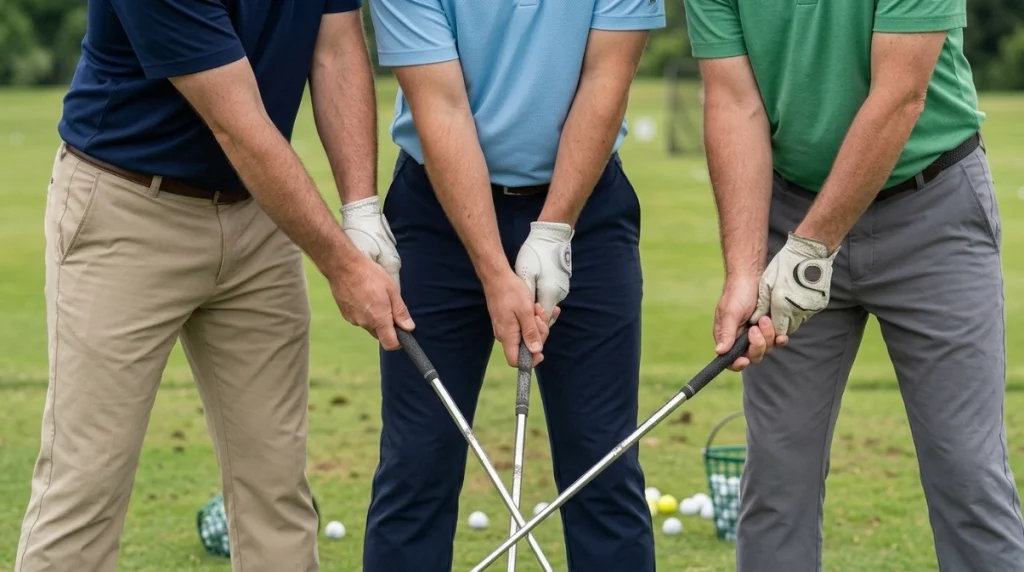
All three methods describe how your hands connect. None is automatically correct for every golfer.
The best choice gives you a secure hold without forcing your fingers into an uncomfortable position.
Overlap grip
With an overlap, the little finger of the trail hand rests over the area between the lead hand’s index and middle fingers. This is also called the Vardon grip.
I like it for golfers who want their hands to feel connected without locking the fingers together. Players with larger hands often find it comfortable.
Interlocking grip
With an interlock, the trail-hand little finger and lead-hand index finger link together. This creates a close connection between both hands.
Some golfers with smaller hands prefer the security of an interlock. Others simply like its compact feel.
Ten-finger grip
In a ten-finger grip, every finger stays on the club and the hands sit beside each other. It is sometimes called a baseball grip.
Beginners may find it natural because the hand connection feels simple. Golfers with limited finger mobility may also find it more comfortable.
| Style | How Hands Connect | May Suit Golfers Who Prefer |
|---|---|---|
| Overlap | Trail pinky rests over lead hand | A connected but less locked-in feel |
| Interlock | Trail pinky and lead index finger interlock | A compact, strongly connected feel |
| Ten-finger | All ten fingers remain on the handle | A simple or less restrictive connection |
A Golf Digest audit of the 2024 PGA Championship field found both interlocking and overlapping grips throughout an elite field. That alone is a useful reminder that one connection style does not own good golf.
Don’t copy a tour player’s grip only because you admire that player’s swing. Their hand size, wrist movement, release, and club delivery may be different from yours.
Pro tip: If interlocking causes finger or joint discomfort, stop forcing it and have an instructor help you test another connection style.
Section Takeaway: Overlap, interlock, and ten-finger grips can all work. Comfort, security, and repeatability matter more than copying a famous player.

How Tightly Should You Grip a Golf Club?
Your grip needs enough pressure to keep the club secure during the swing. It should not make your fingers, wrists, or forearms feel locked.
This is different from grip strength. You can have a strong hand position with light pressure or a weak hand position with heavy pressure.
What happens if you grip too tightly?
Excess pressure often makes the hands and arms feel stiff. It can also make a smooth wrist hinge and release harder to produce.
I notice this most when golfers are nervous or trying to hit a driver harder. Their hands squeeze first, then the rest of the swing loses rhythm.
- Forearm tension: Your arms may feel rigid before the backswing starts.
- Restricted motion: Wrist movement may feel less natural.
- Fatigue: Your hands can tire faster during a long practice session.
- Compensation: Slick grips can make you squeeze harder just to feel secure.
Can grip pressure be too light?
Yes. A grip that is too loose can allow unwanted movement between your hands and the club.
You should still feel that the club is secure at the top of the swing and through impact. Light does not mean careless.
A useful range drill is to start with more pressure than normal, then gradually soften your hands. Stop when the club feels secure but your wrists and forearms remain relaxed.
Don’t become obsessed with assigning an exact number to the feeling. Pressure scales are subjective from one golfer to another.
Pro tip: If you cannot maintain control without squeezing hard, ask a fitter to inspect your grip size, texture, and condition before assuming your swing is the problem.
Section Takeaway: Use enough pressure to control the club, but avoid squeezing so hard that your hands and forearms become rigid.
What Golf Grip Size Should You Use?
Golf grips commonly come in junior, undersize, standard, midsize, and jumbo sizes. Your hand dimensions and preferred feel are better guides than guessing from height.
Grip size affects how comfortably your fingers wrap around the handle. It can also change how secure the club feels in your hands.
How can you choose a starting grip size?
One practical approach is to measure from the wrist crease to the tip of the longest finger. Glove size can also provide a starting reference.
Golf Pride’s current swing grip size guide gives the following hand-size ranges.
| Grip Size | Hand Measurement | Typical Starting Point |
|---|---|---|
| Junior | Under 5 inches | Junior-size hands |
| Undersize | 5 to 6.5 inches | Smaller adult hands |
| Standard | 6.6 to 7.5 inches | Medium-size hands |
| Midsize | 7.6 to 9 inches | Larger hands |
| Jumbo | Over 9 inches | Very large hands |
Does hand size tell the whole story?
No. Those measurements are a starting point rather than a universal fitting law.
Finger length, arthritis, hand strength, glove preference, grip texture, and personal feel can all matter. Tape can also build a grip to an in-between size.
I prefer testing an actual installed grip whenever possible. A size chart can’t tell you exactly how your fingers and pressure pattern will feel during a swing.
What about grip material and texture?
Rubber, cord, hybrid, and softer compounds can feel noticeably different. Weather conditions should influence that choice too.
- Rubber: Common and available in many textures and firmness levels.
- Cord: Often chosen by golfers wanting more texture, especially in damp conditions.
- Hybrid: Combines different materials or textures within one grip.
- Soft compounds: Can feel comfortable but may provide a different level of feedback.
Pro tip: A club fitter can compare sizes and build-up options while keeping shaft butt diameter and your preferred feel in mind.
Section Takeaway: Use hand size to find a starting point, then confirm the choice by feel. The right diameter should feel secure without forcing extra pressure.
When Should You Replace and Clean Golf Grips?
Replace a golf grip when it becomes slick, hard, cracked, damaged, or difficult to hold securely. Calendar age alone does not tell the full story.
Frequency of play, practice volume, sweat, dirt, heat, and sunlight all affect wear. Two golfers can wear the same model at very different rates.
What are the signs of a worn golf grip?
I check the areas under both thumbs first because wear often shows there early. A shiny surface is another easy warning sign.
- Slick surface: The grip has lost noticeable traction.
- Hardening: The material feels firmer and less tacky than before.
- Cracking: Rubber or other material begins splitting.
- Crumbling: Rubber or cord starts breaking down.
- Heavy wear: Texture or surface markings disappear in high-contact areas.
- Slipping: You need extra hand pressure to keep the club stable.
Golf Pride recommends checking grips regularly and says regripping at least annually is a useful general guideline. Its grip wear guidance also emphasizes visible wear, slickness, and material breakdown.
How should you clean golf grips?
For many rubber-style grips, mild soap, water, and a soft brush or cloth are enough. Follow the grip maker’s care instructions when dealing with specialized materials.
- Wet the grip lightly.
- Use mild soap and a soft brush or cloth.
- Work dirt and skin oils from the textured surface.
- Rinse away the soap.
- Dry the grip thoroughly before putting the club away.
Don’t store wet clubs in a closed bag for long periods. A cool, dry storage area away from excessive sunlight and heat is a better choice.
Should every club get new grips at the same time?
Not necessarily. The clubs you use most can wear faster than the rest of the set.
However, many golfers like consistent texture and diameter through their irons and woods. Mixing worn and fresh grips can create noticeably different hand feel from club to club.
Section Takeaway: Replace grips based on traction and condition, not appearance alone. Regular cleaning can help preserve feel, but it cannot restore material that has hardened or worn away.
What Rules Apply to Golf Club Grips?
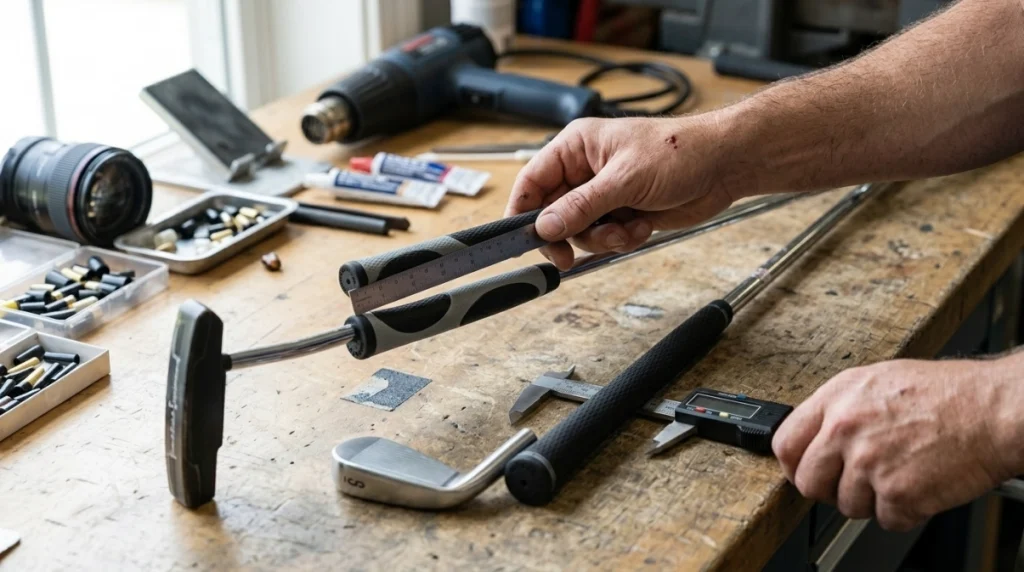
Golf club grips used in competition must conform to equipment rules. The regulations cover shape, dimensions, installation, and special putter configurations.
As of 2026, the USGA Equipment Rules for grips provide the key specifications golfers and club builders should know.
What does the USGA consider a grip?
The rules define the grip as material added to the shaft to help the player obtain a firm hold. It must be fixed to the shaft and extend to the end.
The grip also cannot be shaped as a mold for specific parts of the hands. That is why a molded training grip can differ from a conforming playing grip.
Do regular clubs need round grips?
For clubs other than putters, grips generally need a circular cross-section. The rules allow limited features such as a continuous straight raised rib.
A grip can taper, but it cannot contain a bulge or waist. Its cross-sectional dimension cannot exceed 1.75 inches, or 44.45 mm, measured in any direction.
Are putter grips different?
Yes. Putter grips can use a noncircular cross-section if they meet the applicable symmetry and shape requirements.
A putter can also have two separate grips under specific conditions. Those grips must be circular and separated by at least 1.5 inches, or 38.1 mm.
- Woods and irons: Normally use one conforming grip.
- Putter shape: More noncircular designs are permitted within the rules.
- Maximum dimension: Grip cross-section cannot exceed 1.75 inches.
- Two putter grips: Separate conforming grips require at least a 1.5-inch gap.
- Hand molding: A playing grip cannot be molded to locate parts of the hands.
If you compete and are unsure about an unusual grip, don’t rely on appearance alone. Have the model or installation checked before an event.
Section Takeaway: Most standard grips are straightforward, but unusual shapes and split putter installations deserve a rules check before competition.
Golf Grip FAQ: Quick Answers
How many knuckles should I see in a golf grip?
Many golfers use about two visible lead-hand knuckles as a neutral starting point. Your anatomy and setup can change the exact appearance, so use knuckle count as a checkpoint rather than an absolute rule.
Can changing my golf grip help a slice?
It can when your hand position contributes to an open clubface, but a slice can also involve swing path and strike. Test small grip changes and watch both the ball’s starting direction and curve before deciding the grip was the main cause.
Is a strong golf grip bad?
No. A strong grip is simply a hand position rotated farther around the handle. It can fit some swings well, but an excessively strong position may make face control difficult for a golfer who already tends to hook the ball.
Should beginners use an interlocking or overlapping grip?
Either can work. An interlock gives a close connection, while an overlap can feel less restrictive. Beginners should choose the style that keeps both hands secure without pain or excessive pressure.
Do thicker golf grips stop hooks?
Not automatically. Grip diameter can change how the club feels in your hands, but ball flight still depends on face angle, swing path, strike, and delivery. Choose grip size mainly for fit and control rather than treating it as a guaranteed shot-shape fix.
How often should golf grips be replaced?
Inspect them throughout the season and replace them when they become slick, hard, cracked, worn, or difficult to hold securely. Some manufacturers suggest annual replacement as a general starting point, but heavy practice can shorten grip life.
Can I use different grip sizes on different clubs?
Yes, provided the grips conform to equipment rules. Some golfers deliberately use different putter or wedge grip sizes, although keeping a consistent feel through similar clubs can make setup more familiar.
Final takeaway: Your grip is the connection between your hands and the golf club, so it deserves attention before you rebuild the rest of your swing. Start with comfortable hand placement, moderate pressure, and properly fitted equipment, then make changes based on repeatable ball-flight evidence.
On your next range session, check one variable at a time. A small grip adjustment that you can repeat is far more useful than changing your hands after every bad shot.