
Golf Bag Guide: How to Choose, Pack, and Organize the Right Bag

Quick Answer
The right golf bag matches how you usually play. Choose a light stand bag if you walk, a cart bag if you normally ride, or a compact Sunday bag for short rounds. It should hold your clubs without crowding, keep frequently used gear easy to reach, and remain comfortable when fully loaded. Before a competitive round, count your clubs because the USGA allows no more than 14 clubs.
Five things to check before buying
- Playing style: Match the bag to walking, riding, pushing, practice, or travel.
- Loaded comfort: Test the straps and balance with clubs and gear inside.
- Divider layout: Pick fewer wide sections for easy loading or 14 slots for fixed organization.
- Useful storage: Prioritize reachable pockets, a bottle sleeve, valuables protection, and rain-hood storage.
- Weather protection: Look for durable fabric, strong zippers, a stable base, and suitable water resistance.
Best simple setup
- Keep woods at the top, irons in the middle, wedges at the bottom, and the putter in its own slot when possible.
A golf bag looks simple until you carry the wrong one for five miles or discover that a cart strap blocks every useful pocket. I have learned that the best bag is not the largest or most expensive one; it is the bag that disappears into the rhythm of your round.
This golf bag guide covers bag types, dividers, storage, club organization, maintenance, and air travel. It also explains where golfers tend to overspend and what matters most in 2026.
In This Guide
What Is a Golf Bag, and Why Does the Right Setup Matter?
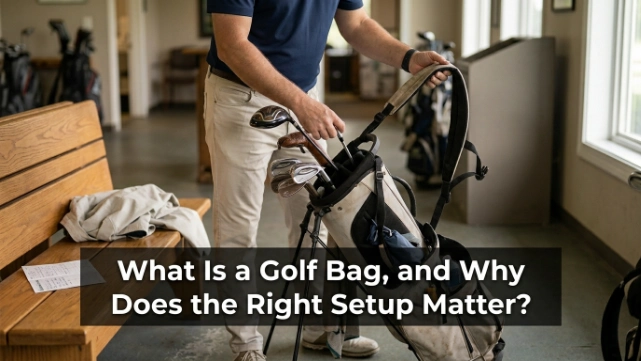
A golf bag is a purpose-built carrier for clubs, balls, clothing, and on-course accessories. Its top opening separates clubs, while its pockets keep smaller gear protected and reachable.
The bag also affects comfort and decision-making. A balanced load reduces distraction, while a clear layout helps you choose a club without slowing play.
Definition: A golf bag divider is a section inside the top opening that separates groups of clubs. A “14-way top” gives every permitted club its own opening, although only some models continue each divider for the full length of the bag.
Why fit matters more than brand
Titleist, Callaway, TaylorMade, Ping, Cobra, Mizuno, and Srixon all offer useful bags. The badge tells you less than the loaded balance, pocket placement, and strap fit.
I judge a carry bag after adding my normal clubs, balls, water, and rain layer. An empty bag can feel excellent in a shop but pull backward once its largest pocket is full.
- Walkers need balance: A stable base and supportive dual straps matter throughout an 18-hole round.
- Riders need access: Front-facing pockets and a cart-strap channel prevent frustrating blockages.
- Push-cart users need stability: The bag should sit securely without twisting or pressing its stand mechanism.
- Range players need simplicity: A light Sunday or pencil bag can hold a small practice set.
- Travelers need protection: The everyday bag must fit safely inside a padded travel cover.
Does a better bag improve scoring?
A bag does not change loft, lie angle, shaft flex, forgiveness, compression, or spin rate. Those terms describe clubs and balls, not the carrier.
Still, good organization removes small delays. You can see whether a wedge is missing, keep grips dry, and avoid searching through loose accessories before every shot.
That matters most in poor weather or on a busy course. Less clutter leaves more attention for yardage, target, wind, and pace.
Section Takeaway: Choose a golf bag as a working system, not a fashion accessory. It should make carrying, club selection, and storage easier from the first tee to the final green.
Which Type of Golf Bag Should You Choose?
Choose a stand bag for walking, a cart bag for regular riding, a Sunday bag for a short set, or a staff bag when maximum space matters more than weight. A hybrid bag suits golfers who divide rounds between walking and riding.
Stand bags
A stand bag has two retractable legs and usually a dual shoulder strap. It is the most flexible choice for golfers who walk but sometimes use a riding or push cart.
Look for a base that opens the legs smoothly on firm and damp ground. The straps should sit flat, and the bag should not bounce against your lower back.
- Best for: Golfers who walk most rounds.
- Main strength: Easy ground access without laying the bag in wet grass.
- Main tradeoff: Less storage than a large cart bag.
Cart bags
A cart bag has a broad, stable base and pockets arranged for access while strapped to a cart. It usually offers more storage and more divider openings than a carry-focused model.
Do not assume any cart bag fits every push cart. Check the base shape, upper support, strap position, and whether the bag rotates on uneven ground.
- Best for: Golfers who ride or use a push cart.
- Main strength: Generous, easy-to-reach storage.
- Main tradeoff: Awkward for long carries.
Sunday and pencil bags
Sunday bags are slim carriers for a partial set. They work well for par-3 courses, quick practice sessions, and casual nine-hole rounds.
The light shape encourages careful packing. You may have room for six to eight clubs, several balls, tees, water, and little else.
Hybrid, staff, and travel bags
- Hybrid bag: Blends stand-bag carrying features with cart-friendly storage and strap access.
- Staff bag: Uses a large tour-style body with extensive storage, but its bulk suits a caddie or cart better than a regular walker.
- Travel bag: Covers and protects another golf bag during transport; it is not a normal on-course carrier.
For most new golfers, a medium stand bag is the safest starting point. It works for walking, practice, and occasional cart use without forcing an early commitment.
Section Takeaway: Let transportation choose the category. Walkers should prioritize low loaded weight, while riders should prioritize stability and pocket access.
How Do You Choose the Right Golf Bag?
Start with how you transport your clubs, then compare loaded comfort, dividers, pocket access, weather protection, and construction. Do not choose from weight or pocket count alone.
1. Match the bag to your usual round
Think about your last ten rounds. If you walked seven, buy primarily for carrying instead of keeping a large cart bag for three riding days.
A push-cart golfer should bring the cart when possible. A bag can look compatible yet twist because its base and the cart’s lower support do not meet securely.
2. Compare honest specifications
Manufacturer specifications reveal how differently bags balance mobility and storage. The following examples were current in August 2026, so confirm details before ordering.
| Model and type | Listed weight | Top | Pockets | Best fit |
|---|---|---|---|---|
| Ping Hoofer carry bag | 5.5 lb | 5-way | 16 | Walking with broad storage |
| Sun Mountain C-Series C-130 cart bag | 7.6 lb | 9-inch, 14-way | 11 | Riding-cart organization |
These are not direct rivals. The comparison shows why a heavier cart bag can still be the better tool for a rider.
Prices and model details can change. Treat the table as a design comparison, then verify the product page for the exact color and version you plan to buy.
3. Decide between fewer dividers and 14-way organization
A four- or five-way top groups clubs together and usually keeps the top lighter. It is quick to load, although grips can touch and tangle near the bottom.
A 14-way top gives each club a home. This makes inventory easy, but narrow openings can feel crowded with oversized grips.
- Choose four or five ways: You carry, prefer wider sections, or use larger grips.
- Choose 14 ways: You ride, value fixed positions, or want missing clubs to stand out.
- Check full-length construction: Top openings do not always mean 14 separate sleeves to the base.
- Test the putter slot: A large putter grip may not fit a narrow external well.
4. Test straps, handles, and balance
Wear a carry bag with realistic weight for several minutes. Adjust both straps until the clubheads sit above and slightly behind one shoulder.
The bag should not lean sharply or force one shoulder downward. Lift handles also matter when moving it from a trunk to a cart.
Pro tip: Ask a PGA of America professional or experienced fitter to check strap height and loaded balance if carrying causes pain or numbness.
5. Inspect storage and weather protection
Count useful pockets, not total pockets. One full-length apparel pocket can matter more than several small compartments.
- Ball pocket: Easy to reach without unloading the bag.
- Valuables pocket: Soft lining and reliable closure for a phone or keys.
- Bottle sleeve: Reachable while walking and deep enough to hold the bottle.
- Rangefinder pocket: Accessible but secure when the bag tips.
- Apparel pocket: Long enough for a rain jacket without tight folding.
- Rain-hood pocket: Dedicated space so the hood stays with the bag.
Water-resistant fabric handles brief showers, but it is not automatically waterproof. Waterproof bags usually add seam sealing and protected zippers, which can raise price and weight.
6. Check durability where wear begins
Inspect the base, leg hinges, strap anchors, zipper tracks, and fabric around pocket corners. These areas absorb repeated stress.
Denier measures fabric yarn thickness, not complete durability. Stitching, coating, panel design, and hardware quality also influence service life.
Section Takeaway: Buy for the loaded round you play most often. A useful bag balances transport, access, organization, and weather protection without adding features you will never use.

What Should You Carry in a Golf Bag?
Carry the clubs and supplies needed for your normal misses, local weather, and course conditions. Remove duplicates and “just in case” items that add weight without helping a round.
Build a practical club setup
The Rules of Golf limit a player to 14 clubs during a round. The R&A’s Rule 4 also explains conformity, adding clubs, sharing, and replacing damaged equipment.
Fourteen is a maximum, not a target. A beginner can learn comfortably with fewer clubs and clearer distance gaps.
- Tee club: Driver, fairway wood, or another reliable option.
- Long approach: Fairway wood or hybrid with useful launch and forgiveness.
- Mid and short irons: Enough loft gaps to cover common approach distances.
- Wedges: Pitching wedge plus one or more short-game lofts that do distinct jobs.
- Putter: A model with a comfortable length, lie angle, and head shape.
Do not copy a tour player’s setup without checking your own distances. Two clubs that fly almost the same yardage create choice without adding coverage.
Pack essential accessories
A tidy accessory kit prevents both delays and excess weight. Keep the most frequently used pieces in the easiest pocket.
- Golf balls: Carry enough for your usual loss rate and the course’s hazards.
- Tees: Pack suitable lengths for driver and shorter tee shots.
- Ball marker: Use a flat marker that will not interfere with another line.
- Divot repair tool: Repair pitch marks promptly and correctly.
- Golf glove: Keep a dry spare in a sealed pouch during humid or wet rounds.
- Towel: Use separate sections for clubs and hands when possible.
- Distance tool: Carry a rangefinder or GPS device where local rules permit its use.
- Pencil and scorecard: Keep them flat in a protected sleeve.
Prepare for heat, cold, and rain
Weather gear should match the forecast and course access. A walker with no halfway water station needs a different load from a rider near the clubhouse.
- Hot weather: Water, sunscreen, a hat, and a small snack.
- Rain: Jacket, rain gloves, rain hood, and an extra towel.
- Cold: Light layers, warm gloves between shots, and a knit hat.
- Changing forecast: Pack one compact layer instead of several bulky options.
Check course and event policies before packing food, drinks, speakers, or training aids. Rules can differ even when an item is legal under the general equipment rules.
What should stay at home?
Remove old scorecards, empty sleeves, loose packaging, and soaked towels after every round. Also avoid carrying dozens of balls when your normal round needs far fewer.
Keep practice-only alignment rods and swing aids separate before competition. Some devices may be carried yet restricted in how they are used during a round.
Section Takeaway: Pack for likely needs, not every possible event. The cleanest bag contains distinct clubs, essential accessories, and weather gear matched to that day.
How Should You Organize, Clean, and Travel With a Golf Bag?
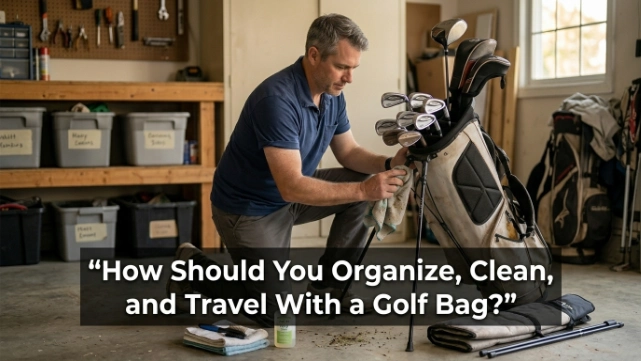
Organize clubs by length and function, keep heavy items low, and assign one pocket to each accessory group. Clean and dry the bag after wet rounds, then add a protective travel cover before flying.
How to organize clubs step by step
- Empty the bag: Remove every club and accessory so you can clear dirt and old items.
- Place long clubs high: Put the driver, fairway woods, and hybrids in the upper section when the bag faces you.
- Group irons: Arrange longer irons above shorter irons in consistent order.
- Put wedges low: Keep scoring clubs together where they are quick to identify.
- Separate the putter: Use a dedicated well when available, especially with an oversized grip.
- Check clubhead contact: Adjust positions so irons do not repeatedly strike graphite shafts.
- Count the set: Confirm the total before leaving for a competitive round.
On a riding cart, orient the long clubs away from the front pockets. Otherwise, tall woods can block shorter clubs and force awkward reaches.
In a stand bag, the best top-to-bottom arrangement depends on how the bag rests. Use the layout that prevents shafts from crossing and keeps clubs visible.
How to organize pockets
- Large apparel pocket: Jacket, vest, or spare layer.
- Ball pocket: Balls only, ideally without damaged practice balls.
- Small accessory pocket: Tees, marker, divot tool, and pencil in small pouches.
- Protected valuables pocket: Phone, wallet, and keys in separate soft sleeves.
- Outer quick-access area: Glove, rangefinder, and a small snack.
- External loops: Towel, umbrella, and brush secured away from the legs.
Keep dense items near the bag’s center and lower half. A large bottle in a high side pocket can make a carry bag feel uneven.
How to clean and store a golf bag
- Check the care label: Materials and waterproof coatings need different cleaning methods.
- Vacuum loose debris: Remove sand, grass, and dirt from pockets and divider channels.
- Spot-clean gently: Use mild soap, cool water, and a soft cloth unless the maker says otherwise.
- Wipe the hardware: Clear dirt from zippers, stands, and the base without soaking hinges.
- Air-dry fully: Open every pocket and keep the bag away from strong direct heat.
- Store upright: Choose a dry, ventilated area instead of a damp trunk or garage corner.
Never close a wet towel or glove inside the bag. Trapped moisture encourages odor and can damage fabric, paper scorecards, and untreated metal.
Inspect the rain hood, zipper pulls, stand legs, and strap stitching each month during the season. Small repairs are easier before a seam or attachment fails.
How to fly with golf clubs
Use a durable travel cover, protect the clubheads, and check the airline’s size, weight, and liability rules before departure. Those terms differ by carrier and ticket.
- Photograph the equipment: Record the clubs and bag condition before packing.
- Remove loose valuables: Keep electronics, keys, medication, and documents in your personal luggage.
- Protect long clubs: Use a stiff-arm support or hard-shell structure taller than the driver.
- Pad the top: Wrap towels or clothing around clubheads without overstuffing.
- Secure straps and legs: Prevent exposed parts from catching during handling.
- Weigh the packed case: Allow a small margin below the airline’s current limit.
- Add identification: Place contact details inside and outside the cover.
The PGA of America’s golf travel advice also recommends limiting excess balls, padding exposed clubs, and checking airline charges.
A hard case offers strong crush protection but may be difficult to fit in a rental car. A padded soft case stores more easily, although a stiff-arm support becomes especially important.
Section Takeaway: Give every club and accessory a fixed home, then reset the bag after each round. Dry storage and careful travel packing protect both the bag and the equipment inside it.
Golf Bag FAQ
How much should an empty golf bag weigh?
There is no single ideal weight. A carry bag should feel balanced after clubs, water, balls, and clothing are added, while a cart bag can trade extra weight for storage. Compare listed weight, then test the complete load you expect to use.
Is a 14-way golf bag better?
A 14-way bag is better for golfers who want one slot per club and quick inventory checks. A four- or five-way top can be lighter and gives large grips more room. Full-length divider construction matters as much as the number of openings.
Can you put a stand bag on a golf cart?
Yes, many stand bags work on riding and push carts. Confirm that the base sits flat, the legs remain secured, and the cart strap does not block pockets. A cart-friendly strap channel and leg lock improve compatibility.
How many clubs should a beginner carry?
Many beginners can start with seven to ten clubs. A tee club, hybrid or fairway wood, several irons, one or two wedges, and a putter cover the main shots. Add clubs only when each one fills a clear distance or trajectory gap.
Where should the putter go in a golf bag?
Use a dedicated putter well when the bag provides one. Otherwise, place the putter where its grip fits without forcing other clubs aside. Keep its headcover on when nearby irons could strike the putter during transport.
How long should a golf bag last?
Service life depends on construction, use, weather, and storage. Replace the bag when straps, stand hinges, zippers, or the base cannot be repaired safely. Regular drying and gentle cleaning usually prevent avoidable early damage.
Do waterproof golf bags still need a rain hood?
Yes. Waterproof fabric and sealed zippers protect the bag body, but the open top still exposes club grips and divider channels. Fit the rain hood before heavy rain begins and keep a dry towel accessible.
Final Takeaway: Build a Bag Around Your Game
The best golf bag is the one that fits your normal method of play. Start with stand, cart, Sunday, or hybrid construction, then judge loaded comfort, divider space, pocket access, and weather protection.
Empty your current bag before shopping and note what you truly use. That five-minute audit usually reveals whether you need lower weight, better organization, or simply less clutter.
Once you choose, assign every item a place and reset the bag after each round. Your next step is simple: count your clubs, remove dead weight, and test the loaded setup before your next tee time.