
Why Beginners Top the Ball: Causes, Fixes, and Simple Drills

Quick Answer
Beginners top the golf ball because the bottom of their swing moves too high or too far behind the ball. Common causes include standing up, shifting weight backward, using the wrong ball position, and trying to lift the shot. Learning the basics of making solid golf-ball contact will help you strike the ball before the turf.
Most likely causes
- Standing up: Your chest rises during the downswing and pulls the club above the ball.
- Hanging back: Your pressure stays on the trail foot, moving the low point behind the ball.
- Trying to lift: You scoop upward instead of letting the club’s loft launch the ball.
- Wrong ball position: The ball sits outside the natural bottom of your swing.
- Poor balance: Excess effort changes your posture and contact point.
Quick way to confirm it
- Draw a line on the practice mat or turf and check whether your club touches the ground ahead of it.
Topping the ball is one of golf’s most frustrating beginner mistakes. I’ve seen players respond by swinging harder, although that usually makes the contact worse.
This guide explains why the shot happens and how to diagnose your own pattern. You’ll also get simple drills that work without expensive training equipment.
In This Guide
What Is a Topped Golf Shot?
A topped shot happens when the clubface strikes the upper half of the golf ball. The ball normally travels low, rolls along the ground, and finishes well short of the target.
The swing low point is the lowest place reached by the clubhead during an ordinary swing. With an iron, that point should occur slightly ahead of the ball.
The clubface contacts the ball first. It then continues downward and brushes or cuts the ground on the target side.
Topped shot versus thin shot
A thin shot contacts the ball below its center but above the ideal strike point. It may fly low yet still travel a useful distance.
A severe top hits much higher on the ball. It often produces almost no flight.
| Contact | Typical flight | Usual evidence |
|---|---|---|
| Solid strike | Normal launch and distance | Divot begins after the ball |
| Thin strike | Low flight with some carry | Little turf contact and a sharp feel |
| Topped strike | Very low flight or immediate roll | Club hits the upper half of the ball |
| Fat strike | Short, heavy shot | Ground contact begins behind the ball |
A topped shot and a fat shot can come from the same low-point problem. The club may strike the ground early on one swing, then miss the ground and catch the ball high on the next.
Why Do Beginners Top the Golf Ball?
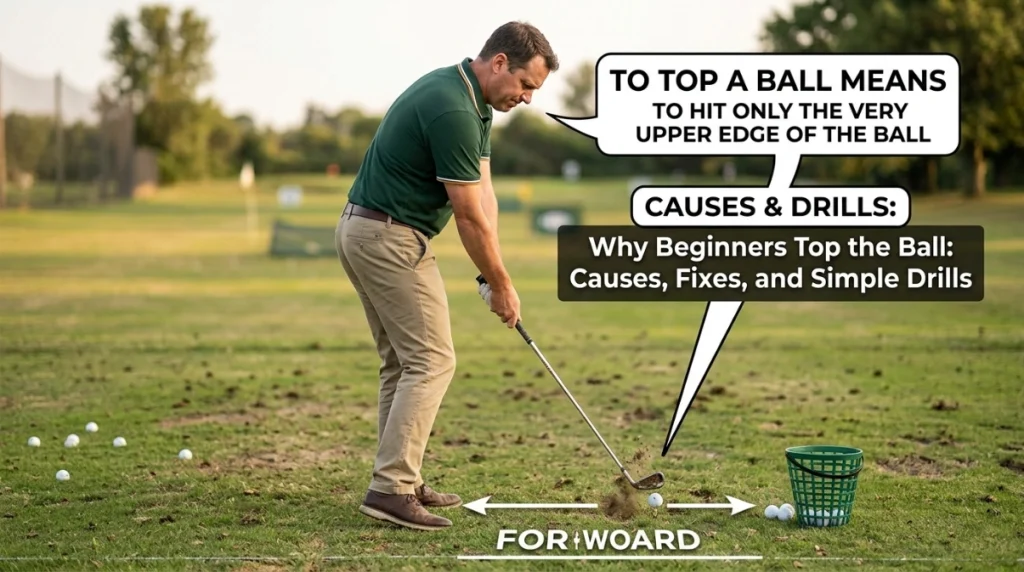
Beginners usually top the ball because their posture, pressure movement, or setup changes the swing’s low point. The mistake rarely comes from one faulty club.
You stand up during the downswing
Your hips move toward the ball while your chest rises. This reduces the space available for your arms and lifts the clubhead.
Golfers often call this movement early extension. It may appear when you lose balance or swing beyond your comfortable speed.
Your weight stays on the trail foot
For a right-handed golfer, the trail foot is the right foot. Finishing with most pressure there moves the low point behind the ball.
Your body may then lift the club to avoid striking the ground. The leading edge catches the top of the ball instead.
You try to help the ball into the air
An iron already has loft, which is the angle that helps launch the ball. You don’t need to scoop it upward.
- Let the clubface’s loft create height.
- Keep turning through the shot.
- Allow the club to descend into an iron strike.
- Finish with pressure on your lead side.
I often see this problem near a water hazard. A player wants extra height, leans backward, and produces the exact low shot they feared.
Your ball position is wrong
A ball placed too far forward can sit beyond the club’s lowest point. The club has started rising when it reaches the ball.
A ball too far back may also create compensations. Review a complete golf ball-position guide before making major swing changes.
You lose balance by swinging too hard
Beginners often chase distance before controlling contact. Excess effort can pull the head, chest, and hips away from their starting positions.
Practice at roughly 60% to 70% effort. A centered strike usually travels farther than a fast swing that barely touches the ball.
Section Takeaway: A top is a low-point error. Improve posture, pressure movement, and ball position before blaming the equipment.
How Can You Diagnose the Cause?
Start by identifying where the club touches the ground. The result tells you more than the ball’s flight alone.
Use a line test
Draw a straight line on a practice mat with chalk. On grass, place two tees several inches apart to create an imaginary line.
- Set the ball directly on the line.
- Make five half-swings with an 8-iron.
- Notice where the club first touches the surface.
- Repeat without a ball.
For an iron shot, your brush mark should begin on or slightly ahead of the line. A mark behind it shows that your low point remains too far back.
Record your swing from two angles
Place a phone around hand height and far enough away to capture your whole body. Record one view from behind and another facing your chest.
- Face-on view: Check whether your head and chest move behind the ball.
- Down-the-line view: Check whether your hips move toward the ball.
- Finish position: Check whether you can balance on your lead leg.
Don’t diagnose ten details at once. Select the clearest pattern and test one correction.
Pro tip: A certified PGA professional can compare your setup and impact position on video. Seek hands-on guidance if a movement causes pain.
Check your equipment without overcorrecting
A club that is far too long may make consistent posture harder. An unsuitable lie angle can also affect turf interaction and direction.
However, equipment seldom explains every topped shot. A qualified fitter can check club length, shaft flex, lie angle, and grip size.


How Do You Stop Topping the Ball?
Use a shorter swing, maintain your posture, and move pressure toward the target. Your first goal is predictable contact rather than maximum distance.
Build a stable setup
A balanced address position gives your body room to rotate. Review these checkpoints before each practice swing:
- Feet: Set them about shoulder-width apart for a mid-iron.
- Knees: Add a small, comfortable flex.
- Hips: Hinge forward instead of rounding your upper back.
- Arms: Let them hang naturally beneath your shoulders.
- Balance: Feel pressure through the middle of both feet.
A sound setup shouldn’t feel rigid. These golf stance fundamentals provide a useful starting point.
Keep your chest level through impact
Imagine that your chest remains over the hitting area while the body rotates. Don’t force your head downward or freeze it in place.
Your head can move naturally. The key is avoiding a sudden upward lift before contact.
Move pressure to your lead side
Begin with short swings and finish with most pressure on your lead foot. Your trail heel may rise naturally as your body turns.
Hold the finish for three seconds. If you fall backward, reduce your speed and shorten the motion.
Trust the loft
With an iron, focus on striking the ball before brushing the turf. Don’t attempt to slide the club underneath it.
The R&A and USGA govern golf’s equipment rules, but ordinary club loft does the launching work for you. Your job is to deliver the club consistently.
Section Takeaway: Shorten the swing and finish on the lead side. Let the club’s loft launch the shot instead of scooping it.
Which Drills Improve Ball Striking?
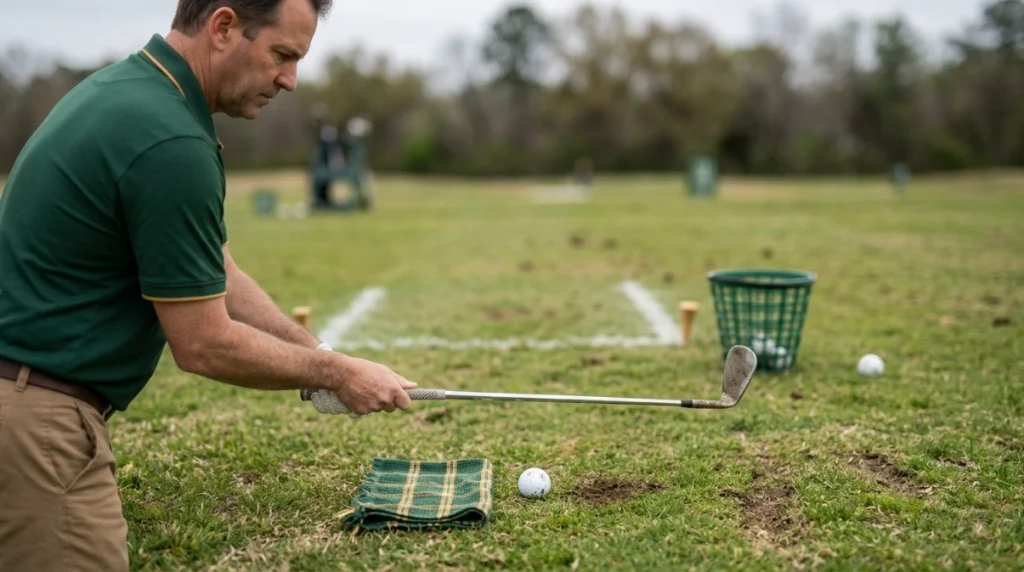
The best beginner drills make the low point visible. Start without a ball, then add one after the movement becomes comfortable.
Forward-brush drill
- Draw a line or choose a mark on the mat.
- Set up with the mark centered in your stance.
- Make waist-high swings without a ball.
- Brush the surface on the target side.
- Complete three sets of five swings.
Add a ball only after several forward brushes. Keep the same motion instead of making a harder “real” swing.
Feet-together drill
Hit short shots with your feet nearly touching. This limits power and reveals movements that disturb your balance.
Use a pitching wedge or 9-iron. Begin with small shots to a target about 20 to 40 yards away.
Step-through drill
Make a slow backswing, then step toward the target with your trail foot after impact. The drill encourages forward pressure and continuous rotation.
Perform it first without a ball. Avoid the drill if balance or lower-body movement causes discomfort.
Towel-behind-the-ball drill
Place a small towel about four to six inches behind the ball. Strike the ball without touching the towel.
Move the towel farther away if you keep hitting it. The goal is a clean learning process, not a punishment.
| Your pattern | Best drill | Main focus |
|---|---|---|
| No ground contact | Forward-brush drill | Move the low point forward |
| Falling backward | Step-through drill | Finish on the lead side |
| Losing posture | Feet-together drill | Control balance and speed |
| Hitting behind the ball | Towel drill | Contact ball before ground |
A useful session needs structure. Follow a consistent set of beginner golf drills instead of hitting a full bucket without a target.
Section Takeaway: Practice the ground-contact pattern at low speed. Increase swing length only after your strike becomes predictable.
How Should You Handle Topped Shots on the Course?
After a topped shot, choose the simplest recovery instead of trying to recover every lost yard. One poor strike doesn’t need to become three.
- Check the lie: Confirm that the ball and your stance are safe.
- Choose enough loft: Clear nearby rough or hazards before chasing distance.
- Make a shorter swing: Use the motion that produced solid practice contact.
- Aim at space: Favor the widest safe part of the fairway or green.
- Reset mentally: Judge the next shot on its own requirements.
I use one simple cue after a poor strike: “finish over the front foot.” A single external cue works better for me than checking six body positions.
As of 2026, launch monitors and swing apps can provide useful feedback. Beginners still improve fastest when they combine that data with a simple practice goal.
The golf practice routine guide can help you divide time between contact, direction, and short-game work.
Frequently Asked Questions
Why do I top the ball with my irons?
You may be standing up, keeping pressure on your trail foot, or placing the ball too far forward. These movements lift the club or move its low point behind the ball. Practice half-swings and make the club brush the ground after the ball.
Why do I top my fairway woods?
Fairway woods encourage some golfers to scoop because the ball must launch from a tight lie. Use a sweeping strike, but don’t lean backward. Keep your chest turning and allow the club to brush the turf near the ball.
Can standing too close cause a topped shot?
Yes. Standing too close may leave insufficient room for your arms, causing your hips to move toward the ball. Let your arms hang naturally at address and check that your weight remains balanced through the middle of your feet.
Should I keep my head down to stop topping?
Not rigidly. Forcing your head down can restrict rotation and create another swing fault. Maintain your posture through impact while allowing your head and body to move naturally toward a balanced finish.
Does looking up early cause topped shots?
Looking up can accompany a topped shot, but it may not be the root cause. Loss of posture or backward pressure often moves the head first. Diagnose the whole motion instead of trying to stare at the ball longer.
Can the wrong clubs make me top the ball?
Clubs that are unsuitable in length, lie angle, weight, or shaft may make consistent contact harder. However, repeated tops usually involve setup or movement too. A certified fitter can confirm whether your equipment matches your body and swing.
How long does it take to stop topping the golf ball?
Some golfers improve during one focused practice session, while others need several weeks. Progress depends on the cause and practice quality. Track how often you contact the ground ahead of a reference line rather than expecting immediate perfection.
Topping the ball is frustrating, but it gives you a useful clue: the club isn’t reaching the correct low point. Start with half-swings, move pressure forward, and learn to brush the turf after the ball.
Take one drill to your next range session and record ten swings. If the pattern remains unclear, book a short lesson with a certified instructor before adding more swing thoughts.