
Golf Practice Routine: A Complete Plan for Consistent Improvement

Quick Answer
A productive golf practice routine divides your time among putting, short-game shots, wedges, irons, and tee shots. Begin with a physical warm-up, work on one skill at a time, and finish by simulating real holes under pressure. A qualified coach from the PGA of America can help you choose drills that fit your swing.
A Simple 60-Minute Routine
- Warm up — 5 minutes: Use gentle movement, practice swings, and short wedge shots.
- Putting — 15 minutes: Work on start line, short-putt accuracy, and long-putt distance control.
- Short game — 15 minutes: Alternate chips and pitches from several lies.
- Full swing — 20 minutes: Practice wedges, irons, and tee clubs with specific targets.
- Pressure test — 5 minutes: Play a simulated hole or complete a measurable challenge.
The Key Rule
- Spend more time on your weakest scoring skill instead of automatically hitting more drivers.
I’ve watched plenty of golfers hit an entire bucket without choosing a target. They leave tired, but their game rarely changes.
A structured golf training routine gives every ball a purpose. This guide shows you how to build one for the range, practice green, home, or course.
In This Guide
What Makes a Golf Practice Routine Effective?
An effective routine uses clear targets, realistic situations, and measurable results. It develops skills that help you produce lower scores on the course.
A golf practice routine is a planned sequence of drills covering specific parts of your game. It replaces random repetition with deliberate practice.
Practice with a defined objective
Choose one main objective before starting. “Improve golf” is too broad to guide a useful session.
A practical objective should describe a shot and a result. Good examples include:
- Start eight of ten short putts on the intended line.
- Land seven of ten chips inside a towel-sized target.
- Hit six of ten drives within an imaginary fairway.
- Control three wedge distances with one club.
- Reduce heavy iron strikes during half-swings.
Separate technique from performance
Technical practice lets you repeat a movement without worrying about score. You might use alignment rods while working on clubface control.
Performance practice gives you one attempt at each shot. It includes consequences, changing targets, and a recorded result.
| Practice Type | Main Purpose | Typical Format | Best Time to Use It |
|---|---|---|---|
| Blocked | Learn a movement | Same club and target | Early skill development |
| Random | Improve adaptability | Change club and target | After contact stabilizes |
| Pressure | Test performance | One ball with a score | End of a session |
Use all three types. Start with blocked repetitions, add random targets, and finish with a pressure challenge.
Section Takeaway: Give every session one main objective and every shot a specific target.
How Do You Build a Balanced Golf Practice Routine?

Build your routine around the shots that affect your score most. Divide the available time before you begin.
Start with a safe warm-up
Spend about five minutes preparing your body. Begin with gentle rotations, hip movement, and easy practice swings.
Hit short wedge shots before longer clubs. Gradually increase swing length and speed.
Pro tip: Ask a certified golf instructor or suitable healthcare professional for help if swinging causes pain or recurring discomfort.
Use your current performance to divide the time
A balanced session does not require equal time for every club. It should give extra attention to the weakest part of your game.
A beginner might use this 60-minute structure:
| Practice Area | Time | Primary Goal |
|---|---|---|
| Warm-up | 5 minutes | Movement and rhythm |
| Putting | 15 minutes | Start line and pace |
| Chipping and pitching | 15 minutes | Landing-point control |
| Full swing | 20 minutes | Playable ball flight |
| Pressure test | 5 minutes | Transfer skills to play |
Mid-handicap players should use their statistics to adjust this split. Frequent three-putts justify more putting time.
Penalty shots from the tee justify targeted driver practice. Missed greens followed by poor recovery shots point toward wedges and chipping.
Prepare before the session starts
Bring only the tools that support your objective. Useful practice equipment includes:
- Alignment rods or two spare clubs
- A towel for landing-zone drills
- Golf tees for gates and boundaries
- A notebook or phone for recording results
- Your normal golf balls for short-game practice
- A rangefinder when the facility permits one
Section Takeaway: Allocate practice time according to your scoring patterns, not your favorite club.
How Should You Practice Putting and the Short Game?
Practice putting and short-game shots with changing distances, lies, and targets. These variations prepare you for the decisions required on a course.
Separate putting direction from distance
Short-putt practice should emphasize start line. Place two tees slightly wider than your putter head to create a gate.
Start from three feet. Make five putts from four positions around the hole before increasing the distance.
For long putts, focus on finishing close rather than holing everything. Place tees about three feet behind the target hole.
Try to stop each ball beyond the cup but before the tees. Change the starting distance after every three putts.
Pick a landing point for chips
A chip normally flies a short distance before rolling. Choose the landing point before selecting your club.
Place a small towel on the green. Hit five balls toward it with a wedge, then repeat with a less-lofted club.
Loft is the angle of the clubface that helps control launch. A higher-lofted wedge usually produces more flight and less roll than a lower-lofted iron.
Practice different lies
Perfect lies create false confidence. Rotate among tight grass, light rough, deeper rough, and sloped ground when the practice facility allows it.
- Tight lie: Prioritize clean contact and a predictable low point.
- Light rough: Expect the grass to reduce spin and control.
- Deep rough: Choose enough loft and make a committed swing.
- Uphill lie: Expect a higher launch and shorter carry.
- Downhill lie: Expect a lower flight and more roll.
Finish with an up-and-down game. Drop one ball in nine different locations and count how often you chip or pitch onto the green and hole the next putt.
Section Takeaway: Train short-game decisions as well as technique by changing the lie, target, and club.


What Is the Best Driving Range Practice Routine?
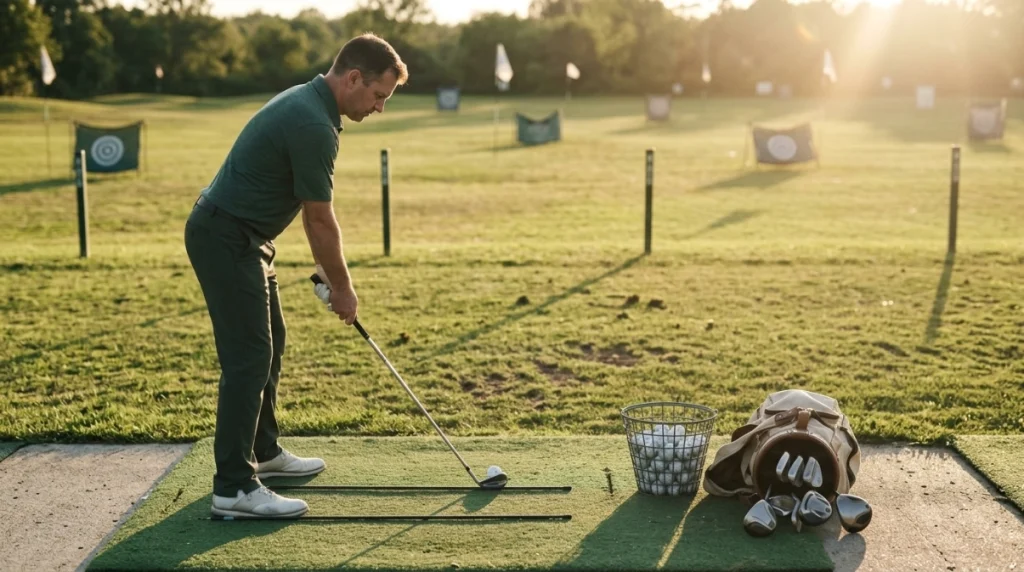
The best range routine moves from short, controlled shots to full swings and simulated holes. It avoids hitting many balls with one club at maximum speed.
Use a small practice station
Place one alignment rod along the target line. Position another parallel to it near your toes.
Aim the clubface first. Then set your feet, hips, and shoulders roughly parallel to the line.
Follow a purposeful club sequence
A 40-ball range routine might look like this:
- Five wedge shots: Use waist-high swings to establish contact and rhythm.
- Five pitch shots: Choose a specific carry target for every ball.
- Eight mid-iron shots: Alternate between two targets.
- Six hybrid or fairway-wood shots: Focus on launch and playable direction.
- Six driver shots: Define a fairway using two range markers.
- Ten simulated shots: Change clubs as if playing real holes.
Do not count only perfect strikes. Track how many shots would remain playable.
A slightly thin iron near the target may be acceptable. A drive beyond an imaginary boundary should count as a serious miss.
Play simulated holes
Picture a real hole and define its boundaries. Hit a tee shot, estimate the remaining distance, and select the next club.
Start a new hole after reaching the imaginary green. Follow your normal pre-shot routine before every attempt.
I often finish range sessions by “playing” three familiar holes. This quickly reveals whether a swing change survives changing targets and clubs.
Avoid common range mistakes
- Hitting another ball immediately after a poor shot
- Using the driver for most of the bucket
- Aiming toward the center without a precise target
- Changing several swing positions at once
- Ignoring wind and uneven range lies
- Judging every shot only by distance
- Continuing after fatigue damages balance and contact
The official rules maintained by the USGA and The R&A can also inspire realistic practice. Include recovery shots and penalty situations you regularly face.
Section Takeaway: Build range sessions around targets and simulated play, not the number of balls you hit.
How Often Should You Practice Golf?
Most recreational golfers can improve with two or three focused sessions each week. Short, regular practice usually works better than one exhausting session.
Beginner weekly schedule
Beginners need contact, basic direction, and confidence. Keep the goals simple.
- Session one: Putting and basic chipping for 30–40 minutes.
- Session two: Wedges, half-swings, and mid-irons for 45–60 minutes.
- Optional session: Play nine holes or complete an on-course lesson.
Mid-handicap weekly schedule
Mid-handicap golfers should connect practice with their recent rounds. Review penalties, approach misses, recovery results, and three-putts.
- Session one: Work on the largest recent scoring weakness.
- Session two: Combine wedge distances with random full-swing targets.
- Session three: Complete short-game and putting performance tests.
- Playing day: Track results without introducing a new swing thought.
Low-handicap weekly schedule
Skilled golfers generally need greater precision and pressure. Their sessions should feature exact yardages, different trajectories, and scoring challenges.
Maintenance also matters. A player preparing for competition should protect reliable skills while targeting one measurable weakness.
What if you only have 20 minutes?
Choose one area rather than rushing through the entire bag. A useful 20-minute session can include:
- Three minutes of warm-up
- Ten minutes on one measurable drill
- Five minutes of random targets
- Two minutes for a pressure test
At home, use a putting mat, carpet, or safe net. Confirm that the practice area protects people, windows, walls, and nearby property.
Section Takeaway: Consistency matters more than marathon sessions. Two focused weekly practices can outperform occasional ball beating.
How Do You Measure Improvement?
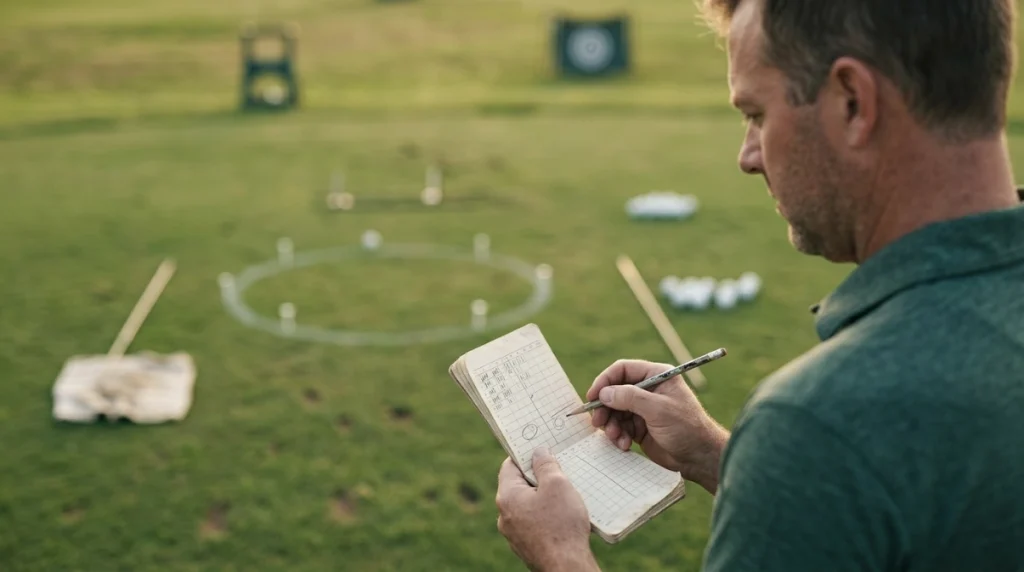
Measure results that connect practice with scoring. Track patterns over several sessions instead of reacting to one good day.
Record simple practice scores
Choose numbers you can repeat under similar conditions. Useful measures include:
- Putts made from three, five, and eight feet
- Long putts finishing within three feet
- Chips stopping within a chosen radius
- Wedges landing inside a distance window
- Iron shots finishing within target boundaries
- Tee shots entering an imaginary fairway
Record the date, drill, score, and one short observation. Avoid writing a complicated swing analysis after every ball.
Track useful on-course statistics
Traditional statistics can help, but they need context. A missed fairway may still leave a clear approach.
Track outcomes that describe the cost of each mistake:
- Playable tee shots
- Penalty strokes
- Approach shots reaching the green area
- Successful recoveries
- Up-and-down attempts and successes
- Putts and three-putts
- Shots lost through poor decisions
Review your routine every four weeks
Compare recent practice scores with on-course results. Improvement should eventually appear in both places.
If a drill score rises but course performance stays unchanged, add more random and pressure practice. Your technique may not yet transfer to changing situations.
Use instruction when progress stalls. A certified coach can identify whether the problem comes from setup, movement, club selection, or practice design.
Pro tip: Use the coaching resources available through the PGA of America when you need hands-on swing guidance.
Section Takeaway: Measure playable outcomes, review trends monthly, and change your routine when practice results stop transferring to the course.
Frequently Asked Questions
How long should a golf practice session be?
A focused session can last 30–60 minutes. Stop earlier if fatigue changes your balance, grip pressure, or contact. Golfers with more time can extend practice, but they should include breaks and change activities to preserve concentration.
Should I practice golf every day?
Daily practice can help when sessions remain short and purposeful. Avoid hitting full-power shots every day if your body feels tired. Putting, slow-motion rehearsals, mobility work, and short chips can support regular practice with less strain.
How many golf balls should I hit at the driving range?
Quality matters more than bucket size. Forty purposeful balls can provide a complete session when you warm up, change targets, use several clubs, and simulate holes. Stop when you begin rushing or repeating poor swings through fatigue.
What percentage of practice should be short game?
Many recreational golfers benefit from spending 40–60% of practice time on putting, chipping, pitching, and wedges. Adjust that percentage using your own scoring patterns. Frequent penalties from the tee may require more full-swing work.
Should beginners practice with a driver?
Yes, but the driver should not dominate beginner practice. Begin with wedges and mid-irons to develop balance and contact. Add a small number of controlled drives after warming up, using a wide target and smooth tempo.
How can I practice golf without a driving range?
Practice putting indoors, rehearse setup with alignment rods, chip into a safe net, or use foam balls. You can also work on your pre-shot routine and course decisions without hitting balls. Always protect people and property.
Why am I good at the range but inconsistent on the course?
Range practice often gives you repeated shots from flat lies with the same club. Course golf constantly changes the target, lie, wind, and consequence. Add random targets, one-ball drills, simulated holes, and pressure tests to improve transfer.
Build a Routine You Can Repeat
The best golf practice routine fits your schedule, current ability, and scoring weaknesses. It does not require expensive technology or endless buckets.
Start with a warm-up and one clear objective. Combine technical repetition with random targets and finish under pressure.
For your next session, record three numbers: the drill score, the number of playable shots, and the skill needing more work. Those simple notes will give your next practice a clear direction.