
Match Play vs Stroke Play: What’s the Difference?

Quick Answer
Match play scores each hole as a separate head-to-head contest, while stroke play adds every stroke across the entire round. Match play rewards tactical decisions and limits the damage from one disastrous hole; stroke play rewards steady scoring and punishes every mistake. You can explore these and other common golf formats before choosing one for your group.
The Main Differences
- Scoring: Match play counts holes won, while stroke play counts total strokes.
- Opposition: Match play pits you directly against an opponent; stroke play compares you with the full field.
- Bad holes: A blow-up usually costs one hole in match play but every stroke in stroke play.
- Concessions: Match-play opponents may concede strokes, holes, or the match; regular stroke play requires holing out.
- Finish: A match can end early, whereas a stroke-play round normally continues through every scheduled hole.
Which Should You Play?
- Choose match play for a social, strategic head-to-head game.
- Choose stroke play when you want a complete measure of your round.
Match play and stroke play can make the same golf course feel like two different games. I’ve watched conservative players become bold in match play, while aggressive golfers suddenly protect every stroke in a medal round.
This guide explains the scoring, rules, strategy, handicap use, and terminology behind both formats. It also shows which option works best for beginners, casual groups, and competitive golfers in 2026.
In This Guide
What Is the Difference Between Match Play and Stroke Play?
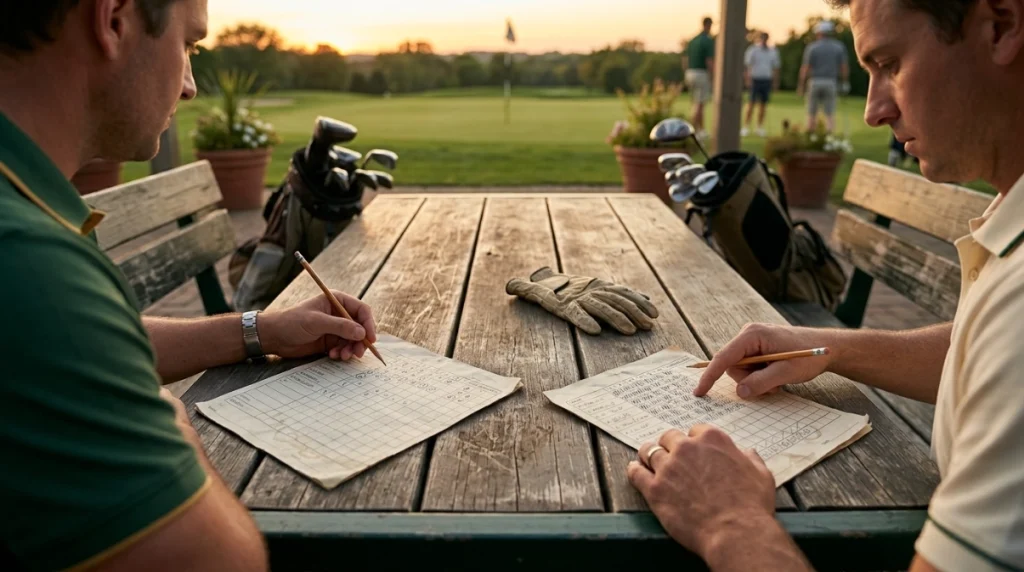
Match play decides the winner by holes won, while stroke play decides the winner by total strokes. That difference changes how you score, recover from mistakes, and react to another golfer’s position.
The official Rules of Golf, Rule 3, treats them as distinct forms of competition. Most basic playing rules remain the same, but several procedures and penalties differ.
Match play is a head-to-head format in which a player or side competes directly against an opponent. Each hole is won, lost, or tied according to the scores on that hole.
Stroke play is a format in which competitors add their strokes and applicable penalties over one or more rounds. The player with the lowest total score wins.
| Feature | Match Play | Stroke Play |
|---|---|---|
| Scoring unit | Holes won, lost, or tied | Total strokes taken |
| Opponent | One player or opposing side | Every player in the field |
| Effect of an 8 | Usually loses only that hole | All eight strokes count |
| Conceded putts | Allowed and final | Not allowed in regular stroke play |
| Typical finish | May finish before the 18th | All scheduled holes completed |
| General penalty | Usually loss of hole | Usually two penalty strokes |
How Does Match Play Scoring Work?
In match play, the golfer with the lower score wins the hole. Equal scores tie the hole, so neither player gains an advantage.
The running score describes the difference in holes won. A player leading by two holes is “2 up,” while the opponent is “2 down.”
Match-play scoring example
- Hole 1: Anna scores 4 and Ben scores 5, so Anna goes 1 up.
- Hole 2: Both score 4, so the hole is tied and Anna remains 1 up.
- Hole 3: Anna scores 7 and Ben scores 5, so Ben wins the hole and the match returns to tied.
Anna’s seven doesn’t create a two-stroke deficit for later holes. Its damage stops when she loses that single hole.
When does a match finish?
A match ends when one player leads by more holes than remain. For example, a golfer who is 4 up with three holes left wins “4 and 3.”
A result of “1 up” means the winner led by one hole after the final scheduled hole. A “2 and 1” result means the winner led by two with only one hole left.
What does all square mean?
“All square” means the match is tied. Current scoreboards may simply show “tied,” but golfers still use the traditional phrase in conversation.
If a knockout match remains tied after 18 holes, the competition terms commonly require extra holes. Players continue until one wins a hole, although organizers may set another procedure.
What is a concession?
A player may concede an opponent’s next stroke, a hole, or the entire match. According to the USGA match-play guidance, a valid concession is final and cannot be refused or withdrawn.
This creates the familiar “gimme” putt, but only within match play. Casual gimmies do not replace holing out when playing regular stroke play.
Section Takeaway: Match play isolates every hole. One ugly score can lose a hole, but it cannot ruin your entire round.
How Does Stroke Play Scoring Work?
Stroke play adds every stroke and applicable penalty across the stipulated round or rounds. The lowest gross or net total wins.
A gross score is the actual number of strokes taken. A net score subtracts the player’s authorized handicap strokes from that total.
Stroke-play scoring example
Suppose Maya records 5, 4, and 7 over three holes. Her total is 16, regardless of whether she “beat” another player on two individual holes.
If Leo records three fives, his total is 15. Leo leads by one stroke even though Maya posted the lower score on Hole 2.
| Player | Hole 1 | Hole 2 | Hole 3 | Total |
|---|---|---|---|---|
| Maya | 5 | 4 | 7 | 16 |
| Leo | 5 | 5 | 5 | 15 |
Must you finish every hole?
In regular individual stroke play, you must hole out on every hole. The USGA stroke-play overview explains that failing to hole out must be corrected before starting the next hole or returning the scorecard on the final hole.
Other stroke-play forms modify that requirement. Maximum Score caps the score set by the Committee, while Stableford awards points according to the score on each hole.
Why does consistency matter more?
A triple bogey stays on your card. You cannot erase it by making birdie on the next hole, although the birdie lowers your overall total.
This makes sensible targets and careful recovery shots valuable. Understanding basic golf scoring terms also helps beginners track a round correctly.
Section Takeaway: Stroke play measures your complete performance. Every saved stroke matters, from the opening drive to the final putt.


Which Rules and Penalties Change Between the Formats?
Most Rules of Golf apply to both formats, but the consequences and procedures can differ. The biggest changes involve concessions, order of play, scorecards, and handling uncertainty.
Order of play
In match play, the player farthest from the hole normally plays first. If someone plays out of turn, there is no penalty, but the opponent may promptly cancel that stroke.
Stroke play also traditionally follows the farthest-away order. However, players may use safe and responsible “ready golf,” and a stroke played out of turn normally stands.
General penalties
- Match play: The general penalty is normally loss of hole.
- Stroke play: The general penalty is normally two strokes.
- One-stroke penalties: Relief penalties, such as stroke-and-distance for a lost ball, generally remain one stroke in either format.
Scorecards and reporting scores
Regular stroke play requires a score for each hole, marker certification, and timely card return. A returned hole score lower than the correct score can lead to disqualification, subject to specific Rules exceptions.
Match play does not normally require the same returned scorecard procedure. However, each player must communicate accurate stroke information when required and keep the match score clear.
What if you’re unsure of a rule?
In stroke play, Rule 20.1 allows a player to complete the hole with two balls when no referee is readily available. The player must follow the required procedure and report the facts to the Committee before returning the scorecard.
You cannot use that two-ball procedure in match play. Instead, an opponent may request a ruling within the required time if both players cannot resolve the issue.
Handicap strokes
Handicap match play applies strokes hole by hole, normally according to each hole’s stroke index. A player receiving a stroke can win with a higher gross score but a lower net score.
In net stroke play, handicap strokes affect the total net result. Review a clear golf handicap guide before arranging an event with mixed skill levels.
Section Takeaway: Never assume a rule carries the same consequence in both formats. Confirm the competition format before the first tee.
How Should Your Strategy Change?

Match play strategy responds to one opponent and the current hole. Stroke play strategy protects the lowest sustainable total across the entire course.
Smart match-play strategy
- Watch the opponent: Their position can change whether you attack or play safely.
- Forget lost holes: An eight costs no more than a five when both lose the same hole.
- Apply pressure: Putting a ball safely on the green forces your opponent to respond.
- Respect short putts: A two-foot putt can feel longer when the opponent makes you finish it.
- Know the match score: Your risk tolerance should change as the remaining holes disappear.
I once watched a player attack a tucked flag after his opponent found a greenside bunker. The aggressive shot also missed the green, turning a likely win into a tied hole.
The better choice was the center of the green. Match play rewards pressure, but it still punishes unnecessary hero shots.
Smart stroke-play strategy
- Limit big numbers: Pitch back to safety when the direct recovery carries heavy risk.
- Choose wider targets: Center-green approaches reduce short-sided misses.
- Play your pattern: Allow for your normal shot shape instead of aiming for a perfect ball.
- Stay patient: One bogey rarely destroys a round, but chasing it can create a triple.
- Track penalties: Add them immediately to avoid scorecard problems.
Distance control often saves more strokes than occasional spectacular shots. A focused distance-control practice routine can improve both formats.
Pro tip: Ask a PGA-certified instructor to help build course-management targets around your real carry distances and normal dispersion.
Section Takeaway: In match play, play the opponent and the moment. In stroke play, manage your misses and protect the total.
Which Format Should You Play?

Choose match play for direct competition, tactical variety, and quick emotional resets. Choose stroke play when you want a complete scoring test or a result comparable with other rounds.
Match play is usually better when:
- Two golfers want a clear head-to-head contest.
- Players enjoy strategy and changing risk decisions.
- One bad hole shouldn’t decide the entire game.
- A club event uses a knockout bracket.
- Teams are playing four-ball or foursomes matches.
Stroke play is usually better when:
- A large field needs one measurable leaderboard.
- Players want to post and compare complete scores.
- Consistency should matter across every hole.
- The event uses gross or net tournament totals.
- Golfers are preparing for standard medal competitions.
Which is better for beginners?
Match play often feels friendlier because a blow-up hole causes limited damage. A beginner can pick up after conceding the hole and mentally restart at the next tee.
Stroke play provides a more complete benchmark, but regular play requires every hole to be finished. Beginners concerned about pace might prefer an authorized Maximum Score format instead.
Before competing, learn the basic areas of a hole through this golf hole layout guide. Knowing the teeing area, fairway, rough, penalty areas, bunkers, and green makes scoring discussions easier.
Section Takeaway: Neither format is universally better. Pick the one that matches your group size, skill level, and purpose.
Frequently Asked Questions
Can match play and stroke play be played at the same time?
The Rules treat them as separate formats, and combining them within one round can create conflicts. A Committee considering a combined competition should establish clear terms and consult the applicable Committee Procedures.
Can you concede a putt in stroke play?
No. A concession is valid in match play, but regular individual stroke play requires the player to hole out. Picking up without correcting the mistake before the required deadline can result in disqualification.
What happens when a match-play hole is tied?
The hole is tied, sometimes called “halved,” and the match score does not change. If one player was 1 up before the tied hole, that player remains 1 up.
Does one terrible hole ruin a match?
Usually not. A terrible score normally loses only that hole, provided the opponent completes it with a better score. In stroke play, every stroke from the bad hole remains in the total.
Can a match finish before 18 holes?
Yes. The match ends when a player leads by more holes than remain. A golfer leading by five with four holes left wins the match 5 and 4.
Can handicaps be used in both formats?
Yes. Both formats can use gross or net scoring. Match-play handicap strokes apply on designated holes, while stroke-play handicaps contribute to the player’s net round total.
Is Stableford match play or stroke play?
Stableford is a form of stroke play that awards points based on the score made at each hole. Rule 21 modifies regular stroke-play procedures, including allowing a player to pick up when no points can be earned.
Final Takeaway
Match play is a hole-by-hole duel. Stroke play is a cumulative test in which every shot contributes to the final number.
For a lively game between friends, try match play and let the changing situation shape your decisions. For a full measure of consistency, keep a stroke-play score and protect every shot.
Whichever format you choose, announce it before teeing off and agree on handicap use. Then keep the competition friendly, clear, and moving at a responsible pace.