
Golf Formats Explained: A Simple Guide to Common Ways to Play Golf

Many golfers know how to count strokes, but the moment someone says “scramble,” “best ball,” “Stableford,” or “match play,” the round can feel confusing fast. That matters because the format changes how you score, how you choose shots, how pressure feels, and even how handicaps are applied.
This Golf Formats Explained guide breaks down the most common ways golfers play casual rounds, tournaments, charity outings, league nights, and team matches. You will learn what each format means, who it suits best, and how to choose the right one for your skill level or group.
Quick Answer
Golf Formats Explained simply means understanding the different scoring and team systems used in golf. The main formats include stroke play, match play, scramble, best ball, alternate shot, Stableford, skins, and shamble. Each format changes how scores are counted and how players compete.
Why Golf Formats Matter

Golf is not always played the same way. Two groups can play the same course on the same day and have very different experiences because of the format.
Some formats reward consistency. Some reward risk-taking. Some make golf easier for beginners. Others create more pressure for skilled players.
Choosing the right format can help you:
- Keep the round fun
- Balance different skill levels
- Speed up pace of play
- Make tournaments fairer
- Reduce pressure on beginners
- Add strategy to casual rounds
The format should match the purpose of the round. A serious club championship needs a different setup than a relaxed charity outing or a weekend game with friends.
Stroke Play
Stroke play is the most familiar golf format. Every player counts every stroke during the round. At the end, the player with the lowest total score wins.
The USGA explains that in regular stroke play, each player competes against the full field by comparing total scores across the round, and each hole score is added to create the final score in stroke play.
How Stroke Play Works
In a standard 18-hole stroke play round:
- You play every hole.
- You count every stroke and penalty.
- You add your total score.
- The lowest total wins.
Example:
| Player | Front 9 | Back 9 | Total Score |
|---|---|---|---|
| Golfer A | 42 | 43 | 85 |
| Golfer B | 45 | 41 | 86 |
| Golfer C | 47 | 46 | 93 |
Golfer A wins because 85 is the lowest total score.
Best For
Stroke play is best for:
- Club tournaments
- Handicap tracking
- Serious practice rounds
- Golfers who want a full measure of performance
- Players comfortable finishing every hole
Limitations
Stroke play can be tough for beginners because one bad hole can ruin the scorecard. If a player makes a 10 on one hole, that score still counts.
Beginner warning: Do not let one disaster hole ruin the rest of your round. Stroke play rewards patience.

Match Play
Match play is different from stroke play because you compete hole by hole. You do not need the lowest total score for the full round. You need to win more holes than your opponent.
The USGA describes match play as a head-to-head format where a player or side wins a hole by completing it in fewer strokes than the opponent.
How Match Play Works
Each hole is its own contest.
- Win a hole: You go 1 up.
- Lose a hole: You go back toward even or fall behind.
- Tie a hole: The hole is halved.
- Win more holes than remain: The match is over.
Example:
If you are 3 holes ahead with 2 holes left, you win “3 and 2.” That means you are up by three holes, and only two holes remain.
Best For
Match play is great for:
- One-on-one games
- Team competitions
- Ryder Cup-style events
- Golfers who like strategy
- Players who want each hole to feel fresh
Why Golfers Like It
A bad hole does not destroy the entire match. If you make a triple bogey on one hole, you only lose that hole. You can still come back on the next tee.
Key idea: Match play rewards smart decisions, not just total score.
Scramble
A scramble is one of the most popular formats for charity tournaments, company outings, and beginner-friendly events. Every player on a team hits a shot. The team chooses the best shot, and everyone plays again from that spot.
This continues until the ball is holed.
How a Scramble Works
For a four-player team:
- All four players hit tee shots.
- The team chooses the best drive.
- All four players hit from that chosen spot.
- The team chooses the best second shot.
- The process continues until the hole is finished.
Only one team score is recorded for each hole.
Best For
Scramble is best for:
- Charity golf events
- Corporate outings
- Beginner groups
- Mixed-skill teams
- Faster, relaxed tournaments
Benefits
Scramble formats are fun because weaker players are not punished for every bad shot. A beginner can hit one great drive or putt and still help the team.
Limitations
A scramble does not measure individual performance very well. If you are trying to track your true golf skill, stroke play is better.
Fair-play warning: In scrambles, teams should agree on rules before starting, including mulligans, tee shot requirements, and how far players may place the ball from the selected shot.
Best Ball
Best ball is often confused with scramble, but they are not the same.
In best ball, each golfer plays their own ball from tee to green. At the end of the hole, the best score among the team members counts as the team score.
Best Ball Example
A two-person team plays a par 4:
| Player | Score |
|---|---|
| Player A | 5 |
| Player B | 4 |
The team score is 4 because Player B had the better score.
Best For
Best ball works well for:
- Two-player teams
- Four-ball matches
- Golf leagues
- Players who want to play their own ball
- Groups with different skill levels
Benefits
Best ball keeps everyone involved while still letting each golfer play a normal round. It also gives teams a safety net because one player can cover for another player’s bad hole.
Limitations
It can take longer than scramble because every player usually finishes the hole.
Alternate Shot
Alternate shot is a team format where two players use one ball and take turns hitting shots. One player tees off, the partner hits the next shot, and they keep alternating until the ball is holed.
The R&A covers alternate shot under foursomes, noting that Rules 22 and 23 address team forms such as foursomes and four-ball.
How Alternate Shot Works
Example:
- Player A hits the tee shot.
- Player B hits the second shot.
- Player A hits the third shot.
- Player B putts.
The team records one score.
Best For
Alternate shot is best for:
- Skilled partners
- Competitive team events
- Match play competitions
- Golfers who enjoy pressure
- Players who communicate well
Limitations
Alternate shot can be stressful. If you hit a poor shot, your partner must deal with it. That makes patience and communication very important.
Beginner warning: Do not blame your partner. Alternate shot tests teamwork as much as ball striking.
Stableford
Stableford is a points-based golf format. Instead of counting total strokes, players earn points based on their score on each hole.
A common Stableford system looks like this:
| Hole Result | Points |
|---|---|
| Double bogey or worse | 0 |
| Bogey | 1 |
| Par | 2 |
| Birdie | 3 |
| Eagle | 4 |
| Double eagle | 5 |
The player with the most points wins.
Best For
Stableford is useful for:
- Casual competitions
- Golfers who dislike one bad hole ruining the round
- Faster play
- Mixed-skill groups
- Club events
Why Stableford Helps Beginners
If you are having a terrible hole, you can pick up once you cannot score points. That helps pace of play and keeps the round enjoyable.
Key idea: Stableford rewards good holes more than it punishes bad ones.
Skins Game
A skins game is a hole-by-hole betting or points format. Each hole has a value called a “skin.” The player with the lowest score on the hole wins that skin.
If two or more players tie, the skin usually carries over to the next hole.
Example
- Hole 1 is worth 1 skin.
- Two players tie, so no one wins it.
- Hole 2 is now worth 2 skins.
- One player wins Hole 2 outright and earns both skins.
Best For
Skins are best for:
- Casual groups
- Competitive friends
- Players who enjoy pressure putts
- Small group games
Warning
Be careful with money games. Keep stakes low and friendly, especially with beginners. The goal should be fun, not stress.
Shamble
A shamble is a hybrid between scramble and best ball.
Everyone tees off. The team chooses the best drive. From that spot, each player plays their own ball into the hole. Then the team may use the best score, two best scores, or another scoring rule.
Best For
Shamble is great for:
- Mixed-skill tournaments
- Golfers who want help off the tee
- Groups that still want individual scoring
- Events that want both fun and fairness
Why It Works
Shamble removes some pressure from the tee shot but still requires players to hit their own approach shots, chips, and putts.
It is often a good middle ground between a scramble and full stroke play.
Chapman Format
Chapman is a two-person team format. Both players tee off. Then each player hits the other person’s ball for the second shot. After that, the team chooses one ball and plays alternate shot until the hole is finished.
Simple Chapman Example
- Player A and Player B both tee off.
- Player A hits Player B’s ball.
- Player B hits Player A’s ball.
- The team chooses the better position.
- They alternate shots from there.
Best For
Chapman works well for:
- Two-person events
- Couples tournaments
- Member-guest competitions
- Players who like strategy
Limitation
Chapman can confuse beginners at first. It helps to explain the format clearly before the round.
Net vs Gross Scoring
Golf formats often use either gross scoring or net scoring.
Gross Score
Gross score is your actual score before handicap adjustments.
If you shoot 92, your gross score is 92.
Net Score
Net score uses your handicap to adjust your score. If you shoot 92 and receive 18 handicap strokes, your net score is 74.
Net scoring helps golfers of different skill levels compete more fairly. The USGA explains that handicap allowances can vary by format and should be clearly communicated by the competition committee in competitions and handicaps.
Which One Should You Use?
Use gross scoring when players are similar in skill.
Use net scoring when:
- Skill levels vary
- Beginners are included
- It is a league or club event
- Fair competition matters
Important: Always confirm handicap rules before the round starts.
Best Golf Format by Situation
| Situation | Best Format | Why It Works |
|---|---|---|
| Serious individual competition | Stroke play | Measures full-round performance |
| One-on-one challenge | Match play | Keeps pressure on each hole |
| Charity outing | Scramble | Fun, fast, beginner-friendly |
| Mixed-skill team event | Shamble | Helps off the tee but keeps real golf involved |
| Two-person team competition | Best ball | Lets both players play their own ball |
| Advanced team match | Alternate shot | Adds strategy and pressure |
| Casual points game | Stableford | Keeps bad holes from ruining the round |
| Friendly wager | Skins | Makes every hole exciting |
How to Choose the Right Golf Format
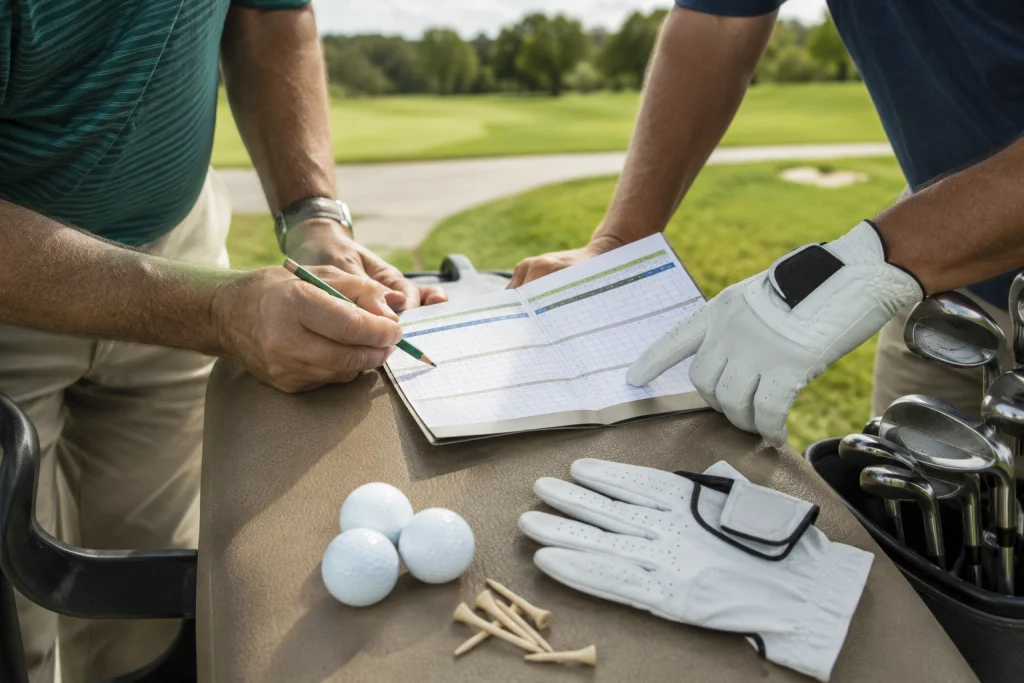
Use this simple process before your round.
- Decide the purpose of the round.
Is it serious, social, instructional, or competitive? - Look at player skill levels.
If the group includes beginners, choose scramble, shamble, or Stableford. - Consider pace of play.
Scramble and Stableford can move faster than full stroke play. - Decide whether handicaps are needed.
If skill levels vary, use net scoring or team balancing. - Explain the rules before teeing off.
Most format problems happen because players assume different rules. - Write down special rules.
This includes mulligans, tee shot minimums, maximum scores, and handicap allowances.
Expert Tip
Expert Tip:
Before joining a tournament, ask two questions: “Are we playing gross or net?” and “What happens if we tie a hole or score?” These two answers prevent most beginner confusion in golf formats.
When to Get Help From a Golf Pro or Fitter
You do not need a golf pro to understand basic formats. But expert help can be valuable if the format exposes a repeated weakness in your game.
Consider getting help from a golf pro if:
- You struggle badly in stroke play because one hole always gets away from you
- You panic under match play pressure
- Your team avoids using your drives in scramble events
- You lose strokes from poor course management
- You do not know when to play safe or attack
- You are preparing for a club tournament or league season
A golf fitter can help if equipment issues are making formats harder than they should be. For example, if your driver is too long, too stiff, or too low-lofted, you may struggle in scramble or shamble formats where tee shots matter.
Clear warning: Do not blame the format for every bad score. Sometimes the real issue is club fit, poor strategy, weak short game, or inconsistent practice.
Common Mistakes Golfers Should Avoid
- Confusing scramble with best ball. In scramble, everyone plays from the chosen shot. In best ball, everyone plays their own ball.
- Forgetting to confirm handicap rules. Net scoring can change the outcome, especially in team formats.
- Playing too aggressively in stroke play. One risky shot can lead to a big number.
- Giving up after one bad match play hole. In match play, the next hole is a fresh chance.
- Not explaining rules before the round. This creates arguments later.
- Using unclear tie-breakers. Decide before the round whether ties carry over, split points, or go to a scorecard playoff.
- Choosing a format that is too hard for the group. Beginners usually enjoy scramble, shamble, and Stableford more than strict stroke play.
- Ignoring pace of play. Formats should help the course move, not slow everyone down.
FAQs
What is the most common golf format?
Stroke play is the most common format. Each golfer counts every stroke, and the lowest total score wins. It is used in many tournaments and regular rounds.
What is the easiest golf format for beginners?
Scramble is usually the easiest format for beginners. Everyone hits a shot, the team chooses the best one, and all players continue from there. It reduces pressure and keeps the round fun.
What is the difference between scramble and best ball?
In scramble, all players hit from the selected best shot each time. In best ball, every player plays their own ball, and the lowest score from the team counts.
Is match play better than stroke play?
Match play is not better or worse. It is just different. Match play is great for head-to-head competition, while stroke play is better for measuring full-round scoring consistency.
What golf format is best for a charity tournament?
Scramble is usually best for charity tournaments because it is simple, social, and friendly for all skill levels. It also helps pace of play.
Can handicaps be used in team formats?
Yes. Handicaps are often used in best ball, match play, scramble, and other team formats. The exact allowance depends on the event rules.
What format should I use for a casual weekend round?
For a casual round, try Stableford, match play, skins, or scramble. These formats keep things interesting without making every bad hole feel too costly.
Conclusion
Golf formats change how the game feels. Stroke play rewards consistency. Match play creates head-to-head pressure. Scramble and shamble make team golf more relaxed. Best ball, alternate shot, Stableford, and skins each add their own strategy.
The best choice depends on your group, skill level, pace, and goal for the day. If you are still learning, start with beginner-friendly formats like scramble or Stableford. If you want a stronger test, try stroke play or match play.
Use this Golf Formats Explained guide before your next round, agree on the rules early, and choose the format that makes the game fair, clear, and enjoyable for everyone.