
Basic Golf Rules: A Complete Beginner’s Guide

Quick Answer
The basic golf rules are simple: play the course as you find it, play your ball as it lies, and count every stroke and penalty. Start each hole between the tee markers, hit until your ball enters the hole, and follow the official Rules of Golf when you need relief or face an unusual situation.
Six rules every beginner should remember
- Count every stroke: Include swings that intentionally try to hit the ball and any penalty strokes.
- Play your own ball: Mark it with a unique line or symbol so you can identify it.
- Respect the teeing area: Begin with the ball between the markers and no farther back than two club-lengths.
- Play it as it lies: Do not improve the ball’s position unless a rule permits relief.
- Use proper relief: Add the required penalty and drop correctly when a ball is lost, unplayable, or in a penalty area.
- Protect other players: Wait until the area ahead is clear and shout “Fore!” if a shot may hit someone.
Best beginner habit
- Tell your playing partners when you are unsure and check the local rules printed on the scorecard.
Golf’s rulebook can look intimidating, but you do not need to memorize every rule before your first round. Most beginner rounds involve the same small group of situations.
I learned faster by focusing on those situations instead of studying rare tournament rulings. This guide explains how to start a hole, count strokes, handle trouble, use the green, and keep play moving.
In This Guide
- How Is Golf Played and Scored?
- What Are the Rules for Starting Each Hole?
- Do You Always Have to Play the Ball as It Lies?
- What Happens When a Ball Is Lost, Out of Bounds, or in Water?
- What Rules Apply on the Putting Green?
- What Golf Etiquette and Safety Rules Should Beginners Follow?
- Frequently Asked Questions About Basic Golf Rules
How Is Golf Played and Scored?
Golf is played by hitting a ball from the teeing area into a hole using as few strokes as possible. A standard round has 18 holes, although beginners often play nine.
Each hole has a designated par. Par represents the score an expert golfer would normally be expected to make under ordinary playing conditions.
What counts as a stroke?
A stroke is the forward movement of a club made to hit the ball. If you intentionally swing and miss, the attempt still counts.
A practice swing does not count because you did not intend to strike the ball. Accidentally knocking a ball off its tee before making a stroke also carries no penalty in the teeing area.
Your total for a hole includes:
- Every stroke you make at the ball
- Any intentional swing that misses
- Penalty strokes required by a rule
What do par, birdie, bogey, and eagle mean?
Golfers compare a hole’s score with its par. These terms describe that relationship rather than the total number of shots alone.
| Scoring term | Meaning | Example on a par 4 |
|---|---|---|
| Eagle | Two strokes under par | 2 strokes |
| Birdie | One stroke under par | 3 strokes |
| Par | Equal to par | 4 strokes |
| Bogey | One stroke over par | 5 strokes |
| Double bogey | Two strokes over par | 6 strokes |
Stroke play versus match play
In stroke play, you count every stroke across the round. The player with the lowest total score wins.
In match play, players compete one hole at a time. The player who takes fewer strokes wins that hole, and the match ends when one side leads by more holes than remain.
A conceded putt is allowed in match play. It is not allowed in individual stroke play, where the ball normally must be holed.
The USGA provides a detailed explanation of match play rules and concessions.
Section Takeaway: Count every attempted stroke and every penalty. The lowest total wins stroke play, while the most holes won decides match play.
What Are the Rules for Starting Each Hole?

Start each hole by playing from inside its designated teeing area. Your ball must sit between the outside edges of the two tee markers and within two club-lengths behind their front edge.
Your feet may stand outside that area. Only the ball must be positioned inside it.
Choose the right tee markers
Golf courses usually offer several sets of tees. They create different hole lengths and are often identified by color.
Choose tees that match your comfortable driving distance and experience. Tee choice should not depend on age, gender, or ego.
Before the round, agree which markers your group will use. You may use a tee, place the ball on the ground, or tee it from a natural surface within the legal area.
What if you tee off from the wrong place?
The answer depends on the playing format. The difference matters most during a competition.
- Stroke play: You receive two penalty strokes and must correct the mistake by playing from inside the proper teeing area.
- Match play: There is no automatic penalty, but your opponent may cancel the stroke and require you to replay it.
- Casual golf: Correct the mistake when practical and follow any format your group agreed to use.
The original shot and any later shots made before correcting a stroke-play error do not count. However, the two-stroke penalty remains.
Who plays first?
On the first tee, groups may use a random method or an event’s starting order. On later tees, the player with the lowest score on the previous hole traditionally has the honor.
During a hole, the ball farthest from the cup traditionally plays first. Casual stroke-play groups may use ready golf when it is safe.
Ready golf means the prepared player hits without waiting for strict order. It saves time but never overrides safety.
You can review the complete USGA teeing-area guidance when playing a formal round.
Do You Always Have to Play the Ball as It Lies?
Normally, yes. You must play the ball from its resting position without moving, bending, or breaking objects to create an easier shot.
This principle keeps golf fair. However, several rules allow free or penalty relief.
Identify your ball before hitting
You are responsible for playing the correct ball. Add a permanent line, dots, or initials before the round.
Check the brand, model, number, and personal mark when several balls land nearby. Hitting a wrong ball usually brings the general penalty: two strokes in stroke play or loss of hole in match play.
You may lift a ball to identify it when necessary. First mark its position, lift only as much as needed, and replace it on its original spot.
Can you improve the area around your ball?
You cannot press down grass, break attached branches, or move soil to improve the lie, stance, swing area, or line of play. Taking a fair stance is allowed, even if that minimally affects surrounding vegetation.
You may generally remove loose natural objects, called loose impediments. Examples include detached leaves, stones, twigs, and pinecones.
Be careful when removing them. If your ball moves because of your action outside the putting green, you will usually receive one penalty stroke and must replace it.
When is free relief available?
Free relief may be available when an abnormal course condition interferes with your ball, stance, or intended swing. The usual conditions include:
- Temporary water: Water visible before or after taking your stance
- Ground under repair: An area marked or declared by the course
- Animal holes: Holes, casts, or runways made by qualifying animals
- Immovable obstructions: Artificial objects such as cart paths or sprinkler heads
Find the nearest point of complete relief that is no closer to the hole. Measure one club-length from that reference point and drop within the resulting relief area.
The longest club in your bag, except your putter, determines a club-length. Most players use their driver for measuring.
How do you drop a golf ball correctly?
Stand upright and release the ball from knee height. The ball must fall straight down without being thrown, spun, or made to touch you before reaching the ground.
It must land and remain inside the proper relief area. Drop again if it finishes outside that area.
After two unsuccessful drops, place the ball where the second drop first touched the ground. This prevents an endless cycle on steep or firm ground.
Section Takeaway: Play the ball as it lies unless a specific rule allows relief. Mark, drop, and replace carefully because small procedural errors can create avoidable penalties.


What Happens When a Ball Is Lost, Out of Bounds, or in Water?
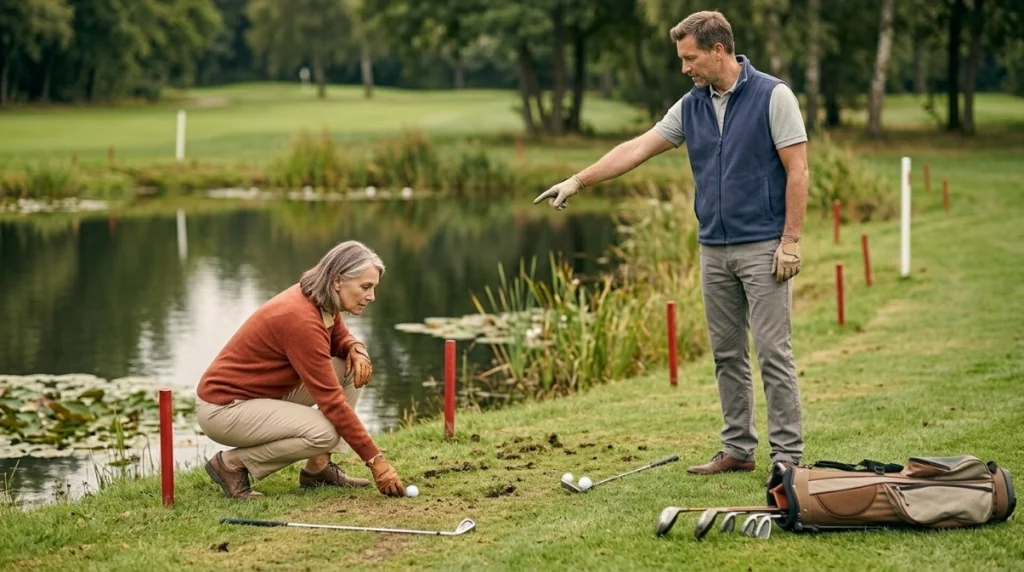
A lost ball or a ball out of bounds normally requires stroke-and-distance relief. You add one penalty stroke and play another ball from where you made the previous stroke.
A penalty area offers different options. The markings and the point where the ball crossed the boundary determine where you can take relief.
Lost ball rule
You have three minutes to search after you or your caddie begins looking. If the ball is not found in time, it is lost.
Return to the spot of your previous stroke, add one penalty stroke, and play again. If you hit your first shot from the tee, your next shot from the tee will be your third.
A ball is not lost merely because you cannot see it. It may be identified within the three-minute period, even if someone finds it just before time expires.
Out-of-bounds rule
White stakes, white lines, fences, or walls commonly mark out of bounds. A ball is out only when all of it lies beyond the course boundary.
Use stroke-and-distance relief after an out-of-bounds shot. Do not drop beside the point where the ball crossed the white boundary unless a Local Rule specifically permits an alternative.
When should you play a provisional ball?
Play a provisional ball when your original may be lost outside a penalty area or may be out of bounds. It prevents a long walk back if the original cannot be played.
- Before hitting, clearly announce that you are playing a provisional.
- Play it from the location of the previous stroke.
- Search for the original within the three-minute limit.
- Abandon the provisional if you find the original in bounds.
- Continue with the provisional under penalty if the original is lost or out of bounds.
Saying “I’ll hit another” is not always a clear announcement. Use the word “provisional” so your intention cannot be misunderstood.
Red versus yellow penalty areas
A penalty area is an area from which relief is allowed for one penalty stroke. Water may be present, but it is not required.
| Relief option | Yellow area | Red area | Penalty |
|---|---|---|---|
| Play the ball as it lies | Allowed | Allowed | None |
| Stroke and distance | Allowed | Allowed | One stroke |
| Back-on-the-line relief | Allowed | Allowed | One stroke |
| Two-club-length lateral relief | Not available | Allowed | One stroke |
Back-on-the-line relief keeps the estimated crossing point between the hole and your chosen reference point. You may move backward as far as needed along that line.
Red areas also permit lateral relief within two club-lengths of the crossing point. The relief area cannot be nearer the hole.
The official USGA penalty-area guide includes diagrams for these options.
What if the ball is unplayable?
You may declare your ball unplayable almost anywhere except inside a penalty area. You are the only person who can make that decision.
For one penalty stroke, your main options are:
- Stroke and distance: Return to the location of your previous stroke.
- Back on the line: Keep the ball’s original position between the hole and your selected reference point.
- Lateral relief: Drop within two club-lengths of the ball’s position, no closer to the hole.
Special relief procedures apply when a ball is unplayable in a bunker. Check the full rule if you plan to drop outside the bunker.
Section Takeaway: Lost and out-of-bounds balls usually mean stroke and distance. Red penalty areas offer one extra lateral option that yellow areas do not.
What Rules Apply on the Putting Green?
On the putting green, you may mark, lift, clean, and replace your ball. You may also repair certain damage and remove sand or loose soil.
Mark the ball before lifting it. Place a ball marker directly behind or beside the ball so its position remains clear.
Repairing damage on the green
You may repair damage caused by people, animals, maintenance equipment, or outside influences. Common examples include ball marks, shoe damage, old hole plugs, and embedded objects.
You cannot repair normal wear, natural surface imperfections, aeration holes, or damage caused by irrigation or rain. Do not make broader improvements to your putting line.
Can you touch the putting line?
Yes, touching the line is not automatically a penalty. You may point to a target, remove loose impediments, measure, repair permitted damage, or address the ball.
You cannot deliberately alter the surface to learn how it affects speed or direction. Scraping or rubbing the green to test it would breach the rules.
What happens if the ball moves?
If natural forces move your ball before it has been marked and replaced, play from its new position. Wind and gravity are natural forces.
After a ball has been marked, lifted, and replaced, return it to its original spot if natural forces move it. This distinction catches many new golfers.
If you accidentally move your ball while marking it on the green, there is no penalty. Replace it on its original spot.
Must you remove the flagstick?
No. You may putt with the flagstick in the hole, have it attended, or remove it before playing.
Decide before making the stroke. You cannot deliberately position the flagstick to gain an unfair advantage.
If a ball rests against the flagstick and part of it lies below the lip of the hole, the ball is considered holed. This applies even if the entire ball is not below the putting surface.
What Golf Etiquette and Safety Rules Should Beginners Follow?

Etiquette covers safety, pace, care for the course, and consideration for others. Some etiquette expectations are not automatic penalties, but they make the round safer and more enjoyable.
Good etiquette matters more to most playing partners than a beginner’s score. Be aware, prepared, and honest.
Safety comes first
Never hit until the players ahead are beyond your possible range. Leave extra space when wind, hard ground, or a downhill slope could make the ball travel farther.
Stand where another player can see you. Avoid standing close to the ball, directly behind the player, or along the expected flight line.
Shout “Fore!” immediately when a shot may endanger someone. Do not wait to see where it lands.
Anyone hearing the warning should cover their head, turn away from the sound, and avoid looking for the incoming ball.
Keep pace without rushing
Be ready when it is your turn. Select a club, check the yardage, and plan your shot while others play, provided you can do so safely.
Useful pace-of-play habits include:
- Walk directly toward your ball when it is safe.
- Carry more than one club when leaving a cart.
- Limit practice swings to one or two.
- Play a provisional when a ball may be lost or out of bounds.
- Place bags and carts toward the next tee before putting.
- Record scores after leaving the green.
- Allow a faster group to play through when space exists ahead.
Ready golf works well in casual stroke play. The R&A pace-of-play resources explain how player behavior affects the speed of a round.
Care for the course
Replace or repair divots when the course asks you to do so. Use the provided seed mixture if that is the facility’s preferred method.
Repair your ball mark on the green and one extra mark when possible. Lift the turf gently toward the center instead of pulling it upward.
Enter bunkers from the lowest practical side. Rake footprints and shot marks, then leave the rake where the course directs.
Keep carts away from greens, tees, bunkers, and wet areas. Follow directional signs and any cart-path-only restriction.
Respect other golfers
Remain quiet and reasonably still while someone prepares to hit. Avoid walking across another player’s putting line.
Do not stand directly behind a player to watch the line of play. On the green, position yourself where you will not distract anyone.
Help watch each shot. A second set of eyes can save search time and prevent lost balls.
Know the local rules
Local Rules address conditions unique to a course or competition. You may find them on the scorecard, notice board, starter’s sheet, or tournament information page.
They can cover dropping zones, no-play areas, power lines, roads, environmentally sensitive areas, and alternative relief for lost or out-of-bounds balls.
Read them before starting. A familiar shortcut used at another course may not apply to the course you are playing.
Section Takeaway: Safe, considerate, efficient play makes you a welcome playing partner. Stay ready, protect the course, and check Local Rules before the first tee.
Frequently Asked Questions About Basic Golf Rules
How many clubs may a golfer carry?
A golfer may start with no more than 14 clubs. You can add clubs during the round if you began with fewer, but you cannot delay play or exceed the 14-club limit.
Does a swing-and-miss count in golf?
Yes. A swing counts when you intended to strike the ball, even if you missed it completely. A practice swing does not count because there was no intention to hit the ball.
Can I move my golf ball away from a tree?
You cannot move it for free merely because a tree blocks your stance or swing. Play it as it lies or declare it unplayable and use an available relief option for one penalty stroke.
How long can you search for a lost golf ball?
You have three minutes from when you or your caddie begins searching. The ball becomes lost if it is not found within that time, and stroke-and-distance relief normally applies.
Can beginners pick up their ball on a difficult hole?
In casual golf, beginners may pick up to maintain pace if the group agrees. Record the score according to the format or handicap procedure being used. You cannot simply pick up during individual stroke-play competition unless the format permits it.
Who hits first in golf?
The player farthest from the hole traditionally plays first during a hole. Casual stroke-play groups often use ready golf, where the prepared player hits first when doing so is safe and responsible.
What is the difference between a one-stroke and general penalty?
A one-stroke penalty applies to situations such as penalty-area relief or an unplayable ball. The general penalty is two strokes in stroke play and loss of hole in match play.
Learn the Common Rules and Enjoy Your Round
You do not need expert-level rules knowledge to begin playing golf. Learn how to count strokes, use the teeing area, identify your ball, take relief, and protect the players around you.
Keep a rules app or short guide available for unusual situations. The USGA Rules and Clarifications provide a reliable place to confirm the correct procedure.
When uncertainty arises during a friendly round, explain the situation to your group before touching the ball. That habit protects your score and builds confidence with every round.
Start with honesty, safety, and steady pace. The finer details become much easier once those habits feel natural.