
Golf Ball Basics: A Practical Guide to Choosing the Right Ball

Choosing a golf ball can feel more complicated than it should. Shelves are filled with terms such as low compression, tour performance, urethane cover, and maximum distance. Prices also range from budget practice balls to premium models costing several dollars each.
Understanding Golf Ball Basics helps you look past the marketing. This guide explains construction, compression, spin, feel, durability, cost, and fitting. You will also learn how to test different balls and choose one that suits your game without spending more than necessary.
Quick Answer
Golf Ball Basics begin with construction, cover material, compression, spin, and feel. Beginners generally benefit from an affordable, durable ball that launches easily and limits excessive spin. More experienced golfers may prefer a multilayer urethane ball for greater short-game control. The best choice is the ball that produces consistent results throughout your entire game.
What Is a Golf Ball Made Of?
A modern golf ball may look simple, but its internal design affects almost every shot. Most balls have between two and five main layers.
Each layer has a different job. Some help produce ball speed, while others control spin, launch, and feel.
The Core
The core is the large rubber-like center of the ball. It compresses at impact and helps transfer energy from the club into ball speed.
Core design influences:
- Driver distance
- Launch angle
- Overall firmness
- Spin with longer clubs
- How the ball feels at impact
A softer core does not automatically mean less distance. Modern manufacturers can adjust the core, mantle layers, and cover together to create different performance characteristics.
Mantle Layers
Mantle layers sit between the core and outer cover. They are most common in three-piece and multilayer balls.
These layers help manufacturers separate long-game and short-game performance. For example, a ball may produce relatively low driver spin but more spin when struck by a wedge.
The Cover
The cover is the part that contacts the clubface. The two most common cover materials are ionomer and urethane.
Ionomer covers are usually firm, durable, and affordable. They often work well for beginners, high-handicap players, and golfers who regularly lose balls.
Urethane covers are generally softer and can provide more greenside spin. They are common on premium balls designed for golfers who want precise control around the green.
Main Types of Golf Balls
Golf balls are often grouped by construction. The number of layers does not automatically determine quality, but it can indicate how the ball is intended to perform.
| Ball type | Typical characteristics | Best suited to | Main limitation |
|---|---|---|---|
| Two-piece | Durable, affordable, strong distance | Beginners and higher-handicap golfers | Usually less greenside spin |
| Three-piece | Balanced distance, feel, and control | Improving and intermediate golfers | Costs more than many two-piece balls |
| Four- or five-piece | Refined spin separation and shot control | Skilled players with consistent contact | Premium price and benefits may be difficult for beginners to notice |
| Practice or recycled | Low cost and useful for casual sessions | Range practice and recreational play | Condition and performance may vary |
A two-piece ball is not an inferior choice simply because it has fewer layers. For many recreational golfers, its durability and predictable long-game performance make it the smarter option.


How Golf Ball Compression Works
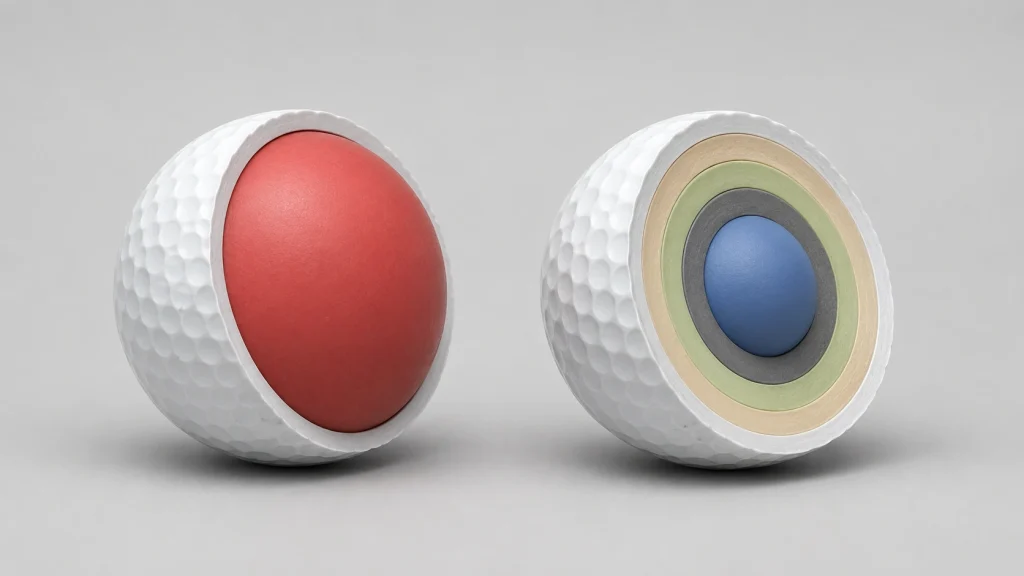
Compression describes the relative firmness of a golf ball and how it deforms under force. A lower number generally represents a softer ball, while a higher number represents a firmer ball.
However, compression is not governed by one universal consumer rating system. A rating from one manufacturer may not be directly comparable with a rating from another.
According to this explanation of golf ball compression from Titleist, compression is a measurement of the ball’s stiffness or softness. It is one design element rather than a complete description of performance.
Does Swing Speed Determine Compression?
Swing speed matters, but it should not be the only factor in your decision. Golfers can compress modern balls across a wide range of swing speeds.
Consider the full result:
- Does the driver launch at a useful height?
- Is the flight stable in normal conditions?
- Can you control approach shots?
- Does the ball feel comfortable with wedges and the putter?
- Are your misses manageable?
A slow-swinging golfer may prefer a soft ball because of feel, but that does not mean every slow swinger needs the lowest-compression model. Likewise, a faster player does not always need the firmest ball available.
Dimples, Lift, and Ball Flight
Dimples help a golf ball travel efficiently through the air. They influence airflow around the ball, allowing it to generate lift and maintain a more stable flight than a smooth ball.
Dimple patterns vary in number, size, depth, and shape. Manufacturers design these patterns to work with the rest of the ball.
Different designs may produce:
- A higher or lower flight
- A flatter or more penetrating trajectory
- Different performance in wind
- Changes in peak height and descent angle
Do not choose a ball based only on dimple count. The complete aerodynamic pattern matters more than one number printed in a product description.
Understanding Spin
Spin changes according to the club, impact conditions, ball construction, and quality of contact.
Long-Game Spin
With a driver, excessive backspin can create a high, weak flight and reduce roll. Too little spin may cause the ball to fall from the air too quickly or become difficult to keep airborne.
The ideal amount depends on clubhead speed, launch angle, strike location, and delivery.
Iron Spin
Iron spin helps the ball stay in the air and stop on the green. Golfers need enough spin for control, but excessive spin can make shots climb too high or lose distance in windy conditions.
Wedge and Greenside Spin
Urethane-covered balls commonly provide more short-game control because the soft cover interacts effectively with wedge grooves.
That extra spin can help with:
- Low chips that stop quickly
- Partial wedge shots
- Pitches over bunkers
- Firm or fast greens
The limitation is that more spin does not repair poor contact. A premium ball cannot compensate for striking the ground first, delivering excessive loft, or using worn wedge grooves.
Expert Tip: Test golf balls from the green backward. Start with putting and short chips, move to wedge and iron shots, and finish with the driver. Most conforming balls provide usable distance, but their short-game feel and control can differ noticeably.
Soft Feel Versus Firm Feel
Feel is the sensation and sound a golfer experiences at impact. It is personal rather than universally good or bad.
A soft ball may feel comfortable with wedges and the putter. A firm ball may provide clearer feedback and a more powerful sensation with longer clubs.
Feel does not prove that one ball travels farther than another. Sound, cover material, compression, club design, and strike location all influence what you experience.
If two balls perform similarly, choose the one that gives you more confidence. Comfort can improve commitment, especially on short putts and delicate shots.
How to Choose the Right Golf Ball
The best golf ball supports your typical game rather than the game you hope to play someday.
1. Consider Your Skill Level
Beginners often benefit from a durable, reasonably priced two-piece or three-piece ball. Losing an expensive premium ball every few holes adds cost without guaranteeing better scores.
Intermediate golfers who strike the ball more consistently may gain useful control from a urethane-covered model.
2. Identify Your Main Need
Choose a starting category based on a real performance need:
- Losing too many balls: Prioritize price and durability.
- Shots feel too firm: Try a softer-feeling model.
- Difficulty stopping chips: Test a urethane-covered ball.
- Driver flight balloons: Compare lower-spinning options through a fitting.
- Approach shots will not hold greens: Look at launch, descent, and iron spin—not just cover type.
3. Set a Realistic Budget
Golf ball prices vary by region and model, but they generally fall into three categories:
- Value balls: Best for beginners, casual rounds, or golfers who lose several balls.
- Mid-priced balls: Often balance durability, feel, and control.
- Premium balls: Designed for refined performance throughout the bag, especially around the green.
Premium construction may provide more control, but it offers poor value if fear of losing the ball changes how you play.
4. Buy a Small Trial Quantity
Buy sleeves of three balls when possible. Compare two or three models on the same course under similar conditions.
Avoid testing six models at once. Too many choices make small differences harder to recognize.
5. Use One Model Consistently
Once you find a suitable ball, use that model for several rounds. Changing balls constantly introduces another variable into distance, trajectory, spin, and putting feel.
Consistency makes it easier to learn how far shots carry and how the ball reacts near the green.
A Simple On-Course Golf Ball Test
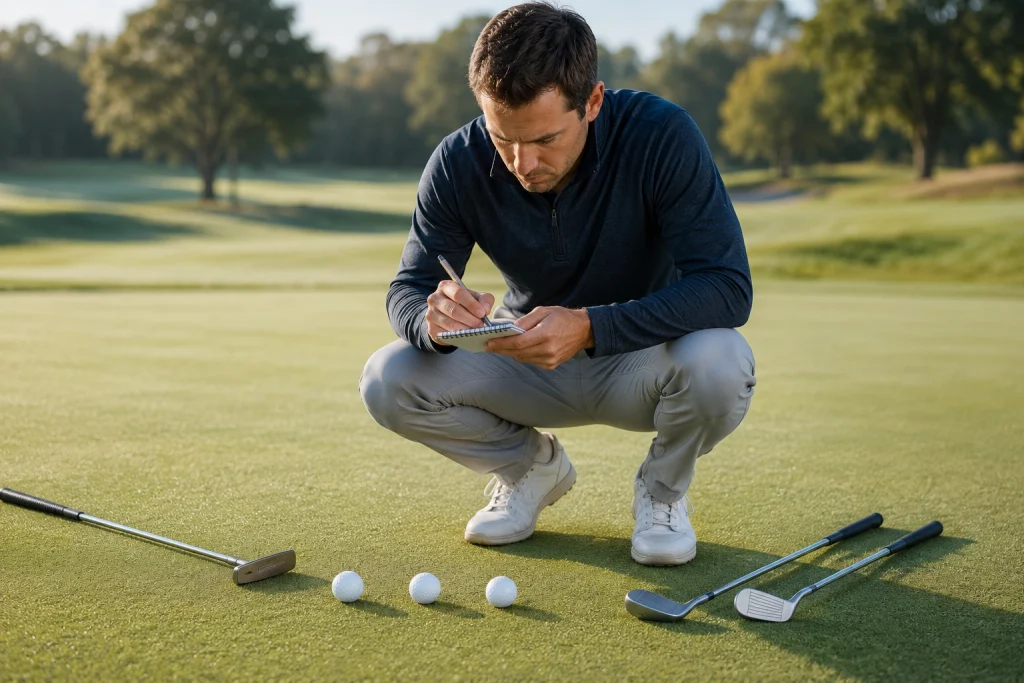
Use this process to compare two models:
- Putt from several distances. Compare sound, feel, and distance control.
- Hit short chips. Observe launch, rollout, and consistency.
- Play partial wedge shots. Check how quickly each ball stops.
- Hit full irons. Compare carry, peak height, and dispersion.
- Finish with the driver. Evaluate launch, curvature, carry, and total distance.
- Repeat on another day. One unusually good swing should not decide the winner.
Use the same clubs and similar lies. If possible, test in calm weather because strong wind can hide normal performance differences.
Durability and When to Replace a Golf Ball
Minor cosmetic marks do not always make a ball unusable. However, deep scuffs, cuts, cracks, or a damaged cover can affect flight and short-game consistency.
Replace a ball when:
- The cover has a visible cut
- Part of the cover is peeling
- The ball is cracked or out of shape
- A deep cart-path mark affects the surface
- Performance becomes noticeably unpredictable
Clean dirt from the dimples before judging the condition. Mud can change ball flight and make a sound ball appear damaged.
Used balls can be economical, but quality varies. Lightly played balls from a reliable source may perform normally. Balls recovered after extended time in water or sold in heavily mixed grades can be less predictable.
Golf Ball Rules and Fair Play
A conforming golf ball must meet specifications for construction, weight, size, symmetry, initial velocity, and overall distance. The USGA golf ball equipment standards state that a ball must weigh no more than 1.620 ounces and measure at least 1.680 inches in diameter.
Most balls sold by established golf brands are intended to conform. For competitions that use the Model Local Rule requiring a listed ball, golfers can check The R&A’s official List of Conforming Golf Balls.
Before starting a round, place a unique identification mark on your ball. This makes it easier to distinguish it from another player’s ball.
Never intentionally alter a ball to change its performance. Cutting the cover, applying a foreign substance for aerodynamic gain, or using a known non-conforming ball may breach competition rules.
Common Mistakes Golfers Should Avoid
- Buying solely by swing speed: Launch, spin, feel, and short-game control also matter.
- Assuming more layers are always better: Construction must match the player’s needs.
- Paying for performance you cannot use: A durable value ball may be better for a beginner who loses several balls per round.
- Changing models during every round: Inconsistent equipment makes distance and rollout harder to learn.
- Testing only with the driver: Important differences often appear around the green.
- Using badly damaged balls: Deep cuts and cracks can produce unpredictable flight.
- Believing a ball will fix a swing fault: Equipment can refine results, but it cannot replace solid contact.
- Playing an unidentified ball: Add a personal mark before teeing off.
When to Get Help From a Golf Pro or Fitter
Consider a professional ball fitting if you cannot tell why your shots launch too high, fall too quickly, curve excessively, or fail to hold greens.
A fitter can measure:
- Ball speed
- Launch angle
- Backspin
- Peak height
- Carry distance
- Descent angle
- Shot dispersion
A PGA professional can also determine whether the problem comes from the ball or your technique. This distinction matters. Buying a lower-spin ball may slightly reduce curvature, but it will not correct a severely open clubface or an out-to-in swing path.
A fitting is most valuable when your contact is reasonably repeatable. New golfers may get more benefit from a lesson first, followed by a simple ball comparison once their strike becomes more consistent.
FAQs
Do expensive golf balls make a big difference?
They can provide more refined short-game spin, feel, and flight control. However, the difference may be small for beginners with inconsistent contact. An affordable, durable ball is often the better starting choice.
What golf ball should a beginner use?
Most beginners should use a reasonably priced two-piece or three-piece ball with good durability and a comfortable feel. Consistency and affordability matter more than tour-level spin.
Are soft golf balls better for slow swing speeds?
Not automatically. Many golfers enjoy their feel, but softness alone does not determine distance. Compare launch, carry, control, and comfort before choosing.
Do golf balls lose performance with age?
Unused balls stored indoors under moderate conditions can remain playable for years. Extreme heat, prolonged moisture exposure, cover damage, and poor storage are more concerning than age alone.
Can the wrong ball cause a slice?
A ball may slightly change spin and curvature, but it does not create the swing conditions behind a major slice. Clubface angle and swing path are usually the primary causes.
Should I use the same golf ball for every round?
Yes, when practical. Using one model consistently helps you learn its carry distances, trajectory, greenside reaction, and putting feel.
Are recycled or lake balls suitable for play?
They may be acceptable for casual rounds or practice, but condition varies. Choose clearly graded balls without cuts, cracks, severe discoloration, or damaged covers when predictable performance matters.
Conclusion
Golf Ball Basics come down to understanding how construction, cover material, compression, aerodynamics, spin, and feel work together. No single model is best for every golfer.
Beginners should prioritize durability, consistency, and sensible cost. Improving players can explore urethane covers and multilayer designs when greater short-game control becomes useful. Skilled players should test complete performance from the green back to the tee.
Choose two or three suitable models, compare them using the same shots, and play several rounds with the winner. A consistent, well-tested golf ball is a smarter investment than the most expensive box on the shelf.