
What Is Par? A Beginner’s Guide to Golf Scoring

Stepping onto a golf course for the very first time can feel overwhelming, especially when players start tossing around unfamiliar scoring terms like birdie, bogey, and par. If you have ever wondered what is par and why it matters to your game, you are not alone. Understanding this foundational scoring concept is the first step toward tracking your progress, building confidence on the course, and enjoying the game to its fullest. Whether you are playing a local municipal track or learning the sport through official guidelines provided by the USGA, knowing how scoring works transforms confusion into clarity.
Quick Answer
Par is the predetermined number of strokes an expert golfer is expected to take to complete a specific hole or an entire round. Most 18-hole golf courses feature a total par of 71 or 72, made up of a combination of short par-3s, medium par-4s, and long par-5s.
What Does Par Mean on a Golf Course?
At its core, par serves as the universal baseline for measuring success on every single golf hole. Golf courses are meticulously designed by architects who assign a specific par value to each hole based primarily on its total length.
When you look at a course scorecard, you will notice that every hole has a designated number, usually 3, 4, or 5. This number represents the yardage challenge ahead of you.
- Par 3 Holes: Typically measure under 250 yards for men and 210 yards for women. These are short holes where your first shot aims to land directly on the putting green.
- Par 4 Holes: Usually measure between 251 and 470 yards. These form the backbone of most golf courses, requiring a tee shot and one or more subsequent approach shots to reach the green.
- Par 5 Holes: Generally measure over 471 yards. These are the longest holes on the course, demanding three solid shots for most recreational players to reach the putting surface.
How Golf Scoring Relates to Par
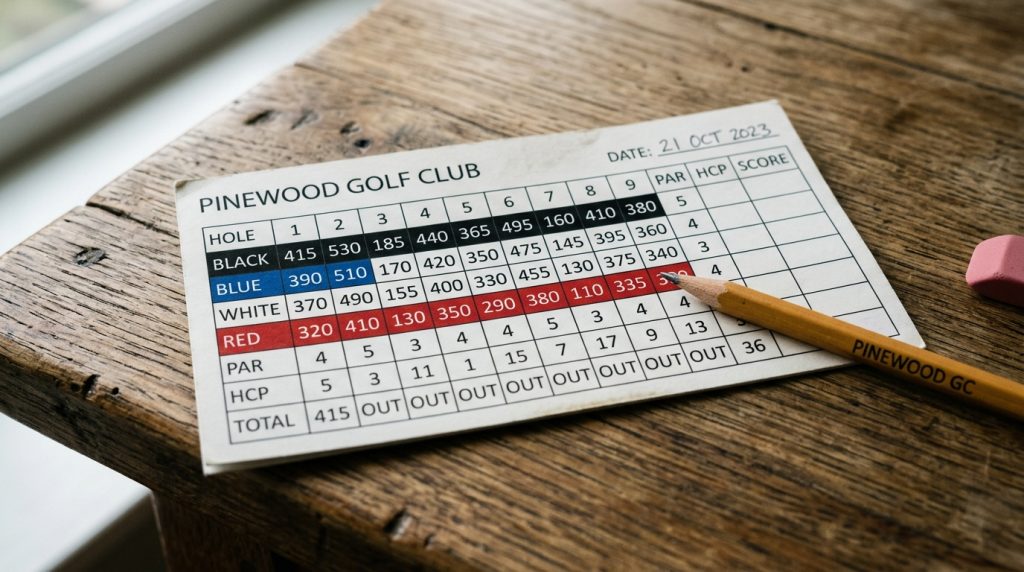
Every time you swing a club, you add a stroke to your tally for that hole. Your goal is to match or beat the designated par score. Golf terminology uses specific names to describe how your total score compares to par on any given hole.
Common Golf Scoring Terms
- Eagle: Two strokes under par (-2). For example, making a 3 on a par-5 hole.
- Birdie: One stroke under par (-1). For example, making a 3 on a par-4 hole.
- Par: Even with the designated score (0). For example, making a 4 on a par-4 hole.
- Bogey: One stroke over par (+1). For example, making a 5 on a par-4 hole.
- Double Bogey: Two strokes over par (+2). For example, making a 6 on a par-4 hole.
Keeping track of these scores helps you evaluate your performance across different aspects of your game. If you consistently score bogeys, you know your target for improvement is shaving off one stroke per hole. For a deeper dive into official guidelines and player classification, you can review resources provided by the USGA handicapping system to understand how your scores translate into an official handicap index.

Course Par vs. Player Skill Level
It is important to remember that par is an idealized standard designed for expert players. For beginners and high-handicap golfers, expecting to make par on every hole can lead to unnecessary frustration.
Instead of chasing professional standards, many modern golf courses utilize forward tees that reduce overall yardage, making par more attainable for developing players, juniors, and seniors. Adjusting your starting tees according to your current swing speed and skill level ensures a much more enjoyable round.
| Hole Type | Average Yardage Range | Expected Shots for Beginner | Expected Shots for Expert |
|---|---|---|---|
| Par 3 | Under 250 yards | 4 to 5 strokes | 3 strokes |
| Par 4 | 251 to 470 yards | 5 to 6 strokes | 4 strokes |
| Par 5 | Over 471 yards | 6 to 8 strokes | 5 strokes |
Expert Tip: Do not let par dictate your mood on the course. As a beginner, celebrate making a bogey or a double bogey as a major victory while you build consistency in your swing.
Common Mistakes Golfers Should Avoid

- Playing from tees that are too far back: Choosing championship tees simply because your friends are playing them will turn every par-4 into an unreachable challenge, ruining your scoring rhythm.
- Chasing distance over accuracy: Trying to swing your driver as hard as possible usually leads to lost balls, penalty strokes, and scores well above par.
- Failing to count penalty strokes: Forgetting to add penalty strokes for lost balls or hitting into penalty areas creates a false sense of your actual score.
- Ignoring course management: Trying to reach a par-5 green in two shots when you lack the distance often results in hazard balls instead of a strategic three-shot approach.
When to Get Help From a Golf Pro or Fitter
If you find that your scores are consistently hovering far above par due to recurring swing flaws or equipment mismatches, it may be time to seek professional guidance.
Working with a certified PGA professional can help identify mechanical swing breakdowns that prevent you from striking the ball cleanly. Similarly, getting a professional club fitting ensures your equipment matches your physical stature and swing speed, making it much easier to control your distance and accuracy on every hole.
FAQs
What is par for an 18-hole golf course?
Most standard 18-hole golf courses have a total par of 71 or 72, though shorter executive courses may feature a total par of 60 to 68.
Can a beginner ever make a par?
Yes! Beginners frequently make par on short par-3 holes or by hitting a great recovery shot after an errant drive on a par-4 or par-5.
What does even par mean?
Even par means your total score for the round matches the course design standard, resulting in a score of zero over or under par.
Is par the same for men and women?
While the par value of a hole is generally the same for all players, women often play from forward tees that shorten the overall yardage of the hole.
What is a net par versus a gross par?
Gross par is your raw score without adjustments, while net par takes your handicap strokes into account to level the playing field.
What happens if I take more than double par on a hole?
For casual or recreational play, many golfers pick up their ball after reaching double par to maintain a steady pace of play on the course.
Conclusion
Mastering the concept of what is par gives you a clear framework for measuring your growth and enjoying every round of golf you play. By understanding course yardages, setting realistic expectations for your current skill level, and managing your game strategically, you will build confidence from the first tee box to the final green. Take what you have learned today, choose the right tees for your game, and focus on making smart, repeatable swings on your next trip out to the links.