
Golf Wedge Explained: Types, Lofts, Bounce, and How to Choose

Wedges can be confusing. Two clubs may look almost identical but produce very different shots because of their loft, bounce, sole shape, or shaft length.
This golf wedge explained guide breaks those details into simple terms. You will learn what wedges do, how the main types differ, which lofts belong in your bag, and how to choose wedges that match your swing and course conditions.
Quick Answer
A golf wedge is a high-lofted club designed for short approach shots, pitches, chips, bunker shots, and recovery shots. The main types are pitching, gap, sand, and lob wedges. Choosing the right wedges depends on loft gaps, sole bounce, course conditions, swing style, and the shots you regularly face.
What Is a Golf Wedge?
A wedge is an iron-style club built for accuracy, height, and control rather than maximum distance. It normally has a shorter shaft and more loft than the other irons in a set.
The extra loft helps launch the ball higher. It also allows the ball to land at a steeper angle, making it easier to stop on or near the green.
Golfers commonly use wedges for:
- Full approach shots
- Controlled three-quarter shots
- Pitch shots
- Chip shots
- Bunker shots
- Flop shots
- Recovery shots from rough
- Low bump-and-run shots
According to the PGA golf glossary, loft is the angle of the clubface. More loft generally creates a higher launch and a shorter shot, although swing speed, contact, ball choice, and playing conditions also affect the result.
The Main Parts of a Golf Wedge
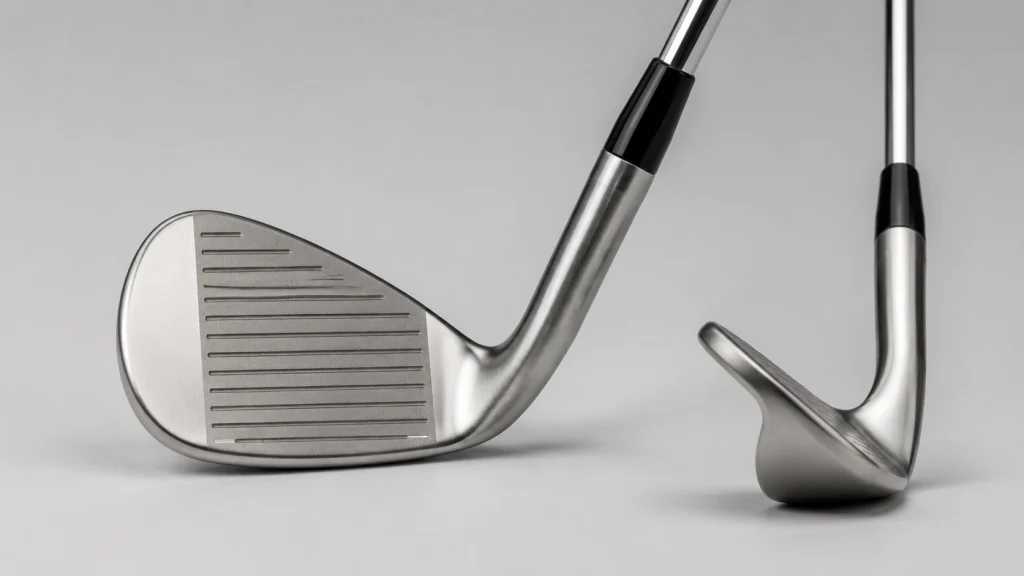
Understanding a few basic design terms makes comparing wedges much easier.
Loft
Loft is the angle between the clubface and a vertical line when the club is in its normal address position.
A wedge with 60 degrees of loft normally launches the ball higher and travels less distance than a wedge with 48 degrees of loft. However, actual distance depends on the golfer and the type of swing.
Bounce
Bounce is the angle created between the leading edge of the club and the lowest point of its sole.
It helps prevent the leading edge from digging too deeply into the ground or sand. A wedge with more bounce generally moves through soft turf and fluffy sand more easily.
As explained in the Titleist guide to wedge bounce, higher-bounce wedges are often suited to soft ground, fluffy lies, and soft bunker sand. Lower bounce may work better from tight lies and firm turf.
Grind
Grind refers to the shaping or removal of material from parts of the sole. Manufacturers shape the heel, toe, or trailing edge to change how the club interacts with the ground.
Some grinds make it easier to open the face. Others provide more stability on square-faced shots.
Grind names are not standardized across brands. Compare the actual design and recommended use instead of assuming that two wedges with the same grind letter will perform alike.
Grooves
Grooves are the horizontal lines cut into the clubface. They help manage moisture, grass, and debris between the face and ball.
Clean, healthy grooves can support predictable launch and spin. They cannot rescue poor contact, however. Strike quality remains the most important factor.
The USGA equipment rules for clubfaces regulate groove dimensions and edge characteristics. Avoid sharpening or altering grooves yourself because doing so may make a club non-conforming.
Leading Edge
The leading edge is the bottom front edge of the clubface. Its height above the ground changes with the wedge’s bounce, grind, face angle, and lie.
A leading edge that sits too high may feel difficult to use from tight turf. One that sits very close to the ground can dig if the golfer delivers the club steeply.


Types of Golf Wedges Explained
The traditional wedge categories are based mainly on loft and intended use. Modern lofts vary, so the number stamped on the club is more useful than its name.
| Wedge type | Common loft range | Typical use | Main consideration |
|---|---|---|---|
| Pitching wedge | 43–48° | Full approaches, low pitches, bump-and-runs | Check its actual loft before buying other wedges |
| Gap wedge | 48–54° | Filling the distance gap between pitching and sand wedges | Match it to your carry-distance gaps |
| Sand wedge | 54–58° | Bunkers, pitches, chips, rough | Choose bounce for your swing and conditions |
| Lob wedge | 58–64° | High, short shots and difficult greenside situations | Requires reliable contact and practice |
These ranges overlap because manufacturers build iron sets differently.
Pitching Wedge
The pitching wedge is usually the lowest-lofted wedge. It is often included with an iron set and may feel more like a short iron than a specialist wedge.
It works well for full swings, controlled approaches, and running chips. Many golfers find it easier to hit than a higher-lofted wedge because it launches lower and requires less precise contact.
Modern iron sets sometimes include strong-lofted pitching wedges around 43 or 44 degrees. This can create a large distance gap before a traditional 52- or 54-degree wedge.
Gap Wedge
A gap wedge fills the space between the pitching wedge and sand wedge. It may also be marked with an “A,” meaning approach wedge.
For example, a golfer with a 44-degree pitching wedge and a 56-degree sand wedge may have too much distance between those clubs. Adding a 48- or 50-degree gap wedge can make partial shots less necessary.
A gap wedge is useful for:
- Full approach shots
- Controlled pitches
- Lower chips
- Longer bunker shots
- Layup shots that leave a preferred distance
Sand Wedge
A sand wedge typically has more loft and bounce than a pitching or gap wedge. Its wider or more rounded sole can help it move through sand without digging excessively.
Despite its name, it is not limited to bunkers. It can also be useful for pitches, chips, rough shots, and full approaches.
A 54- or 56-degree sand wedge is often the most versatile high-lofted option for a beginner.
Lob Wedge
A lob wedge normally has 58 degrees of loft or more. It can produce a high shot that lands softly, but it is less forgiving when contact is inconsistent.
Lob wedges are useful when a golfer must:
- Carry a bunker or steep slope
- Stop the ball quickly
- Play from deep rough
- Hit over an obstacle with little green available
A lob wedge is not automatically the best club for every greenside shot. A lower-lofted chip is often safer when there is open ground between the ball and hole.
How Far Does Each Wedge Go?
There is no universal wedge distance. Two golfers using the same loft may produce very different carry numbers.
Approximate full-swing distances for recreational golfers may look like this:
| Wedge | Example loft | Approximate carry range |
|---|---|---|
| Pitching wedge | 44–48° | 85–125 yards |
| Gap wedge | 48–54° | 70–110 yards |
| Sand wedge | 54–58° | 55–95 yards |
| Lob wedge | 58–64° | 40–80 yards |
These are broad estimates, not targets. Your measured carry distance matters more than a standard chart.
Temperature, wind, elevation, lie, golf ball, strike location, and swing length can all change the result. Use a launch monitor or a marked practice area to record how far each wedge carries with full, three-quarter, and half swings.
How Many Wedges Should You Carry?
Most golfers carry three or four wedges when the pitching wedge is included. A simple setup could be:
- Pitching wedge
- Gap wedge
- Sand wedge
A player who regularly needs higher, softer greenside shots may add a lob wedge.
Remember that the Rules of Golf allow no more than 14 clubs during a stipulated round. Adding another wedge may require removing a long iron, hybrid, fairway wood, or another club.
A Practical Beginner Setup
A beginner can often cover most short-game situations with:
- The pitching wedge supplied with the iron set
- A gap wedge around 50 degrees
- A sand wedge around 54 or 56 degrees
This setup keeps club selection manageable. A lob wedge can be added later if it fills a real performance need.
Loft Gapping
Many golfers aim for approximately four to six degrees of loft between wedges. Possible setups include:
- 44°, 50°, and 56°
- 46°, 50°, 54°, and 58°
- 48°, 52°, and 56°
However, equal loft gaps do not guarantee equal distance gaps. Clubhead design, shaft length, swing weight, and strike quality also matter.
Base the final decision on carry distances, not loft numbers alone.
Expert Tip: Check the loft stamped on your pitching wedge before buying another wedge. Its true loft determines where your wedge setup should begin.
Choosing the Right Bounce
Bounce choice should reflect both the ground and how your club reaches the ball.
Low Bounce
Low-bounce wedges generally have less than about 8 degrees of bounce.
They may suit:
- Firm turf
- Thin or compact bunker sand
- Shallow swings
- Golfers who like opening the clubface
- Tight, closely mown lies
Their limitation is that the leading edge can dig when used with a steep swing on soft ground.
Mid Bounce
Mid-bounce wedges commonly have about 8–10 degrees of bounce.
They offer a balanced option for:
- Mixed course conditions
- Neutral swing styles
- Square-faced shots
- Golfers who want one versatile wedge
Mid bounce is often a sensible starting point when a golfer does not play one extreme type of turf.
High Bounce
High-bounce wedges normally have more than 10 degrees of bounce.
They may suit:
- Soft turf
- Fluffy bunker sand
- Steeper swings
- Golfers who take deep divots
- Players who frequently dig the leading edge
The limitation appears on very firm or bare lies, where a wide, high-bounce sole may sit too far above the ground if the technique and grind are not suitable.
Matching a Wedge to Your Swing and Course

Consider your normal conditions rather than copying a professional player’s setup.
Ask yourself:
- Is the turf usually firm, average, or soft?
- Is the bunker sand compact or fluffy?
- Do I take deep divots or barely disturb the ground?
- Do I play most shots with a square face?
- Do I frequently open the face around the green?
- Which yardages currently force an uncomfortable partial swing?
A golfer who plays soft courses and takes deep divots may benefit from more bounce. A shallow-swinging golfer on firm turf may prefer less bounce.
Some players use different bounce profiles across the set. For example, a higher-bounce sand wedge can handle soft sand while a lower-bounce lob wedge provides options from tight turf. That approach offers versatility but requires enough practice to understand both clubs.
Cavity-Back vs Blade-Style Wedges
Cavity-back wedges place more weight around the outer area of the clubhead. They may provide additional stability and forgiveness when contact misses the center.
Blade-style wedges usually have a compact, traditional shape. Skilled golfers may prefer their appearance, feedback, and range of sole options, but that does not make them automatically better.
| Feature | Cavity-back wedge | Blade-style wedge |
|---|---|---|
| Forgiveness | Usually higher | Usually lower |
| Head shape | Larger and more confidence-inspiring | Compact and traditional |
| Best suited to | Beginners and inconsistent strikers | Consistent players seeking specific sole options |
| Shot versatility | Good, depending on sole design | Often offers more grind choices |
| Feel on mishits | More stable | More noticeable feedback |
Beginners do not need a blade-style wedge to develop a good short game. Reliable contact and suitable loft gaps are more valuable than a tour-style appearance.
Cost, Quality, and Durability
New wedges commonly range from budget models to premium specialist clubs. Price may reflect materials, manufacturing, finish, groove design, grind options, and customization.
A more expensive wedge will not correct poor technique or an unsuitable bounce choice.
When inspecting a new or used wedge, consider:
- Whether the loft fills a real distance gap
- Whether the bounce suits your conditions
- Groove and face condition
- Shaft flex, length, and weight
- Grip condition
- Signs of rust, damage, or unauthorized alteration
- Whether the club conforms to competition rules
Wedge grooves gradually wear through impact and practice. Heavy use from sand can accelerate face wear. Warning signs include inconsistent launch, reduced control in damp conditions, visibly rounded groove edges, and a polished strike area.
Clean the face after shots and dry the club before storage. Use a soft brush or towel instead of a tool that could damage or reshape the grooves.
How to Use a Wedge More Consistently
You do not need a different technique for every loft. Start with a simple, repeatable setup.
- Choose the lowest loft that can safely carry the required obstacle.
- Set the ball near the center for a standard pitch or chip.
- Keep pressure slightly favoring the lead foot.
- Make a controlled turn instead of lifting the club only with your hands.
- Brush the ground at or just after the ball.
- Hold a balanced finish.
For a lower-running shot, use a pitching or gap wedge and a smaller motion. For a higher shot, use more loft only when the situation requires it.
Do not attempt a full-speed flop shot near other players, windows, or equipment until you can control the strike. Thin shots can travel low and fast.
Common Mistakes Golfers Should Avoid
- Buying wedges before checking pitching-wedge loft: This can create duplicate lofts or large gaps.
- Choosing by name alone: One brand’s sand wedge may have a very different loft and sole from another.
- Automatically buying a 60-degree wedge: Higher loft demands more precise contact and may not improve a beginner’s scores.
- Ignoring bounce: The wrong sole can dig or bounce into the ball.
- Copying a tour player’s setup: Professional swing delivery and course conditions may be completely different.
- Using only full swings: Distance control improves when golfers learn several swing lengths.
- Practicing only from perfect lies: Test wedges from rough, slopes, bunkers, and tight turf.
- Trying to create maximum spin: Predictable contact and landing location are more important.
- Sharpening grooves at home: Altered grooves may damage the club or violate equipment rules.
- Replacing a wedge without testing distances: A new model may fly farther or shorter despite carrying the same loft label.
When to Get Help From a Golf Pro or Fitter
A PGA professional can help when technique makes every wedge feel unsuitable. Consider a lesson if you regularly hit shots thin, strike well behind the ball, struggle in bunkers, or cannot control basic carry distance.
A professional fitting is useful when:
- Your wedge distances overlap
- There is a large gap below your pitching wedge
- You play in unusual turf or sand conditions
- Your divots are consistently very deep
- The leading edge often digs or strikes the ball thin
- Standard club length or lie angle feels uncomfortable
- You are unsure which bounce and grind suit your delivery
A good fitting should include real shots from grass, rough, and sand when possible. Hitting only from a mat may hide how the sole interacts with the ground.
FAQs
What is a wedge used for in golf?
A wedge is used for short approach shots, chips, pitches, bunker shots, and recovery shots. Its high loft helps the ball launch upward and land more steeply.
Which wedge should a beginner use?
A beginner can usually start with a pitching wedge, gap wedge, and 54- or 56-degree sand wedge. This combination covers most approach and greenside situations without making club selection too complicated.
Do I need a 60-degree wedge?
Not necessarily. A 60-degree wedge can help with high, short shots, but it requires consistent contact. Many golfers can handle the same situations more reliably with a 56- or 58-degree wedge.
What degree wedge is best for chipping?
There is no single best loft. Use a pitching or gap wedge when you have room for the ball to roll. Use a sand or lob wedge when you must carry an obstacle or stop the ball sooner.
What does 56-12 mean on a wedge?
The first number normally shows loft, while the second shows bounce. A wedge marked 56-12 usually has 56 degrees of loft and 12 degrees of bounce.
How often should golf wedges be replaced?
There is no fixed schedule. Replacement depends on practice volume, bunker use, face condition, and performance. Inspect the strike area and compare launch and control when you notice less predictable results.
Is more bounce better for beginners?
More bounce can provide useful protection against digging, especially on soft ground or with a steep swing. However, excessive bounce may be difficult from firm, bare lies. A mid- or moderately high-bounce sand wedge is often a practical starting point.
Conclusion
A wedge is more than a high-lofted iron. Loft controls the basic launch window, while bounce and grind influence how the sole moves through turf and sand. The best setup provides useful carry-distance gaps and matches the shots you actually play.
Use this golf wedge explained guide to check your current lofts, identify missing distances, and consider your normal course conditions. Start with a simple setup, measure your real carry numbers, and practice several swing lengths with each club.
Before buying, test your preferred wedges from grass and sand or schedule a fitting with a qualified golf professional. The right choice should make your short game simpler, more predictable, and easier to trust.