
Types of Golf Courses: A Practical Guide for Every Golfer

Choosing a golf course can feel confusing when you are new to the game. One course may be wide open and beginner-friendly, while another may have tight fairways, deep bunkers, strong wind, or fast greens. Understanding the types of golf courses helps you pick the right place to play, choose smarter equipment, manage expectations, and enjoy your round more.
Not every golf course is built for the same kind of golfer. Some reward distance. Some reward accuracy. Some are best for short-game practice. Others are designed for tournaments, travel experiences, or relaxed weekend play.
In this guide, you will learn the main types of golf courses, how they differ, which ones suit different skill levels, and what to watch for before booking a tee time.
Quick Answer
The main types of golf courses include links, parkland, heathland, desert, mountain, resort, municipal, private, executive, par-3, and championship courses. Each type differs in terrain, difficulty, cost, layout, scenery, and playing style. Beginners usually do best on shorter public, municipal, par-3, or executive courses.
Why Golf Course Type Matters
Golf course type affects almost every part of your round.
It can change:
- How far the course plays
- How hard it is to keep the ball in play
- What clubs you use most often
- How much the round costs
- How fast or slow the pace of play feels
- How much walking or cart riding is needed
- Whether the course suits beginners, seniors, juniors, or low-handicap players
A 6,200-yard parkland course with wide fairways may feel much easier than a windy 5,800-yard links course with firm turf and deep bunkers. Yardage alone does not tell the full story.
The USGA explains that Course Rating and Slope Rating are used to evaluate how difficult a course plays for scratch and bogey golfers. That means two courses with similar yardage can feel very different based on hazards, green size, fairway width, elevation, and other design features.
Key idea: The right golf course is not always the longest, most famous, or most expensive course. It is the one that matches your skill level, goals, budget, and comfort.
Main Types of Golf Courses
Golf courses are often grouped by land style, design purpose, access, and playing format. Below are the most common types golfers should know.


1. Links Golf Courses
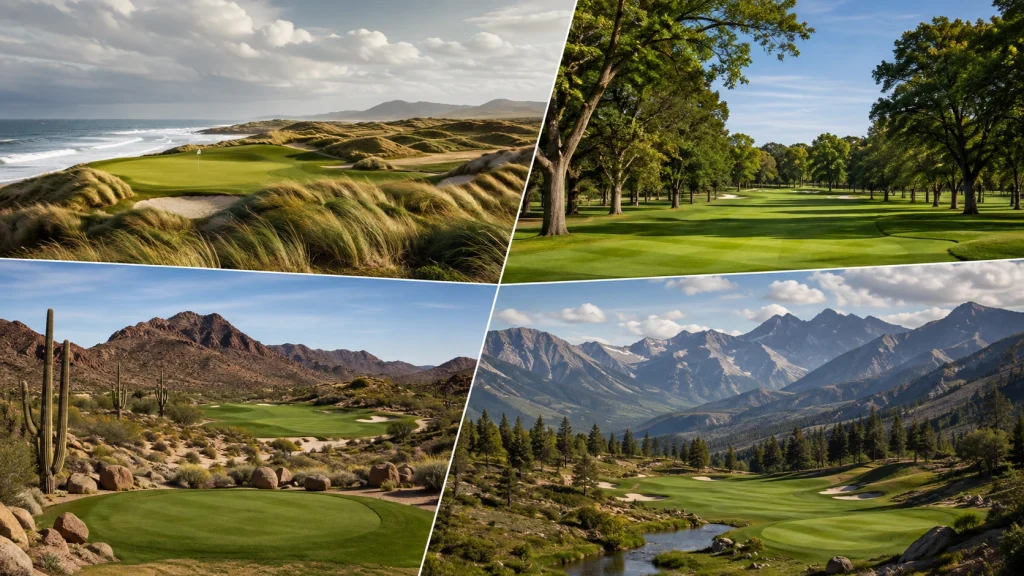
Links courses are among the oldest and most traditional golf course styles. They are usually built on sandy coastal land, often near the ocean.
What Makes a Links Course Different?
Links courses usually have:
- Firm, fast-running fairways
- Natural dunes and uneven lies
- Deep pot bunkers
- Few trees
- Strong wind
- Large, rolling greens
- A ground-game style of play
On a links course, the ball may roll a long way after landing. Golfers often use low shots, bump-and-run chips, and creative approach shots.
Best For
Links courses are great for golfers who enjoy strategy, shot-making, and natural conditions. They are also fun for players who want a classic golf experience.
Beginner Considerations
Links golf can be challenging for beginners because wind and firm ground make distance control harder. However, some links-style courses are playable if the fairways are wide and the rough is not too punishing.
Beginner warning: Do not aim only at the flag on a links course. Sometimes the smarter shot is to land the ball short and let it roll onto the green.
2. Parkland Golf Courses
Parkland courses are common in the United States. They are usually built inland and feature green fairways, trees, water hazards, and manicured landscaping.
What Makes a Parkland Course Different?
Parkland courses often include:
- Tree-lined fairways
- Softer turf
- More target-style shots
- Defined rough
- Water hazards
- Bunkers around greens
- A polished, maintained appearance
Unlike links golf, parkland golf often asks players to carry the ball through the air and stop it on softer greens.
Best For
Parkland courses suit a wide range of golfers. Beginners often enjoy them if the fairways are not too narrow. Intermediate golfers can work on accuracy, approach shots, and course management.
Limitations
Tree-lined holes can be tough for slicers and golfers who struggle with direction. Water hazards can also increase lost balls and frustration.
Smart choice: If you are still learning, look for a parkland course with multiple tee boxes, moderate rough, and generous landing areas.
3. Heathland Golf Courses
Heathland courses are often built on sandy, open land with heather, gorse, natural grasses, and rolling terrain. They can feel like a mix between links and parkland golf.
What Makes a Heathland Course Different?
Heathland courses may have:
- Firm turf
- Natural-looking bunkers
- Heather or scrubland hazards
- Fewer trees than parkland courses
- More elevation changes than many links courses
- A strategic layout
These courses reward thoughtful play. Missing the fairway into heather can make recovery shots difficult.
Best For
Heathland courses are excellent for golfers who like natural beauty and strategy without always dealing with extreme coastal wind.
Beginner Considerations
Beginners should pay attention to rough and hazard placement. A heathland course may look open, but the trouble areas can be very penal.
4. Desert Golf Courses
Desert golf courses are common in dry, warm regions. They are often visually dramatic, with green fairways surrounded by sand, rock, cactus, and native desert areas.
What Makes a Desert Course Different?
Desert courses usually feature:
- Bright green fairways against desert terrain
- Forced carries over waste areas
- Target-style fairways
- Firm playing conditions
- Hot weather
- Limited rough but severe misses
A good shot often needs to land in a specific area. If you miss badly, the ball may be lost in rocks, sand, or desert plants.
Best For
Desert courses are great for golfers who enjoy scenic layouts and precise target golf. They can also be enjoyable for vacation golf.
Beginner Considerations
Beginners may lose more balls on desert courses because off-line shots can be hard to find.
Safety warning: Never reach into cactus, rocks, bushes, or desert areas without checking carefully. Wildlife, sharp plants, and unstable footing can be real hazards.
5. Mountain Golf Courses
Mountain courses are built in hilly or elevated areas. They often include dramatic views, sloped fairways, elevated tees, and downhill or uphill shots.
What Makes a Mountain Course Different?
Mountain courses commonly have:
- Big elevation changes
- Uneven lies
- Sloped fairways
- Scenic tee shots
- Longer walks between holes
- Club-distance adjustments because of elevation
A downhill par 3 may play much shorter than the scorecard yardage. An uphill approach may require more club.
Best For
Mountain courses are ideal for golfers who enjoy scenery and variety. They can make every hole feel different.
Limitations
Walking can be tiring. Uneven lies can challenge beginners. Pace of play may slow down because golfers spend more time judging distances.
Performance tip: On mountain courses, pay extra attention to slope, wind, and elevation. A rangefinder with slope mode can help during casual rounds, but check local rules before using slope features in competition.
6. Resort Golf Courses
Resort courses are designed as part of a golf vacation or hospitality experience. They often focus on scenery, conditioning, service, and memorable holes.
What Makes a Resort Course Different?
Resort courses may include:
- Beautiful landscaping
- Wide tee options
- Good practice facilities
- High-quality maintenance
- Cart service and amenities
- Scenic signature holes
- Higher green fees
Many resort courses are built to be enjoyable for a broad range of players. However, some championship resort courses can be very difficult from the back tees.
Best For
Resort courses are great for vacations, buddy trips, couples golf, corporate outings, and special rounds.
Cost Considerations
Resort golf usually costs more than municipal or daily-fee golf. You may pay for premium conditioning, service, views, and location.
Before booking, check:
- Green fee
- Cart fee
- Rental club cost
- Replay rate
- Dress code
- Cancellation policy
- Practice range access
Best value tip: Play the correct tees. Paying for a premium course and then playing from tees that are too long can make the round less enjoyable.
7. Municipal Golf Courses
Municipal courses are owned or operated by a city, county, or public authority. They are usually built to make golf more accessible.
What Makes a Municipal Course Different?
Municipal courses often offer:
- Lower green fees
- Public access
- Casual atmosphere
- League play
- Junior programs
- Beginner-friendly tee times
- A mix of course conditions
Some municipal courses are simple and affordable. Others are historic, well-designed, and very popular.
Best For
Municipal courses are excellent for beginners, budget-conscious golfers, walkers, seniors, juniors, and regular practice rounds.
Limitations
Conditioning may vary depending on funding, traffic, weather, and maintenance budget. Pace of play can also be slower during busy weekend times.
Beginner-friendly choice: A municipal course is often one of the best places to learn golf without feeling pressured.
8. Public and Daily-Fee Golf Courses
A public course is open to anyone who pays the green fee. A daily-fee course is privately owned but open to public play.
What Makes Them Different?
Public and daily-fee courses can range from affordable local layouts to high-end destination courses.
They may offer:
- Online tee times
- Cart rentals
- Practice areas
- Lessons
- Club rentals
- Membership passes
- Different tee boxes for skill levels
Best For
These courses suit most recreational golfers. They are convenient, flexible, and often easier to book than private clubs.
Quality Considerations
Quality depends on the course’s budget, maintenance staff, design, traffic, and weather. A higher green fee does not always mean a better experience.
Look for recent golfer reviews, course photos, and tee-time availability before booking.
9. Private Golf Courses
Private courses are usually part of a country club or golf club. Access is limited to members and their guests.
What Makes a Private Course Different?
Private clubs often provide:
- Better pace of play
- Strong course conditioning
- Member events
- Practice facilities
- Club storage
- Dining and locker rooms
- Professional staff
- More consistent service
The course may be less crowded than a public layout, which can make rounds faster and more relaxed.
Best For
Private courses are best for golfers who play often, value community, and want consistent course access.
Cost Considerations
Private golf can be expensive. Costs may include initiation fees, monthly dues, food minimums, cart fees, locker fees, tournament fees, and guest fees.
Decision point: Private golf may be worth it if you play frequently enough to use the course, practice facilities, and club benefits.
10. Semi-Private Golf Courses
Semi-private courses offer memberships but also allow public play at certain times.
What Makes a Semi-Private Course Different?
They combine features of private and public golf:
- Members may get preferred tee times
- Public golfers can still book rounds
- Conditions may be better than some public courses
- Prices are usually lower than fully private clubs
- Course access is more flexible
Best For
Semi-private courses are a good middle ground for golfers who want a club feel without full private-club cost.
11. Executive Golf Courses
Executive courses are shorter than standard 18-hole courses. They usually have more par-3s and shorter par-4s.
What Makes an Executive Course Different?
Executive courses often include:
- Shorter total yardage
- Faster rounds
- Fewer long holes
- Less walking distance
- More short irons and wedges
- Lower cost than full-length courses
They are useful for learning, practicing, and playing when time is limited.
Best For
Executive courses are excellent for beginners, juniors, seniors, high-handicap golfers, and anyone working on scoring shots.
Limitations
Long hitters may not use every club in the bag. If your goal is to practice driver and long irons, a full-length course may be better.
12. Par-3 Golf Courses
Par-3 courses are made mostly or entirely of par-3 holes. They are shorter and focus on approach shots, wedges, putting, and short-game control.
What Makes a Par-3 Course Different?
Par-3 courses usually offer:
- Short holes
- Lower cost
- Faster play
- Less pressure for beginners
- Great short-game practice
- Good family-friendly golf
Some par-3 courses are very casual. Others are beautifully designed and challenging.
Best For
Par-3 courses are perfect for beginners, kids, seniors, couples, and golfers who want to improve wedge play.
According to the PGA of America, PGA Professionals help golfers navigate the game at every level, from beginners to advanced players. A par-3 course can be a great place to apply a lesson because the shorter holes reduce pressure and let you focus on contact, aim, and distance control.
Beginner benefit: You can learn golf without needing to hit 250-yard drives.
13. Championship Golf Courses
Championship courses are designed or set up to host serious competitions. They are often longer, tougher, and more demanding.
What Makes a Championship Course Different?
Championship courses may include:
- Longer yardage
- Faster greens
- Deep bunkers
- Narrower landing areas
- Difficult rough
- Strategic water hazards
- Tournament-level tee positions
- Stronger course conditioning
These courses can be rewarding, but they can also punish mistakes.
Best For
Championship courses are best for confident intermediate players, low-handicap golfers, competitive players, and golfers who enjoy a challenge.
Beginner Considerations
Beginners can still play some championship courses from forward tees, but they should avoid playing too far back.
Important warning: Do not choose the back tees just because they look impressive. Playing the wrong tees can slow down the group behind you and make the round frustrating.
14. Stadium Golf Courses
Stadium courses are built with spectators in mind. They often have mounds, viewing areas, dramatic finishing holes, and tournament-friendly layouts.
What Makes a Stadium Course Different?
Stadium courses may have:
- Large viewing areas
- Risk-reward holes
- Water near closing holes
- Dramatic green complexes
- Strong visual design
- Tournament-style pressure points
They are exciting to play, especially if you enjoy seeing how tournament architecture affects strategy.
Best For
Stadium courses suit golfers who like challenge, drama, and a tour-style feel.
Limitations
They may be expensive, busy, and difficult for high-handicap players if played from the wrong tees.
Golf Course Types Compared
| Course Type | Best For | Typical Difficulty | Cost Level | Main Watch-Out |
|---|---|---|---|---|
| Links | Strategic golfers, wind players | Medium to hard | Medium to high | Wind, firm turf, deep bunkers |
| Parkland | Most recreational golfers | Easy to hard | Low to high | Trees, water, rough |
| Heathland | Strategy-focused golfers | Medium to hard | Medium to high | Heather, uneven lies |
| Desert | Accurate players, vacation golf | Medium to hard | Medium to high | Lost balls, forced carries |
| Mountain | Scenic golf, shot variety | Medium | Medium to high | Elevation, uneven stances |
| Resort | Travel and special rounds | Easy to hard | High | Premium pricing |
| Municipal | Beginners and budget golfers | Easy to medium | Low | Busy tee sheets |
| Private | Frequent golfers, club members | Medium to hard | High | Membership costs |
| Executive | Beginners, seniors, short rounds | Easy to medium | Low to medium | Less driver practice |
| Par-3 | Short game, juniors, new golfers | Easy to medium | Low | Limited full-swing variety |
| Championship | Skilled and competitive golfers | Hard | Medium to high | Long yardage and tough setup |
How to Choose the Right Type of Golf Course
The best course for you depends on your skill, goals, budget, and comfort level.
1. Match the Course to Your Skill Level
If you are a beginner, start with courses that reduce pressure.
Good beginner choices include:
- Par-3 courses
- Executive courses
- Municipal courses
- Short public courses
- Parkland courses with wide fairways
Avoid very long, narrow, or heavily bunkered courses until you can keep the ball in play more often.
2. Choose the Right Tees
Tee selection matters more than many golfers realize.
A course can feel fair from one tee box and overwhelming from another. If you are hitting long irons or fairway woods into most par 4s, you may be playing too far back.
A simple tee guide:
- New golfers: choose forward tees
- High handicappers: choose tees that let you reach greens in regulation with realistic shots
- Average hitters: choose tees based on driving distance, not ego
- Strong players: move back only when pace and scoring stay reasonable
Fair-play warning: Playing tees that are too long can slow down the course and make the round less fun for everyone.
3. Think About Your Main Goal
Different courses help with different parts of your game.
Choose:
- A par-3 course to improve wedges and putting
- An executive course to build confidence
- A parkland course to practice accuracy
- A links-style course to learn creativity
- A championship course to test your full game
- A resort course for a memorable golf trip
If you want to lower scores, do not only chase hard courses. Mix challenge rounds with confidence-building rounds.
4. Check Cost Before You Book
Golf course cost can vary a lot.
Common cost factors include:
- Green fee
- Cart fee
- Range balls
- Club rental
- Caddie fee
- Resort surcharge
- Peak-time pricing
- Twilight discounts
- Membership or guest fees
Municipal, executive, and par-3 courses usually offer the best value. Resort and private courses usually cost more but may provide better service, conditions, and amenities.
5. Consider Course Conditions and Durability
Course quality is not only about beauty. It is also about how well the course handles traffic, weather, and maintenance.
Look for:
- Healthy greens
- Safe cart paths
- Clear tee markers
- Bunkers with enough sand
- Fairways without major bare patches
- Good drainage after rain
- Reasonable rough height
Your own gear matters too. Firm links turf may wear softer golf balls faster. Desert courses can scuff balls on rocks. Wet parkland courses may require shoes with better traction.
Equipment note: On firm, windy, or sandy courses, bring extra balls, a reliable glove, and shoes with stable grip.
Course Type and Playing Style
Different courses ask for different golf skills.
Links Courses Reward Low Shots
On links-style ground, a high ball can get punished by wind. A lower shot may be easier to control.
Useful shots include:
- Punch shots
- Bump-and-run chips
- Low tee shots
- Putts from off the green
- Running approach shots
Parkland Courses Reward Accuracy
Tree-lined holes often require a straighter tee shot. If you slice or hook the ball often, use a club that keeps you in play.
Sometimes a 5-wood or hybrid from the tee is smarter than driver.
Desert Courses Reward Target Golf
On a desert course, missing the fairway by a little can be fine, but missing by a lot can mean a lost ball.
Aim for safe landing zones, not just maximum distance.
Mountain Courses Reward Distance Control
Elevation changes affect yardage. Downhill shots can fly farther. Uphill shots can play longer.
Take one extra moment before each shot to check slope, wind, and lie.
Expert Tip
Expert Tip:
Before booking a new course, look at the scorecard and check three things: total yardage from the tees you plan to play, Course Rating, and Slope Rating. If all three look demanding for your current game, choose a shorter tee or a more forgiving course.
Course Access Types: Public, Private, and Semi-Private
Golf course “type” is not only about land. It is also about who can play.
Public Courses
Public courses are open to everyone. They are usually the easiest to book and often the best starting point for new golfers.
Private Courses
Private courses are mainly for members and guests. They may offer better pace, service, and conditions, but they come with higher costs.
Semi-Private Courses
Semi-private courses allow both members and public players. They are useful if you want a club-like setting without full private membership.
When playing any course, follow basic etiquette and local rules. The USGA Rules of Golf are built around fair play, pace, and respect for the course. Even casual golfers should understand simple rules like playing the ball as it lies, repairing ball marks, raking bunkers, and keeping up with the group ahead.
Best Types of Golf Courses for Beginners
Beginners should focus on courses that build confidence.
The best beginner-friendly options are:
- Par-3 courses
Great for learning short shots, putting, and basic etiquette. - Executive courses
Shorter than full courses but still offer variety. - Municipal courses
Affordable, accessible, and usually relaxed. - Short public parkland courses
Good for learning tee shots, approach shots, and course flow. - Beginner-friendly resort courses
Good for vacation rounds if they have forward tees and wide fairways.
Beginners should avoid starting on very long championship courses, especially during busy weekend times. That can create pressure and frustration.
Best Types of Golf Courses for Intermediate Golfers

Intermediate golfers can benefit from more variety.
Good choices include:
- Parkland courses for accuracy
- Links-style courses for creativity
- Heathland courses for strategy
- Mountain courses for uneven lies
- Moderate championship courses for pressure practice
At this stage, you should start learning how different course designs affect decision-making. The goal is not only to hit better shots. It is to choose smarter targets.
Performance advice: If your score gets worse on harder courses, track where you lose strokes. It may be tee shots, approach distance, bunker play, three-putts, or penalty strokes.
How Course Type Affects Equipment Choices
You do not need a completely different bag for every course, but course type can influence smart equipment choices.
Links Courses
Helpful gear:
- Lower-lofted fairway wood or hybrid
- Wedges with bounce that works on firm turf
- Wind-resistant golf ball
- Stable shoes for uneven ground
Parkland Courses
Helpful gear:
- Driver or fairway wood you trust
- Mid-irons and hybrids for approach shots
- Wedges for soft greens
- Golf balls with good stopping power
Desert Courses
Helpful gear:
- Extra golf balls
- Durable ball cover
- Hat and sun protection
- Plenty of water
- Rangefinder or GPS
Mountain Courses
Helpful gear:
- Comfortable shoes
- Distance-measuring device
- Layers for changing weather
- Clubs you can control from uneven lies
Important warning: Do not buy new clubs only because one course felt hard. A lesson or fitting may solve the problem better than a new driver.
When to Get Help From a Golf Pro or Fitter
A golf pro or club fitter can help when course difficulty exposes a repeated problem.
Get help if:
- You lose many balls off the tee
- You cannot get out of bunkers consistently
- You always come up short on approach shots
- You struggle badly on uneven lies
- You do not know which tees to play
- Your clubs feel too long, too heavy, or too stiff
- Your driver works on the range but not on the course
- You are unsure which wedges suit firm or soft turf
A PGA Professional can help with swing basics, course management, and practice plans. A fitter can help with shaft flex, club length, lie angle, wedge bounce, and set makeup.
Honest advice: If your main problem is contact or direction, take a lesson before buying expensive new equipment. If your swing is fairly repeatable but your clubs feel mismatched, a fitting may be the smarter next step.
Common Mistakes Golfers Should Avoid
- Choosing a course that is too hard too soon. A brutal layout can slow learning and reduce confidence.
- Playing from the wrong tees. Distance should match your current ability, not your pride.
- Judging a course only by yardage. Wind, slope, hazards, rough, and green speed matter too.
- Ignoring Course Rating and Slope Rating. These numbers help show how difficult the course really plays.
- Using driver on every par 4 or par 5. On tight holes, a hybrid or fairway wood may be smarter.
- Not bringing enough golf balls. Desert, links, and heavily wooded courses can punish misses.
- Skipping warm-up before a difficult course. Tough layouts expose poor tempo quickly.
- Not reading local rules. Some courses have protected areas, cart-path rules, drop zones, or environmental hazards.
- Expecting resort conditions at municipal prices. Cost often reflects maintenance, staffing, location, and amenities.
- Forgetting pace of play. Be ready when it is your turn, pick up when needed in casual rounds, and keep moving.
FAQs
What are the main types of golf courses?
The main types of golf courses include links, parkland, heathland, desert, mountain, resort, municipal, private, semi-private, executive, par-3, championship, and stadium courses. Each type has a different layout, cost, difficulty, and playing style.
What type of golf course is best for beginners?
Par-3, executive, municipal, and shorter public courses are usually best for beginners. They are more affordable, less intimidating, and easier to finish without feeling rushed or overwhelmed.
What is the difference between a links course and a parkland course?
A links course is usually coastal, firm, windy, and open with few trees. A parkland course is usually inland, greener, softer, and tree-lined. Links golf often rewards low, running shots, while parkland golf rewards accurate aerial shots.
Are private golf courses better than public courses?
Not always. Private courses often have better pace, service, and conditioning, but many public and municipal courses are excellent. The best choice depends on your budget, playing frequency, skill level, and preferred atmosphere.
Why are championship courses harder?
Championship courses are often longer and have tougher hazards, faster greens, deeper bunkers, and narrower landing areas. They are designed to challenge skilled players, especially from the back tees.
Should beginners play championship golf courses?
Beginners can play some championship courses if they use forward tees and keep pace. However, most beginners will learn faster and enjoy the game more on shorter, more forgiving courses first.
How do I know if a course is too difficult for me?
A course may be too difficult if you lose many balls, cannot reach fairways from forced carries, take very long on each hole, or feel pressured all round. Check yardage, Course Rating, Slope Rating, and tee options before booking.
Conclusion
Understanding the types of golf courses helps you make smarter choices before you play. Links courses reward creativity. Parkland courses test accuracy. Desert courses demand target golf. Mountain courses challenge distance control. Par-3 and executive courses help beginners build confidence. Championship courses test advanced skills.
The best course is not always the hardest or most expensive one. It is the course that fits your current game, budget, time, and goals.
Before your next round, check the course style, tee options, rating, slope, price, and pace expectations. Choose a layout that helps you enjoy the game, learn something useful, and make better decisions from the first tee to the final green.