
History of Golf: From Scotland’s Coastal Links to the Modern Game

Golf may look simple: use a club to move a ball into a hole in as few strokes as possible. Yet behind that simple goal is a long history shaped by Scottish landscapes, handmade equipment, changing rules, famous championships, and generations of players.
Understanding the history of golf helps modern golfers appreciate why courses have 18 holes, why players follow strict etiquette, and how equipment developed from wooden clubs and leather balls into adjustable drivers and multilayer golf balls. This guide follows golf from its uncertain early origins to the global sport played today.
Quick Answer
The history of golf is most closely connected to Scotland, where the modern game developed on coastal linksland during the Middle Ages. Golf was recorded in Scotland in 1457, received its first written rules in 1744, adopted the 18-hole format through St Andrews, and later expanded worldwide through organized clubs, championships, and improved equipment.
Where Did Golf Begin?
Golf does not have one clearly documented inventor. Games involving sticks and balls existed in several cultures long before modern golf appeared.
Historical examples include:
- Dutch games in which players struck balls toward targets
- French and Belgian stick-and-ball activities
- Ancient Roman games sometimes compared with golf
- Scottish games played across open coastal ground
These earlier activities may have influenced golf, but they were not necessarily the same game golfers play today.
The strongest historical evidence connects modern golf to Scotland. Scottish players developed the central idea of striking a ball across natural terrain and completing a series of holes using the fewest strokes.
The word “golf” is also connected linguistically to the Dutch words kolf or kolve, meaning a club. The USGA’s golf history research explains that the term later appeared in Scottish forms such as goff and gouff before becoming “golf.” (USGA)
The 1457 Golf Ban
One of the earliest clear written references to golf appeared in Scotland in 1457. King James II prohibited the game because it was distracting men from archery practice, which was important for national defense.
The ban tells us something important: golf was already popular enough to concern the government. It was not simply an occasional activity played by a small group.
Later Scottish rulers issued similar restrictions, but the game continued to grow. By the 1500s and 1600s, golf was being played by members of the royal court as well as ordinary citizens.
(USGA)
Why Scotland Was Ideal for Golf

The Scottish coast contained areas known as linksland. These were stretches of sandy, uneven ground between farmland and the sea.
Linksland was poorly suited to growing crops, but it was excellent for golf because it offered:
- Firm turf that allowed the ball to roll
- Natural sand dunes and bunkers
- Open areas connecting villages and coastal communities
- Strong winds that changed playing conditions
- Small patches of closely cropped grass suitable for putting
Early golfers did not need bulldozers, irrigation systems, or professionally designed greens. They played over the landscape as they found it.
This explains several characteristics of traditional links golf today. Players often keep the ball low, use the ground to shape shots, and accept unpredictable bounces as part of the challenge.

The First Written Rules of Golf
As golf clubs and organized competitions developed, players needed agreed rules. Without common rules, disputes could arise over hazards, lost balls, teeing areas, or interference from other players.
In 1744, the Gentlemen Golfers of Leith prepared the earliest known written golf rules for a competition in Scotland. These regulations became known as the 13 Articles.
The early rules covered familiar situations, including:
- Teeing the ball
- Playing the ball as it lies
- Removing loose objects
- Handling balls struck into water
- Dealing with lost balls
- Avoiding interference with another player’s ball
Although modern rules are much more detailed, their basic purpose remains unchanged: protect fairness while preserving the challenge of the course.
The USGA’s history of the Rules of Golf explains how the original 13 Articles created a foundation for the regulations used today. (USGA)
St Andrews and the Rise of the 18-Hole Round
Early golf courses did not all contain 18 holes. Some had five, seven, 12, 22, or another number determined by the available land.
The Old Course at St Andrews originally had 22 holes. Golfers played 11 holes outward and then returned over the same ground. In 1764, several shorter holes were combined, producing a round of 18 holes.
Other clubs gradually followed the St Andrews model. As the course gained status and golf became more organized, 18 holes became the preferred standard.
The change was not based on the amount of whisky in a bottle, despite a popular story repeated by some golfers. The standard developed through course design, tradition, and the growing influence of St Andrews. Historical research from The R&A shows that courses continued to use different numbers of holes before 18 became widely accepted during the late 1800s. (R&A Publications)
The Formation of Golf Clubs and Governing Bodies
Golf moved from informal local play toward organized competition during the 1700s and 1800s.
The Royal and Ancient Golf Club
The Society of St Andrews Golfers was formed in 1754. It later became the Royal and Ancient Golf Club of St Andrews.
Its influence grew because St Andrews was widely respected, and clubs in other locations began following its rules and traditions. The organization eventually became one of golf’s most important governing authorities.
According to The R&A’s official heritage history, the Royal and Ancient Golf Club was founded on May 14, 1754. The modern R&A organization now helps govern the game, develop golf internationally, establish equipment standards, and organize major championships. (Randa)
The United States Golf Association
Golf expanded rapidly in the United States during the late 1800s. However, different clubs sometimes claimed to have conducted the national championship.
To create consistent national governance, representatives from five clubs formed the United States Golf Association in December 1894:
- Newport Golf Club
- St. Andrew’s Golf Club
- The Country Club
- Shinnecock Hills Golf Club
- Chicago Golf Club
The USGA organized the U.S. Amateur, U.S. Open, and U.S. Women’s Amateur in 1895. The inclusion of a national women’s championship during the organization’s first full year was an important development in American competitive golf.
The Beginning of Major Championship Golf
Organized championships helped transform golf from a local recreation into an international sport.
The first Open Championship was played at Prestwick Golf Club in Scotland on October 17, 1860. Eight professional golfers completed three rounds of the 12-hole course.
Willie Park Sr. defeated Old Tom Morris by two strokes to become the first Champion Golfer.
The official account of the first Open Championship at Prestwick records Park’s winning score of 174 and explains that the competitors played for a leather Challenge Belt rather than prize money. (The Open)
Other major championships followed:
| Championship | First Played | Historical Importance |
|---|---|---|
| The Open Championship | 1860 | Golf’s oldest major championship |
| U.S. Open | 1895 | Established a national open championship in the United States |
| PGA Championship | 1916 | Created a major championship for professional golfers |
| Masters Tournament | 1934 | Introduced an annual invitational championship at Augusta National |
| U.S. Women’s Open | 1946 | Became a leading championship in women’s professional golf |
These events helped create professional careers, recognizable champions, and international interest in competitive golf.
How Golf Equipment Evolved
Equipment development changed how far, high, and accurately golfers could hit the ball. It also forced courses and governing organizations to respond.
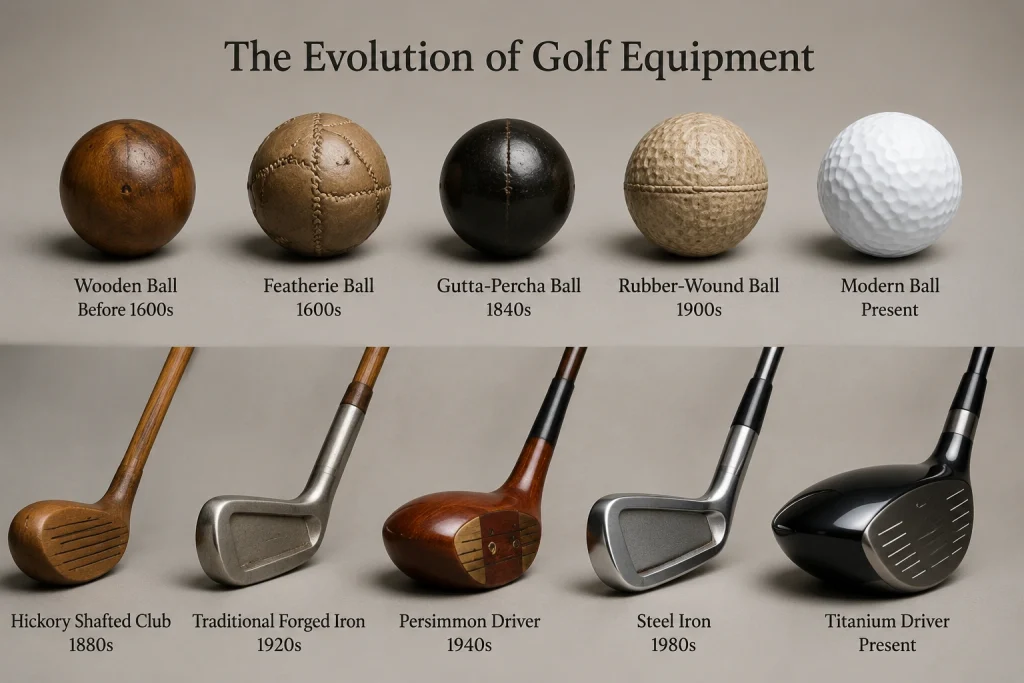
The Evolution of the Golf Ball
Early golf balls were probably made from wood. By the 1600s, skilled makers were producing the featherie.
A featherie consisted of a leather cover tightly packed with boiled feathers. When the materials dried, the leather contracted while the feathers expanded, creating a firm ball.
Featheries performed better than wooden balls, but they had serious limitations:
- They were expensive and slow to produce.
- Moisture could damage them.
- The seams could split.
- Their performance varied from ball to ball.
During the mid-1800s, the gutta-percha ball, or guttie, became popular. It was made from a rubber-like tree sap and could be heated and molded into shape.
Gutties were less expensive, more durable, and easier to manufacture. Players also discovered that scratched or patterned surfaces often produced more stable flight than completely smooth balls.
Around the beginning of the 20th century, Coburn Haskell helped develop a ball with a solid rubber center wrapped in rubber strands. The Haskell ball traveled farther than the guttie and contributed to major changes in course length and design. (USGA)
Modern balls normally use engineered cores, mantle layers, and aerodynamic dimple patterns. Manufacturers can now adjust spin, launch, feel, and durability for different golfers.
The Evolution of Golf Clubs
Early golfers used handmade wooden clubs. Clubmakers selected different shapes for driving, approaching, escaping hazards, and putting.
Club construction gradually progressed through several major stages:
| Equipment Era | Common Materials | Benefits | Limitations |
|---|---|---|---|
| Early wooden clubs | Local hardwoods | Simple and individually crafted | Inconsistent and vulnerable to damage |
| Hickory-shaft era | Hickory shafts and wood or iron heads | Better feel and flexibility | Shafts could warp, crack, or vary in stiffness |
| Steel-shaft era | Steel shafts and forged heads | More consistent and durable | Heavier than many modern options |
| Metal-wood era | Steel and titanium clubheads | Larger faces and greater distance potential | Early models could feel harsh |
| Modern composite era | Titanium, carbon fiber, steel, graphite | Adjustable, forgiving, and precisely fitted | Higher cost and greater fitting complexity |
Modern equipment is generally easier to use, but technology does not eliminate the need for solid fundamentals.
A poorly fitted $600 driver may produce worse results than a properly fitted used driver costing much less. Fit, consistency, and skill level matter more than buying the newest model.
Expert Tip:
Do not select clubs only by copying a tour professional’s setup. Tour players often use lower-launching heads, heavier shafts, and less-forgiving designs. Most beginner and intermediate golfers perform better with higher launch, more forgiveness, and a shaft matched to their swing speed.
How Golf Spread Around the World
Scotland remained golf’s center for centuries, but trade, travel, military service, and migration carried the game to other countries.
British merchants, soldiers, and expatriates established clubs throughout:
- England and Ireland
- Continental Europe
- India and other parts of Asia
- Australia and New Zealand
- South Africa
- Canada
- The United States
Railway development during the 1800s also made coastal golf destinations easier to reach. Resorts and clubs began attracting visitors who wanted to play famous links courses.
In the United States, golf expanded quickly during the late 19th and early 20th centuries. Public courses later made the game available to players who were not members of private clubs.
After World War II, television introduced championship golf to larger audiences. Players such as Ben Hogan, Sam Snead, Arnold Palmer, Gary Player, Jack Nicklaus, Lee Trevino, Nancy Lopez, Annika Sörenstam, and Tiger Woods helped bring different generations into the sport.
Today, golf is played recreationally and competitively across most parts of the world.
How Course Design Changed
Early courses followed natural landforms. Designers used dunes, streams, slopes, vegetation, and exposed sand as hazards.
As equipment allowed golfers to hit farther, courses became longer. Professional course architects also developed more deliberate strategies.
A well-designed hole may offer several choices:
- A safe route that leaves a longer second shot
- A risky drive that creates a better angle
- A ground route for players who cannot carry a hazard
- A demanding line intended for skilled players
- A recovery option for golfers who miss the fairway
Good course design does not simply punish weak players. It asks golfers to make decisions based on their distance, accuracy, confidence, and current lie.
This historical principle remains useful for modern golfers. Playing away from a bunker or water hazard may produce a better score than attempting the most aggressive shot.
Why Etiquette Became So Important
Golf is unusual because players are expected to supervise many of their own actions. A golfer may need to call a penalty on themselves even when no one else notices the violation.
This tradition made honesty and consideration central parts of golf culture.
Important etiquette practices include:
- Remaining still and quiet while another player swings
- Repairing ball marks and replacing divots
- Raking bunkers after use
- Playing at a reasonable pace
- Avoiding damage from practice swings
- Allowing faster groups to pass when appropriate
- Shouting “Fore!” immediately when a ball may hit someone
Never hit while the group ahead is within your possible range. A golfer who normally drives 220 yards may occasionally produce a much longer shot because of wind, firm ground, elevation, or unusually solid contact.
What Golf History Teaches Today’s Players
The history of golf offers practical lessons beyond interesting dates and famous names.
Equipment Cannot Replace Technique
Golfers have always searched for greater distance and control. Modern equipment provides real benefits, especially through forgiveness and consistent manufacturing.
However, no club can fully correct:
- Poor alignment
- Unstable balance
- Inconsistent contact
- An unsuitable grip
- Bad course management
A fitting can improve equipment performance, but lessons and structured practice improve the golfer using it.
The Ground Is Part of the Game
Traditional links golf rewards low shots, controlled trajectories, and creative use of slopes. Many modern golfers automatically try to fly every shot directly to the target.
Learning a bump-and-run or low punch shot can provide a safer option in wind, under trees, or around firm greens.
Fair Play Matters More Than the Score
Golf’s rules developed to create consistent and honest competition. A lower score obtained by ignoring penalties is not a meaningful improvement.
Learning the basic rules also prevents unnecessary penalties and reduces confusion during friendly rounds or competitions.
Common Mistakes Golfers Should Avoid
- Repeating the “Gentlemen Only, Ladies Forbidden” story: Golf is not an acronym. The word has older linguistic roots connected to terms meaning “club.”
- Claiming one person invented golf: The modern game developed gradually. Scotland played the central role, but related stick-and-ball games existed elsewhere.
- Believing 18 holes came from a whisky bottle: The 18-hole standard developed through course changes at St Andrews and the later influence of organized clubs.
- Assuming old equipment was easy to use: Small wooden clubheads, inconsistent balls, and flexible hickory shafts required considerable skill.
- Buying blades because they look traditional: Compact forged blades offer control to consistent ball-strikers, but most beginners benefit from more forgiving cavity-back or game-improvement irons.
- Using antique clubs without inspecting them: Old shafts, glue joints, grips, and clubheads can fail during a swing. Have valuable or fragile equipment inspected before playing it.
- Ignoring etiquette during casual rounds: Safety, pace of play, bunker care, and green repair matter even when no formal competition is involved.
When to Get Help From a Golf Pro or Fitter
Golf history shows that equipment and technique have always developed together. Modern golfers should seek qualified help when guessing is likely to waste time or money.
Consider a lesson with a golf professional when:
- You regularly top, chunk, slice, or hook the ball
- You cannot identify why your ball flight changes
- Online swing tips create conflicting movements
- You experience discomfort during or after swinging
- You are preparing to play your first full course
- You want a structured improvement plan
Consider a professional club fitting when:
- Your clubs feel unusually heavy, light, long, or short
- Your ball launches too low or too high
- You are buying a complete iron set or expensive driver
- Your strike pattern is consistently toward the heel or toe
- Your swing speed has changed because of age, fitness, or injury
- You are moving from beginner equipment to a long-term set
A fitter should examine more than total distance. Useful measurements include launch angle, spin, ball speed, strike location, dispersion, club length, lie angle, shaft weight, and grip size.
FAQs
Who invented golf?
No single person is recognized as golf’s inventor. Several cultures played stick-and-ball games, but the modern game developed primarily in Scotland over many generations.
When was golf first played?
The exact starting date is unknown. Golf was clearly established in Scotland by 1457, when King James II issued a ban against it.
Why does a golf course have 18 holes?
St Andrews changed its course configuration to 18 holes in 1764. As its influence grew, other clubs gradually adopted the same format, and 18 holes became the standard during the late 19th century.
Where was the first golf tournament held?
Many early club competitions took place in Scotland. The first Open Championship was held at Prestwick Golf Club in 1860 and was won by Willie Park Sr.
What were the first golf balls made from?
Very early balls may have been wooden. Later featherie balls were made from leather stuffed tightly with feathers. They were eventually replaced by gutta-percha and rubber-core designs.
When did golf become popular in the United States?
Golf grew rapidly in the United States during the late 1800s. The USGA was formed in 1894, and its first national championships were held in 1895.
Is traditional golf equipment suitable for beginners?
Traditional or replica equipment can be enjoyable for historical events, but it is usually less forgiving than modern gear. Beginners normally learn faster with lightweight, properly fitted clubs and durable modern golf balls.
Conclusion
The history of golf is a story of gradual development rather than a single invention. Scotland’s coastal linksland shaped the modern game, the 1744 rules gave it structure, St Andrews helped establish the 18-hole round, and organized championships carried golf to an international audience.
Equipment has progressed from handmade wooden clubs and feather-filled balls to precisely engineered clubs and multilayer balls. Yet golf’s central challenge remains familiar: choose the right shot, control the ball, respect the course, and count every stroke honestly.
Use that history to make smarter decisions today. Select equipment that fits your current ability, learn the basic rules and etiquette, and focus on dependable technique rather than chasing every new product. Then take what you have learned to the range or course and experience the traditions of the game for yourself.