
Green Rules in Golf: Complete Putting Green Guide for 2026

Quick Answer
Green rules in golf let you mark, lift, clean, and replace your ball once it is on the putting green. You may also repair many types of damage, remove sand and loose soil, and leave the flagstick in while putting. The main official rules are covered by USGA Rule 13 on putting greens.
Green Rules to Remember
- Mark before lifting: Mark the ball’s spot before picking it up when it must be replaced.
- Clean your ball: A ball lifted from the putting green may be cleaned.
- Repair damage: Ball marks, shoe damage, animal damage, and similar surface damage may normally be repaired.
- Replace accidental movement: If you accidentally move your ball on the green, there is normally no penalty, but the ball must be replaced.
- Flagstick may stay: There is no penalty simply because your putt hits an unattended flagstick left in the hole.
- Do not test the green: Deliberately rolling a ball or rubbing the surface to test how it plays can bring the general penalty.
Best Habit
- When a green-side ruling feels uncertain, identify whether the ball is actually on the putting green before deciding what you may do.
Putting greens have their own set of golf rules because they are specially prepared for rolling the ball toward the hole.
I find green rules easier to remember when I separate them into four questions: what can I move, what can I repair, where must the ball go back, and what can I do around the hole?
This guide covers those questions in detail. It reflects the Rules of Golf and available official clarifications as of 2026.
In This Guide
What Are Green Rules in Golf?
Green rules are the parts of the Rules of Golf that govern play on and around a putting green. Rule 13 contains the main putting-green provisions.
A putting green is the specially prepared area for the hole being played where players normally make strokes intended to roll the ball along the ground.
A ball counts as being on the putting green when any part of it touches that green. It can also qualify when it rests on or in something located inside the edge of the green.
Why are the rules different on the green?
The green is prepared much more carefully than the general area. Small imperfections can meaningfully change the roll of a putt.
For that reason, golfers receive permissions on a putting green that they do not always receive elsewhere.
- You may mark and lift your ball.
- You may clean the lifted ball.
- You may replace it on its original spot.
- You may remove sand and loose soil.
- You may repair many types of damage.
- You may normally touch the green without penalty as long as you do not illegally improve conditions.
Those permissions do not mean you can reshape the surface however you want. The Rules still limit deliberate testing and improvements that go beyond permitted repair.
What is the general penalty?
You will see the phrase general penalty several times in green rulings. It means loss of hole in match play or two penalty strokes in stroke play.
That is different from a one-stroke penalty. The specific Rule involved determines which penalty applies.
Section Takeaway: Green rules give golfers extra freedom to handle the ball and repair damage, but only within defined procedures.
What Can You Do With Your Ball on the Putting Green?
Once your ball is on the putting green, you may mark its position, lift it, clean it, and replace it. This is one of the most useful differences between the green and many other areas of the course.
How do you mark a golf ball correctly?
Before lifting a ball that must be returned to its original position, first mark its spot. A normal ball-marker may be placed right behind or right next to the ball.
A club may also be held on the ground right behind or next to the ball to mark the position.
- Place your marker immediately beside the ball.
- Lift the ball.
- Clean or align it if desired.
- Replace the ball on its original spot.
- Remove the marker before making your stroke.
If you lift a ball without properly marking its spot when marking is required, you get one penalty stroke.
The same one-stroke penalty can apply if you make your stroke while the ball-marker is still in place.
Can you clean your ball on the green?
Yes. When your ball has been lifted from the putting green, it may be cleaned.
This lets you remove mud, grass, or moisture from the ball before replacing it.
Can your caddie lift your ball?
A caddie may lift a player’s ball on the putting green without needing separate authorization each time.
That permission is specific to the putting green and should not be assumed everywhere else on the course.
Can you rotate the ball without lifting it?
Deliberately rotating a ball on its spot counts as lifting it under the Rules. Mark the spot before deliberately rotating the ball.
This often matters when golfers turn an alignment line toward their intended starting line.
| Situation | Allowed? | What to Do | Possible Penalty |
|---|---|---|---|
| Mark and lift ball | Yes | Mark first, then replace on original spot | None when done correctly |
| Clean lifted ball | Yes | Clean before replacing | None |
| Lift without marking | No, when marking is required | Replace correctly | One penalty stroke |
| Stroke with marker still in place | No | Remove marker before stroke | One penalty stroke |
Section Takeaway: Mark first, lift second, replace the ball on its original spot, and remove the marker before putting.
What Damage Can You Repair on a Putting Green?
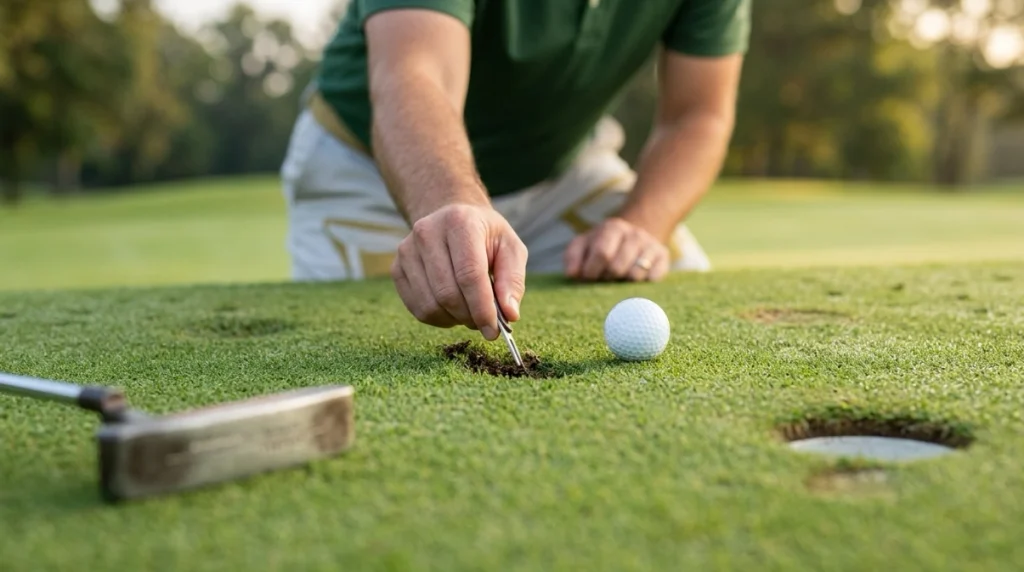
You may repair most damage caused by people, animals, equipment, or outside influences. This permission is broader than many golfers who learned older versions of the Rules realize.
The goal is to restore damage rather than redesign the putting surface.
What damage can you fix?
Common examples of permitted repair include:
- Ball marks or pitch marks.
- Shoe and spike damage.
- Indentations caused by a club.
- Damage caused by a flagstick.
- Animal damage.
- Old hole plugs.
- Damage left by an embedded object.
- Damage to the hole caused by a person or object.
You may use normal methods such as a pitch-mark repair tool, tee, club, hand, or foot where appropriate.
Repairs must not unreasonably delay play.
What can you not repair?
The Rules do not let you fix every irregularity simply because it sits on your putting line.
- Aeration holes: These are part of normal course maintenance and are not automatically repairable under Rule 13.1c.
- Natural imperfections: Ordinary bumps, uneven growth, or natural surface conditions are not treated like player-created damage.
- Normal hole wear: Natural wear around the edge of the cup cannot simply be reshaped.
A Committee can sometimes introduce a Local Rule affecting conditions such as aeration holes. Check the scorecard, notice board, or competition instructions.
Can you remove sand from your putting line?
Yes. Sand and loose soil may be removed from the putting green.
This permission applies even though loose soil receives different treatment in other parts of the course.
Can you touch your putting line?
Simply touching the putting green or your line of play is not automatically a penalty. The important restriction is that you must not improve conditions affecting the stroke in a way the Rules prohibit.
For example, touching the surface while pointing out a line is different from pressing down an imperfection that you are not allowed to repair.
Section Takeaway: Repair genuine damage, but do not turn permitted repair into an attempt to smooth natural imperfections or rebuild your putting line.


What Happens If Your Ball Moves on the Green?
A moved ball on the putting green is one of the most misunderstood golf situations. The correct ruling depends on what caused the movement and whether the ball had already been lifted and replaced.
What if you accidentally move the ball?
If you accidentally cause your ball or ball-marker to move on the putting green, there is normally no penalty.
Replace the ball or marker on its original spot. Estimate the spot if you do not know the exact location.
This commonly covers accidental contact while placing a marker, addressing the ball, or taking normal actions around the ball.
What if wind moves the ball?
Wind produces two different outcomes.
- Ball was not lifted and replaced: If natural forces move it, normally play it from the new spot.
- Ball was already lifted and replaced: If it later moves for any reason, including wind or gravity, replace it on its original spot.
This distinction is worth memorizing. Once you have lifted and replaced your ball on the green, its original spot effectively controls if natural forces later move it.
I use a simple memory cue during a round: replaced once, replace again.
What if someone else moves your ball?
When another player, opponent, caddie, or outside influence moves a ball, the applicable Rule determines whether a penalty applies to that person.
Your immediate concern is usually restoring the ball to the correct spot when the Rules require replacement.
What if the ball moves during your backswing?
Do not automatically assume every movement produces the same ruling. The timing, cause, and whether the stroke was completed can change the result.
When competing, check the official Rules rather than guessing from a casual-round habit.
The R&A Rules Hub provides the current Rules and related guidance when a moved-ball situation becomes complicated.
Section Takeaway: Accidental movement on the green normally means replace without penalty, while wind depends on whether the ball had already been lifted and replaced.
What Are the Flagstick and Hole Rules?
You may putt with the flagstick left in the hole. A ball hitting an unattended flagstick in the hole does not automatically create a penalty.
Can you leave the flagstick in while putting?
Yes. You can choose to leave the flagstick in the hole when making a stroke from the putting green.
You may also arrange to have it removed or attended before the stroke.
The important point is that your choice should be established before you make the stroke. Deliberate actions involving the flagstick while a ball is moving can create different rulings.
What if the ball rests against the flagstick?
If a ball comes to rest against a flagstick left in the hole, look at the position of the ball relative to the surface of the green.
- If any part of the ball is in the hole below the surface of the putting green, the ball is treated as holed.
- If no part is below the surface, the ball is not yet holed.
If the ball is not holed and removing the flagstick makes it move, there is no penalty merely for that movement. The ball must be replaced on the lip of the hole.
How long can a ball hang over the hole?
If part of your ball overhangs the lip, you receive a reasonable amount of time to reach the hole. You then receive another 10 seconds to see whether it falls.
If it falls within that waiting period, you have holed out with the previous stroke.
If it remains at rest after the permitted waiting period but later falls before you play it, you still hole out with the previous stroke. However, one penalty stroke is added to your score for the hole.
Can another player knock away an overhanging ball?
Do not casually knock away another golfer’s ball while its Rule 13.3 waiting period is still active.
The outcome differs between match play and stroke play, and the player moving the ball can face consequences.
Section Takeaway: You may leave the flagstick in, and an overhanging ball receives a reasonable travel time plus 10 seconds before it is treated as being at rest.
Can You Touch, Test, or Play From Another Green?

You may touch a putting green in many ordinary situations, but deliberately testing its playing characteristics is restricted.
Can you test a putting green during the round?
During a round, you must not deliberately test a putting green or a wrong green by rubbing its surface or rolling a ball to learn how it will roll.
A breach carries the general penalty.
Between two holes, the Rules provide limited exceptions involving the green of the hole just completed and practice greens. A Committee may restrict some of that practice through a Local Rule.
Can you read grain by scraping the grass?
Deliberately roughening or scraping the grass to determine the direction of the grain is an example of prohibited testing.
Reading visual clues is different. You can observe color, slope, moisture, surrounding terrain, and the roll of shots played normally during the round.
What happens if your ball lands on the wrong green?
A wrong green is any putting green other than the green for the hole you are currently playing, including certain practice or temporary greens when defined that way.
If your ball lies on a wrong green, you must not simply play it from there.
Free relief is required when the wrong green interferes with:
- The position of your ball.
- Your area of intended stance.
- Your area of intended swing.
Find the nearest point of complete relief in the same area of the course where the ball lies. The relief area is one club-length from that reference point, no nearer the hole, with complete relief from the wrong green.
Playing from the wrong place instead of taking required relief can bring the general penalty.
What if another ball or marker interferes with your putt?
A ball or ball-marker may be moved when it reasonably helps or interferes with play under Rule 15 procedures.
A ball-marker moved out of the way should be measured from its original position, often using one or more clubhead-lengths. It must then be returned correctly before the ball is replaced.
In stroke play, players must not agree to leave a ball beside the hole specifically to help another player by acting as a backstop. If the stroke is made with that helping ball left in place after such an agreement, the players involved receive the general penalty.
For rule changes or newer interpretations, check the USGA’s current Rules clarifications. The published clarifications were updated July 1, 2026.
Section Takeaway: Observe the green, but do not deliberately test it, and always take required free relief when a wrong green interferes.
Green Rules FAQ
Can I pick up my golf ball on the green?
Yes. You may mark and lift your ball when it is on the putting green.
Mark the spot first when the ball must be replaced, then return the ball to its original position before playing.
Can I clean my ball after marking it?
Yes. A ball lifted from the putting green may be cleaned before it is replaced.
This is different from several situations elsewhere on the course where cleaning a lifted ball can be restricted.
Can I fix spike marks on my putting line?
Yes. Shoe and spike damage are among the types of putting-green damage that may normally be repaired.
Make the repair reasonably and do not unreasonably delay play.
Can I repair aeration holes on the green?
Not automatically. Aeration holes are specifically outside the normal category of repairable putting-green damage under Rule 13.1c.
A Committee may adopt a Local Rule that provides relief in certain aeration-hole situations, so check the course’s Local Rules.
Is there a penalty if my putt hits the flagstick?
There is no penalty simply because a ball played from the putting green hits an unattended flagstick left in the hole.
Different rules can apply when someone deliberately moves or positions a flagstick to affect a ball in motion.
What happens if wind blows my ball after I marked it?
If you marked, lifted, and replaced the ball before wind moves it, replace the ball on its original spot.
If the ball had not previously been lifted and replaced, a ball moved only by natural forces is normally played from its new position.
Can I putt from another green if my ball lands there?
No. When a wrong green interferes under Rule 13.1f, you must take free relief rather than play the ball as it lies.
The relief area is based on the nearest point of complete relief and must not be nearer the hole.
The easiest way to avoid penalties on the green is to slow down for five seconds before touching the ball. Identify the spot, mark correctly, repair only what the Rules allow, and confirm unusual situations before making the next stroke.
Once those habits become automatic, green rules stop feeling complicated and become part of a normal putting routine.