
Golf Posture Guide: Build a Balanced, Repeatable Setup

Quick Answer
Good golf posture starts with a hip hinge, soft knees, relaxed arms, and balanced pressure through the middle of each foot. Keep your back comfortably neutral rather than stiff, then let your body rotate around that setup angle; this PGA posture drill offers a useful visual check.
Five quick setup steps
- Stand tall: Begin upright before adding any bend or knee flex.
- Hinge from hips: Push your hips back while keeping your chest open.
- Soften the knees: Add a small athletic flex without sitting into a squat.
- Let arms hang: Your hands should fall naturally below your shoulders.
- Check balance: Feel pressure centered between your heels and toes.
Fast verification
- Hold the position for ten seconds, then make a small turn. If you wobble, strain, or cannot rotate, reset with less tension.
A sound setup makes the golf swing simpler before the club even moves. I have chased swing fixes on the range, only to discover that my balance or hip bend caused the problem.
This golf posture guide explains the full setup, club-by-club changes, common faults, and useful drills. It is written for beginners and mid-handicap golfers who want a repeatable starting position.
In This Guide
What Is Correct Golf Posture?
Correct golf posture is a balanced address position that lets you turn freely while your arms swing naturally. It should feel athletic, comfortable, and easy to repeat.
Definition: Golf posture is the arrangement of your feet, knees, hips, spine, shoulders, and arms before and during a stroke. Your stance describes mainly your foot position, while posture describes how the whole body is organized.
There is no single perfect spine angle
Your height, arm length, club length, mobility, and shot type all affect your setup. A tall golfer and a short golfer will not create identical angles.
Do not force your back into a rigid line. Aim for a comfortable neutral shape, with the chest open and the pelvis neither tucked hard nor arched excessively.
- Feet: Stable enough to support rotation without feeling rooted.
- Knees: Soft and responsive, not deeply bent.
- Hips: Pushed back through a true hip hinge.
- Spine: Long and neutral, without forced stiffness.
- Arms: Hanging freely below the shoulders.
- Pressure: Centered through the middle of both feet.
Why posture matters for contact and direction
Posture creates room for your arms and club to move. It also gives your torso a stable angle around which to rotate.
If you begin off balance, your body must recover during the swing. That compensation may move the low point, change the clubface, or alter your swing path.
I notice poor posture fastest with a mid-iron. Thin contact often appears when I stand up through impact, while heavy contact appears when my chest drops toward the ball.
Posture does not guarantee a straight shot. Grip, alignment, ball position, clubface control, and swing sequence still matter.
Section Takeaway: Build a balanced, mobile position instead of copying a tour player’s exact angles.
How Do You Set Up With Good Golf Posture?
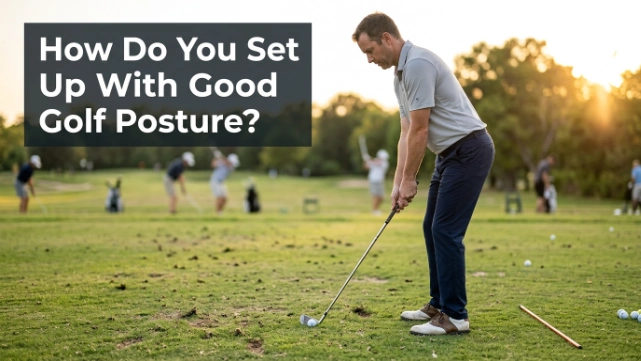
Build posture in a fixed order: stand tall, set your feet, hinge from the hips, soften the knees, and let the arms hang. This sequence prevents extra knee bend from replacing a proper hip hinge.
1. Set your feet and target line
Aim the clubface before arranging your body. Then place your feet, knees, hips, and shoulders roughly parallel to the target line for a standard straight shot.
For a mid-iron, start with the inside edges of your feet near shoulder width. Your exact width should allow a stable turn and a balanced finish.
2. Hinge from your hip sockets
Stand upright and place your fingertips in the creases at the front of your hips. Push those creases backward as your chest tips toward the ball.
This is a hip hinge. It differs from rounding your shoulders or bending mainly through the waist.
Your rear should move slightly behind your heels. Your chest should point down without collapsing inward.
3. Add soft knee flex
Unlock your knees after the hip hinge. You need enough flex to feel athletic, but not enough to resemble a squat.
Too much knee bend places extra pressure toward the heels. Too little can make the legs rigid and restrict your turn.
4. Let the arms hang naturally
Relax your shoulders and allow both arms to hang below them. Bring your hands together without reaching toward the ball.
The club should meet the ground from this position. If you must stretch or crowd your thighs, first recheck your distance from the ball.
5. Center your pressure
Feel pressure through the balls of your feet and heels, not only one area. You should be able to lift your toes briefly without falling backward.
You should also be able to make a small heel lift without falling forward. A gentle rocking test helps you find the middle.
6. Add the correct upper-body tilt
With irons, keep your shoulders close to level while your trail hand sits lower on the grip. That lower hand creates a small natural trail-side tilt.
With a driver, the ball sits forward and the trail shoulder rests lower. This creates more visible tilt away from the target without forcing your hips sideways.
Pro tip: Ask a certified PGA professional to check your posture if a position feels strained or changes your balance.
Section Takeaway: Hinge first and flex second. Then let relaxed arms determine your comfortable distance from the ball.
How Should Golf Posture Change for Each Club?
Your core posture stays consistent, but stance width, ball position, torso tilt, and distance from the ball change. Longer clubs make you stand farther away and slightly taller.
| Club or shot | Stance width | Typical ball position | Posture cue | Common error |
|---|---|---|---|---|
| Wedge | Narrower than shoulders | Near center | Balanced with modest knee flex | Sitting too low |
| Mid-iron | About shoulder width | Slightly forward of center | Neutral spine with free arm hang | Reaching for the ball |
| Hybrid or fairway wood | Shoulder width or slightly wider | Forward of a mid-iron | Stand slightly taller and farther away | Copying driver tilt |
| Driver | Wider than a mid-iron | Inside lead heel | Taller setup with trail shoulder lower | Leaning the whole body back |
| Putter | Comfortably narrow | Near center or slightly forward | Eyes near the ball line; arms relaxed | Forcing the eyes directly over the ball |
These are starting points, not fixed laws. Your club fitting, body shape, and intended shot may require small changes.
Uneven lies require temporary adjustments
- Ball above your feet: Stand taller, grip down if needed, and expect the club to feel more upright.
- Ball below your feet: Add knee flex, widen the stance, and keep your chest down without reaching.
- Uphill lie: Match your shoulders more closely to the slope and keep pressure stable.
- Downhill lie: Match the slope, shorten the swing, and avoid falling onto your toes.
On sloped fairways, balance matters more than textbook appearance. I shorten my swing before trying to manufacture a perfect address position.
Section Takeaway: Preserve the same hip hinge and balance while allowing the club length, ball position, and ground slope to shape the details.


What Are the Most Common Golf Posture Mistakes?
The most common faults are rounded shoulders, excessive lower-back arch, too much knee bend, reaching, crowding, and poor foot pressure. Each fault limits movement in a different way.
Rounded upper back, or C-posture
A rounded upper back makes the chest look collapsed at address. The Titleist Performance Institute calls this pattern C-posture.
Try standing tall, opening the chest gently, and hinging from the hips. Do not pull your shoulders back so hard that your neck and arms become tense.
Excessive lower-back arch, or S-posture
An exaggerated arch often appears when a golfer sticks the rear out and lifts the chest too far. TPI describes this address pattern as S-posture.
Return the pelvis toward a comfortable middle position. Light core tension should support the posture without making breathing difficult.
Too much knee bend
Deep knee flex can move pressure toward the heels and crowd the hands. It often happens when a golfer bends the knees before hinging the hips.
Stand up and rebuild the setup in the correct order. Keep only enough knee flex to feel responsive.
Reaching or standing too close
Reaching creates tension and often shifts pressure toward the toes. Crowding forces the hands close to the thighs and removes space for the downswing.
Let your arms hang first. Then move your feet until the club sits behind the ball without a stretch or squeeze.
Using the head as the main posture cue
“Keep your head down” can create a tucked chin and restricted shoulder turn. Your eyes need to see the ball, but your neck should remain comfortable.
Allow room beneath your chin for the lead shoulder to turn. The ball does not need an unbroken stare throughout the entire motion.
Pro tip: Persistent back, hip, knee, or neck pain needs assessment from a qualified health professional, not another swing cue.
How Do You Maintain Posture During the Swing?
Maintaining posture means preserving enough of your setup angles to keep space and balance while you rotate. It does not mean freezing your head or spine.
Your body rises, turns, shifts, and extends during a functional swing. The goal is controlled change rather than an exact copy of the address position.
Turn around the hip hinge
During the backswing, let your chest turn while your hips remain behind you. Your trail hip should feel as though it moves backward, not toward the ball.
During the downswing, the lead hip begins moving back as the body opens. This creates room for the hands and club.
Avoid early extension
Early extension occurs when the hips move toward the ball during the downswing. The torso often rises, and the hands must compensate to reach impact.
The PGA’s guide to keeping posture through impact shows how this fault changes the space around the ball. A chair or wall drill can make the movement easier to feel.
Judge posture through ball flight and balance
Video helps, but the shot still matters. Check contact location, divot position, start direction, curve, and finish balance together.
- Repeated thin shots: You may be rising early or beginning too far from the ball.
- Repeated heavy shots: Your chest may be dropping, or your pressure may remain on the trail side.
- Heel strikes: Your hips or upper body may move closer to the ball.
- Toe strikes: You may pull away, stand up, or begin too far away.
- Unbalanced finish: Start by checking foot pressure and swing effort.
These clues are not diagnoses. Several grip, path, ball-position, and equipment issues can create the same result.
Section Takeaway: Keep your hips working behind you as you turn, but allow the body to extend naturally after impact.
Which Drills Improve Golf Posture?
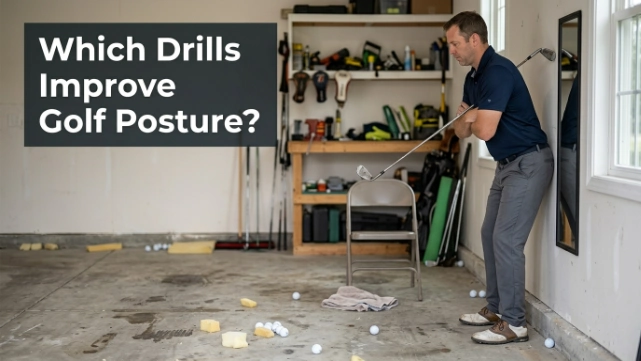
The best posture drills provide simple feedback without forcing a pose. Practice them slowly before adding a ball or full swing.
Club-along-the-spine drill
- Stand tall and hold a club along your back.
- Keep it touching your head, upper back, and tailbone area without forcing pressure.
- Hinge from the hips while keeping a comfortable neutral shape.
- Stop if you feel strain in the neck or lower back.
This drill helps separate a hip hinge from a rounded bend. Body shape differs, so treat the contact points as feedback rather than a strict test.
Wall hip-hinge drill
- Stand about one foot in front of a wall, facing away.
- Keep your feet stable and push your hips back.
- Touch the wall lightly with your rear.
- Return to standing without driving your knees forward.
Repeat five slow movements. Then hold the hinged position and let your arms hang.
Chair-turn drill
- Set a chair behind you so its edge lightly touches your rear at address.
- Make a slow backswing while the trail hip keeps contact.
- Begin down slowly and let the lead hip take over the contact.
- Finish tall and balanced.
Use a stable chair on level ground. Keep the club away from people, walls, windows, and other breakable objects.
Mirror and phone checks
Use a mirror for face-on balance and a phone for the down-the-line view. Position the camera around hand height and aim it through your hands toward the target line.
Record normal swings instead of posing after you press the button. Compare setup, impact space, and finish balance rather than tracing one “perfect” line.
- Practice dose: Five rehearsals before hitting a ball.
- Swing length: Begin with waist-high half-swings.
- Effort: Stay near 50% speed until balance feels automatic.
- Reset rule: Stop after two poor rehearsals and rebuild from standing tall.
As of 2026, phone video makes setup feedback easy, but camera angle can mislead you. A small change in camera position can make the spine or club appear steeper.
Follow the R&A’s safety guidance during practice swings. Make sure nobody stands close enough to be struck by the club, ball, or debris.
Pro tip: A certified instructor can match a drill to your real swing fault and prevent you from overcorrecting.
Section Takeaway: Use slow rehearsals, clear feedback, and short swings before testing posture at full speed.
Golf Posture FAQs
Should your back be straight in golf posture?
Your back should feel comfortably neutral, not rigidly straight. Hinge from the hips, keep the chest open, and avoid excessive rounding or lower-back arch.
How much should you bend your knees in a golf stance?
Use a small, athletic knee flex after you hinge from the hips. You should feel balanced and ready to move, not seated in a deep squat.
Where should your weight be at address?
For a standard level shot, begin with pressure centered through the middle of both feet. Shot type, lie, and club may shift that pressure slightly.
Should your arms hang straight down in golf posture?
Yes, your arms should hang naturally below relaxed shoulders. The exact hand position varies with body shape and club, but you should not reach or crowd your thighs.
Does golf posture change with the driver?
Yes. A driver usually needs a wider stance, forward ball position, taller posture, and more trail-side torso tilt than a mid-iron.
Why do I stand up during my golf swing?
You may start off balance, crowd the ball, lose the hip hinge, or move your hips toward the ball. Check setup and practice slow chair-turn drills before changing your full swing.
Can poor golf posture cause back pain?
Poor movement or excessive tension may add stress, but pain has many possible causes. Stop if a swing hurts and consult a qualified medical professional for persistent symptoms.
Final takeaway: Start tall, hinge from the hips, soften the knees, and let your arms hang. Check balance before every shot, then use one feedback drill until the setup feels natural.
Take this golf posture guide to the range and begin with a mid-iron. Build five careful setups, hit five half-shots, and judge the pattern before adding speed.