
Casting Explained: What It Means in the Golf Swing and How to Fix It

Quick Answer
Casting in golf happens when the wrists unhinge and the clubhead moves outward too early during the downswing. This early release can waste speed, move the bottom of the swing behind the ball, and produce fat, thin, weak, or inconsistent shots. The best fix is usually better downswing sequencing rather than trying to hold your wrists rigid. For hands-on help, a PGA golf professional can identify what is causing the early release in your swing.
Common Signs of Casting
- Early wrist release: The angle between your lead arm and club shaft disappears quickly after transition.
- Fat iron shots: The club reaches the bottom of its arc before the ball.
- Thin contact: You may straighten or lift your body to avoid striking the ground too early.
- Weak ball flight: Speed is spent too early instead of building closer to impact.
- Rushed transition: The hands and clubhead attack the ball immediately from the top.
Best Way to Check
- Record a face-on slow-motion swing and watch when the wrist angle begins disappearing during the downswing.
Casting is one of those golf terms that sounds more complicated than the movement itself. Once you see it on video, the pattern becomes much easier to understand.
I also find that golfers often attack the symptom instead of the cause. This guide explains what casting is, why it happens, how it affects contact, and which drills can help you change it.
In This Guide
What Is Casting in the Golf Swing?
Casting is an early release of the club during the downswing. The wrists begin unhinging too soon, causing the clubhead to move outward and catch the hands earlier than intended.
The name comes from the motion of casting a fishing rod. Instead of allowing speed to build later, the golfer throws the clubhead away from the body near the top.
Definition: Casting in golf is a downswing pattern where the wrist hinge and arm-to-shaft angle are released prematurely, usually before the club reaches the main delivery position.
What should happen instead?
A functional downswing lets the clubhead trail the hands during the early part of the motion. That relationship then changes naturally as the club accelerates toward impact.
You don’t need to freeze the wrist angle. In fact, trying to hold it deliberately can create a different set of problems.
- Lag describes the clubhead trailing the hands during part of the downswing.
- Casting describes that relationship disappearing too early.
- Release is the necessary unhinging and rotation that occurs as the club approaches and moves through impact.
- Flipping usually describes excessive hand action used to square or rescue the club near impact.
Those terms are related, but they are not interchangeable. A golfer needs a release, while excessive casting can interfere with how that release develops.
Casting versus a proper release
| Checkpoint | Early Casting | Functional Release |
|---|---|---|
| Transition | Clubhead is thrown outward quickly | Body and arms change direction together |
| Early downswing | Wrist angle disappears rapidly | Clubhead still trails the hands naturally |
| Speed | Club accelerates too early | Speed builds progressively toward impact |
| Low point | Can move behind the ball | Easier to control with irons |
| Typical feeling | Hard hit from the top | Smooth buildup of speed |
For broader swing instruction, I also like using Golf Digest as a reference when comparing different teaching approaches.
What Causes Casting in Golf?
Casting rarely begins because a golfer consciously decides to unhinge the wrists. It is often a reaction to something that happened earlier.
That is why simply telling yourself to “hold the angle” often fails. Fixing the cause gives you a better chance of changing the release.
1. Trying to hit hard from the top
This is the pattern I see most often. The golfer reaches the top and immediately tries to create maximum clubhead speed.
The hands tighten, the arms accelerate, and the clubhead gets thrown outward. The swing feels powerful even though the speed is arriving too early.
2. Poor downswing sequence
A good transition involves pressure movement, body rotation, arm movement, and club acceleration working together. When the hands dominate first, casting becomes much more likely.
Think of the downswing as a chain. You don’t need to fire each body part separately, but the clubhead should not win the race immediately.
3. Staying on the trail side
Golfers who remain heavily on the trail foot can struggle to move the bottom of the swing forward. An early hand release may appear as the body tries to reach the ball.
The result can be heavy contact followed by a compensating lift. One mistake creates another.
4. Excessive grip and forearm tension
Tight hands can make the transition feel abrupt. They can also stop the wrists and arms from responding naturally to the body’s movement.
I prefer a secure grip without squeezing the club as hard as possible. The club should feel controlled, not trapped.
5. An open clubface
An open clubface can encourage a golfer to throw the hands early in an attempt to square it. In this case, casting may be a compensation rather than the original fault.
This is why video and ball flight matter. Fixing the release without checking the clubface can make the swing worse.
- Rushed transition: The golfer attacks immediately from the top.
- Trail-side hang back: Pressure does not move forward effectively.
- Open face: The hands try to rescue the club before impact.
- Weak sequence: Arms and club outrun the body’s motion.
- Too much tension: The swing loses flow during the change of direction.
Section Takeaway: Casting is often a reaction, not the original problem. Look at transition, pressure, clubface control, and tension before trying to manipulate your wrists.
What Does Casting Do to Your Golf Shots?
Casting can affect both contact and speed because it changes when the clubhead begins overtaking the hands. The exact miss still depends on clubface, path, posture, and body movement.
That means casting does not create one guaranteed ball flight. Several different misses can come from the same early release pattern.
Fat shots
With irons, an early release can move the low point of the swing behind the ball. The club reaches the ground first and produces a heavy strike.
You may see a deep divot beginning before the ball. Distance usually drops sharply.
Thin and topped shots
A golfer who senses the club approaching the ground too early may stand up or pull the arms inward. That compensation can turn a potential fat shot into a thin one.
This explains why the same golfer may alternate between heavy and thin contact. Both misses can come from poor low-point control.
High, weak iron shots
Casting can add delivered loft when the hands lose their forward relationship to the club too soon. The ball may launch higher without the solid compression the golfer expects.
The shot can look reasonable at first. It simply lacks the penetrating flight and distance of a centered strike.
Loss of clubhead speed
Golf speed matters most when it is delivered efficiently near the ball. Spending too much acceleration at the beginning of the downswing can leave less available through impact.
I think of it like sprinting too early in a race. Effort alone does not guarantee good timing.
Inconsistent directional control
Casting can also interact with an outside-in path, open clubface, or last-second hand flip. That combination can produce slices, pulls, hooks, and weak fades.
Do not diagnose casting from shot shape alone. Use ball flight together with slow-motion video.
Section Takeaway: Casting usually hurts consistency more than it creates one specific miss. Heavy shots, thin strikes, weak launches, and poor speed can all appear when release timing breaks down.


How Can You Tell If You Are Casting?
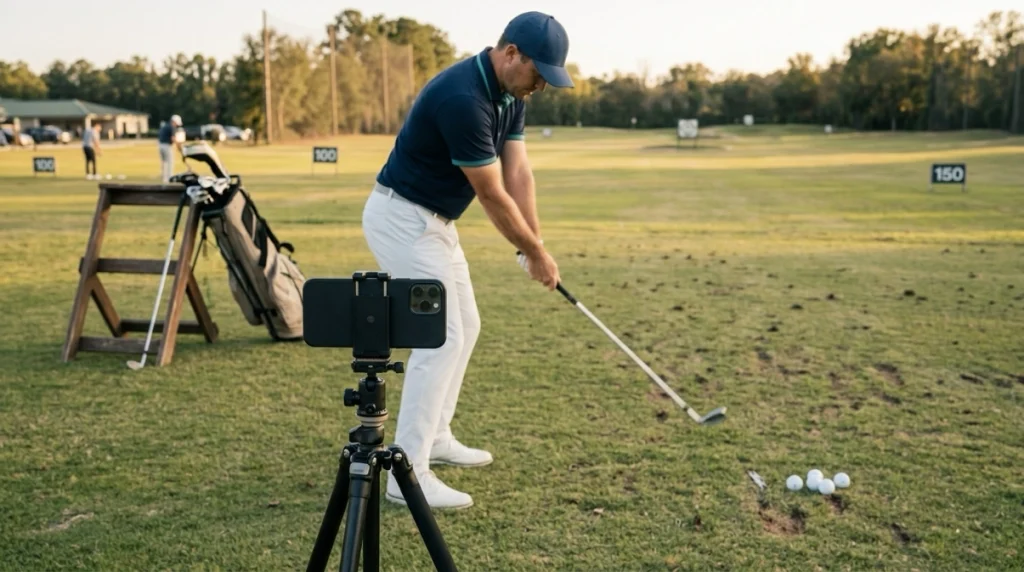
The easiest way to identify casting is with face-on slow-motion video. You are looking for when the clubhead begins catching the hands during the downswing.
You do not need expensive equipment. A phone camera and a stable position are enough for a useful first check.
Film from face-on
Place the camera around hand height and roughly perpendicular to your target line. Make normal swings rather than trying to perform for the camera.
I like recording three to five swings. One unusual swing can give you the wrong diagnosis.
Watch the transition
Pause the video near the top of the backswing. Then advance slowly into the downswing.
If the clubhead immediately moves away from the body while the arm-to-shaft angle rapidly widens, you may be casting.
Check your low point
Hit several short irons from grass and watch where the divot begins. For a normal iron shot, you generally want ball contact before the club reaches its lowest point.
Repeated turf contact well behind the ball deserves attention. It does not prove casting by itself, but it supports the diagnosis.
Compare feel with video
This step is important because feel can be misleading. A swing that feels like a huge wrist hold may look almost normal on camera.
The opposite happens too. A golfer may feel smooth while the club is being thrown strongly from the top.
- Film from face-on.
- Use normal-speed swings.
- Watch the first part of the downswing.
- Check when the wrist angle begins widening.
- Compare that movement with your strike pattern.
- Change only one major variable at a time.
The USGA is also a dependable source for broader golf standards, equipment information, and Rules of Golf resources.
How Do You Stop Casting the Golf Club?
The best way to stop casting is to improve the motion that creates your release. Start with a smoother transition, better pressure movement, and coordinated rotation.
Do not make “hold the wrist angle” your only swing thought. A rigid hold can create tension and leave the club trapped behind you.
1. Reduce effort at the top
Make several swings at about 60% to 70% effort. Let the backswing finish without immediately throwing the club toward the ball.
This slower pace makes sequence easier to feel. Speed can return after the movement improves.
2. Move pressure toward the lead side
As the backswing finishes, begin feeling pressure move toward your lead foot. Avoid throwing your entire upper body toward the target.
The goal is support under the lead side. That gives your body a better base for rotation.
3. Let the arms lower
Allow the arms to move down while the body begins unwinding. Do not try to launch the clubhead outward immediately.
I like the sensation that the hands have time to fall before maximum speed arrives. Keep the movement athletic rather than forced.
4. Keep rotating through impact
Stopping the chest can force the hands to take over. Continue turning while the arms and club release through the strike.
A balanced finish is a useful checkpoint. You should not feel as though all your effort ended at the ball.
5. Practice with shorter swings first
Half-swings make the change easier because there is less speed to control. Start with a wedge or mid-iron before returning to the driver.
When I work on release timing, a 7-iron is often easier than a driver. Contact gives immediate feedback without encouraging a maximum-effort swing.
Pro tip: If changing your wrist, shoulder, hip, or downswing motion causes pain or strain, stop the drill and work with a certified golf instructor or appropriate healthcare professional.
Section Takeaway: Improve the sequence that produces the release instead of freezing your wrists. Smooth transition, lead-side pressure, arm flow, and continued rotation give the club more room to accelerate naturally.
Which Drills Help Fix Casting?
The best casting drills change when you create speed. They should also make the correct movement easier to feel without requiring complicated positions.
Start slowly. A drill is useful only if the improved motion eventually transfers into your normal swing.
Whoosh drill
Hold a driver upside down near the clubhead so the grip end moves through the air. Make smooth practice swings and listen for the loudest whoosh.
If the loudest sound happens early in the downswing, you may be spending your speed too soon. Try moving the sound closer to the bottom of the swing.
Pump drill
Swing to the top, then rehearse the club partway down without hitting a ball. Return it slightly upward and repeat the motion two or three times.
Feel the arms lowering while your body remains organized. Then swing through on the final repetition.
Step-through drill
Begin with your feet closer together and make a controlled backswing. As the club changes direction, step toward the target with your lead foot.
The step encourages pressure to move forward before the hands dominate. Keep the drill slow until your balance feels natural.
Half-swing contact drill
Use a wedge or 8-iron and make waist-high-to-waist-high swings. Focus on striking the ball before the turf without trying to hit it far.
Ten solid half-swings teach you more than ten violent full swings. Add length only after contact becomes predictable.
Split-hand drill
Separate your hands slightly on the grip and make slow practice swings. The wider hand spacing can make the relationship between your arms and club easier to sense.
Keep the motion comfortable. This is a feel drill, not a full-speed hitting method.
- Whoosh drill: Trains later speed delivery.
- Pump drill: Helps organize the early downswing.
- Step-through drill: Encourages lead-side pressure movement.
- Half-swing drill: Improves strike and low-point awareness.
- Split-hand drill: Builds awareness of release timing.
Use one drill for several sessions before constantly switching. Consistent feedback makes it easier to know whether the movement is improving.
For coaching and instruction ideas, the R&A also provides a broad range of golf education and official game resources.
Section Takeaway: The best drill is the one that changes your normal swing without adding tension. Train sequence and timing first, then gradually restore full speed.
Casting in Golf FAQs
What does casting mean in golf?
Casting means releasing the wrist hinge too early during the downswing. The clubhead begins moving outward and catching the hands before the golfer reaches an efficient delivery position, which can affect speed, strike quality, and low-point control.
Does casting always cause a slice?
No. Casting can appear with slices, pulls, hooks, fat shots, thin shots, and weak straight shots. Ball direction also depends on clubface angle and swing path, so you should not diagnose casting from shot shape alone.
Is casting the same as losing lag?
They are closely related, but the terms describe the pattern differently. Lag refers to the clubhead trailing the hands during the downswing, while casting describes releasing that relationship earlier than intended.
Should I hold my wrist angle to stop casting?
Usually not as a rigid position. Deliberately holding the angle can create tension or trap the club behind your body. It is generally more useful to improve transition sequence and allow the wrist angles to respond naturally.
Can casting make me hit behind the ball?
Yes. An early release can move the bottom of the swing behind the ball, especially with irons. The club may contact the turf first, creating a fat shot and reducing both ball speed and distance.
Can beginners fix casting?
Yes. Beginners often improve casting by slowing the transition, making shorter swings, shifting pressure toward the lead side, and learning better contact. Video feedback can help separate what the swing feels like from what is actually happening.
How long does it take to stop casting?
There is no fixed timeline because the underlying cause varies. A simple timing problem may improve quickly, while a pattern involving clubface control, balance, or sequencing may require longer practice and professional coaching.
Closing takeaway: Casting is not something you fix by fighting your wrists all the way to impact. Improve the transition, move pressure toward the lead side, let the arms fall, and allow speed to build later.
Start with slow video and half-swings in your next practice session. Once your contact improves without extra effort, gradually add speed and swing length while keeping the same balanced sequence.