
Grip for Irons: How to Choose the Right Size, Feel, and Material

Quick Answer
The best grip for irons is one that lets you hold the club securely without squeezing hard. Start with the correct size, then choose texture, material, and taper based on your hands, weather, and preferred feel while keeping the grip within USGA equipment rules.
What I check first
- Grip size: Your fingers should sit comfortably against the heel area of your upper hand without digging into it.
- Texture: Pick enough traction to keep the club stable without forcing extra grip pressure.
- Material: Rubber feels familiar, cord adds traction, and hybrid designs combine different textures.
- Taper: Traditional taper feels smaller under the lower hand, while reduced-taper designs feel more even.
- Condition: Replace slick, cracked, hardened, or badly worn grips before blaming your iron swing.
My simple rule
- Fit the grip to your hands and comfort first. Brand name comes later.
Choosing a grip for irons looks simple until you compare sizes, compounds, textures, and taper profiles. I used to treat grips as an afterthought, but small differences in feel can change how naturally I hold an iron.
This guide breaks the choice into practical steps. You can use it whether you’re regripping an old set or trying to understand why your current irons never feel settled in your hands.
In This Guide
- What is a grip for irons?
- What grip size should you use for irons?
- Which grip material works best on iron clubs?
- Tapered vs reduced-taper grips: which should you choose?
- How should an iron grip feel in your hands?
- Should every iron have the same grip?
- When should you replace iron grips?
- Grip for irons FAQ
What Is a Grip for Irons?
A grip for irons is the material fitted over the upper end of an iron shaft so you can hold and control the club. It creates the main contact point between your hands and the golf club.
Definition: An iron grip is the handle material installed over the shaft where both hands hold the club during a golf swing.
The grip may look basic, but several parts change how it feels. Size, surface pattern, rubber compound, cord content, taper, and installation all matter.
I pay particular attention to grips when an iron feels less secure than the rest of the set. The clubhead or shaft isn’t always the problem.
Why does the grip matter?
Your hands need enough traction to keep the club stable without excessive pressure. A grip that feels slippery often makes golfers squeeze harder than they intended.
- Correct size helps your fingers sit naturally around the handle.
- Useful traction helps the club stay secure in dry, damp, or sweaty conditions.
- Consistent texture gives every iron a familiar feel.
- Comfortable firmness can make repeated practice more pleasant.
- Proper installation keeps the grip straight and securely attached.
The rules also matter. The USGA places requirements on golf club grips, including their form and cross-section.
The R&A is another useful authority when checking equipment rules for competitive golf.
What Grip Size Should You Use for Irons?
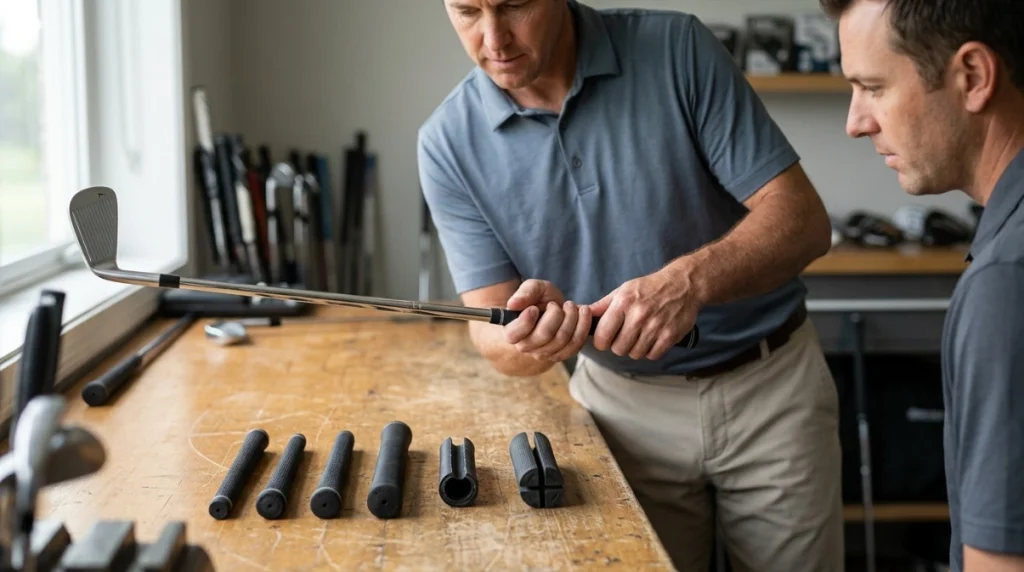
The correct iron grip size should let your hands close naturally around the club. Your fingers shouldn’t feel cramped, but the handle shouldn’t feel difficult to wrap your hands around either.
Common retail categories include undersize, standard, midsize, and jumbo or oversize. The names are helpful starting points, not universal fitting rules.
Use your hand fit as the first check
One simple test is to take your normal address grip and look at the fingers of your upper hand. They should come close to the heel pad without strongly digging underneath it.
- Fingers digging deeply: The grip may feel too small for your hands.
- Fingers comfortably meeting: You may be near a useful starting size.
- Large gap at the heel pad: The grip may feel too large.
Glove size can also provide an initial clue. I still prefer judging the completed grip in the hands because two golfers with similar glove sizes can prefer different feels.
The Golf Pride fitting resources are useful for seeing how manufacturers approach hand and grip sizing.
Remember that grip labels do not tell the whole story
The internal core diameter also affects installation. Common markings such as 58 and 60 refer to nominal core diameters around 0.580 and 0.600 inches.
Shaft butt diameter and build-up tape can change the finished result. That is why two grips carrying the same size label don’t always feel identical after installation.
| Grip factor | Specific example | Why it matters |
|---|---|---|
| Core marking | 58 core | Nominal internal core diameter is about 0.580 inches. |
| Core marking | 60 core | Nominal internal core diameter is about 0.600 inches. |
| Build-up | Extra tape layers | Can create an in-between size without changing grip model. |
| Size category | Standard, midsize, jumbo | Lets golfers compare progressively larger handle options. |
Don’t choose size from a swing myth
You may hear that a larger grip automatically stops a hook or that a smaller grip automatically creates a draw. I wouldn’t choose an entire iron set around a claim that simple.
Grip size can change comfort and hand awareness. Ball flight still depends on the whole swing, club delivery, lie angle, face angle, shaft, and impact.
Pro tip: If you’re changing grip size to solve a ball-flight problem, test the idea with a qualified PGA professional or club fitter before regripping the full set.
Section Takeaway: Start with hand fit, then test the finished grip. Size labels, shaft diameter, and installation can all change what you feel.
Which Grip Material Works Best on Iron Clubs?
There is no single material that works best for every golfer. I choose grip material by balancing traction, firmness, comfort, and the conditions I normally play in.
Rubber grips
Rubber and rubber-based compounds are common because they can offer a familiar blend of comfort and traction. Surface patterns can range from smooth and soft to firm and heavily textured.
I like this style when I want a straightforward grip that doesn’t feel harsh. It is also easy to compare many texture options within this category.
Cord grips
Cord fibers add a rougher surface and can provide stronger traction when hands or grips become damp. Some golfers love that locked-in feel, while others find full cord too abrasive.
A full-cord grip is worth testing if you often play in humidity or rain. Try one club first if you are unsure about the texture.
Hybrid grips
Hybrid grips combine materials or textures in different sections of the handle. A common idea is firmer traction under the upper hand with a different feel under the lower hand.
This can work well when you want traction without a full-cord sensation across both hands. The exact construction varies by manufacturer.
You can compare current material and construction options through established grip makers such as Lamkin.
| Grip type | Typical feel | Worth considering when |
|---|---|---|
| Rubber | Ranges from soft to firm | You want familiar feel and broad texture choices |
| Full cord | Firm and textured | You prioritize traction in moisture |
| Hybrid | Mixed textures | You want different feel zones for each hand |
| Soft compound | Cushioned | Comfort matters more than a firm response |
Weather should influence the choice too. A soft grip that feels excellent indoors may not give you the traction you want during a humid summer round.


Tapered vs Reduced-Taper Grips: Which Should You Choose?
A traditional tapered grip becomes narrower toward the lower hand. A reduced-taper grip keeps more thickness through that lower section.
Neither design is automatically better. The useful choice is the one that lets both hands sit on the club without unwanted tension.
Traditional taper
This is the shape many golfers recognize immediately. The upper hand sits on a thicker section while the lower hand wraps around a narrower area.
I prefer traditional taper when I want a familiar transition from top to bottom. It also makes it easy to compare new grips with older sets I’ve already played.
Reduced taper
Reduced-taper grips keep the lower-hand section relatively thicker. Some golfers prefer the fuller sensation because both hands feel closer in size on the handle.
You can also alter the lower-hand build with installation tape. That can be useful when a standard grip feels right at the top but too narrow farther down.
- Choose traditional taper if the classic shape already feels natural.
- Try reduced taper if your lower hand feels cramped or overly active.
- Test build-up tape when you’re between profiles.
- Fit one club first before changing every iron.
I usually test a 7-iron because it is easy to hit repeatedly on the range. A short trial exposes an uncomfortable grip faster than staring at specifications online.
How Should an Iron Grip Feel in Your Hands?
A good iron grip should feel secure before you start squeezing. You should be able to hold the club with comfortable pressure and still sense where the club is throughout the swing.
I look for three things immediately: finger position, surface traction, and tension in the forearms. If one feels wrong at address, I don’t expect it to improve at full speed.
Signs the grip may feel too small
- Your fingers feel crowded against the palm.
- You feel as though you must wrap your hands tightly around the handle.
- The lower hand feels cramped.
- You notice uncomfortable pressure points after repeated shots.
Signs the grip may feel too large
- You struggle to wrap your fingers naturally around the handle.
- The club feels bulky before the swing starts.
- Your normal hand position feels stretched.
- You lose the comfortable finger contact you expect.
Traction matters as much as diameter
A grip can be the correct size and still feel wrong because the surface has worn smooth. Dirt, skin oils, sunscreen, and ordinary use can reduce the clean texture you felt when the grip was new.
Clean the grip before replacing it if the material is still in good condition. Mild soap, water, and careful drying can sometimes restore useful surface feel.
If you’re unsure whether the problem comes from grip fit or swing technique, a PGA professional can help separate equipment fit from movement issues.
Pro tip: Persistent hand, wrist, or joint discomfort deserves professional attention rather than repeated grip experiments.
Should Every Iron Have the Same Grip?
For most golfers, matching grips across the iron set makes sense because it gives every club a consistent hand feel. The same model, size, and installation method also remove one variable as you move through the bag.
I notice mismatched grips most when moving from a mid-iron to a scoring club. A sudden change in diameter or texture can make the next club feel unfamiliar before I even swing.
Consistency usually helps
A matched iron set gives you predictable texture and taper. That is useful when your 5-iron, 7-iron, 9-iron, and pitching wedge all need different swings but the same basic hand connection.
- Use the same grip model when possible.
- Keep grip size consistent unless fitting suggests otherwise.
- Use the same tape build throughout the set.
- Align logos or ribs consistently during installation.
When different grips can make sense
There are exceptions. A golfer may intentionally use a different grip on specialty wedges, a training club, or a club modified for a particular physical need.
That should be deliberate rather than accidental. I wouldn’t leave three random grip models on an iron set simply because they still have some life left.
Don’t forget swing weight and total feel
Grip models can differ in weight. A major weight change at the handle can alter how the overall club feels, even when the head and shaft stay unchanged.
That does not mean heavier or lighter is automatically better. It means a club fitter should consider the whole build when you make a large grip change.
Pro tip: If you’re changing size and grip weight together, ask a qualified club fitter to check the completed iron rather than treating the grip as an isolated part.
When Should You Replace Iron Grips?
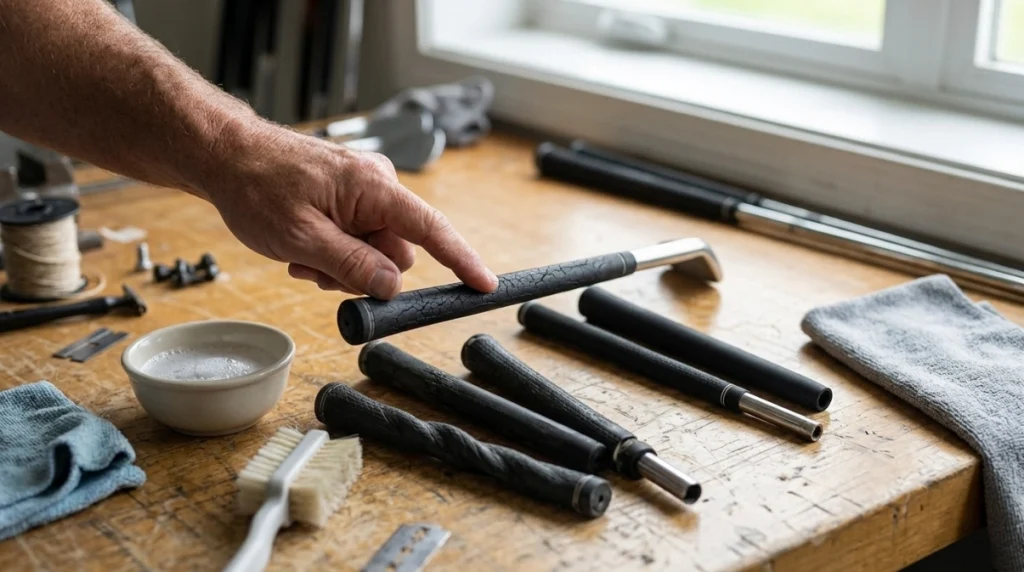
Replace an iron grip when wear prevents it from giving you secure, predictable contact. Calendar age matters less than actual condition, playing frequency, storage, and exposure.
I inspect grips by touch before judging them by appearance. A grip can look acceptable yet feel polished and hard where my hands contact it most.
Common signs an iron grip needs attention
- Slick surface: The grip stays slippery even after cleaning.
- Hardening: The compound feels noticeably firmer and less responsive.
- Cracking: Visible splits appear in the material.
- Worn texture: Raised patterns have flattened in high-contact areas.
- Loose grip: The grip twists or moves on the shaft.
- Uneven set: Some clubs feel fresh while others feel polished and old.
Clean before you replace
Normal grime can imitate wear. I clean a questionable grip first, let it dry fully, and then check the traction again.
- Use mild soap with water.
- Gently scrub the grip surface.
- Rinse away soap residue.
- Dry it completely before playing.
- Replace it if secure texture does not return.
Avoid using a harsh chemical just to make the grip feel tacky again. You don’t want to damage the material while trying to extend its life.
Inspect the whole set at once
When one iron feels suspicious, I check every grip in the bag. Clubs used most often may show wear before less-used long irons.
This set-wide inspection also helps maintain consistency. You can decide whether one club needs attention or whether a complete regrip makes more sense.
Section Takeaway: Judge replacement by condition and traction, not a rigid date. Clean first, then replace grips that remain slick, cracked, hardened, loose, or badly worn.
Grip for Irons FAQ
What is the best grip size for irons?
The best size is the one that lets your hands close naturally around the club without crowding or stretching your fingers. Standard is only a size category, so test hand fit instead of assuming it is automatically correct.
Are midsize grips good for irons?
Midsize grips can work well when standard grips feel too narrow or when you simply prefer a fuller handle. Test one iron first because hand size, taper preference, shaft diameter, and tape build all affect the finished feel.
Should beginners use standard golf grips?
Beginners do not automatically need standard grips. A new golfer should use a comfortable size that supports a secure hold, then focus on learning sound grip technique with an instructor.
Are cord grips better for irons?
Cord grips aren’t universally better, but their textured construction can appeal to golfers who want stronger traction. They are worth considering in wet or humid conditions, although some players prefer the softer feel of rubber compounds.
Can I put extra tape under an iron grip?
Yes, installers commonly use additional build-up tape to create a slightly larger finished diameter. The amount and placement should stay consistent if you want the same feel throughout an iron set.
Can different grip sizes change my ball flight?
Grip size can change comfort, hand awareness, and how you hold the club, but it should not be treated as a guaranteed ball-flight correction. Have your swing and equipment checked if you are trying to fix a persistent hook, slice, or strike problem.
Are large golf grips legal on irons?
Larger iron grips can conform, but they still have to meet equipment rules for golf club grips. USGA rules govern factors such as shape, cross-section, and maximum dimensions, so unusual designs should be checked before competition.
How Do You Choose the Right Grip for Your Irons?
Start with size, then work through texture, material, taper, and condition. A grip should let you hold the iron securely without forcing your fingers or forearms to work harder than necessary.
As of 2026, I still see grip fitting as one of the simplest equipment checks golfers overlook. It costs nothing to compare how different sizes feel before committing to an entire set.
- Check how your fingers meet the heel pad.
- Choose traction for your normal playing conditions.
- Compare traditional and reduced-taper shapes.
- Keep the iron set consistent where practical.
- Clean worn-looking grips before replacing them.
- Test one club before making a major size change.
If your current irons feel slippery, cramped, bulky, or inconsistent, start at the handle. The right grip won’t replace good technique, but it can give your hands a much better place to begin.