
Can You Practice Golf at Home? A Complete Guide for Better Practice

Quick Answer
Yes, you can practice golf at home and improve important parts of your game without visiting a course or driving range. Putting, chipping, setup, balance, tempo, and swing positions all work well for home practice, while full shots require enough safe space and proper equipment. If you want professional feedback on your technique, the PGA of America can help you find coaching resources.
Best Ways to Practice at Home
- Putting: Work on alignment, starting direction, speed control, and short-putt confidence.
- Chipping: Use foam balls or a safe target to improve contact and landing control.
- Swing mechanics: Practice grip, posture, takeaway, rotation, balance, and finish positions without a ball.
- Impact practice: A golf impact bag or folded cushion can help you rehearse controlled impact positions.
- Full shots: A properly installed hitting net gives you another option when space and safety allow.
Start Simple
- A putter, a few balls, and 10 to 15 focused minutes can create a useful practice session.
You don’t need a driving range every time you want to work on your golf game. Some of the most repeatable skills can be practiced in a bedroom, garage, basement, backyard, or living room.
I prefer home sessions for focused repetition because there is less temptation to hit ball after ball without a goal. This guide shows what you can practice, how to stay safe, and how to build a routine that carries onto the course.
In This Guide
- Can You Really Practice Golf at Home?
- What Golf Skills Can You Practice at Home?
- How Do You Set Up a Safe Home Golf Practice Area?
- What Are the Best Golf Drills to Practice at Home?
- Is a Golf Net or Simulator Worth It at Home?
- How Often Should You Practice Golf at Home?
- Frequently Asked Questions About Practicing Golf at Home
Can You Really Practice Golf at Home?
Yes. Golf practice at home can improve several skills that influence your score, especially putting, short-game contact, setup, balance, and swing consistency.
The important part is choosing drills that give you useful feedback. Repeating a movement without knowing whether it is correct can reinforce the wrong habit.
Definition: At-home golf practice is structured golf training performed away from a course or traditional practice range, usually using limited-flight balls, putting equipment, training aids, a hitting net, or swing rehearsals.
What home practice does well
Home practice works best when the skill does not require you to watch a golf ball fly 150 yards. Putting is the clearest example because most of the important feedback happens immediately.
- Starting direction: Did the ball begin on your chosen line?
- Contact: Did you strike the center of the putter face?
- Distance control: Did the ball finish near your intended distance?
- Setup: Were your feet, eyes, hands, and clubface positioned consistently?
- Balance: Could you complete the motion without unnecessary movement?
What home practice cannot fully replace
Home practice has limits. You still need real ball flight and course conditions to understand how your swing performs outside.
A net can tell you that you made contact, but it may hide a slice or hook unless you use ball-flight technology. Grass, slopes, rough, bunkers, wind, and course pressure also change how golf feels.
- Practice at home for repetition.
- Use the range for ball-flight feedback.
- Use the course for decision-making and scoring skills.
The three forms of practice complement each other. I would not treat one as a complete replacement for the others.
As of 2026, golfers have more home-training tools available than ever, but the basic principle remains simple. Good practice needs a clear target and feedback.
What Golf Skills Can You Practice at Home?
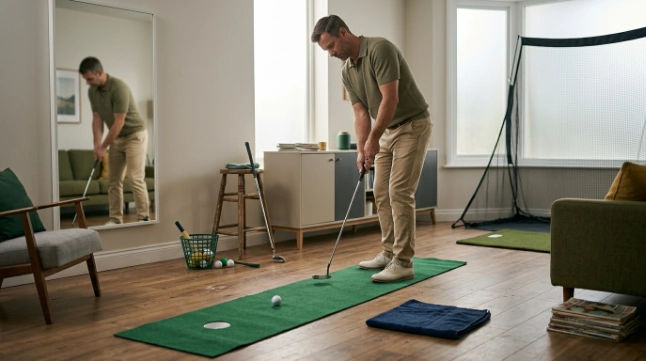
You can practice more than putting at home. The best choice depends on your available space and whether you can safely strike a ball.
| Skill | Simple Setup | Useful Practice Distance | Main Feedback |
|---|---|---|---|
| Putting | Putter, ball, flat carpet or mat | 3 to 10 feet | Start line and distance |
| Chipping | Wedge, foam balls, towel | 5 to 15 feet indoors | Contact and landing spot |
| Setup | Club and mirror | Stationary | Posture and alignment |
| Tempo | Club or training stick | No ball required | Rhythm and balance |
| Full swing | Mat, net, real or practice ball | Depends on net setup | Contact; ball flight needs more feedback |
Putting
Putting is usually the easiest skill to train indoors. Even a short stretch of level carpet can help you improve face control and starting direction.
Start with three-foot putts instead of immediately rolling balls across the room. Short putts expose face-angle mistakes quickly.
Chipping
Short chips can work well if you have a safe landing area. Indoors, I would use foam practice balls rather than standard golf balls.
Place a folded towel several feet away and treat it as your landing zone. The goal is to land the ball on the towel rather than trying to hole every shot.
Grip, posture, and alignment
These fundamentals require almost no space. A mirror is especially useful because it gives immediate visual feedback.
- Check that your grip pressure feels controlled.
- Set your feet consistently.
- Check your spine angle from the side.
- Confirm that your shoulders match your intended line.
Small setup errors can change the swing before the club even moves. Home practice gives you time to make those details repeatable.
Balance and swing positions
Slow-motion swings are useful when you cannot hit balls. Move through the takeaway, backswing, transition, impact area, and finish at reduced speed.
The slower pace lets you notice balance problems that disappear when you swing aggressively.
Pro tip: If you’re making a major swing change, ask a certified golf instructor to check the movement before repeating it hundreds of times.
How Do You Set Up a Safe Home Golf Practice Area?
Safety should decide where and how you practice. A golf club needs much more clearance than it appears to need when you’re standing still.
Check the full swing path before using any club. That includes the backswing, downswing, follow-through, ceiling, walls, lights, furniture, windows, pets, and people nearby.
Start with slow clearance checks
Never begin with a full-speed swing in a new space. Hold the club normally and make several slow rehearsals first.
- Stand in your intended hitting position.
- Make a slow backswing.
- Pause and check ceiling clearance.
- Move slowly through impact.
- Finish the swing and check surrounding objects.
- Repeat with the longest club you expect to use.
Choose the right practice ball
A standard golf ball can damage drywall, glass, screens, furniture, and other objects. It can also cause injury if a shot escapes your practice area.
- Real golf balls: Reserve them for a secure net designed for golf shots.
- Foam balls: Useful for indoor chipping and reduced-risk practice.
- Plastic practice balls: Helpful for light outdoor drills where full ball flight is unnecessary.
- No ball: Best for mirror work, balance drills, and slow swing rehearsals.
Check your hitting net carefully
A net should have enough surrounding protection for your worst shot, not just your best one. Think about shanks, topped shots, high wedges, and rebounds.
Inspect the net regularly for wear or openings. Leave enough space behind it so a struck ball cannot push the material directly into a wall or window.
The USGA is a useful authority for the Rules of Golf and equipment standards, while your home setup still requires common-sense safety beyond the Rules.
Section Takeaway: Build your practice area around the worst possible miss. If a bad swing could hit a person, window, vehicle, television, or fragile object, change the setup before hitting balls.


What Are the Best Golf Drills to Practice at Home?
The best home golf drills produce feedback you can see or measure. Randomly swinging a club for 30 minutes is less useful than ten focused repetitions with a specific target.
1. Putting gate drill
This drill tests whether you can start the ball on your intended line. You need a putter, ball, and two small objects such as coins.
- Choose a target about three to six feet away.
- Place two coins slightly wider than the golf ball.
- Position the gate several inches in front of the ball.
- Roll the ball through the gate.
- Complete sets of six putts.
If the ball repeatedly hits one side, your starting direction needs attention. Adjust your setup or face control instead of changing your target.
2. Distance-control ladder
Distance control matters even when your indoor surface does not perfectly match a putting green. The drill trains you to produce different roll lengths on purpose.
- Mark targets at roughly three feet.
- Add another at six feet.
- Add a third near nine feet if space allows.
- Roll one ball to each target in sequence.
- Repeat the sequence from longest to shortest.
Focus on changing stroke length while keeping your rhythm smooth. Avoid suddenly hitting the ball harder with your hands.
3. Towel landing drill for chipping
Place a towel on the floor and chip foam balls toward it. Count a successful shot when the ball lands on the towel before bouncing away.
Start close enough that you can succeed regularly. Then move the towel farther away or make the target smaller.
4. Mirror setup drill
Stand in front of a mirror with a mid-iron. Build your normal address position without hitting a ball.
- Check knee flex.
- Check your spine angle.
- Check hand position.
- Check shoulder alignment.
- Look for unnecessary tension.
Step away after every repetition. Rebuilding the position is more useful than standing there and making tiny adjustments for several minutes.
5. Slow-motion swing drill
Make swings at around half your normal speed. Pause at several positions and check whether you remain balanced.
Finish each repetition with your weight supported comfortably and your body under control. If you cannot hold the finish, slow down again.
6. Chair or wall awareness drill
A chair or wall can provide a reference for body movement, but use it carefully. The goal is awareness, not forcing your body against an object.
Rehearse slowly and stop if you feel restricted or uncomfortable. A qualified coach can help confirm whether the movement suits your swing.
Pro tip: A certified PGA Professional can identify whether a drill matches your actual swing fault before you build it into your routine.
Section Takeaway: Give every drill a target, number of repetitions, and success measure. Ten deliberate swings with feedback usually teach you more than an unfocused pile of repetitions.
Is a Golf Net or Simulator Worth It at Home?
A golf net can be useful if you want to hit real shots without traveling to a range. A simulator adds more feedback, but neither is necessary for productive home practice.
| Setup | What You Can Practice | Feedback Level | Best For |
|---|---|---|---|
| No-ball practice | Setup, positions, tempo, balance | Movement feedback only | Small spaces |
| Putting mat | Putting stroke and start line | Good for short putting | Daily practice |
| Hitting net | Full swings and contact | Limited ball-flight feedback by itself | Garage or backyard practice |
| Net plus launch monitor | Full swing with measured shot data | Higher | Structured swing practice |
| Golf simulator | Shot practice and simulated course play | Depends on the tracking system | Dedicated home golf spaces |
When a net makes sense
A net is most useful when you already have enough safe space to make unrestricted swings. It lets you work on contact and repeat movements without collecting balls after every shot.
The weakness is obvious. You cannot judge complete ball flight by watching the ball travel a few feet into a net.
When a launch monitor helps
A compatible launch monitor can provide additional information about the shot. The exact measurements available depend on the device and tracking method.
That feedback can make net practice more useful because you are no longer judging the swing only by feel.
Do beginners need a simulator?
No. Beginners can build useful skills with a putter, wedge, practice balls, mirror, and enough room for controlled rehearsals.
A simulator becomes more attractive when you want a dedicated indoor practice environment. It should solve a real practice problem rather than become an expensive substitute for a simple routine.
For broader instruction ideas, Golf Digest publishes golf instruction alongside equipment and course coverage.
How Often Should You Practice Golf at Home?
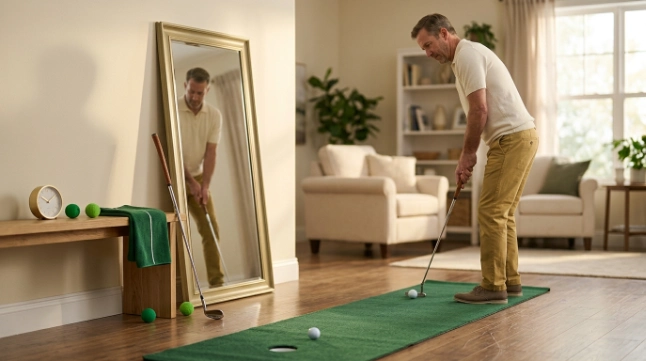
Short, focused sessions work well for home practice because they are easy to repeat. You do not need a marathon session every weekend.
A practical starting point is 10 to 20 minutes per session, several times each week. Stop before your concentration disappears and your repetitions become careless.
A simple weekly home golf routine
| Day | Focus | Example Session |
|---|---|---|
| Monday | Putting | 10 minutes of three- to six-foot start-line practice |
| Wednesday | Setup and swing | 15 minutes of mirror work and slow swings |
| Friday | Short game | 15 minutes of foam-ball landing practice |
| Weekend | Transfer | Range session or round when possible |
Practice with a purpose
Before every session, decide what you are trying to improve. Do not simply choose a club and start swinging.
- Bad goal: Practice putting for 20 minutes.
- Better goal: Start 15 of 20 three-foot putts through a small gate.
- Bad goal: Work on my swing.
- Better goal: Make 20 balanced slow swings and hold every finish for three seconds.
Measurable practice shows whether you are improving. It also makes a short session feel more purposeful.
Transfer the skill to real golf
Home practice should eventually connect to the course. Use your next range session or round to see whether the new movement survives when you have a real target.
Rules and playing conditions matter once you return to the course. The R&A provides official Rules and governance resources for golfers around the world.
If the home drill works only in your living room, keep refining how you transfer it. The goal is better golf, not simply becoming good at the drill.
Frequently Asked Questions About Practicing Golf at Home
Can beginners practice golf at home?
Yes. Beginners can practice grip, posture, alignment, putting, short chips, balance, and slow swing movements at home. These fundamentals can be trained without hitting full shots, making home practice especially useful when a beginner cannot visit a range regularly.
Can I practice my golf swing indoors?
Yes, but only when you have enough clearance around and above you. Start with slow rehearsals and check the complete path of the club. If your ceiling or surrounding objects are close, use a shorter training stick or practice setup and movement without making full swings.
Can I practice golf without hitting a ball?
Yes. No-ball drills can improve setup consistency, balance, tempo, grip, posture, and awareness of swing positions. A mirror can provide useful visual feedback. You will still need ball-flight practice later to confirm how those changes affect actual shots.
What can I use instead of golf balls indoors?
Foam or lightweight plastic practice balls can reduce the risk of indoor damage. They work well for short chips and contact drills. They are not completely risk-free, so keep fragile objects, pets, and people outside the practice area.
Can carpet be used to practice putting?
Yes. A reasonably flat carpet can help with starting direction and stroke mechanics. Its speed may differ from a real putting green, so do not expect distance control learned on carpet to transfer perfectly. Focus first on centered contact and starting the ball on line.
Is 10 minutes of golf practice enough?
Ten focused minutes can be productive when the session has one measurable goal. For example, you can spend ten minutes starting short putts through a gate. A brief deliberate session is often more useful than much longer practice with no clear objective.
Will practicing golf at home lower my score?
Home practice can strengthen skills that influence scoring, especially putting and short-game consistency. However, scoring also depends on ball striking, course management, uneven lies, hazards, weather, and pressure. Combine home practice with range work and on-course play when possible.
Yes, you can practice golf at home effectively. The key is choosing skills that fit your available space and creating feedback instead of simply repeating swings.
Start with putting, setup, balance, and short-game contact. Build a routine you can repeat, then test those skills at the range and on the course.
You do not need a complicated home golf studio to begin. A clear goal, a safe practice area, and 10 focused minutes are enough to make the first session worthwhile.