
Driving Range Guide: How to Practice Golf With Purpose

Quick Answer
A driving range is a practice facility where golfers hit balls from individual bays toward marked targets. For a productive session, warm up first, choose one goal, practice with targets, change clubs regularly, and finish with simulated holes. A lesson from a qualified PGA golf professional can help you build safe fundamentals.
A simple range-session plan
- Warm up: Make slow practice swings before hitting 10 easy wedge shots.
- Pick a target: Aim at a flag, marker, or narrow landing area for every shot.
- Build gradually: Move from wedges to irons, woods, and finally the driver.
- Change clubs: Avoid hitting the same club for an entire bucket.
- Track results: Record solid strikes, starting direction, and shot pattern.
- Stop before fatigue: Quality practice matters more than emptying a large bucket.
Best beginner tip
- Begin with a small bucket and controlled half-swings instead of chasing maximum distance.
A driving range gives you room to learn without the pressure of keeping pace on a golf course. It is where I test swing changes, confirm club distances, and rebuild confidence after a difficult round.
This driving range guide explains what to expect, what to bring, how to practice, and which mistakes waste the most time. It is designed for beginners, but developing golfers can use the same structure to sharpen their practice in 2026.
In This Guide
What Is a Driving Range?
A driving range is a dedicated golf practice area with individual hitting stations and an open landing field. Golfers hit repeated shots toward flags, nets, greens, or distance markers.
Despite its name, the facility is not only for practicing with a driver. You can work on wedges, irons, hybrids, fairway woods, and tee shots.
Definition: A driving range is a controlled practice facility where golfers develop contact, direction, distance control, and swing consistency without playing complete holes.
How does a driving range work?
You normally pay for a bucket containing a set number of range balls. The facility then assigns a bay or allows you to choose an open station.
Depending on the property, you may hit from:
- Natural grass
- Synthetic hitting mats
- Covered or heated bays
- Indoor simulator bays
- Upper levels at a multi-story facility
Outdoor ranges often display distance markers at 50, 100, 150, and 200 yards. Treat those numbers as estimates unless the facility confirms how they were measured.
Grass range vs. hitting mats
A grass range gives you turf interaction similar to an actual fairway. It allows you to see whether the club strikes the ball before entering the ground.
A mat stays level and usable during wet weather. However, it can disguise a heavy strike because the club may bounce into the ball.
| Practice surface | Main advantage | Main limitation | Best use |
|---|---|---|---|
| Natural grass | Realistic turf feedback | May close or move during poor conditions | Iron and wedge contact |
| Synthetic mat | Consistent stance and year-round access | Can hide shots struck behind the ball | General practice and warmups |
| Indoor simulator | Shot data and weather protection | Limited outdoor ball-flight feedback | Club-distance and launch analysis |
When practicing on grass, follow the facility’s divot pattern. Many ranges prefer a straight line of consecutive divots because it leaves more recoverable turf.
Section Takeaway: A driving range supports every full-swing club, not only the driver. Grass provides better contact feedback, while mats offer convenience and consistency.
What Should You Expect on Your First Visit?
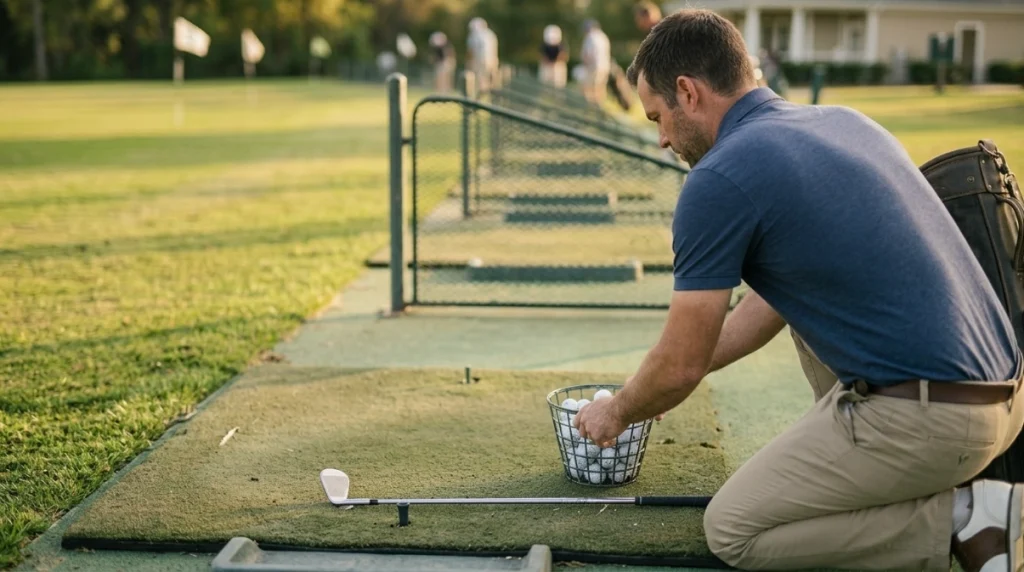
Your first range visit should feel informal. You do not need a handicap, tee time, complete club set, or polished swing at most public facilities.
Policies differ, so check opening hours, dress requirements, rental options, and whether the range uses tokens or prepaid cards. Some facilities close grass sections after rain or for scheduled maintenance.
Arriving and getting golf balls
Start at the golf shop, reception desk, or ball dispenser. Ask an employee which bays beginners may use and whether any part of the facility is reserved for lessons.
Bucket sizes vary by location. A small bucket often makes the best first choice because repeated full swings can cause fatigue.
Your basic arrival process will usually look like this:
- Pay for a bucket or load credit onto a range card.
- Collect balls from the counter or dispenser.
- Choose an available bay or receive an assigned one.
- Place your bag where it will not block the walkway.
- Check that nearby golfers are clear before swinging.
Understanding the hitting bay
A bay gives each golfer a defined area. Stay inside it and never walk forward to collect a ball, tee, or club.
Outdoor range equipment may include:
- A rubber tee for drivers and fairway woods
- A hitting mat or marked grass section
- A bag stand or club rack
- Target maps and distance labels
- A ball tray or automatic teeing system
Some ranges provide launch-monitor data. Common measurements include ball speed, launch angle, carry distance, and shot direction.
Carry distance measures how far the ball travels through the air. Total distance includes the bounce and roll after landing.
Driving range safety and etiquette
Safety comes before technique. The clubhead moves quickly, while balls can travel far enough to cause serious injury.
Follow these rules throughout the session:
- Never step in front of the hitting line.
- Check beside and behind you before every swing.
- Keep children within close supervision.
- Do not walk onto the field to retrieve balls.
- Avoid loud conversations near someone preparing to hit.
- Never aim over boundary nets or toward range workers.
- Wait for an all-clear signal after any practice-area closure.
The R&A publishes the Rules of Golf and player conduct guidance. Local range signs still take priority because each facility has different boundaries and operating procedures.
Section Takeaway: Ask how the facility works, remain behind the hitting line, and start with fewer balls. A calm first visit is more useful than an exhausting one.
What Should You Bring to a Driving Range?
You need only a few clubs, comfortable clothing, and a plan. Most first-time golfers can rent equipment instead of buying a complete set.
Essential equipment
A simple practice bag might contain:
- A pitching wedge or sand wedge
- A 7-iron or 8-iron
- A hybrid or fairway wood
- A driver
- A golf glove
- A small towel
- Water and weather protection
You do not need to bring your own golf balls. Ranges supply balls designed for repeated practice and easy collection.
Do not remove those balls from the facility. Range balls belong to the operator and may perform differently from regular course balls.
Can you rent golf clubs?
Many public ranges rent individual clubs or small sets. Call first because availability, club condition, and left-handed options vary.
A beginner can learn with one wedge and one mid-iron. Add a longer club only after you can make balanced swings with the shorter clubs.
What should you wear?
Wear clothing that allows comfortable rotation. Athletic shoes work at many public ranges, although some private clubs enforce golf-specific dress rules.
Bring these weather items when needed:
- Sunscreen and a hat for exposed outdoor bays
- A light rain jacket for changing conditions
- Warm layers for covered winter practice
- A water bottle during hot or humid weather
A glove can reduce slipping and rubbing, but it is not required. Right-handed golfers normally wear one on the left hand, while left-handed golfers wear one on the right.
Which clubs should a beginner hit first?
Start with a wedge or short iron. Its shorter shaft and higher loft make controlled contact easier than a low-lofted driver.
Loft is the angle of the clubface that helps launch the ball. A pitching wedge commonly has much more loft than a driver, although exact specifications vary by model.
I normally begin with waist-high wedge swings. Those shots reveal my balance and contact without placing full-speed stress on my body.
Pro tip: Ask a certified instructor or qualified club fitter to check club length, grip size, and shaft weight if the equipment feels difficult to control.
Section Takeaway: Bring only enough equipment to support your goal. Short clubs, comfortable shoes, water, and weather protection cover most beginner sessions.


How Should You Practice at a Driving Range?
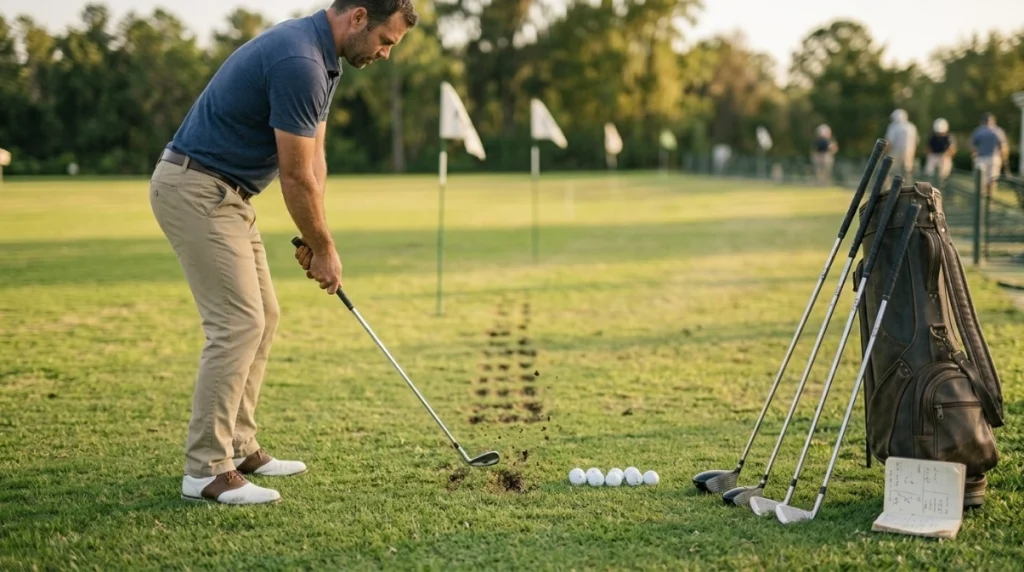
Effective practice needs a target, a routine, and feedback. Hitting balls quickly without changing the task mostly trains you to hit balls quickly.
1. Warm up without a ball
Begin with gentle shoulder turns, hip rotations, and slow swings. Then make several balanced motions with a wedge.
Do not force your maximum range of motion. Stop if you feel sharp pain, dizziness, or unusual discomfort.
2. Hit short wedge shots
Use 10 balls to develop centered contact. Make half-swings toward a close target instead of trying to generate distance.
Pay attention to:
- Where the ball starts
- Whether contact feels centered
- Whether you remain balanced
- Where the club meets the turf
3. Build through the bag
Move gradually from shorter clubs to longer ones. A practical sequence is wedge, 9-iron, 7-iron, hybrid, fairway wood, and driver.
Hit five to eight purposeful shots with each club. That gives you enough repetition without encouraging careless swings.
4. Use a target for every shot
Choose a flag or create a landing zone between two markers. Stand behind the ball, select your target, and align before entering your stance.
A target changes the task from swinging to playing a golf shot. It also exposes a consistent miss pattern.
5. Practice one technical change at a time
Working on grip, posture, backswing length, and downswing position together creates confusion. Choose one clear priority for the session.
Good practice goals include:
- Starting eight of 10 shots inside a defined corridor
- Finishing in balance after every swing
- Contacting the ball before the ground with an iron
- Producing three different wedge carry distances
- Keeping driver shots within two target markers
The goal should measure a result you can observe. “Hit the ball better” is too broad to guide useful practice.
6. Simulate holes near the end
Range practice becomes more realistic when you change clubs after every ball. Imagine a hole and select shots based on the result.
A sample simulated par 4 might include:
- Hit a driver toward a fairway-width target.
- Choose an iron based on the estimated remaining distance.
- Play a wedge if the approach would have missed short.
- Reset and imagine a different hole.
You cannot replay a poor shot immediately on a course. This drill helps you accept the result and prepare for the next decision.
7. Finish with confidence
End with several smooth shots using a comfortable club. Avoid finishing the session by repeatedly attacking the driver while tired.
Write down one successful pattern and one priority for next time. A short practice record makes improvement easier to judge.
The USGA provides equipment and Rules of Golf resources. Use those references when equipment conformity or formal play matters.
Pro tip: A certified golf instructor can confirm whether a repeated miss comes from technique, alignment, or unsuitable equipment.
Section Takeaway: Warm up, work from short clubs to long clubs, and aim every shot. Finish by changing clubs as you would during a real round.
How Is Range Practice Different From Playing Golf?
A range helps you repeat and evaluate shots. A course tests decision-making, uneven lies, changing targets, penalties, and emotional control.
Both settings matter. Range skill does not transfer automatically unless your practice includes targets, routines, and club changes.
| Factor | Driving range | Golf course |
|---|---|---|
| Shot repetition | Many similar shots are possible | Usually one attempt per situation |
| Lie | Mostly flat and consistent | Level, sloped, rough, sand, or divot |
| Targets | Open field with several markers | Defined fairways, greens, and hazards |
| Consequences | Another ball is immediately available | Poor shots affect position and score |
| Primary benefit | Technique and controlled repetition | Strategy and complete playing skill |
Why do range shots sometimes travel differently?
Range balls may use durable covers and limited-flight designs. Their carry, spin, launch, and feel can differ from the balls you play on the course.
Weather also changes distance. Temperature, wind, elevation, turf firmness, and moisture can influence the result.
Do not build an exact distance chart from worn range balls alone. Confirm important carry distances with your normal ball under suitable conditions.
Why can you hit well on the range but struggle on the course?
Repetition creates rhythm and allows immediate correction. On the course, several minutes may pass before you use the same club again.
The course also adds:
- Penalty areas and out-of-bounds stakes
- Uneven ground
- Different wind directions
- Pressure from score and playing partners
- Decisions about targets and club selection
Use a complete pre-shot routine at the range to close this gap. Step away after every ball instead of dragging another into position.
Combine range sessions with putting, chipping, bunker practice, and short-course play. Full swings represent only one part of golf.
Section Takeaway: The range develops repeatable shots, while the course tests when and where to use them. Simulated holes make practice transfer more effectively.
Which Driving Range Mistakes Should You Avoid?
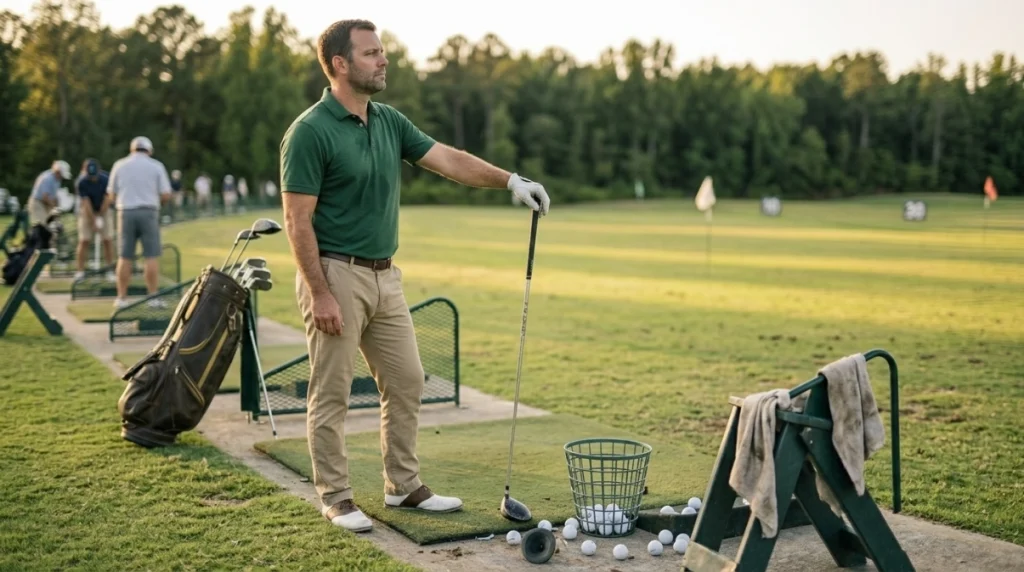
The biggest mistake is treating the bucket as a task to finish. A tired, rushed swing can reinforce the pattern you came to correct.
Hitting every shot at full power
Maximum effort often reduces balance and centered contact. Most practice swings should feel controlled enough to finish without stepping or falling.
Speed work needs a clear method and suitable physical preparation. It should not become the default for every ball.
Using only the driver
Driver practice can be useful, but it gives an incomplete picture of your game. Approaches and short shots require different lengths, trajectories, and targets.
Allocate more balls to clubs you use for approach shots. Save a smaller group for the driver unless tee shots are the day’s main priority.
Hitting without alignment
Aiming errors can look like swing faults. Place an alignment stick or spare club on the ground only when the facility permits it.
The guide should point parallel to the target line, not directly at the target. Remove it before moving or leaving the bay.
Practicing too quickly
A pause between shots helps you evaluate the last result. Use that time to change clubs, select a target, and rehearse the next movement.
A purposeful 45-ball session can provide more value than 100 rushed swings. Fatigue changes posture, tempo, and decision-making.
Copying random swing advice
One golfer’s correction may exaggerate your existing problem. Video tips also lack information about your ball flight, physical movement, and equipment.
Use trustworthy instruction and test one change at a time. The Golf Digest instruction section offers broad educational material, but individual coaching provides personal feedback.
Ignoring pain or physical strain
Repeated swings place stress on the hands, wrists, elbows, back, and hips. Stop when discomfort becomes sharp or worsens with each shot.
Warm up and allow recovery between demanding sessions. Seek appropriate medical advice when pain persists or affects normal movement.
Pro tip: Work with a certified instructor on movement and a qualified healthcare professional on persistent pain before attempting major swing changes.
Section Takeaway: Do not measure practice by bucket size or driver distance. Measure it through balance, contact, direction, and decisions you can repeat.
Driving Range FAQ
How much does it cost to use a driving range?
Prices vary by location, bucket size, technology, and facility type. Traditional outdoor ranges often charge by the bucket, while entertainment venues and simulator facilities may charge by time or bay.
How many balls should a beginner hit?
A beginner should start with a small bucket and stop when balance or contact declines. Around 30 to 50 purposeful shots can be enough for an introductory session, although there is no required number.
Can you go to a driving range if you have never played golf?
Yes. Public driving ranges commonly welcome complete beginners. Tell an employee that it is your first visit, ask about rental clubs, and learn the facility’s safety rules before swinging.
Do you need to book a driving range bay?
Some facilities accept walk-ins, while busy ranges, simulators, and multi-level venues may require reservations. Check the official facility website or call ahead, especially during evenings and weekends.
Can you use tees at a driving range?
Yes, most ranges allow tees for drivers and other clubs. Mat-based bays often have rubber tees, while grass ranges may permit normal wooden or plastic tees within the marked hitting area.
Can you practice without a driver?
Yes. Wedges and irons are often better for learning contact, direction, and distance control. A complete beginner can have a productive session with one wedge and one mid-iron.
How often should you practice at the range?
One or two focused sessions each week can support steady development when combined with rest and short-game practice. Consistent, purposeful sessions are more useful than occasional large buckets hit without a plan.
Is a driving range lesson worth it?
A lesson can help beginners learn grip, posture, alignment, and safe movement. It can also prevent a golfer from repeating a poor pattern through hundreds of unguided swings.
The best driving range session has one purpose. Arrive with a target, warm up properly, evaluate each shot, and finish before fatigue controls your swing.
Start with a small bucket and three clubs on your next visit. Record what the ball does, then use that evidence to plan the following session.