
Golf Swing Basics: A Complete Beginner’s Guide

Quick Answer
Golf swing basics begin with a neutral grip, balanced posture, correct ball position, and smooth body rotation. Start with half-swings and focus on centered contact before adding speed. A complete beginner golf guide can also help you connect swing practice with equipment, scoring, and course etiquette.
Seven Simple Swing Steps
- Choose one club: Begin with a pitching wedge or 7-iron.
- Grip lightly: Hold the club securely without tightening your arms.
- Build your stance: Stand in an athletic, balanced position.
- Aim the face: Point the clubface at the target before setting your feet.
- Turn back: Move your shoulders, chest, and arms together.
- Rotate through: Shift pressure toward your lead foot and face the target.
- Hold the finish: End balanced instead of chasing maximum speed.
Best Way to Confirm Progress
- Judge improvement by contact, starting direction, and balance—not distance alone.
Golf swing basics can feel confusing when every video offers a different tip. I prefer a simpler approach built around setup, balance, contact, and rhythm.
This guide explains the complete beginner golf swing in a practical order. You will also learn how to practice without filling your head with too many thoughts.
In This Guide
- What Are the Basic Fundamentals of a Golf Swing?
- How Should a Beginner Grip and Address the Ball?
- What Is the Correct Golf Swing Sequence?
- Does the Swing Change for Different Golf Clubs?
- How Should a Beginner Practice the Golf Swing?
- What Are the Most Common Beginner Swing Mistakes?
- Golf Swing Basics FAQs
What Are the Basic Fundamentals of a Golf Swing?
The basic golf swing uses a balanced setup and coordinated body turn to move the club through the ball. Good contact matters more than raw effort.
Definition: A golf swing is the coordinated motion used to move a club from the address position, into the backswing, through impact, and into a balanced finish.
The golf ball is not the final destination of the swing. It sits along the path of a club moving toward the target.
Many beginners stop their motion at impact. That creates weak contact, scooped shots, and an unfinished follow-through.
Centered Contact Comes First
Centered contact means striking the ball close to the middle of the clubface. It improves distance and direction without demanding more effort.
A smooth center strike often travels farther than a hard heel or toe strike. That lesson changes how most beginners practice.
- Thin contact: The lower clubface hits too high on the ball.
- Fat contact: The club strikes the ground before reaching the ball.
- Toe contact: The ball meets the outer end of the clubface.
- Heel contact: The ball meets the area closest to the shaft.
- Centered contact: The ball meets the usable middle portion of the face.
You can use impact tape or foot spray made for practice to see the strike location. Follow the product directions and clean the club afterward.
Balance Supports Every Part of the Swing
Your body must stay stable while the club changes direction quickly. Poor balance makes consistent contact much harder.
At address, feel your pressure near the middle of each foot. Avoid settling completely into your heels or leaning toward your toes.
A useful test is holding your finish for three seconds. If you must step or stumble, reduce your swing speed.
Rhythm Controls the Motion
Rhythm describes how smoothly the swing moves from start to finish. Tempo describes the relative timing of the backswing and downswing.
You do not need one perfect tempo. You need a repeatable pace that gives your body time to stay coordinated.
- Move the club away without a sudden snatch.
- Complete a comfortable shoulder turn.
- Change direction without throwing your hands at the ball.
- Keep rotating until your chest faces the target.
When my timing feels rushed, I make three slow practice swings without a ball. This usually restores the shape of the motion.
The goal is not to copy a tour player’s exact positions. Build a motion that produces safe, balanced, and repeatable contact.
Section Takeaway: Contact, balance, and rhythm form the foundation of a reliable golf swing. Develop those skills before chasing extra distance.
How Should a Beginner Grip and Address the Ball?
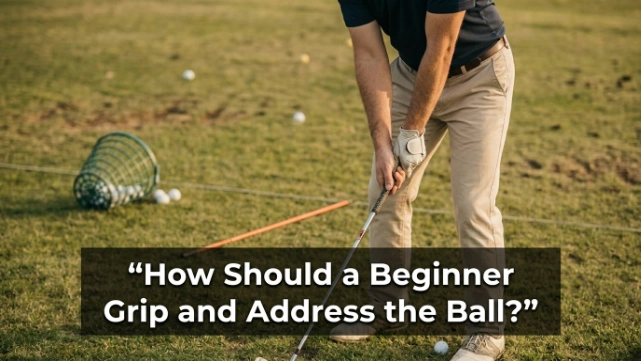
A good address position places your hands, feet, body, clubface, and ball in useful starting positions. It cannot guarantee a good shot, but it removes avoidable problems.
How to Hold a Golf Club
Your grip controls how your hands connect to the club. It influences the clubface without requiring conscious hand action during impact.
Start by placing the grip across the fingers of your lead hand. The lead hand is left for a right-handed golfer.
- Rest the club diagonally across the lead-hand fingers.
- Close the hand without squeezing hard.
- Place the trail hand below the lead hand.
- Join the hands using an overlap, interlock, or ten-finger grip.
- Check that both hands feel connected.
Many golfers describe grip pressure on a scale from 1 to 10. A starting pressure near 4 or 5 can keep the club secure without stiffening your forearms.
Pressure may increase during the swing. Avoid beginning with your hands already at maximum tension.
Choose a Comfortable Grip Style
The overlap grip places the trail-hand little finger over the lead hand. It is common among experienced golfers.
The interlock joins the trail little finger with the lead index finger. Golfers with smaller hands often find it secure.
The ten-finger grip places every finger on the club. Some beginners find it natural because it resembles holding a baseball bat.
| Grip style | How the hands connect | Possible advantage |
|---|---|---|
| Overlap | Little finger rests over the lead hand | Comfortable hand unity |
| Interlock | Little and index fingers link | Secure connection |
| Ten-finger | All fingers remain on the grip | Simple beginner feel |
Build an Athletic Golf Stance
Stand with your feet roughly shoulder-width apart for a mid-iron. Wedges can use a narrower stance, while drivers usually need a slightly wider base.
- Stand tall with the club in front of you.
- Tip forward from your hips.
- Allow your knees to soften.
- Let your arms hang below your shoulders.
- Keep your back in a comfortable, neutral position.
Avoid squatting deeply or forcing your spine into a rigid shape. Your posture should feel athletic, not strained.
Aim the Clubface Before Your Body
Choose a small target, such as a patch of grass beyond the ball. Aim the clubface toward that point first.
Set your feet, knees, hips, and shoulders roughly parallel to the target line. Your body should not point directly at the target.
I often place a second club on the ground during practice. One club shows the target line, while the other checks my foot alignment.
Pro tip: A certified PGA coach can check your grip and posture before small errors become established habits.
Section Takeaway: Aim the clubface first, then build a relaxed grip and balanced posture around it. A repeatable setup gives every swing a better chance.
What Is the Correct Golf Swing Sequence?
The correct golf swing sequence moves from setup into takeaway, backswing, transition, downswing, impact, and follow-through. These parts should blend into one motion.
1. Start With a Calm Takeaway
The takeaway covers the first part of the backswing. Your chest, shoulders, arms, and club should begin moving together.
Avoid pulling the club sharply inside with your hands. Do not lift it straight upward either.
- Keep your grip pressure steady.
- Allow your lead shoulder to move under your chin.
- Keep the clubface controlled by turning your body.
- Maintain your original balance.
2. Turn Into the Backswing
The backswing creates space and prepares the club to change direction. It does not need to reach parallel with the ground.
Turn your shoulders farther than your hips while keeping both movements comfortable. Your trail hip should move behind you rather than sliding sideways.
Your pressure will feel stronger under the trail foot. That is different from leaning your entire upper body away from the target.
3. Change Direction Smoothly
The transition is the short change from backswing to downswing. Beginners often rush here because they want to hit the ball hard.
Let pressure begin moving toward your lead side as your body starts unwinding. Your arms and club can then follow.
Simple transition cue: Finish the backswing, settle into the lead foot, and turn toward the target.
4. Swing Through Impact
Impact happens too quickly for most beginners to control consciously. A useful motion before impact creates a better impact position.
With an iron, the club normally reaches the ball before its lowest point. This allows the club to contact the ball and then brush the ground.
The driver works differently because the ball sits on a tee. A forward ball position helps the club meet it later in the swing arc.
5. Finish in Balance
Continue turning after contact. Your chest and belt buckle should finish facing the target.
Most pressure should rest on your lead foot. Your trail heel can rise naturally as your body rotates.
- Your head and chest remain tall.
- Your hands finish around the lead shoulder.
- Your trail knee moves toward the lead knee.
- You can hold the finish without stepping.
A balanced finish does not repair an earlier mistake. However, it reveals whether the swing stayed controlled.
The R&A provides official rules and resources for the game. Those rules govern play, but they do not require golfers to copy one swing style.
Section Takeaway: Treat the swing as one connected motion. Turn back, change direction smoothly, rotate through, and finish over your lead side.


Does the Swing Change for Different Golf Clubs?
The core motion stays similar, but ball position, stance width, and swing length change with the club. Longer clubs generally need more room and a wider setup.
Golf clubs also have different lofts. Loft is the angle of the clubface that helps control launch and trajectory.
| Club | Typical ball position | Stance | Main contact goal |
|---|---|---|---|
| Wedge | Near the center | Narrow to moderate | Ball first, then turf |
| 7-iron | Slightly forward of center | About shoulder width | Centered strike before the low point |
| Hybrid | One or two ball widths forward | Moderately wide | Sweep with slight downward contact |
| Fairway wood | Forward of center | Moderately wide | Shallow strike near the bottom of the arc |
| Driver | Near the inside of the lead heel | Widest | Centered contact from the tee |
Why Beginners Should Start With a 7-Iron
A 7-iron offers a useful blend of loft, shaft length, and control. It is easier to manage than a driver or long iron.
Use it for half-swings before attempting full shots. This helps you learn contact without excessive speed.
If you are unsure what else belongs in your bag, review the essential clubs beginners need.
How to Swing a Wedge
A wedge uses the same core motion with a narrower stance and shorter swing. Keep turning instead of striking only with your hands.
For a basic pitch, let the length of the swing control distance. Do not slow the club suddenly before impact.
How to Swing a Driver
The driver has a longer shaft and less loft than most beginner clubs. These features can make face control harder.
Place the ball near your lead heel and tee it high enough for a clean strike. Tilt your upper body slightly away from the target.
Do not try to lift the ball with your hands. The club’s design, ball position, and swing arc create the launch.
Our beginner’s guide to the driver covers its setup and purpose in greater detail.
Section Takeaway: Keep the same basic motion while adjusting your stance and ball position. Learn with a wedge or 7-iron before making the driver your main practice club.
How Should a Beginner Practice the Golf Swing?
A beginner should practice in short stages that move from contact to direction and distance. Working on one goal per session prevents mental overload.
Use a Simple 45-Minute Practice Plan
| Time | Activity | Main goal |
|---|---|---|
| 5 minutes | Warm-up and practice swings | Comfortable movement |
| 10 minutes | Wedge half-swings | Centered contact |
| 15 minutes | 7-iron swings | Direction and balance |
| 10 minutes | Hybrid or driver | Long-club control |
| 5 minutes | Random targets | On-course decisions |
Start With the Feet-Together Drill
Place your feet a few inches apart and make short swings with a wedge. This drill discourages excessive force and highlights poor balance.
- Use a short club and a low practice tee.
- Make a waist-high backswing.
- Brush the ground after the ball.
- Finish with your chest facing the target.
- Return to a normal stance after several solid shots.
Practice the Low-Point Line Drill
Draw a line on a grass practice area where the facility permits it. Place the ball just ahead of the line.
Try to strike the ball before brushing the ground on the target side. This provides immediate feedback for iron contact.
Do not perform this drill on a putting green or an area that prohibits divots. Protect the practice facility.
Change Targets Frequently
Repeatedly hitting the same club toward one target can become too comfortable. Golf requires a new distance, lie, and target on every shot.
After warming up, change clubs or targets every few balls. Complete your normal setup routine each time.
- Select a clear target.
- Make one rehearsal swing.
- Aim the clubface.
- Build your stance.
- Look at the target once more.
- Swing without adding another technical thought.
Take Your Swing to the Course
The driving range gives you a flat lie and repeated attempts. The course introduces slopes, rough, wind, hazards, and consequences.
Choose a forgiving target and use a club you trust. A controlled shot in play has more value than a perfect range swing.
Before your first round, learn the main golf safety rules. Never swing when someone is within reach of your club.
As of 2026, the official USGA resources remain a reliable starting point for rules, handicapping, and equipment information.
Section Takeaway: Practice contact first, then direction and distance. Short, focused sessions usually teach more than hitting a large bucket at full speed.
What Are the Most Common Beginner Swing Mistakes?

The most common mistakes come from poor setup, excess tension, rushed timing, and trying to lift the ball. Each problem has a simple starting correction.
Trying to Hit the Ball Too Hard
Extra effort often tightens the arms and interrupts body rotation. The club may move faster, but contact becomes less reliable.
Swing at a speed that lets you finish in balance. Add speed only after your strike pattern improves.
Lifting the Ball Into the Air
Golf clubs already contain loft. Beginners do not need to scoop under the ball with their hands.
With an iron, focus on contacting the ball before brushing the turf. Let the clubface create the height.
Moving the Head Too Much
Your head does not need to stay frozen. It can move slightly as your body turns.
Large sideways movement changes the location of the swing’s low point. Keep your turn centered without forcing complete stillness.
Using Only the Arms
An arms-only swing reduces power and makes the clubface harder to control. The torso and lower body must support the motion.
Feel your chest turn the club back. Then rotate your body toward the target during the downswing.
Changing Several Things at Once
A beginner can receive conflicting advice about grip, hips, wrists, shoulders, and head position. Trying everything at once makes improvement difficult to measure.
- Choose one contact or ball-flight problem.
- Record five to ten normal swings.
- Apply one clear adjustment.
- Test it over several practice sessions.
- Keep it only if the result improves.
Copying a Professional Swing
Professional golfers have different mobility, speed, body proportions, and practice histories. Their visible positions may not suit you.
Use professional swings for broad ideas, such as balance and rotation. Do not force your body into an uncomfortable pose.
Ignoring Pain or Physical Limits
Normal effort may create mild muscle fatigue. Sharp pain, numbness, or repeated joint discomfort is different.
Stop if a swing hurts. A shorter backswing or lighter club may help, but persistent pain deserves qualified medical advice.
Pro tip: Ask a certified instructor to adapt your movement when mobility limits affect the swing. A qualified fitter can also check club length, shaft weight, grip size, and lie angle.
Practicing Without Feedback
Ball flight tells you what happened, but not always why. Alignment sticks, strike spray, video, and professional coaching offer clearer feedback.
Film from behind your hands or directly in front of your chest. Keep the phone outside the hitting area and away from other golfers.
The Golf Digest instruction section can provide further practice ideas. Use one relevant drill rather than collecting dozens.
If progress feels slow, remember that golf takes time. This realistic guide explains how long learning golf may take.
Section Takeaway: Most beginner faults improve when you reduce tension, control your speed, and work on one change. Stop whenever the motion causes pain.
Golf Swing Basics FAQs
What should a beginner focus on during a golf swing?
A beginner should focus on balanced posture, a light grip, smooth rhythm, and centered contact. Use only one swing thought at a time. Distance can improve later as your contact and movement become more reliable.
Which golf club should I learn to swing first?
Start with a pitching wedge or 7-iron. These clubs are shorter and easier to control than a driver. They also provide enough loft to help beginners see useful ball flight without swinging at maximum speed.
Should my arms or hips start the golf downswing?
The downswing should feel coordinated rather than divided into isolated parts. Pressure begins moving toward the lead side as the body unwinds. Your arms and club then move through the ball with that rotation.
Should I keep my head down during the swing?
Keep your attention near the ball, but do not force your head down. A rigid head position can restrict rotation. Allow your eyes and head to follow the ball naturally after contact.
Why do I hit the ground before the golf ball?
This usually happens when the swing’s low point falls behind the ball. Poor pressure movement, excess body sway, or an attempt to scoop the shot can contribute. Practice short iron swings that brush the ground after impact.
How often should a beginner practice golf?
Two or three focused sessions each week can build familiarity without creating excessive fatigue. Even 20 to 45 minutes can help. Divide the time between short shots, irons, long clubs, and putting.
Can I learn the golf swing without lessons?
You can learn basic movement through careful practice, but early coaching can prevent costly habits. One lesson may clarify grip, posture, alignment, and contact. Group clinics offer another beginner-friendly option.
Final takeaway: Golf swing basics are easier when you learn them in order. Build your grip and posture, practice half-swings, improve contact, and add speed gradually.
Take a wedge or 7-iron to the range and begin with ten controlled half-swings. Hold every finish, note the strike location, and let simple feedback guide your next session.