
Types of Golf Clubs Explained: A Practical Guide for Beginner and Intermediate Golfers

Choosing golf clubs can feel confusing when every club looks slightly different and every golfer seems to carry a different setup. If you are new to the game, you may wonder why you need a driver, woods, hybrids, irons, wedges, and a putter instead of just one club that does everything.
Understanding the Types of Golf Clubs matters because each club is built for a different distance, ball flight, and course situation. A driver helps you hit long tee shots. Wedges help near the green. A putter is made for rolling the ball on the green.
This guide explains each club type in simple terms, how golfers use them, what beginners should carry, and when it makes sense to get professional help.
Quick Answer
The main Types of Golf Clubs are drivers, fairway woods, hybrids, irons, wedges, and putters. Drivers are for long tee shots, woods and hybrids help with distance, irons handle approach shots, wedges are for short shots around the green, and putters are used on the green.
Why Golf Clubs Are Different
Golf clubs are not just different shapes. They are designed to create different results.
The biggest differences are:
- Loft: The angle of the clubface. More loft sends the ball higher and shorter.
- Shaft length: Longer clubs usually hit farther but are harder to control.
- Clubhead design: Bigger heads usually add forgiveness.
- Shaft flex: How much the shaft bends during the swing.
- Lie angle: How the club sits on the ground at address.
A simple way to think about it is this: the longer the club, the more distance it can create, but the harder it usually is to hit well.
That is why beginners often play better with forgiving clubs instead of the longest or most advanced models.
How Many Clubs Can You Carry?

Under the USGA Rules of Golf on clubs, a golfer may carry up to 14 clubs during a round. You can carry fewer than 14, and many beginners should.
A beginner does not need a full professional-style setup. In fact, too many clubs can make decisions harder.
A smart starter setup may include:
- Driver or higher-lofted driver
- 5-wood or 7-wood
- Hybrid
- 6-iron through 9-iron
- Pitching wedge
- Sand wedge
- Putter
That gives you enough options without filling the bag with clubs you rarely use.
Fair-play warning: Always count your clubs before a tournament or league round. Carrying more than 14 clubs can lead to penalties.


Driver
The driver is the longest club in the bag and usually has the largest clubhead. It is mainly used from the tee on par 4 and par 5 holes.
Drivers are built for distance. They have low loft, usually around 9 to 12 degrees, and long shafts. This helps create speed, but it also makes the driver harder to control.
When to Use a Driver
Use a driver when:
- You have a wide fairway
- You need maximum distance
- The hole gives you enough room for a miss
- You feel confident with your tee shot
Avoid driver when the fairway is very narrow, there is water near your landing area, or you are struggling to keep the ball in play.
Beginner Driver Tips
Many beginners should choose a driver with more loft, such as 10.5 or 12 degrees. More loft can help the ball launch higher and reduce side spin.
Do not buy a low-loft driver just because better players use one. A club that looks powerful may not fit your swing.
Fairway Woods
Fairway woods are distance clubs used from the tee or fairway. Common fairway woods include the 3-wood, 5-wood, and 7-wood.
A 3-wood can go far, but it is also harder to hit from the ground. A 5-wood or 7-wood is often easier for beginner and intermediate golfers because it has more loft and launches the ball higher.
Best Fairway Woods for Beginners
For many newer golfers, a 5-wood or 7-wood is more useful than a 3-wood.
They can help with:
- Long second shots on par 5 holes
- Safer tee shots on tight holes
- Shots where you need height and carry
- Getting the ball airborne from the fairway
A fairway wood should feel easy to swing. If it feels too long, too heavy, or too hard to launch, it may not be the right club for your current game.
Hybrids
Hybrids combine features of fairway woods and irons. They are often easier to hit than long irons.
A hybrid has a wider sole and more forgiving clubhead than a traditional long iron. This helps the club glide through grass and launch the ball higher.
Why Hybrids Are Popular
Hybrids are useful because they work in many situations:
- From the fairway
- From light rough
- On long par 3 holes
- From the tee on narrow holes
- For low-running recovery shots
For many golfers, a 4-hybrid or 5-hybrid is easier than a 4-iron or 5-iron.
Beginner guidance: If you struggle with long irons, replace them with hybrids. This is one of the easiest equipment changes that can make golf feel more manageable.
Irons
Irons are used for approach shots, tee shots on shorter holes, and controlled shots from the fairway or rough.
A standard iron set may include 4-iron through pitching wedge, but many beginner sets now start at 6-iron or 7-iron because long irons are harder to hit.
Long Irons
Long irons include 3-irons and 4-irons. They have less loft and are difficult for many golfers to launch.
Most beginners do not need them.
Mid Irons
Mid irons usually include 5-iron, 6-iron, and 7-iron. These are used for medium-distance approach shots.
A 7-iron is one of the best practice clubs because it offers a helpful balance of distance, loft, and control.
Short Irons
Short irons include 8-iron and 9-iron. They are used when you need more height and accuracy into the green.
Short irons are easier to control than longer clubs, making them important scoring clubs.
Wedges
Wedges are high-lofted clubs used for short shots, chips, pitches, bunker shots, and approach shots close to the green.
Common wedges include:
- Pitching wedge: Often used for full approach shots.
- Gap wedge: Fills the distance between pitching wedge and sand wedge.
- Sand wedge: Useful for bunkers and short shots.
- Lob wedge: Creates high, soft shots near the green.
Which Wedges Do Beginners Need?
Most beginners should start with a pitching wedge and sand wedge. A gap wedge can be helpful if there is a large distance gap between them.
A lob wedge can be useful, but it is also easy to misuse. It requires good contact and touch.
Common beginner mistake: Trying to hit a high lob shot when a simple chip or bump-and-run would be safer.
Putter
The putter is used on the green to roll the ball into the hole. It is the most-used club in most rounds.
Putters come in many shapes, but the two most common styles are blade putters and mallet putters.
Blade Putter
A blade putter has a smaller, traditional shape. It can feel clean and precise, but it may be less forgiving on mishits.
Mallet Putter
A mallet putter has a larger head. It often provides more stability and easier alignment.
Many beginners prefer mallet putters because they can make aiming and distance control feel easier.
Important point: A putter does not need to be expensive to work well. It needs to fit your stroke, eye, and comfort level.
Golf Club Types Comparison Table
| Club Type | Main Use | Typical Distance Role | Beginner Friendly? | Key Buying Consideration |
|---|---|---|---|---|
| Driver | Tee shots | Longest shots | Moderate | Choose enough loft and forgiveness |
| Fairway Wood | Long shots from tee or fairway | Long distance | Moderate to good | 5-wood or 7-wood may be easier than 3-wood |
| Hybrid | Replacing long irons | Long to medium distance | Very good | Great for launch and forgiveness |
| Irons | Approach shots | Medium distance | Good | Cavity-back irons help beginners |
| Wedges | Short game | Short distance | Good | Avoid too many wedges at first |
| Putter | On the green | Rolling the ball | Very good | Comfort and alignment matter most |
Clubhead Design: Forgiveness vs Workability
Golf clubs are often described as forgiving or workable.
Forgiving clubs help reduce the damage from mishits. They usually have larger heads, wider soles, and more weight around the edges.
Workable clubs allow skilled players to shape shots more easily. They often have smaller heads and less forgiveness.
For most beginner and intermediate golfers, forgiveness is more valuable than workability.
You do not need clubs designed for tour-level shot shaping if your main goal is solid contact, better launch, and fewer big misses.
The R&A Equipment Rules explain that golf equipment rules are designed to protect the skill of the game while still allowing innovation. For regular golfers, this means modern clubs can help, but they cannot replace practice, course management, and good fundamentals.
Shaft Flex, Length, and Feel
The shaft connects your hands to the clubhead. It affects feel, timing, launch, and control.
Common shaft flex options include:
- Ladies
- Senior
- Regular
- Stiff
- Extra stiff
A slower swing often fits softer flex. A faster swing may need stiffer flex. But swing speed is not the only factor. Tempo, transition, release, and ball flight also matter.
Titleist’s shaft performance guide shows how shafts can vary by weight, launch, spin, and other performance traits. That is why two shafts with the same flex label can still feel very different.
Do not choose shaft flex based only on ego. A stiff shaft is not automatically better. The right shaft is the one that helps you strike the ball consistently.
Cost and Quality Considerations
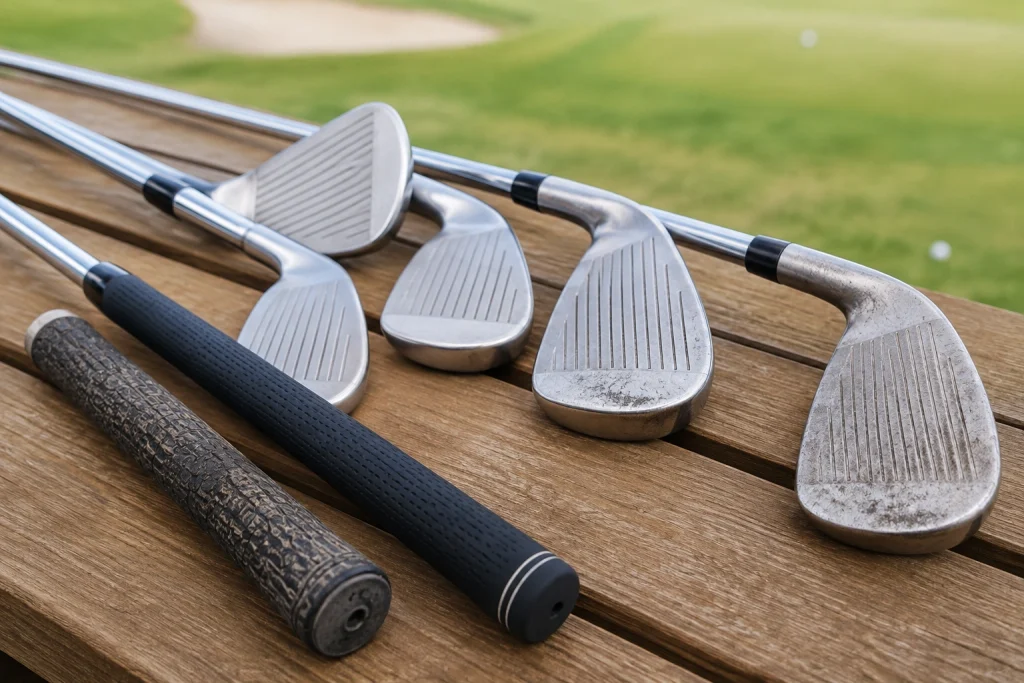
Golf clubs can be expensive, but beginners do not need the newest premium set to enjoy the game.
A practical budget approach:
- Start with a forgiving starter set or used clubs in good condition.
- Add a better wedge or putter only if needed.
- Upgrade your driver, irons, or hybrids after your swing becomes more consistent.
- Get fit before spending heavily on a full new set.
Higher-priced clubs may offer better materials, adjustability, and feel. But they are not magic. A $600 driver will not fix poor alignment, bad contact, or a swing path problem by itself.
What Affects Club Durability?
Durability depends on:
- Shaft quality
- Grip condition
- Clubhead material
- How often you play
- How well you store the clubs
- Whether clubs are cleaned after wet or sandy rounds
Grips wear out faster than clubheads. If your grips feel slick, hard, cracked, or shiny, replace them before blaming the clubs.
Best Golf Clubs for Beginners
The best beginner clubs are usually forgiving, easy to launch, and comfortable to swing.
Look for:
- Higher-lofted driver
- 5-wood or 7-wood instead of hard-to-hit 3-wood
- Hybrids instead of long irons
- Cavity-back irons
- Pitching wedge and sand wedge
- Mallet-style putter if alignment is difficult
A beginner should focus on clubs that make normal shots easier. You are not trying to copy a professional tour bag.
Best Golf Clubs for Intermediate Golfers
Intermediate golfers may need more specific clubs based on ball flight, distance gaps, and scoring goals.
Good upgrades may include:
- A driver fitted for launch and spin
- A fairway wood that fills a real distance gap
- A hybrid or utility iron based on contact quality
- Irons with a balance of forgiveness and feel
- Extra wedges for better short-game distance control
- A putter that matches stroke type
At this stage, distance gaps matter more. You want clubs that cover different yardages without big overlaps.
Expert Tip
Expert Tip: Before buying new clubs, write down your real carry distances for each club during practice or a launch monitor session. Many golfers buy extra clubs they do not need because they guess their distances instead of measuring them.
When to Get Help From a Golf Pro or Fitter
You should consider help from a golf pro or club fitter when your clubs may be limiting your progress.
A fitter can help with club length, lie angle, shaft flex, grip size, and set makeup. A golf pro can tell whether the problem is really the club or your swing.
The PGA notes in its guide to getting the most out of a fitting experience that a good fitting should be specific to the individual golfer, not based on a generic assumption.
Get help if:
- You are very tall or short
- Your shots always start far left or right
- Your clubs feel too heavy or too light
- You hit the ground before the ball often
- Your grips feel too small or too large
- You have big distance gaps between clubs
- You are spending serious money on new equipment
Important warning: If you are brand new, a lesson may help more than a full fitting. Once your swing becomes more repeatable, fitting becomes more useful.
Common Mistakes Golfers Should Avoid
- Buying clubs only because a pro uses them. Tour clubs are often less forgiving.
- Carrying too many long irons. Hybrids are easier for most amateurs.
- Choosing a driver with too little loft. More loft often helps beginners hit better drives.
- Ignoring grip condition. Worn grips can cause tension and poor control.
- Buying a full wedge set too early. Learn basic short-game shots first.
- Assuming expensive means better. Fit and forgiveness matter more than price.
- Not checking the 14-club limit. This matters in competitive rounds.
- Skipping lessons when contact is poor. Equipment cannot fix every swing issue.
How to Build a Simple Golf Club Setup
If you are unsure where to start, build your bag around the shots you actually face.
Step 1: Choose a Forgiving Tee Club
This may be a driver, 3-wood, 5-wood, or hybrid. The best tee club is the one you can keep in play.
Step 2: Add Easy Distance Clubs
Use fairway woods or hybrids for longer shots. Avoid clubs you cannot launch consistently.
Step 3: Use Irons You Can Hit Solidly
Many beginners do not need 4-iron or 5-iron. Start with irons you can control.
Step 4: Cover the Short Game
A pitching wedge and sand wedge are enough for many golfers. Add a gap wedge later if needed.
Step 5: Pick a Comfortable Putter
Try different head shapes. Choose the one that helps you aim and control distance.
FAQs
What are the main types of golf clubs?
The main types are drivers, fairway woods, hybrids, irons, wedges, and putters. Each one is designed for a different distance, ball flight, and course situation.
What golf clubs should a beginner carry?
A beginner should carry a driver or fairway wood, one hybrid, several forgiving irons, a pitching wedge, a sand wedge, and a putter. You do not need all 14 clubs right away.
Are hybrids easier to hit than irons?
Yes, hybrids are easier for many golfers to hit than long irons. They usually launch the ball higher and are more forgiving from the fairway or light rough.
Do expensive golf clubs make a big difference?
They can help if they fit your swing, but price alone does not guarantee better golf. Forgiveness, shaft fit, grip comfort, and proper lessons often matter more.
How many wedges should I carry?
Most beginners should start with a pitching wedge and sand wedge. Intermediate golfers may add a gap wedge or lob wedge when they need better distance control around the green.
Should I get fitted for golf clubs as a beginner?
A basic fitting can help if you are buying new clubs, especially if you are unusually tall, short, strong, or have physical limitations. If your swing is still changing quickly, lessons may be the better first step.
What is the easiest golf club to hit?
For many beginners, a 7-iron, hybrid, or higher-lofted fairway wood is easier to hit than a driver or long iron. The easiest club depends on your swing and confidence.
Conclusion
Understanding the Types of Golf Clubs helps you make better choices on the course and smarter decisions when buying equipment. Drivers, woods, hybrids, irons, wedges, and putters all have a role, but you do not need every club right away.
Start with forgiving clubs that help you launch the ball, control distance, and enjoy the game. Avoid buying based only on looks, price, or what advanced players use.
The best next step is simple: review your current bag, remove clubs you rarely hit well, and build a setup that matches your real skill level. When you are ready to upgrade, get advice from a golf pro or fitter so your next club purchase actually helps your game.