
Golf Flags Explained: Colors, Rules, Meanings, and Proper Etiquette

A golf flag may look like a simple piece of fabric at the end of the hole, but it gives players valuable information. It shows the hole’s location, helps with distance judgment, reveals wind conditions, and can influence club selection.
This Golf Flags Explained guide covers the difference between a flag and a flagstick, common flag-color systems, the Rules of Golf, proper etiquette, and practical ways to use the flag when planning your next shot.
Quick Answer
A golf flag marks the location of the hole on the putting green. Its color may indicate whether the hole is positioned at the front, middle, or back of the green, although systems vary by course. Golfers may normally leave the flagstick in, remove it, or have it attended before making a stroke.
What Is a Golf Flag?
A golf flag is the fabric marker attached to the pole standing inside the hole. It allows golfers to see the target from the tee, fairway, rough, or bunker.
Golfers often use the words flag, pin, and flagstick interchangeably. However, they have slightly different meanings:
- Flag: The fabric attached to the top of the pole.
- Flagstick: The removable pole and its attached components.
- Pin: An informal term for the flagstick or hole location.
- Cup: The liner placed inside the hole below the putting surface.
The official Rules of Golf mainly use the term flagstick. The USGA Equipment Rules for flagsticks explain that its components must not be designed to influence the ball improperly or function as unauthorized wind-measuring equipment. (USGA)
A flag’s primary purpose is visibility, but it can also help you judge:
- The general direction of the target
- Whether the hole is near the front, center, or back of the green
- Wind direction around the green
- How much landing space may be available
- Whether attacking the hole is worth the risk
What Do Golf Flag Colors Mean?
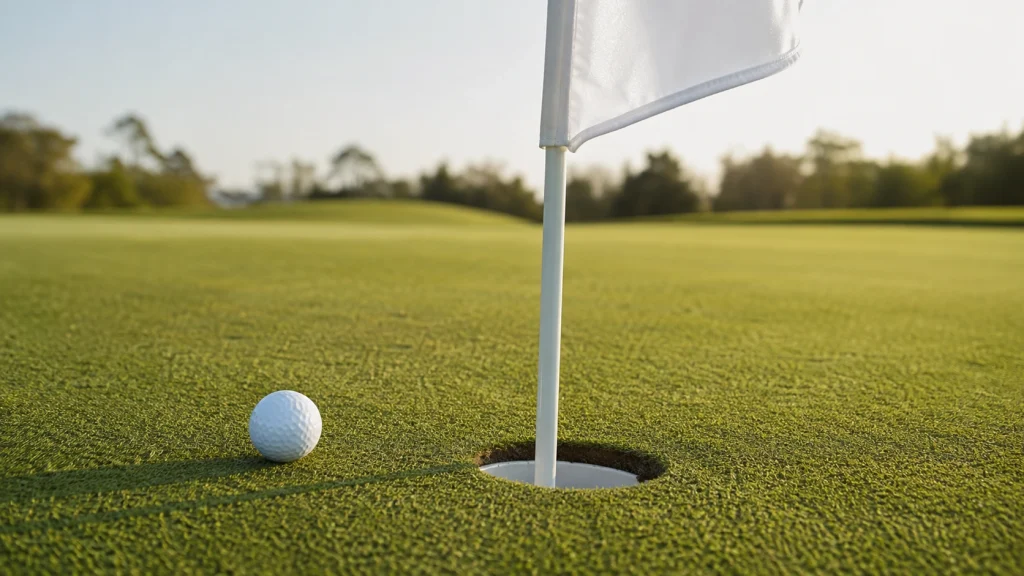
Many courses use different flag colors to communicate the approximate depth of the hole location. A common system is:
| Flag color | Common meaning | Practical adjustment |
|---|---|---|
| Red | Front portion of the green | Expect a shorter carry and limited landing space before the hole |
| White | Middle portion of the green | Use your normal center-of-green distance |
| Blue | Back portion of the green | Expect a longer carry and more green before the hole |
| Yellow | Varies by course | Check the scorecard, cart sign, or starter’s instructions |
| Checkered or patterned | Special event or course-specific use | Do not assume a standard meaning |
There is no universal golf flag-color system. A red flag may mean a front location at one course but have a completely different purpose at another.
Before starting your round, check:
- The scorecard
- The first-tee information board
- The golf cart screen
- The course’s mobile application
- Instructions from the starter
- A printed daily hole-location sheet
Some courses use the same flag color on every green. They may communicate hole depth with a smaller secondary flag, a colored disk, or a movable marker attached to the flagstick.
Numbered Hole-Location Systems
Courses sometimes divide each green into several numbered areas. The day’s hole-location number may appear on the scorecard, cart, or first-tee sign.
For example, a course may use six green zones. If the day’s position is number four, every hole will be placed within the area marked number four on that green’s diagram.
This system is more precise than simple front, middle, and back colors. However, the number usually identifies a general area rather than an exact yardage.
Why Hole Locations Change
Course staff regularly move holes to:
- Spread foot traffic across the green
- Prevent excessive wear around one cup
- Protect damaged or stressed turf
- Create variety for regular players
- Adjust difficulty for tournaments or busy days
- Avoid areas affected by water, maintenance, or poor growth
A back corner location near a bunker may be challenging, while a central location on a flatter section is generally more forgiving.


How to Use the Flag When Planning a Shot
The flag should guide your decision, but it should not automatically become your target. For many beginner and intermediate golfers, the safest target is still the center of the green.
1. Confirm the Hole Location
Determine whether the flag is at the front, middle, or back. Use the course’s color or numbering system rather than relying on assumptions.
2. Find the Correct Distance
A rangefinder, GPS device, sprinkler-head marker, or course yardage book may provide distances to the front, center, and back of the green.
Suppose your distances are:
- Front: 125 yards
- Center: 140 yards
- Back: 154 yards
A red front flag might be approximately 130 yards away. A blue back flag could require close to 150 yards. The exact distance depends on the green’s shape and your angle of approach.
3. Study the Trouble Around the Green
Look beyond the flag before selecting a club.
Consider:
- Bunkers in front of the hole
- Water beside or behind the green
- Steep slopes near the pin
- Thick rough around the edges
- Limited space between the flag and the green’s boundary
A flag placed close to a hazard may tempt you into a low-percentage shot. Missing toward the center of the green is often smarter than aiming directly at a dangerous pin.
4. Choose a Target That Matches Your Skill
A skilled player with reliable distance control may attack more hole locations. A developing golfer will usually score better by choosing a larger, safer target.
For example, when the flag is five paces behind a deep bunker, a beginner should normally aim away from the bunker. Landing safely on the green creates a reasonable putting opportunity and avoids a difficult recovery shot.
Expert Tip: Use the flag for distance information, but choose your target based on the safest miss. Center-green shots often produce lower scores than aggressively chasing every pin.
Reading Wind From a Golf Flag
A moving flag can help identify wind direction near the green.
Watch for:
- The direction the fabric is extending
- How quickly it changes direction
- Whether it hangs loosely or remains fully stretched
- Differences between the flag and nearby treetops
A gently moving flag suggests light wind. A flag held almost horizontally may indicate a stronger breeze.
However, a flag is not a perfect wind gauge. Trees, slopes, buildings, and the green’s elevation can affect air movement. Wind at your ball may also be different from wind around the target.
Use several clues together:
- Grass tossed into the air
- Movement of your clothing
- Tree branches
- Nearby flags
- The expected ball flight
- Wind felt at the hitting position
Do not base club selection on the flag alone. Gusts may change during the shot, and a sheltered flag can underestimate the wind above the tree line.
Can You Leave the Flagstick in While Putting?
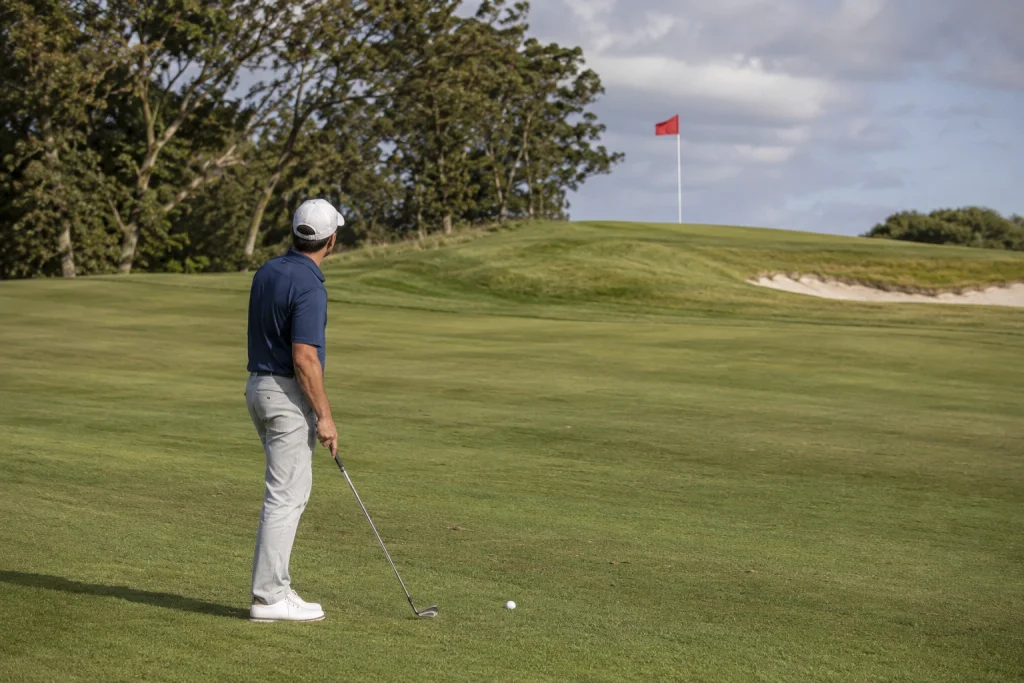
Yes. A golfer may normally putt with the flagstick left in the hole.
Under USGA Rule 13.2, a player may leave the flagstick in the hole, have it removed, or have someone attend it. The choice should be made before the stroke. (USGA)
If a ball played from the putting green accidentally strikes an unattended flagstick left in the hole, there is normally no penalty. This rule allows golfers to choose the option they prefer without being penalized simply because the putt hits the flagstick. (USGA)
Reasons to Leave the Flagstick In
Golfers may leave it in because:
- It provides a clear aiming reference
- It may help with depth perception
- It saves time on long putts
- It avoids repeatedly removing and replacing the pole
- Some golfers feel more confident seeing a defined target
Reasons to Remove the Flagstick
A golfer may remove it because:
- The flag is moving and causing a distraction
- A shadow from the pole crosses the putting line
- The player prefers to see the open cup
- The ball is close enough that removal feels more comfortable
- The pole is leaning noticeably inside the cup
There is no single correct choice for every putt. Test both methods during practice and use the option that supports a confident routine.
What Does It Mean to Attend the Flagstick?
Attending the flagstick means a person stands beside the hole and holds the pole so it can be removed after the player makes a stroke.
This is most useful when a golfer has a long putt and wants to see the hole location clearly but does not want the ball to reach an attended flagstick.
Before attending it:
- Confirm that the player wants assistance.
- Stand where you will not distract the player.
- Hold the flag and pole securely.
- Remove the flagstick carefully after the stroke.
- Move away from the ball’s expected path.
The R&A’s official guidance on Rule 13 also covers leaving the flagstick in, removing it, and authorizing another person to attend it. (R&A)
Never remove or move a flagstick deliberately to influence where another player’s moving ball will finish. That can result in a penalty.
When Is a Ball Resting Against the Flagstick Holed?
A ball can become trapped between the flagstick and the side of the hole.
Under the Rules of Golf, the ball is treated as holed when any part of it is below the surface of the putting green. The entire ball does not need to be at the bottom of the cup. (USGA)
When this happens, look carefully before lifting or moving anything. Avoid pulling the flagstick quickly because the ball may move before its position is confirmed.
Proper Golf Flag Etiquette
Handling the flagstick correctly protects the green and prevents distractions.
Communicate With Your Group
Before someone putts, ask whether they want the flagstick:
- Left in
- Removed
- Attended
A simple question prevents confusion and keeps play moving.
Place It Away From Putting Lines
When removing the flagstick, place it gently outside all likely putting lines. Do not drop it heavily onto the green.
Whenever practical, place it in the fringe or another safe area where players will not step on it.
Protect the Edge of the Hole
Pull the flagstick straight upward and replace it vertically. Dragging it against the cup can damage the edge of the hole.
Damage around the cup may change the direction of a slow-moving putt and creates additional work for the maintenance team.
Avoid Distracting Movement
Do not wave the flag, move around unnecessarily, or allow the fabric to flap close to a player preparing to putt.
Also avoid standing where your shadow crosses the player’s ball, line, or hole.
Replace It Before Leaving
The flagstick should be returned securely to the hole after the group finishes. Check that it is seated properly and is not leaning because it was replaced carelessly.
General PGA guidance for beginner golfers emphasizes learning basic etiquette alongside the Rules of Golf so groups can play safely and respectfully. (PGA of America)
Golf Flag Materials, Quality, and Durability
Most golfers do not need to purchase course flagsticks, but understanding their construction can be helpful when choosing practice equipment for a backyard green, training area, or golf facility.
| Component | Common options | Benefits | Limitations |
|---|---|---|---|
| Flag fabric | Nylon | Lightweight, bright, and moves easily in light wind | May fade or fray with heavy exposure |
| Flag fabric | Polyester | Durable and often more resistant to regular weather | May feel heavier than thin nylon |
| Flagstick | Fiberglass | Flexible, weather-resistant, and commonly used | Can splinter when badly damaged |
| Flagstick | Aluminum | Strong, straight, and durable | May bend after a hard impact |
| Attachment | Ties or grommets | Simple and inexpensive | Can loosen or wear |
| Attachment | Tube-lock design | Secure fit and reduced tangling | Usually costs more |
| Visibility feature | Reflector or prism | Helps compatible rangefinders lock onto the target | Not necessary for every golfer |
For personal practice, focus on a flag that is visible, weather-resistant, and properly sized for the space. A lightweight backyard setup may be enough for putting practice. A commercial course needs stronger materials that can handle daily removal, weather, mower activity, and frequent player contact.
Inspect damaged fiberglass poles carefully. Exposed fibers can irritate the skin, so a cracked or splintering practice flagstick should be replaced rather than handled repeatedly.
When to Get Help From a Golf Pro or Fitter
A flag itself does not require professional fitting, but repeated problems with approach-shot decisions may reveal gaps in your technique or equipment setup.
Consider speaking with a golf professional when:
- You regularly aim at dangerous flags without recognizing safer targets
- You struggle to control carry distance with wedges and short irons
- Wind makes your club selection unpredictable
- You consistently miss on the short side of the green
- You do not understand how slopes and hole locations affect strategy
- You need help developing a reliable pre-shot routine
A professional lesson can teach you how to aim for realistic targets and manage front, middle, and back hole locations.
A club fitter may help when inconsistent distance gaps, excessive spin, poor launch, or unsuitable club specifications make it difficult to reach predictable yardages. Equipment will not replace good judgment, but correctly fitted clubs can make distance planning easier.
Common Mistakes Golfers Should Avoid
- Assuming all flag colors mean the same thing: Always check the course’s system before interpreting red, white, blue, or yellow flags.
- Firing directly at every flag: The hole is not always the safest target. Consider bunkers, water, slopes, and your normal shot pattern.
- Using the flag as the only wind indicator: Air movement near the green may differ from conditions at your ball or above the trees.
- Moving the flagstick while a ball is in motion: Do not deliberately move it to influence another player’s result.
- Dropping the pole onto the green: Place it down gently and away from putting lines.
- Damaging the cup while removing the flagstick: Pull upward instead of dragging the pole against the edge.
- Forgetting to replace the flagstick: Secure it in the hole before leaving the green.
- Standing too close to the hole: Give the player room and avoid casting a shadow across the putting line.
- Chasing back pins without enough club: Use a realistic carry distance and account for hazards behind the green.
FAQs
Are golf flag colors standardized?
No. Red commonly means front, white often means middle, and blue frequently means back, but courses can use different systems. Check the scorecard, starter’s instructions, or course signage before your round.
What is the difference between a golf flag and a flagstick?
The flag is the fabric marker. The flagstick is the removable pole and its attached components. Golfers also commonly call the entire setup the pin.
Can I putt with the flagstick in the hole?
Yes. The Rules of Golf allow you to leave the flagstick in while putting. You may also remove it or have someone attend it before your stroke.
Is there a penalty if my putt hits the flagstick?
There is normally no penalty when a ball accidentally hits an unattended flagstick that was left in the hole. Different consequences may apply when someone deliberately moves the flagstick to affect a moving ball.
Should beginners aim directly at the flag?
Not always. Beginners will often score better by aiming toward the center or safest section of the green, especially when the flag is close to a bunker, water, or steep slope.
Can a golf flag accurately show wind speed?
It can provide a general indication, but it cannot give an exact measurement. Trees, elevation, surrounding terrain, and gusts may cause the wind at the flag to differ from the wind affecting your shot.
How often do golf courses move their flags?
Many courses change hole locations regularly, sometimes daily. Frequency depends on course traffic, turf condition, weather, maintenance needs, and upcoming competitions.
Conclusion
Golf flags do more than show where the hole is located. They help golfers judge direction, understand possible hole depth, observe the wind, and select safer targets.
The most important lesson from this Golf Flags Explained guide is that colors and marker systems vary. Confirm the system used by the course before making strategy decisions. Follow the current flagstick rules, handle the pole carefully, and communicate clearly with your playing partners.
On your next round, check the daily hole-location system before teeing off. Then use each flag as helpful information—not an automatic target—to choose smarter clubs, avoid unnecessary hazards, and give yourself more realistic scoring opportunities.