
Understanding Golf Scoring Explained: A Complete Guide for Every Player

Stepping onto the golf course for the first time can feel intimidating, especially when players start tossing around terms like birdie, bogey, and par. Golf Scoring Explained is essential knowledge for anyone looking to build confidence, keep an accurate tally, and enjoy the game to its fullest. Whether you are playing a casual weekend round with friends or preparing for your very first club tournament, understanding how scores are recorded transforms confusion into clarity. In this comprehensive guide, we will break down the fundamentals of golf scoring, examine how pars work, and explore the difference between stroke play and match play so you can track your progress like a seasoned player.
Quick Answer
Golf scoring is based on the number of strokes it takes to hit a golf ball into each hole. Each hole has a designated “par,” which is the expected number of strokes for an expert golfer. Your total score is the sum of every stroke taken across all 18 holes, where lower numbers represent better performance.
The Foundation of Golf Scoring: Understanding Par
Every golf hole on a standard course is assigned a specific par, which usually ranges from 3 to 5. Par represents the benchmark score that a skilled golfer is expected to achieve on that specific hole.
Course architects and governing bodies determine par primarily based on the total yardage of the hole from the tee box to the green.
Standard Hole Yardages and Par Designations
- Par 3 Holes: Typically measure under 250 yards for men and under 210 yards for women. These are short holes where players generally aim to reach the putting green with their very first tee shot.
- Par 4 Holes: Usually range from 251 to 470 yards for men and 211 to 400 yards for women. These require a long tee shot followed by an approach shot to the green.
- Par 5 Holes: Generally measure over 471 yards for men and over 401 yards for women. These long holes require three distinct shots for most players to reach the putting green.
As you learn the ropes, keeping track of par helps you understand whether you are playing defensively or aggressively. It gives you a clear target for every single swing you take on the course.
Common Golf Score Terminology
Golf has a unique vocabulary for every score relative to par. Knowing these terms helps you communicate your performance clearly and understand what is happening on the scorecard.
Scoring Terms Above and Below Par
- Birdie: One stroke under par on a single hole. For example, scoring a 3 on a par 4 hole.
- Par: Completing the hole in the exact number of strokes designated by the course.
- Bogey: One stroke over par on a single hole. Scoring a 5 on a par 4 is a bogey.
- Double Bogey: Two strokes over par on a single hole.
- Eagle: Two strokes under par on a single hole, most commonly achieved on par 5 holes with a brilliant second shot.
- Hole-in-One: Completing a par 3 hole with a single tee shot. This is also called an ace.
Expert Tip: Beginners should not stress about making birdies or pars right away. Focusing on eliminating triple and quadruple bogeys by keeping your ball in play will lower your overall score much faster than trying hero shots.


Stroke Play vs. Match Play Formats
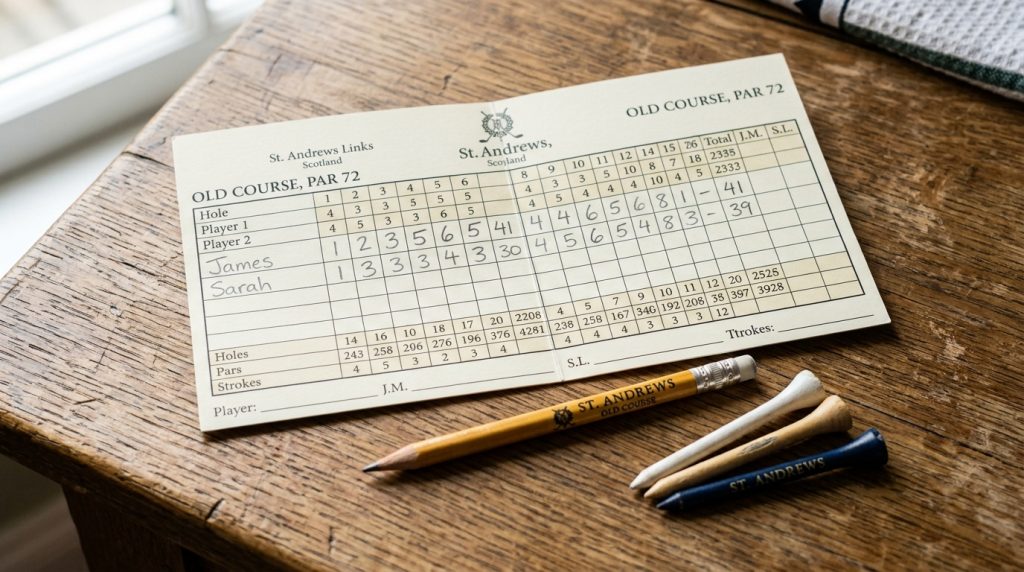
When you play golf, your score can be calculated using different formats. The two most common formats are stroke play and match play, each offering a unique competitive experience.
Stroke Play
Stroke play is the most common format used in casual rounds, local leagues, and professional tournaments like those governed by the USGA Rules of Golf. In this format, you count every single stroke you take from the first tee to the final green. Your ultimate score is the total number of strokes accumulated over 9 or 18 holes. If you hit a ball out of bounds or into a water hazard, penalty strokes are added directly to your running total.
Match Play
Match play is a head-to-head competition where golfers play against each other rather than the entire golf course. Instead of counting total strokes, players compete hole by hole. The golfer who completes a specific hole in the fewest strokes wins that hole. If both players score the same, the hole is halved, meaning nobody wins it. The match is won when one player leads by more holes than remain to be played.
How to Calculate Your Handicap
Once you understand basic scoring, you will likely encounter the concept of a golf handicap. A handicap is a numerical measure of a golfer’s potential ability, allowing players of different skill levels to compete fairly against one another.
Official handicaps are calculated using a complex formula that factors in course difficulty, slope rating, and your recent scores. According to guidelines set by organizations like the R&A Handicap System, this system ensures that a beginner and an advanced player can enjoy a competitive match on equal footing.
If you are a beginner, do not worry about establishing an official handicap immediately. Simply tracking your total score over ten rounds will give you a reliable baseline to measure your personal improvement.
| Skill Level | Average 18-Hole Score | Typical Scoring Focus |
|---|---|---|
| Beginner | 105 to 120+ | Keeping the ball in play, avoiding lost balls, and counting every penalty stroke. |
| Intermediate | 85 to 100 | Minimizing three-putts, reducing double bogeys, and managing course strategy. |
| Advanced | Under 75 to 80 | Executing precise shot shapes, capitalizing on birdie opportunities, and course management. |
Common Mistakes Golfers Should Avoid
Keeping an accurate score requires honesty, attention to detail, and knowledge of the rules. Many golfers, especially beginners, make simple mistakes that ruin the integrity of their scorecards.
- Failing to Count Penalty Strokes: Forgetting to add penalty strokes for hitting a ball out of bounds or into a penalty area is the most common scoring error.
- Conceding Putts Too Casually: In casual play, golfers often pick up short putts without holing out. While fine for casual fun, this prevents you from knowing your true score.
- Playing the Wrong Ball: In the heat of play, it is easy to accidentally hit a partner or opponent’s ball, which results in penalty strokes under standard rules.
- Ignoring Provisional Ball Rules: If you think your tee shot landed out of bounds, failing to hit a provisional ball can waste valuable time walking back to the tee box.
When to Get Help From a Golf Pro or Fitter
While learning to score is straightforward, consistently high scores often point to underlying swing flaws, equipment mismatches, or poor course management. If your scores are plateauing despite regular practice, it may be time to seek expert guidance.
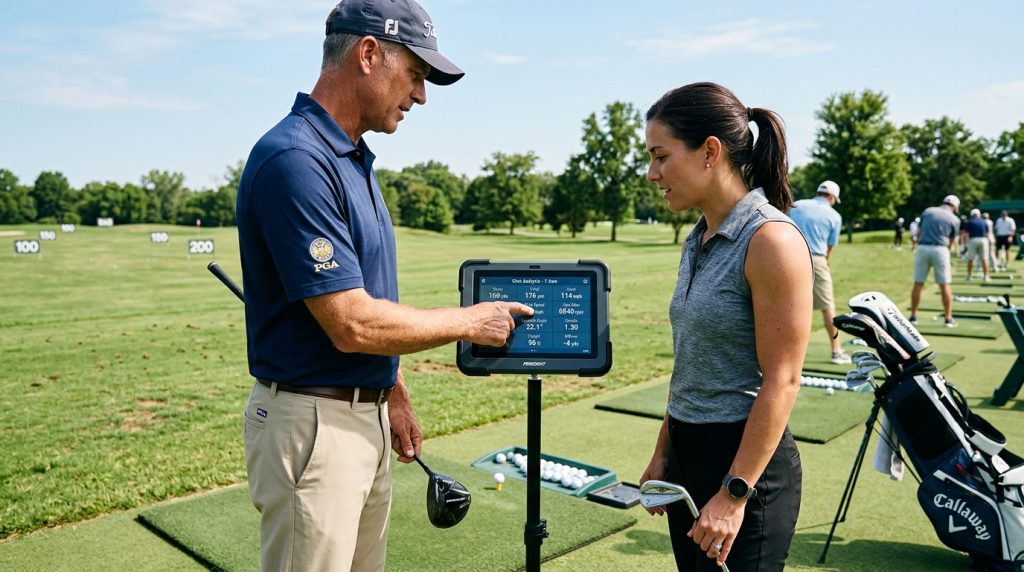
A certified PGA professional can analyze your swing mechanics, help you eliminate erratic ball flight, and teach you how to manage risk on the golf course. Additionally, working with a professional club fitter ensures your equipment matches your swing speed, which instantly improves accuracy and makes scoring much easier. Investing in a single lesson or a proper fitting session often saves you dozens of frustrating strokes over the course of a season.
Frequently Asked Questions
What is the difference between gross score and net score?
Gross score is the absolute total number of strokes you take during a round without any adjustments. Net score is your gross score minus your official handicap strokes, reflecting your performance adjusted for your skill level.
What should I do if I lose my golf ball?
If your ball is lost outside of a penalty area or goes out of bounds, you must add a one-stroke penalty and play a ball from the spot of the previous shot, or take relief under local modern local rules if available.
Is a bogey considered a bad score for a beginner?
Not at all. For a beginner golfer, scoring a bogey on a par 4 or par 5 hole is a fantastic achievement that represents solid, consistent play.
Do I have to count penalty strokes in casual matches?
While casual games between friends can follow any house rules you agree upon, counting all penalty strokes is the only way to track your true progress and establish a genuine handicap.
What does max score mean in modern golf formats?
To speed up slow play, many recreational formats use a maximum score rule, often set at a double par or triple bogey per hole, meaning you pick up your ball and move on once that limit is reached.
How many clubs am I allowed to carry in my bag?
The maximum number of golf clubs you can legally carry during a standard round is 14. You can carry fewer if you prefer a lighter bag, but you cannot exceed 14.
Conclusion
Mastering golf scoring is one of the most rewarding steps you can take on your journey as a golfer. By understanding pars, tracking every stroke honestly, and knowing the difference between formats like stroke play and match play, you build a solid foundation for lifelong enjoyment of the sport. Remember that every golfer starts out feeling overwhelmed by the terminology, but consistency comes with time on the course. Take your time, keep an accurate scorecard, and enjoy watching your scores drop as your skills improve.