Hip Turn in the Golf Swing: How to Rotate for More Power and Consistency
Quick Answer
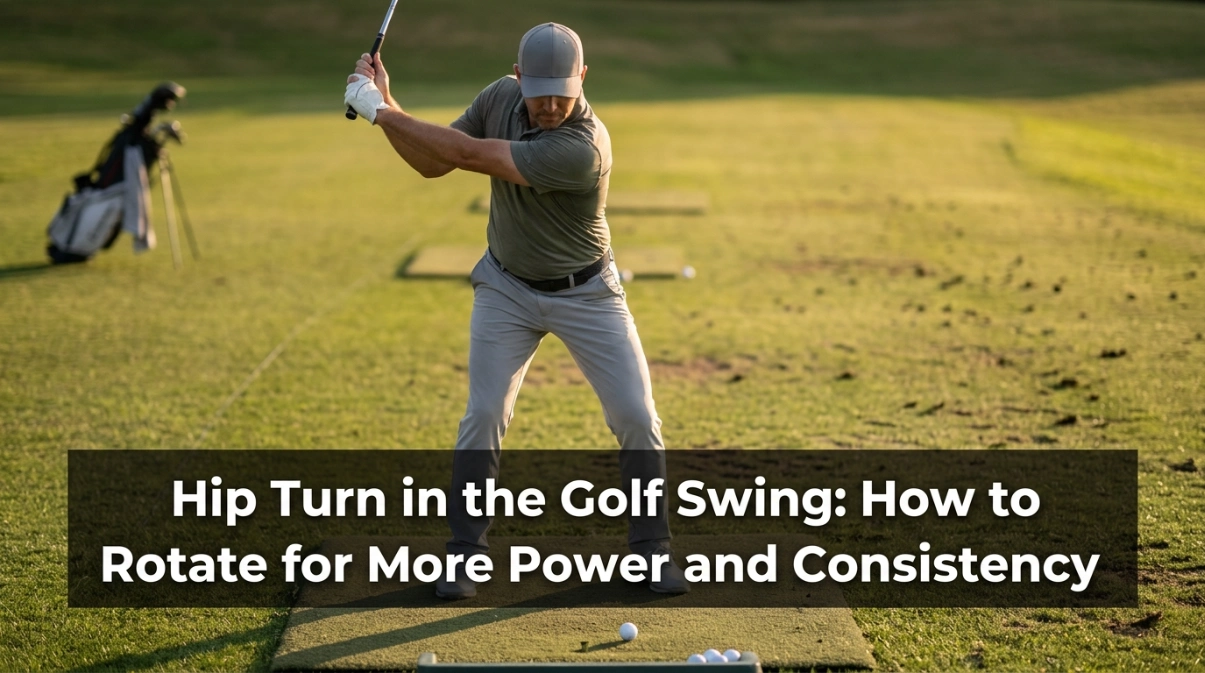
A good hip turn lets your lower body rotate without losing posture, balance, or control. In the backswing, your trail hip turns behind you; in the downswing, your lead hip begins rotating toward the target before the arms and club arrive at impact. PGA guidance also emphasizes that the hips and shoulders work together rather than forcing the hips to spin independently. PGA golf instruction offers additional coaching resources.
What a good hip turn should do
- Turn around you: Rotate your hips while maintaining your athletic posture instead of sliding away from the ball.
- Create separation: Let your shoulders rotate more than your hips to create useful coil.
- Start the transition: Allow the lower body to begin unwinding before the club reaches impact.
- Clear the target: Keep the lead hip moving so the arms and club have room to approach the ball.
- Stay balanced: Finish on the lead side without excessive swaying, standing up, or falling backward.
Quick check
- Make slow-motion swings and watch whether your trail hip turns behind you rather than moving straight sideways.
I used to think a better hip turn meant simply trying to rotate my hips harder. That approach usually created more tension than speed.
The better goal is a coordinated turn that keeps the body balanced while giving the shoulders, arms, and club room to move.
In This Guide
What Is Hip Turn in the Golf Swing?
Hip turn is the rotational movement of your pelvis during the golf swing. Instead of keeping the hips fixed, you allow them to rotate around your body while maintaining your golf posture.
The movement matters because your hips connect your lower body to your torso. They help transfer pressure and rotation from the ground through your body and into the club.
Definition: Hip turn is the rotation of the pelvis around the body during the backswing, transition, downswing, and follow-through. It is different from simply moving the hips sideways toward or away from the target.
Why the hips matter
Your hips contribute to both rotation and balance. They also help create the relationship between your lower-body and upper-body movements.
PGA instruction describes the hips and shoulders as closely connected parts of an effective swing. When the hips move well, the shoulders can turn more naturally. :contentReference[oaicite:0]{index=0}
- Rotation: Your hips help turn the body away from the target and back through it.
- Balance: Good hip movement helps you maintain your posture throughout the swing.
- Sequence: The hips contribute to the order in which the lower and upper body move.
- Space: A clearing lead hip gives your arms more room through impact.
That doesn’t mean you should consciously spin your hips as fast as possible. Speed without sequencing can create a completely different set of problems.
Section Takeaway: A good hip turn is controlled rotation, not a forced spin. The goal is to turn while staying balanced and connected to the rest of the swing.
How Should the Hips Turn During the Golf Swing?
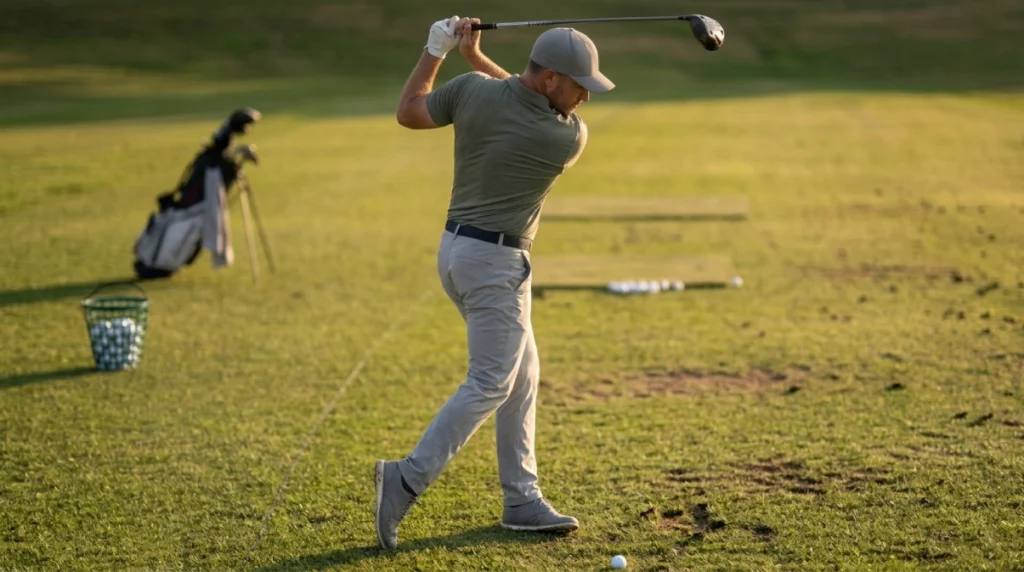
The simplest way to understand hip turn is to divide the motion into the backswing, transition, downswing, and follow-through.
1. Backswing: turn the trail hip behind you
For a right-handed golfer, your right hip is the trail hip. During the backswing, it should rotate behind you as your upper body turns away from the target.
Think about turning around your body rather than pushing your hips sideways. Your trail hip should feel as though it is moving back and around.
2. At the top: create useful separation
Your shoulders generally rotate farther than your hips. That difference creates what golfers often call coil or separation.
PGA instruction commonly uses roughly 90 degrees of shoulder rotation and about 45 degrees of hip rotation as a useful model, although individual swings vary. :contentReference[oaicite:1]{index=1}
| Swing phase | Hip movement | Main goal |
|---|---|---|
| Address | Hips pushed back in athletic posture | Create balance and space |
| Backswing | Trail hip rotates behind you | Build coil without losing posture |
| Transition | Lead side begins moving toward the target | Start the change of direction |
| Impact | Lead hip is opening toward the target | Create space and support solid contact |
| Follow-through | Hips continue rotating | Finish balanced and fully rotated |
3. Transition: let the lead side begin
The transition is where many golfers try to hit harder with their arms. A better pattern lets the lower body begin unwinding toward the target.
PGA instruction emphasizes that the lead hip can move slightly toward the target as pressure shifts forward, while the hips continue rotating rather than simply sliding. :contentReference[oaicite:2]{index=2}
4. Downswing: clear the lead hip
As you approach impact, the lead hip should continue rotating away from the ball. This creates room for the hands and club to move through.
At impact, the hips aren’t frozen. PGA coaching specifically identifies the hips rotating toward the target as an important component of a consistent impact position. :contentReference[oaicite:3]{index=3}
Section Takeaway: Think “turn back, shift and turn through.” Don’t try to manufacture speed by spinning your hips independently of the rest of your body.
What Is the Difference Between Hip Turn and Hip Slide?
Hip turn and hip slide are different movements. Rotation means the pelvis turns around you, while a slide means the pelvis moves laterally toward one side.
Some lateral movement can be useful during the transition. The problem comes when the lateral movement replaces rotation.
What a slide can look like
- Trail-side sway: The hips move away from the target instead of turning.
- Excessive lateral shift: The pelvis moves dramatically toward the target.
- Early extension: The hips move toward the ball and the body stands up.
- Blocked rotation: The hips stop turning because they have moved too far laterally.
These patterns can change the low point, club path, strike, and face delivery. They can also make consistent contact much harder.
PGA instruction warns against standing up through the downswing or “backing up” because excessive or poorly timed hip movement can interfere with weight transfer and contact. :contentReference[oaicite:4]{index=4}
Turn versus slide: a simple comparison
| Movement | What happens | Potential result |
|---|---|---|
| Hip turn | Pelvis rotates around the body | Better space, sequencing, and balance |
| Hip slide | Pelvis moves laterally | Can disrupt posture and low point when excessive |
| Early extension | Hips move toward the ball | Can change strike and delivery |
Section Takeaway: Some lateral pressure shift is normal. The key is allowing that shift to blend into rotation instead of replacing it.

What Are the Most Common Hip-Turn Mistakes?
Most hip-turn problems aren’t caused by a complete lack of rotation. They usually come from timing, posture, or trying too hard to create a specific movement.
Trying to spin the hips as fast as possible
This is one of the first mistakes I see golfers make when they hear that the hips create power. They try to fire the hips violently and leave the arms and club behind.
That can produce timing problems. PGA guidance also notes that forcing the hips can cause them to open too early, contributing to blocks or hooks depending on the player’s delivery. :contentReference[oaicite:5]{index=5}
Keeping the hips too still
The opposite mistake is trying to restrict the hips excessively. Your lower body needs to rotate during the backswing.
PGA coaching has noted that increasing hip rotation can help some golfers who struggle to create enough upper-body turn because they try to restrict the lower body too much. :contentReference[oaicite:6]{index=6}
Losing posture
If your hips move toward the ball during the downswing, your torso can rise and your relationship with the ball changes.
Good address posture gives the hips room to rotate while helping you maintain your spine angle. :contentReference[oaicite:7]{index=7}
Stopping the rotation at impact
Your swing doesn’t end when the club hits the ball. Your body should continue rotating into the follow-through.
A PGA coaching drill uses a simple body-turn sensation to help golfers keep rotating through the hitting area rather than trying to throw the club solely with their arms. :contentReference[oaicite:8]{index=8}
Overthinking exact hip angles
Numbers can help explain swing mechanics, but they shouldn’t become a rigid target. Your mobility, build, swing style, and physical limitations all affect how much you can comfortably rotate.
Use measurements as reference points, not as instructions to force your body into a position.
Section Takeaway: The biggest hip-turn mistake is treating rotation as an isolated move. Your hips must work with your posture, shoulders, pressure shift, arms, and club.
How Can You Practice a Better Hip Turn?
The best hip-turn drills make the movement easier to feel before you add full-speed swings. Start slowly and focus on the motion rather than trying to hit the ball hard.
Drill 1: Club-across-the-hips turn
- Stand in your normal golf posture.
- Place a club across your hips and hold both ends.
- Turn your pelvis toward the backswing position.
- Feel the trail hip move behind you.
- Rotate back toward the target and finish balanced.
This drill removes the clubhead from the equation. You can concentrate entirely on the movement of the pelvis.
Drill 2: Club-in-the-belly-button turn
Another useful drill is to hold the grip end of a club near your abdomen while the shaft extends forward. Turn your body back and through while keeping the club connected to your center.
PGA instruction has used a similar turn drill to help golfers feel the relationship between their arms and body during the swing. :contentReference[oaicite:9]{index=9}
Drill 3: Slow-motion swings
Make swings at roughly half speed. Pause briefly at the top, then begin the transition by allowing your lead side to start moving toward the target.
Slow practice exposes unnecessary swaying and early extension much more clearly than full-speed swings.
Drill 4: Step-through swings
- Set up normally with a short club.
- Make a controlled backswing.
- Begin moving toward the target as you change direction.
- Allow your hips and torso to rotate through.
- Finish with your weight balanced on the lead side.
This drill can help golfers who struggle to transfer pressure forward without becoming stuck on the trail side.
Practice Tip
Record your swing from face-on and down-the-line angles. Look for excessive lateral movement, early extension, or a trail hip that never rotates behind you.
Section Takeaway: Practice the movement slowly first. Once the turn feels natural, gradually add speed while keeping the same balance and posture.
How Does Hip Mobility Affect Your Golf Swing?
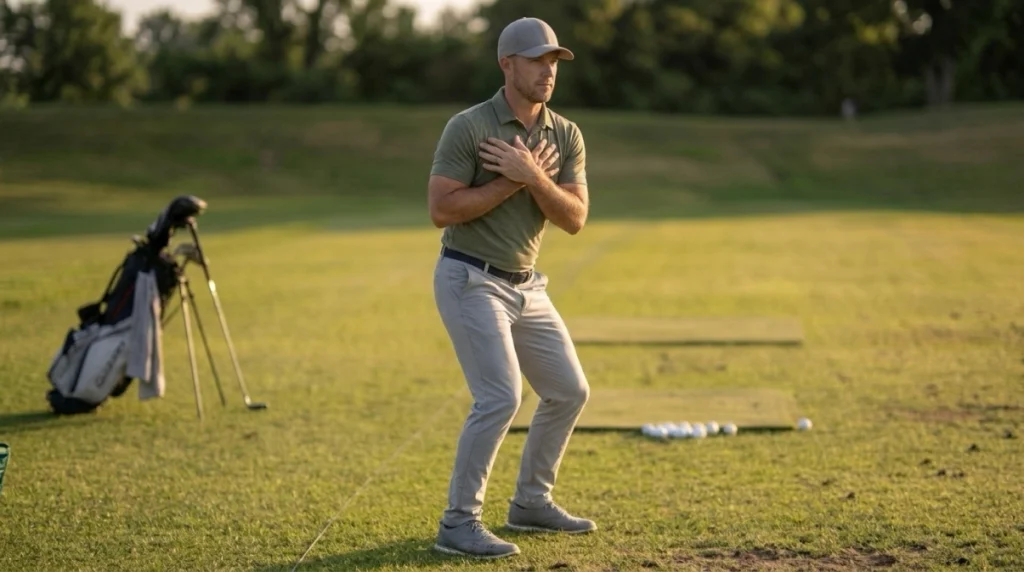
Hip mobility can influence how comfortably you rotate during the backswing and downswing. If your available range of motion is limited, your body may find another way to create movement.
That compensation can appear as excessive sway, sliding, loss of posture, or unwanted movement elsewhere in the body.
Mobility is not the same as forcing a bigger turn
A larger turn isn’t automatically a better turn. You need enough mobility to make your natural swing comfortably and repeatedly.
PGA fitness guidance recommends exercises that address hip mobility, core stability, balance, and rotational movement as part of golf-specific physical preparation. :contentReference[oaicite:10]{index=10}
- Hip rotations: Use controlled movements to explore comfortable range of motion.
- Hip flexor work: Address restrictions that may affect your setup and rotation.
- Glute bridges: Build strength around the hips and help reinforce pelvic control.
- Single-leg work: Challenge balance and lower-body stability.
- Controlled rotation: Train your body to rotate without losing posture.
Don’t chase a flexibility number just because you saw it in a professional golfer. Your goal is usable movement that supports your own swing.
Section Takeaway: Better mobility can make hip rotation easier, but mobility alone doesn’t create a good golf swing. Control and sequencing matter just as much.
Pro tip: If you have pain, a significant mobility limitation, or you’re changing your swing mechanically, work with a qualified golf instructor or appropriate movement professional rather than forcing a new range of motion.
Hip Turn Golf Swing FAQ
How much should your hips turn in the backswing?
There isn’t one correct amount for every golfer. A commonly cited model uses roughly 45 degrees of hip rotation with about 90 degrees of shoulder rotation, but individual mobility and swing characteristics vary.
Should you restrict your hip turn?
You generally shouldn’t try to lock your hips in place. Your hips need to rotate during the backswing, and excessive restriction can make a comfortable upper-body turn harder for some golfers.
Should the hips lead the downswing?
The lower body should contribute to the transition, but “hips first” doesn’t mean violently spinning the pelvis. The hips, torso, arms, and club need to sequence together.
What does a good hip turn feel like?
A good turn often feels like the trail hip moves behind you during the backswing and the lead hip moves around and away from the ball during the downswing. The motion should feel rotational rather than purely sideways.
Can hip turn increase swing speed?
Efficient hip rotation can contribute to speed because the hips help transfer movement through the swing. However, simply rotating faster doesn’t guarantee more clubhead speed. Sequencing, balance, mobility, and impact delivery all matter.
Why do my hips slide instead of turn?
Sliding can come from poor sequencing, limited mobility, setup issues, or an attempt to shift pressure without rotating. Slow-motion video can help you identify whether the movement starts in the backswing or transition.
Can I improve my hip turn without changing my swing?
Yes. Start with simple body-turn drills, slow-motion swings, and mobility work. The goal isn’t to rebuild your entire swing immediately. First, learn to recognize a balanced rotation and then introduce it gradually into your normal motion.
The Bottom Line on Hip Turn
A good hip turn isn’t about making the biggest possible rotation. It’s about creating a coordinated movement that helps you stay balanced, maintain posture, shift pressure, and deliver the club consistently.
For most golfers, the best starting point is simple: turn the trail hip behind you, allow the lead side to begin the transition, and keep rotating through impact.
As of 2026, the coaching message remains consistent: the hips are an important part of the golf swing, but they work best as part of a complete movement rather than as an isolated source of power. :contentReference[oaicite:11]{index=11}
Start with slow swings. Watch your movement. Then add speed only when the motion stays balanced.
Ready to improve your swing? Take your next practice session and spend just 10 minutes on hip-turn drills before hitting full shots. The goal isn’t to swing harder. It’s to make the movement easier to repeat.