
Weak Golf Grip: What It Means, Problems It Causes, and How to Fix It

Quick Answer
A weak golf grip means your hands are rotated too far toward the target on the handle at address. For a right-handed golfer, this usually means the lead hand is turned left and fewer knuckles are visible. A weak grip can make it harder to square the clubface and may contribute to fades, slices, higher ball flight, and lost distance. The PGA’s grip guidance also explains how hand position can influence clubface control.
Common signs of a weak grip
- Few visible knuckles: You may see zero or one knuckle on your lead hand at address.
- Lead hand turned left: The back of the lead hand faces the target more than it would with a neutral grip.
- Open clubface: The face may arrive open relative to your swing path.
- Fade or slice: Shots may curve away from the golfer’s lead side.
- Higher flight: Some golfers add dynamic loft because the face remains open.
Quick check
- Set up normally and look down at your lead hand. If almost no knuckles are visible and your shots consistently start or curve right as a right-handed golfer, test a slightly more neutral hand position.
A weak golf grip can look like a tiny setup detail, yet it can change how easily you control the clubface. I pay attention to grip first whenever a golfer develops a stubborn fade or slice.
The important part is not making your grip as strong as possible. It’s finding a position that lets your hands, wrists, clubface, and swing work together.
In This Guide
What Is a Weak Golf Grip?
A weak golf grip describes the rotation of your hands around the handle. It does not mean you are holding the club loosely or lack hand strength.
For a right-handed golfer, both hands are generally rotated more toward the target than they would be in a neutral grip. For a left-handed golfer, the directions reverse.
What does the lead hand look like?
With a weak lead-hand position, the back of your lead hand tends to face the target. Looking down at address, you may see zero or only one knuckle.
The lead thumb may also sit closer to the center or target side of the shaft. That position can influence how your wrists move during the swing.
What does the trail hand look like?
The trail hand often sits more on top of the handle. Its palm can feel more downward-facing than it would with a neutral or strong grip.
That arrangement may make closing the clubface harder for some golfers. The effect depends on the rest of your swing.
Definition: A weak grip is a hand orientation in which the hands are rotated toward the target relative to a neutral grip. It describes position, not grip pressure.
The distinction matters. You can have a weak hand position while squeezing the club extremely hard.
How Do You Know If Your Golf Grip Is Too Weak?
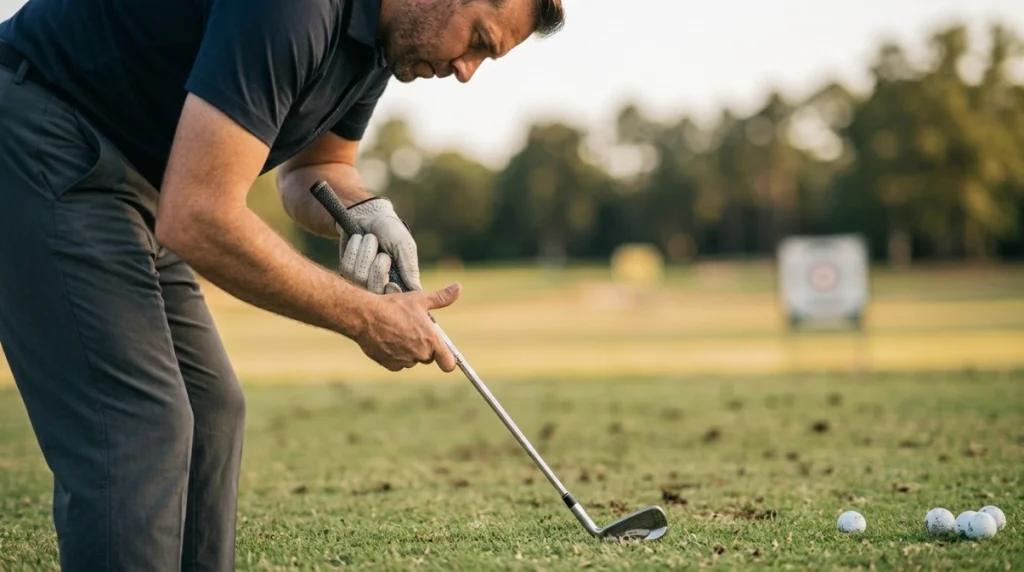
The easiest check combines hand position and ball flight. Don’t diagnose your grip from one bad shot.
I prefer checking several normal swings because strike location, alignment, and swing path can imitate grip problems.
Check your lead-hand knuckles
Take your normal address position without deliberately changing anything. Then look down at your lead hand.
- Weak tendency: zero to one knuckle may be visible.
- Neutral starting point: roughly two knuckles are commonly visible.
- Strong tendency: three or more knuckles may become visible.
These are checkpoints rather than universal laws. Anatomy, wrist angles, handle shape, and individual technique can change what you see.
Check the direction of the V shapes
The gap between each thumb and index finger forms a rough “V.” With a weak grip, those V shapes tend to point more toward the lead side.
With a more neutral grip, the hands normally appear better matched. Neither hand should feel dramatically opposed to the other.
Watch your typical miss
A weak grip becomes more suspicious when your normal shots repeatedly show an open-face pattern.
- Ball starts right and remains right for a right-handed golfer.
- Ball starts near the target and curves significantly right.
- Driver launches higher than expected with weak contact.
- Solid strikes lose distance because of excessive curvature.
- You feel as though you must flip your hands to square the face.
Those symptoms don’t prove that grip is the cause. Alignment, club path, wrist conditions, strike location, and equipment can produce similar results.
Pro tip: If you keep changing your hands but cannot predict the clubface, have a certified PGA professional check your grip and ball flight together.
What Does a Weak Grip Do to Ball Flight?
A weak grip can make it easier for the clubface to remain open relative to the swing path. That often pushes ball flight toward a fade or slice pattern.
PGA instruction has long connected weak hand positions with reduced ability to square the face for many recreational golfers.
Why can a weak grip cause a slice?
A slice curves dramatically away from the golfer’s lead side. For a right-handed golfer, that means a curve to the right.
Golf Digest’s slice instruction specifically identifies an overly weak grip as one setup issue that can contribute to the problem.
Grip still isn’t the complete ball-flight equation. Clubface direction and swing path at impact determine the curvature pattern.
- Open face with an out-to-in path: commonly produces a pull-fade or slice.
- Open face with a near-neutral path: can produce a push or push-fade.
- Square face with a workable path: can produce a straighter shot even from an unconventional grip.
Can a weak grip reduce distance?
It can for some players. An open face can add effective loft and produce inefficient curvature.
That combination may create a higher, shorter flight. A glancing strike can also transfer less energy in the intended direction.
Can it affect irons and driver differently?
Yes. Longer clubs expose face-control problems more clearly because the club moves faster and carries farther.
You might hit acceptable wedges with a weak grip yet lose your driver far to the right. That difference is common enough that I never judge grip quality from short irons alone.
Section Takeaway: A weak grip does not automatically create a slice, but it can make an open clubface harder to manage. Evaluate grip alongside face angle, path, and strike.


Weak vs Neutral vs Strong Golf Grip
Weak, neutral, and strong grips describe hand rotation. They do not rank golfers from bad to good.
A neutral grip is usually the most practical reference point when diagnosing your own setup.
| Grip Type | Lead-Hand Look | Typical Face Tendency | Common Miss |
|---|---|---|---|
| Weak | About 0–1 knuckle visible | Can favor a more open face | Push, fade, or slice |
| Neutral | Often around 2 knuckles visible | Balanced starting position | Depends more on swing pattern |
| Strong | Often 3+ knuckles visible | Can favor a more closed face | Pull or hook for some golfers |
These descriptions are tendencies, not guaranteed outcomes. Skilled golfers can successfully match unusual grips with specific wrist and body movements.
That’s why copying another player’s grip without understanding the matching swing can create a new problem.
Does grip pressure mean the same thing?
No. Grip pressure describes how firmly you hold the club, while grip strength describes hand rotation.
You can therefore have a strong grip position with light pressure. You can also have a weak grip position while squeezing far too hard.
Does grip size matter?
It can. A grip that feels too large or too small may affect how comfortably your hands control the club.
The PGA has also discussed grip size as part of club fitting. If your grips feel awkward, check equipment before rebuilding your swing around them.
How Do You Fix a Weak Golf Grip?
Fix a weak golf grip by moving toward neutral in small increments. A dramatic change can make the club feel foreign and produce quick hooks.
I prefer changing the lead hand first, matching the trail hand second, then testing short shots before reaching for a driver.
1. Square the clubface before gripping
Place the club behind the ball with the face aimed where you want it. Don’t twist the clubface after your hands are attached.
This gives you a reliable reference before changing hand position.
2. Place the handle through the lead hand
Let the handle run diagonally through the fingers rather than burying it entirely across the palm. Close your fingers naturally around it.
For a right-handed player, rotate the lead hand slightly clockwise from an obviously weak position.
3. Use the knuckles as a checkpoint
Look down after taking your stance. Seeing roughly two lead-hand knuckles is a useful neutral starting point for many golfers.
Don’t chase an exact number if the position feels forced. Your anatomy still matters.
4. Match the trail hand
Place the trail hand so both hands feel like one unit. Avoid letting the trail palm sit dramatically on top of the handle.
The hands should support each other rather than fight during the swing.
5. Check grip pressure
Hold the club securely without squeezing until your forearms become rigid. Excess tension can interfere with wrist motion and rhythm.
A useful test is whether you can waggle the club comfortably before starting the swing.
6. Test the change with half-swings
Start with a wedge or 8-iron and make controlled half-swings. Watch the start direction and curvature rather than chasing distance.
- Hit five shots with your old grip.
- Hit five with the adjusted position.
- Use the same target and club.
- Compare starting direction.
- Compare curvature and strike quality.
If shots suddenly hook hard left for a right-handed player, you may have rotated too far. Move back toward neutral rather than compensating elsewhere.
7. Progress to longer clubs
Once the new position works with shorter clubs, move to a 6- or 7-iron. Test the driver last.
This progression makes the change easier to evaluate because speed and shaft length increase gradually.
Pro tip: Grip changes can alter wrist motion and clubface delivery quickly. A certified golf instructor can confirm whether your grip is the cause before you rebuild other parts of your swing.
Section Takeaway: Move a weak grip toward neutral gradually, then test ball flight with controlled shots. Don’t turn your hands dramatically stronger just because one slice appears.
Is a Weak Golf Grip Always Bad?
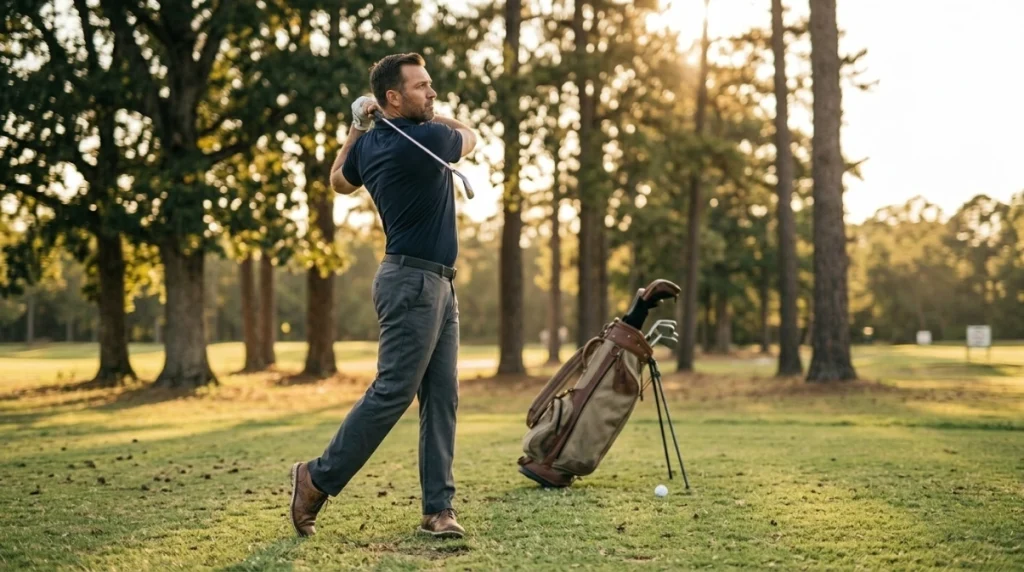
No. A weak grip is not automatically a swing fault.
It becomes a problem when it contributes to ball flight you cannot control or forces difficult compensations elsewhere.
Some skilled golfers use weaker grips
Elite players sometimes use hand positions that look weak by conventional checkpoints. Their wrist conditions and body rotation can still deliver the clubface consistently.
This demonstrates an important lesson: grip must match the swing.
A weaker grip can help a golfer who hooks
A player who closes the face too quickly may benefit from moving the hands slightly weaker. That can reduce an excessive face-closing tendency.
The change should be small. Turning both hands dramatically toward the target can replace a hook with a slice.
A weak grip can help shape certain shots
Advanced golfers sometimes adjust setup when intentionally producing a fade. That is different from accidentally playing every shot with an uncontrolled open clubface.
If you are still developing consistency, build a repeatable stock shot first. Shot-shaping can come later.
Don’t forget the rules
How you position your hands normally remains a technique choice, but certain ways of using the club during a stroke are regulated. The R&A’s Rule 10 explains requirements for making a stroke, including restrictions on anchoring.
For ordinary full-swing grip troubleshooting, focus on predictable face control rather than trying to make your hands look identical to another golfer’s.
Weak Golf Grip FAQs
Does a weak golf grip cause a slice?
A weak grip can contribute to a slice because it may make the clubface harder to square. However, slices also depend on clubface angle and swing path. Check all three before assuming your grip is the sole problem.
How many knuckles should I see in a golf grip?
Many golfers use roughly two visible lead-hand knuckles as a neutral reference. Seeing zero or one may indicate a weaker position, while three or more can indicate a stronger grip. Anatomy and wrist position can change the appearance.
Can a weak grip cause an open clubface?
Yes, it can encourage an open clubface for some golfers. A weak hand position can limit how naturally the face closes during the downswing. Your wrist motion and body rotation also influence the face.
Can a weak grip cause loss of distance?
It can if the grip contributes to excessive loft, an open face, or a large slice. Those conditions may produce a less efficient strike and shorter usable distance, especially with longer clubs such as the driver.
Should beginners use a weak or strong golf grip?
Most beginners should start near a neutral position rather than deliberately choosing an extreme weak or strong grip. A neutral reference makes it easier to learn how setup, swing path, and clubface position influence ball flight.
Can changing my grip fix my slice immediately?
Sometimes a better grip produces an immediate improvement, especially when the face was dramatically open. However, a slice can also involve an out-to-in swing path, alignment, or wrist movement. Treat grip as one part of the diagnosis.
How long does a new golf grip position take to feel normal?
There is no fixed timeline. A small change can feel strange for several practice sessions because your previous position became familiar. Use short, controlled practice and judge progress by repeated ball flight rather than how comfortable the first few swings feel.
Final Takeaway: Should You Change a Weak Golf Grip?
A weak golf grip is worth changing when it consistently contributes to an open clubface, slice, weak fade, or loss of control. The safest starting adjustment is usually toward neutral, not toward an extreme strong position.
Check your lead-hand knuckles, match both hands, keep pressure comfortable, and test the change with short swings. Then let your ball flight tell you whether the adjustment is helping.
Most importantly, don’t rebuild your entire swing around one setup checkpoint. If the same miss remains after a sensible grip adjustment, have a qualified instructor check your clubface, swing path, and impact pattern together.