
How Long Is a Round of Golf?

Quick Answer
An 18-hole round of golf usually takes 4 to 4.5 hours for a foursome. Nine holes often take 1.5 to 2.25 hours. Your group size, course traffic, skill level, format, and the course’s expected pace of play can move those times in either direction.
Typical Playing Times
- 18-hole foursome: Plan for about 4 to 4.5 hours.
- 18-hole twosome: Allow roughly 3 to 3.5 hours on an open course.
- Nine holes: Expect about 1.5 to 2.25 hours.
- Solo round: It may take 2 to 3 hours if nobody blocks your group.
- Busy weekend: An 18-hole round can exceed five hours.
Best Planning Tip
- Check the course’s posted pace before booking, then add at least 30 minutes for check-in and warm-up.
When someone asks me how long golf takes, I never give one rigid number. I’ve played quick weekday rounds and slow weekends where every tee box had a wait.
This guide gives you realistic planning times for 18 holes, nine holes, walking, cart golf, and different group sizes.
In This Guide
How Long Does an 18-Hole Round of Golf Take?
Most golfers should allow 4 to 4.5 hours to complete 18 holes. That estimate works best for a three-player or four-player group moving at a normal pace.
Definition: Under the Rules of Golf, a round is 18 or fewer holes played in the order set by the course committee. Casual golfers often use “round” to mean either nine or 18 holes.
As of 2026, a four-hour round remains a useful target, but it isn’t universal. The USGA reported in 2025 that its recent research placed the average round at about four hours and 30 minutes.
A quiet course can be much quicker. I’ve found that a two-player group can finish near three hours when the fairways ahead stay open.
The same group may need four hours when it catches several foursomes. A golf cart cannot solve that traffic problem.
How much time should beginners expect?
A beginner foursome should budget about 4.5 to 5 hours. New golfers usually take more shots and need extra time to choose clubs, find balls, and learn course routines.
- Play from tees that suit your normal driving distance.
- Carry spare balls, tees, and a ball marker in an easy-to-reach pocket.
- Limit practice swings before each shot.
- Pick up after reaching the maximum score your group agreed to use.
Playing slowly isn’t the same as being inexperienced. A prepared beginner can keep pace better than a skilled golfer with a long pre-shot routine.
Section Takeaway: Plan for 4 to 4.5 hours for 18 holes, or closer to five hours when the course is busy or your group is new.
How Long Do Nine Holes and Shorter Golf Formats Take?

Nine holes usually take 1.5 to 2.25 hours. It’s a practical choice when work, daylight, or family plans make a full round difficult.
The first nine of an 18-hole course may take longer than a separate nine-hole layout. Full-size courses often have longer walks between greens and tees.
| Golf format | Typical time | Good time to budget |
|---|---|---|
| 18-hole foursome | 4–4.5 hours | 5–5.5 hours including arrival |
| Nine-hole foursome | 1.5–2.25 hours | 2.5–3 hours including arrival |
| 18-hole solo round | 2–3 hours on an open course | 3–3.5 hours |
| Nine-hole par-3 course | 1–1.5 hours | About 2 hours |
| Six-hole loop | 1–1.5 hours | About 2 hours |
These are planning ranges, not official limits. Always check the scorecard, starter’s instructions, or booking page for that course’s target time.
The USGA also recommends playing nine when a golfer lacks time for 18. Nine holes still provide a complete score and a useful practice session.
What Makes a Round of Golf Longer or Shorter?
Course traffic has the largest effect on round length. Your group cannot play through an entire line of golfers on a crowded Saturday morning.
Several other factors can add minutes to every hole:
- Group size: Four golfers make more shots than one or two golfers.
- Course difficulty: Deep rough, water, trees, and blind shots increase search and recovery time.
- Tee selection: Tees that are too long create more shots and difficult approaches.
- Player experience: Beginners may need more strokes and help with basic procedures.
- Playing format: Individual stroke play often takes longer than a scramble.
- Weather: Wind, rain, and heat can slow walking and club selection.
- Course restrictions: Cart-path-only rules create extra walking between the cart and ball.
Does the type of golf course matter?
Yes. A short municipal course may play faster than a long resort layout with major distances between holes.
Mountain courses can have steep paths and long cart rides. Links-style courses may move quickly until strong wind makes each shot harder.
If you’re new, use this guide to choose a suitable first golf course. A shorter, more forgiving layout can improve both pace and confidence.
Why do lost balls cause such long delays?
One search may feel harmless. Several searches across a foursome can add considerable time.
The Rules allow up to three minutes to search after a player or caddie begins looking. Play a provisional ball when your original shot may be lost outside a penalty area or out of bounds.
The R&A also advises golfers to watch everyone’s shots carefully. That simple habit reduces search time and helps the group stay connected.
Section Takeaway: Traffic sets the ceiling, but tee choice, preparation, course design, and ball searches determine how well your group keeps pace.

Does Walking, Using a Cart, or Group Size Change the Time?
A cart doesn’t automatically make golf faster. It helps most when players can drive near their balls and organize each trip well.
Walking can be equally quick on a compact course. Each golfer can move directly toward their own ball instead of sharing one vehicle.
| Group | Walking estimate | Cart estimate |
|---|---|---|
| One golfer | 2.5–3 hours | 2–2.5 hours |
| Two golfers | 3–3.5 hours | About 3 hours |
| Three golfers | 3.5–4 hours | 3.5–4 hours |
| Four golfers | 4–4.5 hours | 4–4.5 hours |
These ranges assume open space ahead. A solo golfer behind several foursomes will move at the foursomes’ pace.
Cart-path-only conditions may make walking faster. Cart partners must also avoid driving to one ball, waiting, and then repeating the trip for the second ball.
- Drop one player with several possible clubs, then drive to the other ball.
- Park beside or behind the green toward the next tee.
- Record scores at the next tee instead of beside the finished green.
Group size affects time, but habits matter more than golfers often think. An organized foursome can stay ahead of an unprepared twosome.
How Can You Play Faster and Plan Your Day?
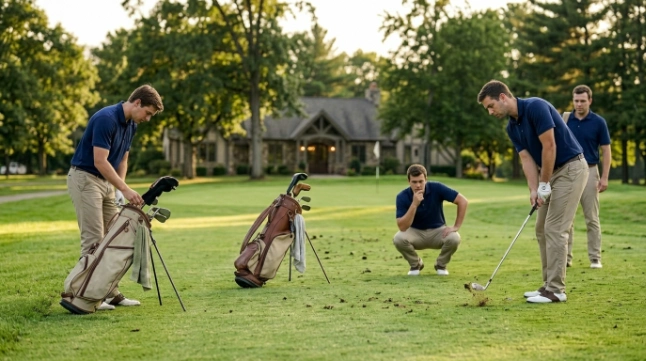
The best way to save time is to prepare while other golfers play. Choose your club, read your putt, and check the wind before your turn arrives.
Use ready golf safely
Ready golf means playing when you’re prepared and it’s safe, instead of always waiting for the golfer farthest from the hole. It’s suitable for stroke play when the group agrees.
Our full guide explains how ready golf works. The R&A also confirms that golfers may play out of turn for convenience or to save time when nobody faces danger, distraction, or interference.
- Let a shorter hitter play while a longer hitter waits for the fairway to clear.
- Hit your shot before helping another golfer search.
- Finish a short putt when doing so won’t disturb another player.
- Carry an extra ball when walking across the fairway.
- Keep up with the group ahead, not merely ahead of the group behind.
The Rules of Golf on prompt play recommend making a stroke within 40 seconds once you can play without interference. Most shots should take less time.
The PGA’s beginner golf etiquette guidance also emphasizes being ready when it’s your turn. Fast play should remain calm and safe.
How much total time should you reserve?
Don’t plan only for the time between the first and final shots. You may need time for parking, check-in, practice, food, and travel around the property.
- Arrive 30–45 minutes early: This gives you time to check in, stretch, putt, and reach the first tee.
- Allow 4–4.5 hours for play: Add more time for a busy weekend or difficult course.
- Add 15–30 minutes afterward: Return the cart, clean up, and collect your belongings.
- Include meal time separately: A clubhouse lunch can add another 30–60 minutes.
For a standard 18-hole day, I reserve about five to six hours at the property. That buffer keeps a normal delay from disrupting the rest of my schedule.
First-time players can review what to expect on their first day at a golf course. A simple list of what to bring for a round also prevents last-minute delays.
Section Takeaway: Prepare before your turn, use ready golf safely, and reserve five to six hours for a complete 18-hole visit.
Frequently Asked Questions
Can you play 18 holes in three hours?
Yes. A solo golfer or twosome can finish in about three hours on an open course. That time becomes unlikely when the course is crowded, the layout is difficult, or the group must wait on most shots.
How long does a round of golf take for four players?
A four-player group usually needs 4 to 4.5 hours for 18 holes. Beginners, heavy traffic, difficult rough, and long gaps between holes can push the round closer to five hours.
How long does a round of golf take with a cart?
An 18-hole cart round usually takes 3.5 to 4.5 hours, depending on group size and traffic. A cart saves less time when the course requires cart-path-only driving or when two partners use it inefficiently.
How long does it take to walk 18 holes?
Walking 18 holes commonly takes 4 to 4.5 hours in a foursome. A fit solo golfer may finish in 2.5 to 3 hours when the course is compact and open.
How long does nine holes take for beginners?
A beginner group should allow 2 to 2.5 hours for nine holes. Choosing suitable tees, carrying spare balls, and limiting practice swings can help the group finish sooner.
Why do weekend golf rounds take longer?
Weekend tee sheets are often full, so one slow group can create delays across the course. Tournaments, difficult pin positions, beverage stops, and closely spaced starting times may add more waiting.
Is a five-hour round of golf normal?
A five-hour round is common on busy resort or weekend courses, but it isn’t an ideal target. Check the course’s posted pace and speak with a marshal if your group repeatedly loses contact with the group ahead.
Final Takeaway
For practical planning, expect an 18-hole round to take 4 to 4.5 hours. Nine holes usually need 1.5 to 2.25 hours.
Add check-in, warm-up, and post-round time before building golf into your day. When time is tight, book nine holes or choose an early tee time with fewer groups ahead.
Stay prepared, play ready golf safely, and watch the group in front. Those habits improve pace without making the round feel rushed.