
Golf Swing Timeline: How Long Does It Take to Build a Consistent Golf Swing?

Quick Answer
A realistic golf swing timeline is measured in months, not days. Many beginners can learn a functional setup and make better contact within 2–4 weeks, build a more repeatable swing over 2–3 months, and develop dependable on-course patterns over 6–12 months with regular practice. Structured instruction from a PGA golf professional can help prevent poor habits from becoming permanent.
A Practical Golf Swing Timeline
- First 1–2 weeks: Learn grip, posture, alignment, ball position, and controlled half-swings.
- Weeks 3–4: Improve contact and begin producing a recognizable ball-flight pattern.
- Months 2–3: Build a repeatable motion and start transferring it from practice to the course.
- Months 3–6: Improve face control, low-point control, balance, and consistency with different clubs.
- Months 6–12: Develop a more reliable swing under changing lies, targets, pressure, and course conditions.
Remember
- Practice quality matters more than hitting hundreds of balls without feedback.
- Your progress will rarely move in a perfectly straight line.
If you’re searching for a golf swing timeline, you probably want to know when the swing will finally stop feeling awkward. That’s a fair question, but there isn’t one magic number of range sessions that turns a beginner into a consistent ball-striker.
I prefer to think in milestones. First you learn the movement, then you improve contact, and eventually you learn to reproduce it when the shot matters.
In This Guide
What Does a Golf Swing Timeline Really Mean?
A golf swing timeline is the period needed to move from learning basic mechanics to producing a repeatable motion you can trust on the course. It isn’t a countdown to a perfect swing.
Your starting ability changes everything. A complete beginner learning grip and posture faces a different challenge from a 15-handicap golfer changing clubface delivery.
A useful timeline measures skills, not appearance. Your swing doesn’t have to resemble a tour player’s motion to produce playable shots.
There Are Several Stages of “Learning” a Swing
- Understanding: You know what movement or setup change you’re trying to make.
- Performing: You can produce the movement during a controlled drill.
- Repeating: You can perform it across several shots without constant thought.
- Transferring: The movement survives different clubs, targets, and lies.
- Trusting: You can use the swing on the course without running through a technical checklist.
Those stages don’t always happen together. You may understand a change during one lesson yet need weeks before it appears consistently at normal speed.
What Counts as a Consistent Golf Swing?
A consistent golf swing doesn’t produce identical shots. Even excellent players have normal variation in strike, direction, trajectory, and distance.
For a developing golfer, consistency means your misses become predictable enough to manage. You also produce playable contact more often than disastrous contact.
A practical definition looks like this:
- You can establish your setup without rebuilding it before every shot.
- Your strike pattern becomes more centered.
- You control where the club reaches the ground more reliably.
- Your normal curve becomes recognizable.
- You can finish balanced at normal swing speed.
- You know what to practice after a poor session.
The USGA provides the rules and handicapping framework golfers eventually use to measure on-course performance. Your swing, however, should first be judged by contact and playable patterns rather than handicap alone.
Section Takeaway: A golf swing timeline should track repeatable skills and predictable misses. Don’t use cosmetic perfection as the finish line.
What Should Happen During Your First 12 Weeks?
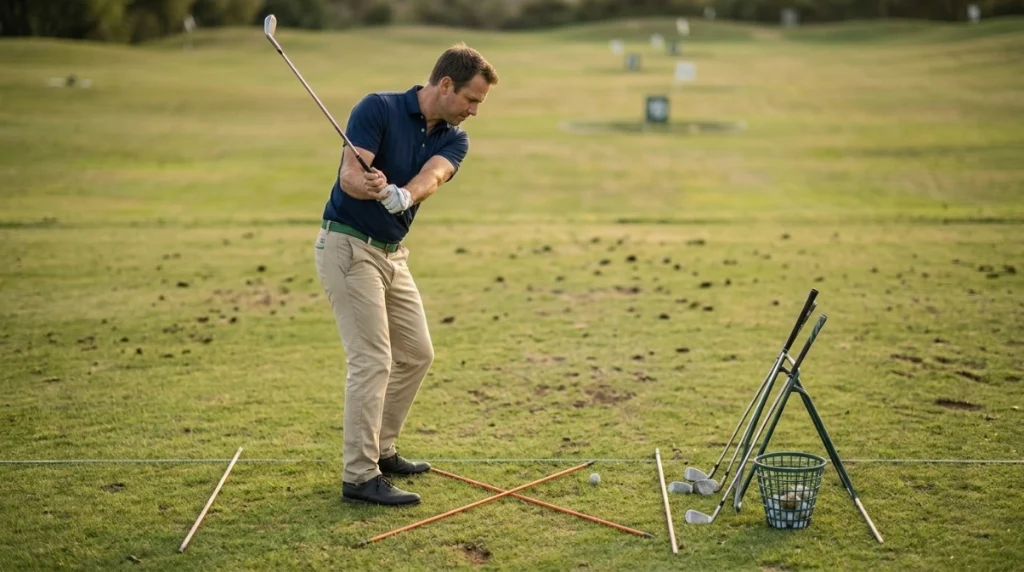
During the first 12 weeks, a beginner should build a reliable setup, learn controlled contact, and gradually add speed. Trying to manufacture maximum distance immediately usually makes the process harder.
The timeline below is a practical framework, not a guarantee. Some golfers will move faster, while others need longer at one stage.
| Stage | Main Focus | Useful Progress Marker | Avoid |
|---|---|---|---|
| Weeks 1–2 | Grip, posture, alignment, ball position | Comfortable setup and balanced half-swings | Full-power driver swings |
| Weeks 3–4 | Contact and low-point control | More shots launch cleanly | Changing several mechanics together |
| Weeks 5–8 | Direction, clubface control, rhythm | A recognizable normal shot pattern | Chasing every poor ball flight |
| Weeks 9–12 | Transfer to different clubs and targets | More playable misses on the course | Range-only practice |
Weeks 1–2: Build the Setup First
Early improvement often comes from what happens before the club moves. Grip, alignment, posture, stance width, and ball position all influence what follows.
Start mainly with wedges and mid-irons. Shorter clubs make it easier to feel balance and observe the strike.
A simple early session can include:
- Make several slow rehearsal swings without a ball.
- Hit short waist-high shots with a wedge.
- Move to controlled half-swings with a 7-iron.
- Finish every swing in balance.
- Stop when fatigue begins changing your motion.
The goal isn’t distance. You’re teaching your body how the club, arms, and rotation work together.
Weeks 3–4: Improve Contact
Once setup feels familiar, start paying closer attention to strike quality. Golfers often progress faster when they learn where the club meets the turf and where the ball meets the face.
A useful practice session has a clear target. Don’t simply hit fifty balls toward an open field.
- Choose one target line.
- Use one club for several shots.
- Notice whether contact is thin, heavy, heel-side, toe-side, or centered.
- Record your dominant miss.
- Work on one correction at a time.
Weeks 5–8: Build a Pattern
This is when many golfers become impatient. Better contact has appeared, but occasional slices, hooks, chunks, and tops haven’t disappeared.
That’s normal. Your goal is now to make the overall pattern narrower and more predictable.
Start introducing targets at different distances. Alternate clubs occasionally so practice feels closer to a real round.
Weeks 9–12: Take the Swing to the Course
A driving-range swing and a golf-course swing aren’t identical challenges. The course introduces uneven lies, hazards, targets, consequences, and waiting time between shots.
Begin testing the swing in realistic situations:
- Change targets after each ball.
- Switch clubs frequently.
- Use your normal pre-shot routine.
- Play imaginary holes on the range.
- Spend time on putting, chipping, and pitching too.
Section Takeaway: The first 12 weeks are about building a foundation and a recognizable ball-flight pattern. Reliable contact matters more than maximum speed.
What Changes After Six to Twelve Months?
After six to twelve months of structured practice, the biggest change should be adaptability. You aren’t just learning to make one good swing from a perfect range lie.
You begin learning which version of your swing works on the course. That means knowing your normal shot, your common miss, and your dependable clubs.
You Start Managing Misses
Golf becomes easier when you stop expecting perfect shots. A useful swing creates misses you can plan around.
For example, a golfer whose normal iron shot falls slightly right can select targets with that pattern in mind. That is far more useful than alternating randomly between large hooks and slices.
Different Clubs Need Different Setups
Your basic motion may remain similar, but club length and loft change how you set up. A driver, wedge, and 7-iron should not be treated as identical shots.
Loft is the angle of the clubface relative to a vertical face. More loft generally launches the ball on a higher initial trajectory, while other delivery conditions also affect flight.
As your swing develops, pay attention to:
- Ball position
- Stance width
- Tee height
- Club length
- Strike location
- Launch pattern
Scoring Skills Start Mattering More
A better full swing doesn’t automatically produce a dramatically lower score. Putting, wedges, recovery shots, penalties, and decisions still matter.
By this stage, divide practice across the complete game. The R&A maintains the Rules of Golf alongside the USGA, and learning common playing situations can make your transition from practice to regular rounds smoother.
Your progress can also be measured through simpler outcomes:
- Fewer penalty shots
- More tee shots kept in play
- More solid approach shots
- Fewer wasted recovery strokes
- Better distance control around the green
- More confident club selection
Section Takeaway: Months six through twelve should produce a more usable golf game, not just a prettier range swing. Predictability and course transfer are the real goals.


How Often Should You Practice Your Golf Swing?
For many recreational golfers, two or three focused sessions each week provide a practical learning rhythm. Short, purposeful practice normally beats occasional marathon sessions.
You also need enough recovery time to avoid turning fatigue into poor movement. Quality drops quickly when every swing becomes an effort.
A Practical Weekly Schedule
| Session | Suggested Focus | Purpose |
|---|---|---|
| Session 1 | Technique and contact | Work on one movement priority |
| Session 2 | Targets and club changes | Develop variability and decision-making |
| Session 3 | Course or simulated round | Transfer the swing under realistic conditions |
You don’t need a large bucket every time. Twenty attentive swings can be more valuable than eighty rushed ones.
Separate Practice From Performance
Technical practice gives you permission to exaggerate movements and hit imperfect shots. Performance practice asks you to choose a target and produce a result.
Mixing those goals constantly can become confusing. Give each portion of the session a purpose.
- Technique block: Rehearse one specific movement.
- Contact block: Track strike and turf interaction.
- Target block: Hit toward defined landing areas.
- Transfer block: Change clubs and targets after each ball.
Pro tip: If a swing change causes pain, repeated loss of balance, or confusing compensations, work with a certified golf instructor instead of forcing the movement yourself.
Why Does Golf Swing Progress Sometimes Stall?
Golf swing progress often stalls because the golfer changes too many variables, practices without feedback, or expects a new movement to work immediately. A plateau doesn’t automatically mean the change has failed.
Learning can look messy. Some sessions improve quickly, while the next one feels worse.
You Have Too Many Swing Thoughts
Trying to control your knees, hips, shoulders, wrists, head, tempo, clubface, and finish during one swing creates overload. Choose one priority whenever possible.
A simple external goal can also help. Examples include striking a specific part of the face or starting the ball through a defined window.
You Keep Changing Advice
Golf instruction is full of ideas that can be useful for different players. The problem begins when you combine unrelated fixes from several sources without understanding the cause of your own miss.
A tip designed for a golfer who leaves the clubface open may be harmful for someone already closing it too quickly.
You Practice Only With Your Favorite Club
Repeating one 7-iron from a flat mat can create confidence without building adaptability. Golf demands changes in club length, lie, target, and shot shape.
Once your technical priority starts feeling comfortable, add variety deliberately.
You Judge Progress by Your Best Shot
Your best shot shows what is possible. Your overall pattern tells you whether you’ve improved.
Track simple measures instead:
- How many shots were playable?
- Where was the strike pattern?
- What was the dominant curve?
- How wide was the dispersion?
- Could you finish in balance?
- Did the same miss appear repeatedly?
Section Takeaway: A plateau often means your practice needs clearer feedback or fewer priorities. Don’t rebuild the swing every time one session goes badly.
When Should You Get Professional Help?

Consider professional instruction when you cannot identify the cause of a recurring miss or your practice keeps producing contradictory results. Early feedback can save weeks of working on the wrong problem.
PGA coaching commonly addresses grip, setup, posture, alignment, swing fundamentals, practice structure, and long-term development. Those fundamentals are especially useful before a beginner adds speed.
Book a Lesson When You See These Signs
- You repeatedly top or chunk the ball.
- Your shots curve severely in one direction.
- You cannot establish a comfortable grip or posture.
- Your strike pattern keeps moving around the clubface.
- You don’t know which swing thought to keep.
- Your results become worse despite regular practice.
- You experience recurring physical discomfort.
A coach can also use video or launch-monitor information to compare what you feel with what the club and ball are doing. That feedback can make a vague problem much easier to understand.
When Does Club Fitting Enter the Timeline?
A complete beginner doesn’t always need an expensive fitting before the first lesson. Borrowed, rental, or sensible beginner equipment can be enough during the earliest stage.
Fitting becomes more useful once your motion is repeatable enough to produce meaningful patterns. A fitter may assess club length, lie angle, shaft weight, shaft flex, loft, grip size, launch, spin, strike, and dispersion.
Lie angle describes the angle between the club’s shaft and sole when the club is positioned for use. An unsuitable specification can affect how comfortably a golfer delivers the club.
If you’re preparing to spend heavily on equipment, a qualified fitter can help separate equipment issues from technique issues. For broader instruction and equipment coverage, Golf Digest is another established golf resource.
Pro tip: Use professional instruction for hands-on swing changes that affect movement or physical strain, especially if you have an existing injury or limited mobility.
Golf Swing Timeline FAQs
How long does it take a beginner to learn a golf swing?
A beginner can understand the basic grip, setup, and motion during the first few practice sessions. Building repeatable contact normally takes longer, and developing a swing that holds up on the course can require several months of regular practice.
Can I build a good golf swing in 30 days?
You can make meaningful progress in 30 days, especially with focused instruction and regular practice. However, one month is better viewed as a foundation period than a deadline for a finished swing.
How many golf balls should I hit to improve?
There is no ideal ball count that guarantees improvement. A smaller number of deliberate swings with a target and clear feedback can be more useful than hitting a large bucket while tired or unfocused.
Is practicing golf twice a week enough?
Two focused sessions per week can support steady improvement for many recreational golfers. Adding short-game work or occasional course play helps transfer technical changes into real scoring situations.
Why does my swing get worse after a lesson?
A new movement can temporarily disrupt your familiar timing. That doesn’t automatically mean the lesson was wrong. Slow the motion down, return to the assigned drill, and contact your instructor if the new pattern remains unclear.
When should I start practicing with a driver?
You can introduce the driver once you understand basic setup and can make reasonably balanced swings. Beginners don’t need to master irons first, but the driver’s extra length and lower loft can make poor face control more obvious.
How long does it take to become consistent at golf?
Consistency is gradual rather than absolute. Several months of structured practice can create a recognizable swing and miss pattern, while dependable performance across different courses and conditions can take much longer.
Your golf swing timeline should be measured by better contact, smaller misses, clearer patterns, and more confidence—not by whether your swing looks perfect.
Start with one priority, practice it at controlled speed, then test it with targets and different clubs. Give the change enough time to become familiar before deciding you need another rebuild.
As of 2026, the fundamentals haven’t changed: sound setup, useful feedback, purposeful practice, and a balanced motion still provide the best foundation. Build those first, then let speed and refinement follow.