
Swing Speed Basics: What Every Golfer Should Know

Quick Answer
Golf swing speed is how fast the clubhead travels near impact, usually measured in miles per hour. More speed can create more distance, but only when you combine it with solid contact, useful launch conditions, and control. The USGA has studied clubhead speed extensively because it plays a major role in ball speed and driving distance.
Swing Speed Basics at a Glance
- Speed is measured: Clubhead speed is normally recorded in mph near the moment the club meets the ball.
- Faster can go farther: Higher speed gives you more potential ball speed and distance when impact quality stays strong.
- Contact still matters: A centered strike can outperform a faster swing that misses the middle of the face.
- Every club differs: Driver swing speed is higher than iron swing speed because the driver is longer.
- Equipment must fit: Shaft, loft, club length, and ball characteristics can influence how efficiently you use your speed.
Best Starting Point
- Measure your current driver speed before changing your swing or buying equipment based on speed.
Swing speed gets plenty of attention because golfers connect it with distance. That connection is real, but speed alone doesn’t tell the whole story.
I prefer to think of swing speed as one part of an efficiency equation. Once you understand what the number means, you can make smarter choices about technique, practice, clubs, and distance expectations.
In This Guide
What Is Golf Swing Speed?
Golf swing speed is the speed of the clubhead as it moves through the impact area. Launch monitors usually express the number in miles per hour.
You may also hear the terms clubhead speed or club speed. In everyday golf conversations, those terms usually describe the same basic measurement.
Swing speed is not ball speed
Club speed tells you how fast the club is moving. Ball speed tells you how fast the golf ball leaves the face after impact.
The two numbers are related, but they are not interchangeable. Strike location and impact efficiency influence how much club speed becomes ball speed.
- Club speed: How fast the clubhead travels.
- Ball speed: How fast the ball launches after impact.
- Launch angle: The vertical angle at which the ball starts.
- Spin rate: How quickly the ball spins after impact.
- Carry distance: How far the ball travels before landing.
These measurements work together. That is why two golfers swinging at the same speed can produce noticeably different drives.
Why driver speed gets most of the attention
The driver has the longest shaft in a standard golf bag. That length helps the clubhead travel faster than a shorter iron during a full swing.
Driver swing speed is therefore the number most often used when discussing a golfer’s general speed category. It is also useful during club fitting.
A 7-iron speed should not be compared directly with driver speed. The club lengths, lofts, and swing characteristics are different.
Section Takeaway: Swing speed measures clubhead speed, not ball speed or distance. Treat it as one piece of the impact picture.
How Fast Should You Swing a Golf Club?

There is no single swing speed every golfer should reach. Your useful speed depends on strength, mobility, technique, strike quality, age, equipment, and how consistently you control the clubface.
For recreational golfers, the goal should be repeatable speed. A controlled 85 mph swing that finds the center can be more useful than an uncontrolled 95 mph attempt.
Common driver swing-speed context
USGA material has used approximately 60–65 mph to illustrate slower recreational swing speeds. It has also described roughly 80–90 mph as a representative range for many male recreational golfers.
At the other end, elite players can swing much faster. USGA distance reporting listed the PGA Tour’s 2023 average driver clubhead speed at 115.1 mph.
| Driver Speed | Useful Context | Main Priority |
|---|---|---|
| Around 60–65 mph | Slower recreational speed range | Launch, centered contact, suitable tees |
| Around 80–90 mph | Common recreational context | Efficiency and dispersion |
| 100+ mph | Higher-speed amateur territory | Face control and launch optimization |
| 115 mph range | Comparable to recent PGA Tour averages | Elite-level efficiency and control |
These ranges are context, not performance grades. A lower number does not mean someone is a poor golfer.
Don’t chase someone else’s number
Many golfers make the mistake of comparing themselves with tour professionals. That can push them toward a swing they cannot control.
A better target is the fastest speed you can produce while keeping acceptable contact and direction. That number can improve gradually.
The PGA of America repeatedly emphasizes grip, stance, posture, alignment, contact, and swing path as core fundamentals. Those basics still matter when speed becomes a goal.
Pro tip: If increasing speed causes pain, major balance loss, or worsening contact, work with a PGA professional or qualified golf coach before pushing harder.
Section Takeaway: Your ideal swing speed is not a universal number. Build usable speed that still produces solid contact and predictable shots.
Why Does Swing Speed Affect Distance?
Faster clubhead speed creates the potential for higher ball speed. Higher ball speed can produce more distance when launch, spin, and contact remain efficient.
The word potential matters. Extra speed is only valuable when you transfer it into the ball effectively.
What happens at impact?
The clubhead carries energy into the collision with the golf ball. Clubhead speed is one factor that influences the ball’s initial velocity.
USGA research has repeatedly studied this relationship. Its recreational-golfer analysis found a clear association between increasing swing speed and driving ability.
- More club speed: Raises the ceiling for ball speed.
- Centered contact: Helps transfer energy efficiently.
- Useful launch: Helps turn ball speed into carry.
- Suitable spin: Keeps the flight from ballooning or falling too quickly.
- Good direction: Makes the distance playable.
Why a mishit can erase your speed advantage
A golfer can swing hard and still lose distance through poor impact. Heel, toe, low-face, and high-face strikes change ball speed and flight.
That is why speed training without strike feedback can become misleading. The launch monitor may show a faster club, while the course shows no useful gain.
Speed versus efficiency
Imagine one golfer swings at 90 mph and consistently finds the center. Another reaches 96 mph but regularly misses the center and curves the ball severely.
The second golfer owns more raw speed. The first may still produce better average drives.
This is the practical side of swing speed basics. Distance comes from a system, not one number.
The governing bodies also treat speed as only one part of distance testing. The R&A works alongside the USGA on equipment standards and distance-related issues.
Section Takeaway: Faster speed can create more distance, but only when impact efficiency, launch, spin, and direction remain good enough to use it.


How Do You Measure Golf Swing Speed?
The best way to measure swing speed is with a launch monitor or radar-based speed device. Use several normal swings rather than treating one maximum effort as your true number.
Modern fitting studios, teaching bays, and many driving ranges offer this technology. Personal launch monitors can also provide club or ball data, depending on the model.
A simple testing routine
- Warm up first. Hit short clubs before moving into full driver swings.
- Use your normal driver. Changing clubs makes comparisons less useful.
- Hit several shots. Five to ten usable swings provide better context than one swing.
- Remove obvious mishits. A slip or extreme miss should not define your baseline.
- Record the average. Track normal speed, not only your fastest effort.
- Note strike quality. Speed without contact data can hide an important problem.
Measure under similar conditions when you retest. A rushed cold start and a fully warmed-up session are not equal comparisons.
Which numbers should you record?
Swing speed is useful, but it becomes much more informative beside other launch-monitor numbers.
- Clubhead speed
- Ball speed
- Carry distance
- Total distance
- Launch angle
- Spin rate
- Impact location, if available
This gives you a fuller picture. If speed rises while ball speed and carry stay flat, contact or launch conditions deserve attention.
How often should you test?
You do not need to check swing speed every practice session. Constant number chasing can distract you from the actual golf shot.
For most golfers, periodic testing is enough. Retest after a meaningful block of technique work, physical training, or an equipment change.
As of 2026, launch monitors are common enough that golfers can measure speed far more easily than a generation ago. The important step is interpreting the number correctly.
Section Takeaway: Use several representative swings and record more than club speed. Average speed plus impact and ball-flight data tells you much more.
How Can You Increase Swing Speed Safely?
You can improve swing speed through better movement, sequencing, strength, mobility, and speed-specific practice. Simply swinging harder is rarely the best long-term plan.
Start with technique. An inefficient motion can waste physical effort before the club reaches impact.
Build the movement before chasing maximum effort
A sound setup gives you room to move. Balance also helps you apply force without falling away from the shot.
Good sequencing means the parts of the swing work in a useful order. When golfers rush from the top, they can spend effort without creating efficient clubhead speed.
- Check your setup: Stable posture and balance give the swing a better starting point.
- Improve contact: Extra speed is more valuable when you strike the center.
- Train rotation: Better movement can create speed without relying only on the hands.
- Use speed sessions: Short, rested bursts make more sense than endless all-out swings.
- Recover properly: Fatigue changes movement and can lower practice quality.
Don’t confuse tension with speed
Golfers often grip harder and tighten their shoulders when trying to swing faster. That can make the motion feel powerful while reducing freedom of movement.
Speed usually needs both force and coordination. Excess tension can interfere with both.
Can strength training help?
General strength, power, balance, and mobility can support a faster swing. The right program depends on your age, training history, physical limitations, and goals.
Golf-specific exercise should support your swing rather than leave you too sore to practice. Progress gradually.
Pro tip: Ask a qualified fitness professional, medical professional, or certified golf instructor for individual guidance if you have pain, previous injuries, or major mobility restrictions.
Speed practice should still include a golf ball
Speed-only drills can help you learn to move faster. However, the game still requires you to strike a ball toward a target.
I like the logic of alternating goals: make a few athletic swings, then return to normal shots and check contact. That keeps the connection between speed and actual golf performance clear.
Instruction resources such as Golf Digest can offer useful drill ideas, but individual technique problems are easier to diagnose with a coach who can see your swing.
Section Takeaway: Increase speed through better movement and gradual training, then confirm that the added speed still produces solid golf shots.
How Does Swing Speed Affect Equipment Choices?
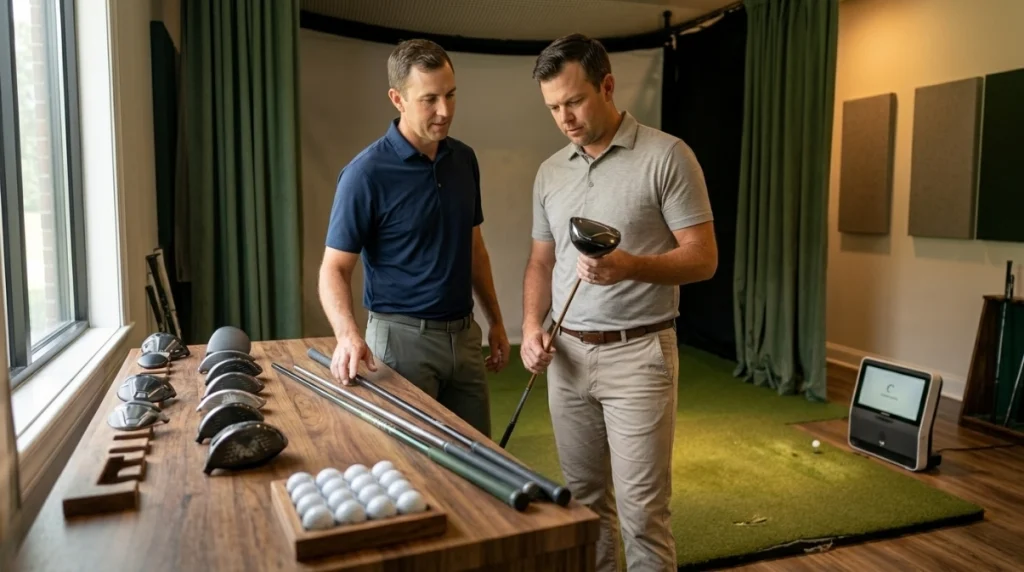
Swing speed can help guide equipment fitting, but it should never choose your clubs by itself. Tempo, transition, delivery, strike pattern, launch, spin, and feel also matter.
This is especially important with shafts. Two golfers with identical driver speeds may prefer different shaft weights, profiles, or flex labels.
Does faster swing speed require a stiffer shaft?
Not automatically. Swing speed is one fitting input, not a complete shaft prescription.
A golfer with a smooth transition can load a shaft differently from someone with an aggressive transition. Manufacturer flex labels also are not perfectly standardized across every shaft model.
- Swing speed: Provides a useful starting reference.
- Tempo: Describes how quickly the swing develops.
- Transition: Influences how forcefully the shaft is loaded.
- Release pattern: Affects delivery into impact.
- Strike pattern: Helps determine whether the club’s length and setup work for you.
What about driver loft?
Loft is the angle of the clubface relative to a vertical plane. Driver loft influences launch and spin, but the printed number alone cannot predict ball flight.
Your dynamic loft and angle of attack also influence the shot. That is why a fitter looks at measured launch conditions rather than matching loft to swing speed from a simple chart.
Does golf ball choice depend on swing speed?
Swing speed can affect how a ball performs, but it should not be your only buying filter. Feel, driver spin, iron performance, short-game control, and trajectory matter too.
Modern golf balls are designed across a wide range of playing characteristics. Test complete performance rather than assuming a particular compression automatically belongs to one speed.
When is a club fitting worthwhile?
A fitting is most useful when you arrive with a reasonably repeatable swing. The fitter can then evaluate how different club setups affect launch, spin, speed, dispersion, and strike.
A fitting can also reveal that the club is not the main problem. Sometimes the best result is keeping your current equipment and improving delivery.
Pro tip: Use a qualified club fitter for hands-on shaft, loft, length, or lie-angle changes rather than choosing solely from an online speed chart.
Section Takeaway: Swing speed helps narrow equipment choices, but a proper fit also considers tempo, delivery, impact, launch, spin, and dispersion.
Swing Speed FAQ
What is a good golf swing speed for a beginner?
A good beginner swing speed is one the golfer can control while making consistent contact. Beginners should not chase a specific mph target before developing grip, setup, balance, and strike quality. Speed can increase naturally as movement and confidence improve.
Is 80 mph a slow driver swing speed?
An 80 mph driver speed is within normal recreational territory and can produce useful distance with good impact and launch. Whether it feels “slow” depends on who you compare it with. Course setup and consistent contact matter more than matching tour-level speed.
Is 90 mph a good golf swing speed?
Yes. A 90 mph driver swing can support plenty of distance for recreational golf when the ball is struck efficiently. Rather than chasing a larger number immediately, check ball speed, launch, spin, carry, and dispersion to see how well you use that speed.
Does swing speed decrease with age?
Swing speed can decline as strength, mobility, coordination, and power change with age, but the amount varies widely. Good technique, suitable physical training, proper equipment, and appropriate tee selection can help golfers continue playing effectively even if raw speed changes.
Can a lighter shaft increase swing speed?
A lighter shaft may help some golfers move the club faster, but speed gains are not guaranteed. Weight also affects timing, feel, strike location, and control. Compare shafts using launch-monitor data and dispersion instead of choosing the lightest option automatically.
How much does one mph of swing speed matter?
Even a small speed increase can add distance potential, but there is no fixed yardage gain that applies to every shot. Launch, spin, strike, weather, ball characteristics, and club delivery all influence how much extra distance appears.
Should I swing as hard as possible with my driver?
No. Your best on-course driver swing is usually the fastest motion you can repeat while maintaining useful contact and direction. Maximum-effort swings can be useful in controlled speed training, but they should not automatically become your normal playing swing.
The Bottom Line on Swing Speed Basics
Swing speed matters because it affects how much ball speed and distance you can potentially create. It is not, however, a complete measure of driving performance.
Start by measuring your normal speed. Then look at contact, ball speed, launch, spin, carry, and dispersion beside it.
- Build reliable contact before chasing a large mph number.
- Compare your progress with your own baseline.
- Increase speed gradually through technique and physical preparation.
- Use launch-monitor data to confirm whether added speed helps.
- Fit equipment around your complete delivery, not speed alone.
That approach makes swing speed useful instead of distracting. The goal is not simply to move the club faster—it’s to turn the speed you have into better golf shots.