
How to Keep Score in Golf: A Simple Beginner’s Guide

Quick Answer
To keep score in golf, count every stroke you make to complete each hole, add any penalty strokes, and write the total beside that hole on your scorecard. After the round, add all hole scores together for your gross score. The USGA Rules of Golf resources can help when a penalty or unusual situation affects your score.
Quick Scoring Steps
- Count each stroke: Track every stroke made with the intention of hitting the ball.
- Add penalties: Include penalty strokes before recording your hole total.
- Record each hole: Write the final number as soon as you finish the hole.
- Compare with par: Note whether you made par, birdie, bogey, or another score.
- Add your round: Total all nine or 18 holes to get your gross score.
- Apply handicaps correctly: Calculate net scoring separately when the format requires it.
Learning how to keep score in golf is much easier once you separate scoring from all the other rules. At its core, you count strokes, include penalties, and record a number after every hole.
I’ve found new golfers get confused mostly by scorecard terms and penalty strokes. Once those pieces make sense, keeping golf score becomes almost automatic.
This guide explains the process from your first tee shot through the final total. I’ll also show you how par, handicaps, stroke play, match play, and Stableford affect what goes on the card.
In This Guide
How Do You Keep Score in Golf?
You keep score by recording how many strokes it takes to complete each hole. Your hole score includes both strokes made at the ball and any penalty strokes that apply.
Golf score definition: Your golf score is the total number of strokes and applicable penalty strokes counted during a hole or round.
The simplest beginner system is to finish one hole before worrying about the next. I use the same short routine every time.
- Start counting with your tee shot.
- Count each following stroke until the ball is holed.
- Include any penalty strokes.
- Write the final total beside that hole.
- Move to the next hole and reset your count.
- Add all hole scores after nine or 18 holes.
Suppose you take one tee shot, two more shots to reach the green, and two putts. You made five strokes, so your score is 5.
If the hole is a par 4, that 5 is also called a bogey. The name describes your score relative to par, but the number 5 is what you record.
Do putts count as strokes?
Yes. A putt counts just like a driver, iron, wedge, or chip shot.
This is a common beginner mistake. Golf does not separate long shots and putts when calculating your total.
Does a missed swing count?
If you intended to strike the ball and swung but missed, you made a stroke. A normal practice swing without an intention to strike the ball is different.
When I play with someone new, I suggest saying the running number quietly after each shot. “That’s three” or “I’m lying four” prevents forgotten strokes later.
How Do You Read a Golf Scorecard?
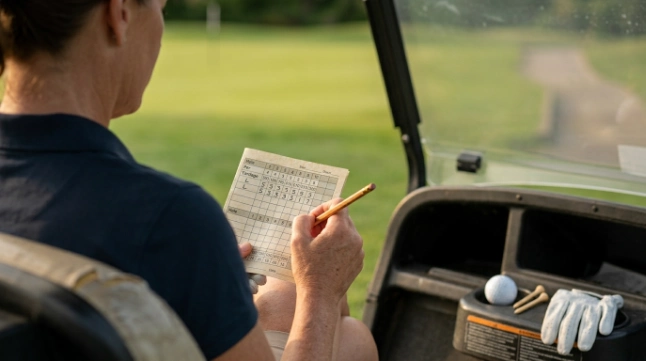
A golf scorecard lists each hole along with information such as par, yardage, and stroke index. Your job is to find your scoring row and enter your total for each hole.
Most cards look complicated at first because several sets of tees may appear. You only need the information connected to the tees you’re playing.
What information appears on a scorecard?
- Hole: The hole number, usually 1 through 18.
- Par: The target number assigned to the hole.
- Yardage: The approximate length from a particular tee.
- Handicap or stroke index: A ranking used when allocating handicap strokes.
- Out: The total for holes 1 through 9.
- In: The total for holes 10 through 18.
- Total: Your complete 18-hole score.
Example of a simple scorecard
| Hole | 1 | 2 | 3 | 4 | 5 | Total |
|---|---|---|---|---|---|---|
| Par | 4 | 3 | 5 | 4 | 4 | 20 |
| Your Score | 5 | 4 | 6 | 4 | 5 | 24 |
In this example, par for the five holes is 20. The player scored 24, which is four strokes over par.
You do not need to calculate your relation to par after every hole. Recording accurate hole totals matters more.
When should you write down the score?
I recommend recording it after leaving the putting green and before the next tee shot. That keeps play moving while the hole is still fresh in your mind.
In formal stroke play, scorecard responsibilities are more specific. The R&A’s Rule 3 guidance explains player and marker responsibilities for competition scoring.
Section Takeaway: Read only the scorecard information you need, record every finished hole promptly, and double-check your totals before the round ends.
What Do Par, Birdie, and Bogey Mean?
Par is the target score assigned to a hole. Birdie, bogey, eagle, and similar terms describe how your actual score compares with that par.
These terms do not replace the numerical score. If you make a birdie 3 on a par 4, you still write 3 on the card.
| Scoring Term | Relation to Par | Example on Par 4 |
|---|---|---|
| Eagle | 2 under par | 2 |
| Birdie | 1 under par | 3 |
| Par | Even | 4 |
| Bogey | 1 over par | 5 |
| Double bogey | 2 over par | 6 |
| Triple bogey | 3 over par | 7 |
Suppose you play a par 5 in six strokes. Your score is 6, or one-over-par for the hole.
On television, you may see a player listed as “-4” or “+2.” Those figures show the player’s cumulative score relative to par rather than the raw stroke total.
- -4: Four strokes under par.
- E: Even par.
- +2: Two strokes over par.
For beginners, I prefer keeping the actual number first. Relative-to-par scoring becomes easy once your hole totals are accurate.


How Do Penalties Affect Your Golf Score?
Penalty strokes are added to the strokes you make at the ball. This is why your final hole score can be higher than the number of physical swings you remember.
Penalty situations are where many casual scorecards become inaccurate. When you are unsure, identify the rule before writing the final number.
What happens when a ball enters a penalty area?
If you take relief from a red or yellow penalty area, the normal relief procedures include a one-stroke penalty. Playing the ball as it lies can be an option when the Rules allow it.
For example, imagine you hit your second shot into a penalty area and take one-stroke relief. Your next stroke will be your fourth.
What happens with a lost ball or ball out of bounds?
Under the standard stroke-and-distance procedure, a lost or out-of-bounds ball requires one penalty stroke plus playing again from where the previous stroke was made.
This can surprise beginners because the next ball may already represent a much higher number. Keeping a running count makes the situation easier.
- First shot: Your tee shot goes out of bounds.
- Penalty: Add one penalty stroke.
- Next ball: Your replay from the tee is stroke three.
Some courses adopt a Local Rule that changes how certain lost or out-of-bounds situations may be handled. Check the scorecard, notice board, starter instructions, or competition rules before assuming it applies.
Should beginners count every penalty?
If you want a meaningful score, yes. Accurate scoring gives you a useful baseline and makes improvement easier to measure.
A relaxed beginner group may choose its own format for pace and enjoyment. Just do not confuse a modified casual score with a score played entirely under the Rules.
The PGA’s beginner golf guide is also useful when you are learning scoring alongside basic rules and etiquette.
How Do Stroke Play, Match Play, and Stableford Differ?
The way you keep score depends on the format. Stroke play totals strokes, match play compares holes, and Stableford converts hole performance into points.
Before starting a round or event, confirm the format. A perfectly recorded stroke-play total may not tell you who is winning a match-play game.
| Format | What You Track | How You Win |
|---|---|---|
| Stroke Play | Total strokes plus penalties | Lowest total score |
| Match Play | Holes won, lost, or tied | Win more holes than the opponent |
| Stableford | Points earned on each hole | Highest point total |
How does stroke play scoring work?
Regular stroke play is the format most beginners picture when they hear “golf score.” You total every hole, including applicable penalties.
If you shoot 47 on the front nine and 49 on the back nine, your 18-hole gross score is 96.
How does match play scoring work?
Match play compares your performance directly with an opponent on each hole. The golfer with the lower score wins that hole.
If both players make the same score, the hole is tied. The match score tracks how many holes one golfer leads by rather than total strokes.
A golfer could take nine strokes on one bad hole and lose only that hole. That is a major difference from stroke play, where all nine strokes remain in the round total.
How does Stableford scoring work?
Stableford is a form of stroke play that awards points based on how your hole score compares with a fixed target score. Par is normally the target unless the Committee specifies another one.
The goal is to finish with the most points. In some situations, a player can stop playing a hole once no more points can be earned, which can help pace of play.
Section Takeaway: Know the format before the first tee. Stroke play counts total strokes, match play counts holes, and Stableford counts points.
How Does a Golf Handicap Affect Scoring?
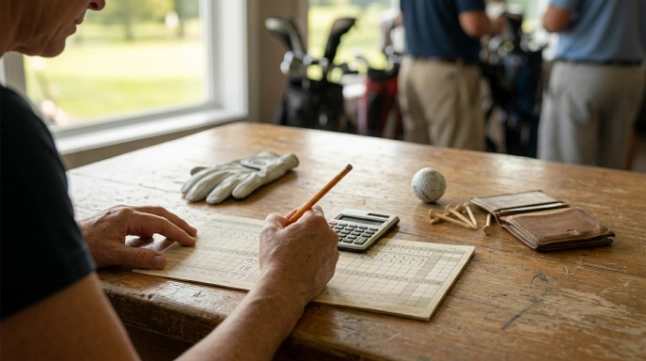
A handicap can convert a gross score into a net score for handicap competitions. Your gross score and your handicap-adjusted score are not the same thing.
Gross score means the strokes and applicable penalty strokes you actually recorded. Net score reflects handicap strokes according to the format being played.
What is the difference between gross and net score?
Suppose your gross score is 95 and the applicable handicap adjustment for the competition is 18 strokes. A simple 18-hole net calculation would produce 77.
However, handicap strokes can also be allocated hole by hole. That is why the “handicap” or “stroke index” row appears on many scorecards.
What is net double bogey?
For USGA handicap posting, a golfer with an established Handicap Index has a maximum hole score for handicap purposes called net double bogey. It equals double bogey plus any handicap strokes received on that hole.
This limit is for handicap purposes. It does not automatically erase a higher score from every stroke-play competition.
For example, a player may make an actual 9 during a competition yet have a lower adjusted hole score used when submitting the round for handicap purposes. The competition format determines what appears in the competition result.
Golfers establishing an initial Handicap Index use different maximum-hole-score rules. As of 2026, the USGA states that the maximum for initial score posting is par plus five.
You can review these details in the USGA Rules of Handicapping.
Should a beginner worry about handicap scoring immediately?
Not necessarily. Your first goal should be learning to count strokes accurately and move around the course at a comfortable pace.
Once you begin posting scores or joining handicap competitions, the distinction between Course Handicap, Playing Handicap, gross score, net score, and adjusted hole scores becomes much more important.
- Casual round: Focus first on an accurate running score.
- Handicap posting: Follow the current Rules of Handicapping.
- Competition: Follow the event’s stated format and Terms of the Competition.
That separation solves a lot of scoring confusion. A number used for handicap posting is not always identical to the number determining a tournament result.
Golf Scoring FAQ
What is considered a good golf score for a beginner?
There is no single score every beginner should reach. Course difficulty, tees, experience, and playing conditions all matter. I would rather see a new golfer track accurate scores and gradual improvement than chase an arbitrary number after only a few rounds.
Do practice swings count toward your golf score?
A normal practice swing does not count as a stroke because you are not intending to strike the ball. If you make a swing intending to strike the ball and accidentally miss it, that attempted stroke counts.
Do putts count in your golf score?
Yes. Every qualifying stroke counts whether you use a driver, iron, wedge, hybrid, or putter. A golfer who reaches the green in three strokes and takes three putts has recorded six strokes before any penalties are considered.
What does “E” mean on a golf leaderboard?
“E” means even par. The golfer has taken exactly the same number of strokes as the course’s cumulative par at that point. A negative number means under par, while a positive number means over par.
What score should I write if I pick up my ball?
That depends on the format and why you picked up. Maximum Score, Stableford, match play, handicap posting, and casual golf can treat an unfinished hole differently. Do not invent a score when playing a formal event; follow the applicable format and competition rules.
Who keeps the scorecard in a golf competition?
In formal stroke play, a marker records the player’s hole scores and certifies them as required by the Rules. The player remains responsible for checking the hole scores and properly returning the scorecard under the competition procedure.
Is the lowest score always best in golf?
In regular stroke play, yes: the lowest total score wins. Other formats work differently. Match play is decided by holes won, while Stableford rewards points and is won by the player or side with the highest point total.
Final Takeaway: Golf scoring becomes simple when you follow one habit: count your strokes, add penalties, and record the hole before moving on. Learn gross scoring first, then add par terms, handicaps, and alternative formats as you gain experience.
On your next round, keep the card simple. An accurate score gives you something useful to compare when you play again.