
Why Beginners Slice the Golf Ball and How to Fix It

Quick Answer
Beginners slice because the clubface is open relative to the swing path at impact. A weak grip, open shoulders, an out-to-in swing, and rushed upper-body movement often create that relationship. Start with your grip and alignment, then use simple drills like those recommended in these PGA coaching tips for fixing a slice.
Common causes of a beginner’s slice
- Open clubface: The face points right of the swing path at impact for a right-handed golfer.
- Weak grip: Poor hand placement makes closing the clubface harder.
- Open alignment: Shoulders aimed left encourage the club to cut across the ball.
- Over-the-top move: The upper body starts the downswing and sends the club outward.
- Heel contact: Striking the driver near the heel can increase rightward curvature.
How to confirm the cause
- Watch where the ball starts, note how it curves, and check the clubface for the strike location.
Most beginners don’t slice because they lack talent. They slice because several small setup and swing errors combine at impact.
I’ve watched new golfers aim farther left after every sliced drive. That compensation feels logical, but it often makes the curve worse.
This guide explains why beginners slice, how to identify the real cause, and which fixes deserve your practice time.
In This Guide
What Is a Golf Slice?
A slice is a shot that curves sharply from left to right for a right-handed golfer. For a left-handed player, it curves from right to left.
A slice differs from a controlled fade. A fade has a smaller, predictable curve, while a slice usually loses distance and misses the target badly.
Definition: Face-to-path describes the clubface angle compared with the club’s travel direction at impact. A slice occurs when the face is open relative to that path.
Why does the ball curve?
The clubface and swing path create a tilted spin axis. That tilted axis makes the ball curve during flight.
The clubface strongly influences the ball’s starting direction. The face-to-path relationship determines which way it bends.
- Face open to path: The ball curves right for a right-handed golfer.
- Face closed to path: The ball curves left for a right-handed golfer.
- Face matched to path: The ball flies with little sideways curve.
The Titleist explanation of ball-flight laws offers a useful visual breakdown of this relationship.
Slice vs. fade vs. push
| Shot | Typical flight for a right-hander | Likely impact condition | First check |
|---|---|---|---|
| Slice | Starts left, straight, or right and curves sharply right | Clubface open relative to path | Starting direction and grip |
| Fade | Starts slightly left and curves gently right | Face slightly open to path | Whether the curve is predictable |
| Push | Starts right and stays mostly straight | Face and path both point right | Alignment and swing direction |
| Pull-slice | Starts left and curves right | Out-to-in path with face open to path | Shoulder alignment and downswing path |
Why Do Beginners Slice the Golf Ball?
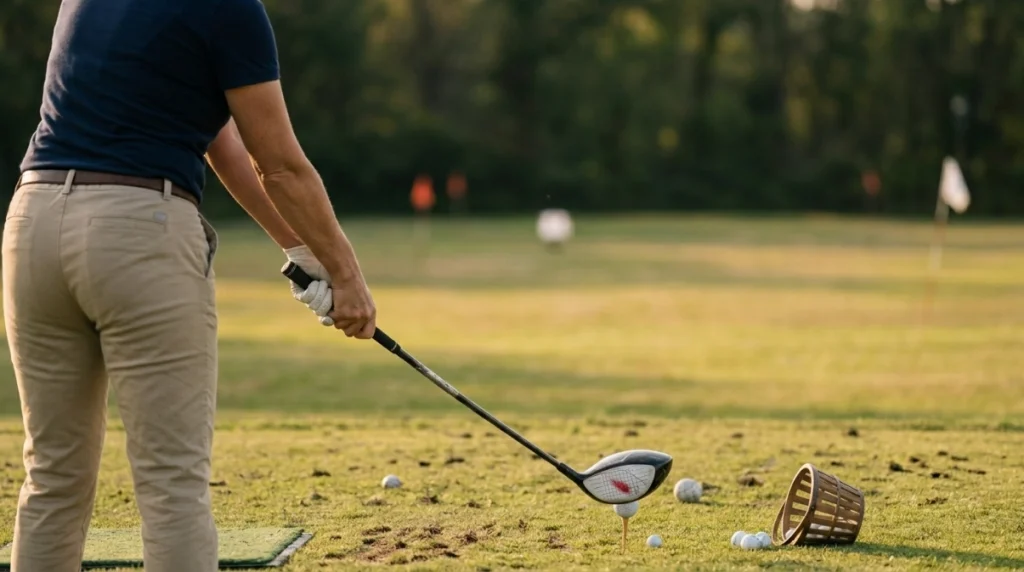
Beginners usually slice because they leave the face open, swing across the ball, or do both. Setup mistakes often create these impact problems before the swing begins.
1. The grip is too weak
A weak grip means the hands are rotated too far toward the target. It doesn’t describe grip pressure or physical strength.
For a right-handed golfer, the lead hand may sit too far under the handle. This position can make squaring the face difficult.
- Place the grip diagonally across the lead-hand fingers.
- Let the heel pad rest on top of the handle.
- Check whether you can see about two lead-hand knuckles at address.
- Match the trail-hand palm to the lead-hand angle.
- Hold the club securely without squeezing it.
Two knuckles are a checkpoint, not a rule for everyone. Hand shape and wrist movement differ between golfers.
2. The shoulders aim left
Many beginners aim left because they expect the ball to curve right. This open setup can encourage an out-to-in path.
The feet may look square while the shoulders point left. Shoulder alignment deserves its own check.
Place one alignment stick along the target line. Put another parallel to it near your toes.
3. The downswing starts with the upper body
Beginners often try to hit the ball hard from the top. Their shoulders spin early, and the club moves outside the ideal path.
This move is commonly called coming over the top. The club then travels left across the ball for a right-handed player.
Start the downswing with a small pressure shift toward the lead foot. Let the arms fall before turning through the shot.
4. The clubface stays open
An improved path won’t cure every slice. The clubface must also return closer to square.
Common face-control problems include:
- Excessive grip pressure that restricts wrist movement
- A cupped lead wrist near impact
- Fear of hitting the ball left
- Trying to steer the club through impact
- A grip that slips during the swing
5. The ball contacts the driver’s heel
A driver’s curved face creates a gear-effect response on off-center hits. Heel contact can add fade or slice curvature.
Use foot spray or an impact sticker on the clubface during practice. The mark shows where the ball touched the face.
6. The swing is too fast
Beginners often mistake effort for speed. A rushed transition can disturb balance, path, and face control.
Make practice swings at about 60% effort. Increase speed only after the ball starts more consistently.
Section Takeaway: A slice is an impact problem, but grip, alignment, tempo, and contact location often create it. Check those basics before rebuilding your swing.
How Can You Diagnose Your Slice?
Start by recording the ball’s initial direction and curve. Those two clues reveal more than the final landing position.
Read the full ball flight
- Starts right and curves farther right: The face was likely open to the target and path.
- Starts straight and curves right: The face was near the target but open relative to the path.
- Starts left and curves right: The path likely moved left, with the face open relative to it.
- Starts right and stays straight: You probably hit a push rather than a slice.
These patterns are useful starting points. Strike location, wind, club delivery, and lie can also affect flight.
Check contact before changing mechanics
Spray the driver face with a light, removable foot powder. Hit five balls and inspect the strike pattern.
A tight heel-side pattern points toward a contact problem. Scattered marks suggest that balance and strike consistency need attention first.
Film from two useful angles
Record one swing from behind, with the camera near hand height. Align it roughly with your hands and target line.
Record another from face-on. Keep the camera centered and far enough away to include the club.
Review these checkpoints:
- Shoulder alignment at address
- Ball position inside the lead heel with a driver
- Balance during the backswing
- Whether the shoulders lunge toward the ball
- Finish position and weight distribution
Pro tip: A certified PGA professional can compare face angle, club path, and strike location. One measured lesson may prevent months of practicing the wrong fix.


How Do You Fix a Beginner Golf Slice?
Fix the slice in a logical order: grip, alignment, face control, swing path, and center contact. Changing everything at once makes improvement harder to measure.
Step 1: Build a neutral grip
Set the club down before placing your hands. Keep the face square to the target while forming the grip.
Make waist-high swings and watch the ball start. A playable starting direction matters more than immediate distance.
Step 2: Square your setup
Set the clubface first. Then position your feet, knees, hips, and shoulders parallel to the target line.
Don’t point your body directly at the target. Your body line should run parallel, like a railway track.
Step 3: Slow the transition
Use a smooth backswing and a brief change of direction. Avoid throwing the hands outward from the top.
Count “one” during the backswing and “two” through impact. The simple rhythm reduces rushed movement.
Step 4: Train the clubface
Hit short shots with a 7-iron. Feel the lead-hand glove logo turn toward the ground during the downswing.
Stop if the ball begins hooking sharply. The goal is a more neutral face, not excessive hand rotation.
Step 5: Improve the swing path
Place a headcover just outside and behind the ball. Swing without hitting it.
This obstacle encourages the club to approach from a less out-to-in direction. Begin slowly and remove the ball if needed.
Step 6: Find the center of the face
Tee the ball at a comfortable height and reduce your swing speed. Try to create five centered strikes before adding speed.
Contact quality usually improves distance more than extra effort. That’s especially true for new golfers.
Section Takeaway: Work on one variable at a time. A neutral grip and square setup often produce the fastest improvement.
Which Practice Drills Help Stop a Slice?
The best drills give clear feedback without forcing a complicated swing thought. Use them at reduced speed before hitting full drivers.
Split-hand release drill
- Grip a short iron normally with the lead hand.
- Move the trail hand about two inches down the shaft.
- Make slow waist-high swings.
- Feel the forearms rotate naturally through the strike area.
- Return to a normal grip and repeat the motion.
This drill helps golfers feel the face closing. It shouldn’t become an aggressive roll of the wrists.
Headcover path drill
- Place a headcover about four inches outside the ball.
- Move it six inches behind the ball.
- Make a slow swing without touching the headcover.
- Hit ten half-shots before attempting full swings.
Move the obstacle farther away if contact feels unsafe. The drill should guide your path, not create tension.
Trail-foot-back drill
Move the trail foot several inches behind its normal position. Keep the shoulders close to square.
This closed stance can help you feel the club approaching from inside. Treat it as a drill, not a permanent setup.
Nine-to-three drill
Swing from roughly waist high on the backswing to waist high after impact. Focus on balance and solid contact.
Begin with a wedge or short iron. Progress to longer clubs when the flight becomes predictable.
A simple 30-ball practice plan
- Balls 1–5: Hit easy wedge shots to establish balance.
- Balls 6–10: Use the split-hand release drill without chasing distance.
- Balls 11–15: Hit half-shots through the headcover gate.
- Balls 16–20: Use a 7-iron with your normal setup.
- Balls 21–25: Hit controlled drivers at 60% to 70% effort.
- Balls 26–30: Alternate between five imaginary fairway targets.
Track starting direction, curvature, and contact. Don’t judge the session by the single longest drive.
Pro tip: Stop any drill that causes wrist, elbow, shoulder, or back discomfort. Ask a qualified instructor to check your movement before continuing.
Can Golf Equipment Reduce a Slice?
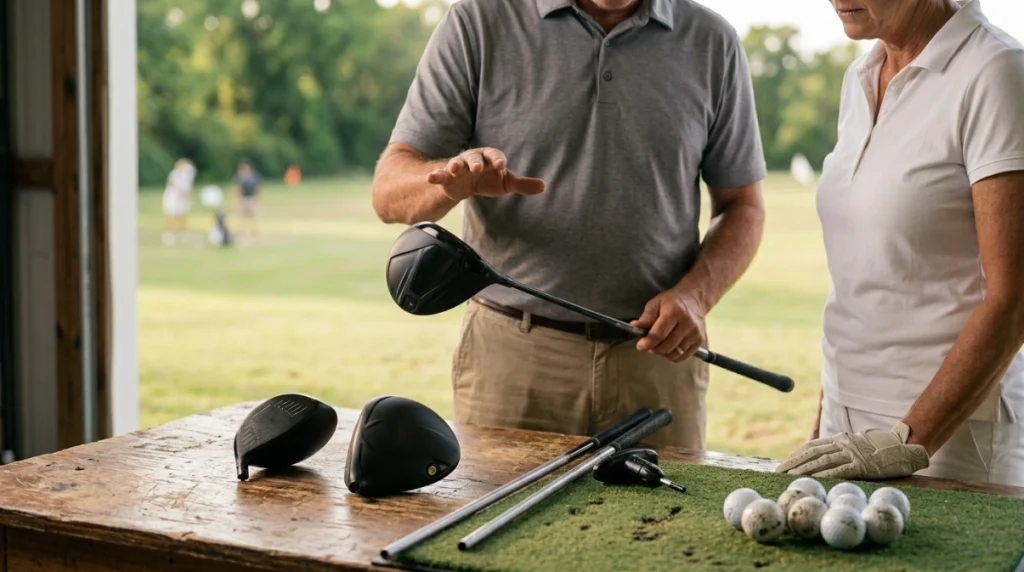
Equipment can reduce the severity of a slice, but it cannot correct a major face-to-path error. Use fitting as support for sound fundamentals.
Driver loft
Loft is the angle of the clubface relative to a vertical plane. More driver loft can improve launch and may make a beginner’s ball flight easier to manage.
A golfer struggling with a 9-degree driver might test 10.5 or 12 degrees. Launch conditions differ, so compare settings rather than guessing.
Draw-bias drivers
A draw-bias driver places weight to help the face close or reduce rightward curvature. It may also use heel weighting or an upright lie setting.
The feature can soften a modest slice. It won’t overcome a severely open face and steep out-to-in path.
Shaft length and flex
A long driver can make center contact harder. Some beginners strike the ball better with a slightly shorter playing length.
Shaft flex should match more than swing speed. Tempo, transition, delivery, and strike pattern also matter.
Golf-ball choice
A lower-spinning ball may reduce total curvature for some players. However, no legal ball can turn a poor impact relationship into a straight shot.
Players competing under the Rules of Golf can confirm equipment status through the USGA or The R&A.
When should you get fitted?
Consider a fitting when your strike pattern remains consistent but the flight still looks unsuitable. A fitter can test loft, lie, shaft, length, and head settings.
Wait before buying a new driver if contact covers the entire face. Improve strike consistency first.
Section Takeaway: Forgiving equipment can make a slice smaller, but impact controls ball flight. Pair suitable clubs with focused practice.
Frequently Asked Questions
Why do I slice my driver but not my irons?
The driver has a longer shaft, less loft, and a different setup than an iron. Those features magnify face and contact errors. Heel strikes, forward ball position, and an open face may become more noticeable with the driver.
Does a strong grip fix a slice?
A slightly stronger grip can help some golfers close the face. Rotating the hands too far may create hooks or inconsistent contact. Make small adjustments and judge them by starting direction, curvature, and strike quality.
Why does aiming left make my slice worse?
Aiming left often opens the shoulders and encourages an out-to-in swing path. The face can remain open relative to that path, creating more curvature. Build parallel alignment instead of compensating for the miss.
Can standing farther from the ball stop a slice?
Changing distance from the ball may alter posture and contact, but it isn’t a universal fix. Let your arms hang naturally, maintain balanced foot pressure, and check where the ball strikes the face.
How long does it take to fix a golf slice?
A simple grip or alignment problem may improve during one practice session. A deeply learned path or face-control pattern can take several weeks. Short, focused sessions usually work better than occasional high-volume practice.
Should beginners use a driver if they keep slicing?
Yes, but they don’t need to use it on every hole. Practice the driver at controlled speed while using a fairway wood, hybrid, or iron when accuracy matters more on the course.
When should I take a golf lesson?
Book a lesson when you cannot identify the cause, different tips produce conflicting results, or the slice returns quickly. A professional can measure what the club does at impact and recommend a specific change.
Final Takeaway
Beginners slice when the clubface remains open relative to the swing path. Weak grip placement, open shoulders, an over-the-top transition, and heel contact are common contributors.
Start with your setup. Then improve face control, path, and centered contact through slow practice.
Don’t chase a perfect draw immediately. Your first goal should be a smaller curve, a predictable starting line, and more balls in play.
For your next range session, bring two alignment sticks and removable face spray. Record ten controlled drives before changing anything, then work on the clearest pattern you find.