
Putting Practice: A Complete Guide to Building a Better Stroke

Quick Answer
Effective putting practice combines start-line control, distance control, green reading, and pressure drills. Spend 20–30 minutes practicing with a clear target, record your results, and favor varied putts over repeatedly hitting from one spot. If your setup or stroke remains inconsistent, a lesson from a PGA golf coach can help identify the cause.
A Simple Putting Practice Routine
- Warm up: Roll long putts using one ball and different targets.
- Control the start: Hit straight putts through a gate placed just beyond the ball.
- Build touch: Practice stopping putts inside a three-foot distance zone.
- Improve scoring: Work around the hole from three to six feet.
- Add pressure: Finish with a drill that restarts after a miss.
- Track results: Record makes, misses, and three-putts to measure progress.
I’ve spent plenty of practice sessions rolling putt after putt without learning much. The biggest improvement came when I gave every drill a purpose and measured the result.
This guide explains how to organize putting practice for better contact, pace, accuracy, and confidence. You’ll also find drills that transfer more effectively from the practice green to the course.
In This Guide
- What Should You Practice to Become a Better Putter?
- How Do You Build a Repeatable Putting Setup and Stroke?
- What Are the Best Putting Drills?
- How Do You Improve Putting Distance Control?
- How Should You Practice Reading Greens?
- What Does an Effective Putting Practice Plan Look Like?
- Putting Practice FAQs
What Should You Practice to Become a Better Putter?
Good putting depends on four skills: starting the ball accurately, controlling speed, reading the green, and performing under pressure. A balanced session should train all four.
Putting practice is structured work designed to improve how consistently you start, roll, and stop the golf ball. It should produce measurable feedback instead of relying only on feel.
Start-line control
Your start line is the direction the ball travels immediately after impact. You can read the break correctly and still miss if the ball starts offline.
A ball gate provides useful feedback. Place two tees slightly wider than the ball, then roll putts through them without touching either tee.
Distance control
Distance control determines how far the ball rolls. On long putts, speed usually matters more than perfect directional accuracy.
Good pace leaves a short second putt. Poor pace creates three-putt risk, even when your original read was sound.
Green reading
A putt’s line depends on slope, speed, grain, moisture, and the force of the stroke. Practice should teach you to connect your read with your intended pace.
- Slope: The rise, fall, or side tilt that changes the ball’s path.
- Break: The sideways curve caused mainly by slope and speed.
- Entry point: The part of the hole where you expect the ball to enter.
- Capture speed: The speed at which the ball reaches the cup.
Pressure performance
Most casual practice contains no consequence for missing. Golf does, so part of your session should create a clear pass-or-fail result.
Try making ten three-foot putts in a row. If you miss, restart the count and notice whether your routine changes.
Section Takeaway: Train start line, speed, reading, and pressure as separate skills. Then combine them in game-like challenges.
How Do You Build a Repeatable Putting Setup and Stroke?

A repeatable stroke begins with a comfortable setup that lets the putter return naturally to the ball. You don’t need to copy one exact professional model.
Build a neutral setup
Place your feet about hip-width apart with the ball near the front half of your stance. Let your arms hang without forcing your elbows into a fixed position.
Your eyes can sit directly over the ball or slightly inside it. The important point is keeping that position consistent.
- Posture: Bend from the hips while keeping your neck comfortable.
- Ball position: Start slightly forward of center and adjust only with evidence.
- Grip pressure: Hold the putter securely without tightening your forearms.
- Alignment: Set the putter face before arranging your feet and shoulders.
Control the putter face
The putter face strongly influences the ball’s initial direction. A square path cannot rescue a face that points away from your target at impact.
Use a chalk line, alignment string, or straight three-foot putt. Compare your intended line with the ball’s actual starting direction.
Find a natural tempo
Tempo describes the timing relationship between the backswing and forward stroke. Smooth acceleration usually produces more reliable contact than a sudden hit.
I like to make two rehearsal strokes while looking at the hole. That keeps my attention on distance instead of mechanical positions.
Check strike quality
Off-center contact can change both speed and direction. Mark the putter’s sweet spot with removable tape or use a simple impact gate.
Place two objects just outside the putter head. Swing between them without contact while striking the center of the ball.
Pro tip: If pain, restricted movement, or repeated technical problems affect your stroke, work with a certified instructor or qualified club fitter.
Section Takeaway: Set the face first, keep your setup comfortable, and use feedback to improve centered contact.
What Are the Best Putting Drills?
The best putting drills produce immediate feedback and have a defined scoring system. Choose drills based on the weakness you’re trying to correct.
| Drill | Primary Skill | Distance | Success Target |
|---|---|---|---|
| Tee Gate | Start line | 3–6 feet | 8 of 10 through gate |
| Around the Clock | Short-putt accuracy | 3–5 feet | Complete one full circle |
| Ladder Drill | Distance control | 10–40 feet | Stop in each target zone |
| Leapfrog | Changing pace | 15–30 feet | Five progressively longer putts |
| Nine-Hole Game | Course transfer | Mixed | 18 putts or fewer |
Tee-gate drill for start direction
- Find a straight putt between three and six feet.
- Place two tees just wider than the ball.
- Position the gate six inches ahead of the starting point.
- Roll ten putts through the gate.
- Record clean passes instead of counting only makes.
A putt can pass the gate and miss because of pace or an imperfect read. That distinction helps separate stroke problems from reading errors.
Around-the-clock drill for short putts
Place six to eight balls around the hole at one distance. Begin at three feet before moving farther away.
Complete the circle without missing. This drill exposes discomfort with different slopes and visual angles.
One-ball nine-hole game
Select nine different putts around the practice green. Use your complete routine and finish every hole before moving to the next.
- Par score: 18 putts for nine simulated holes.
- Strong target: Finish without a three-putt.
- Pressure rule: Count every stroke and never replay a poor putt.
- Transfer benefit: Each attempt presents a new read and distance.


How Do You Improve Putting Distance Control?
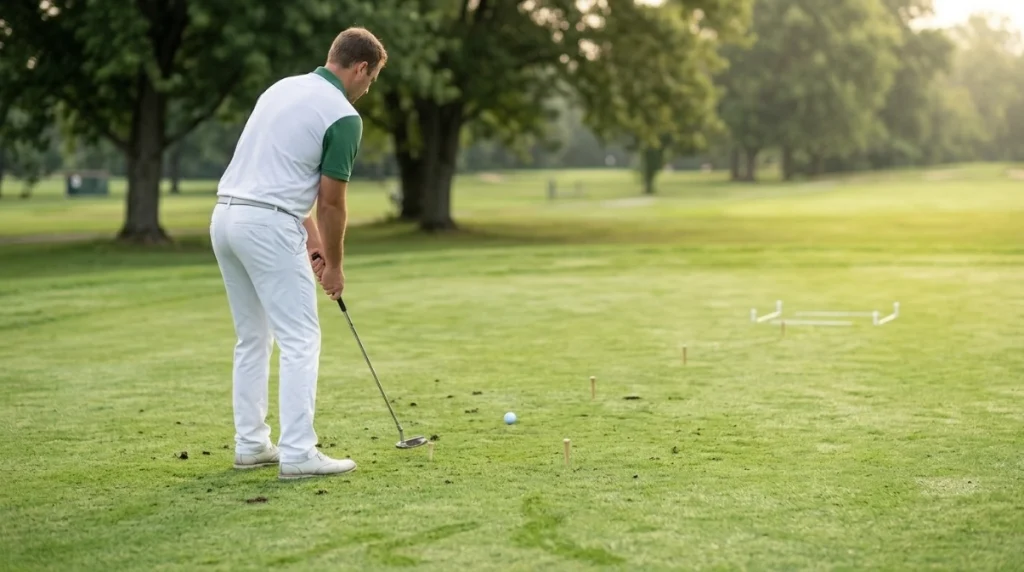
Improve distance control by changing targets frequently and judging where each ball stops. Avoid hitting a pile of balls from one position.
Practice to a zone, not only a hole
Create a target zone using tees about three feet deep. Roll putts from 15, 25, and 35 feet while trying to finish inside it.
A zone rewards useful speed even when the line isn’t perfect. It also represents the leave you want after a lag putt.
Use the ladder drill
- Place markers at 10, 15, 20, 25, and 30 feet.
- Roll one ball toward each marker in order.
- Keep every ball within three feet of its target.
- Restart after a ball finishes outside the zone.
Reverse the order after completing the ladder. Moving from long to short putts tests your ability to reduce stroke length.
Match practice to green speed
Green speed changes with grass type, mowing, moisture, slope, and weather. Spend several minutes calibrating pace before every round.
Roll putts toward the fringe instead of a hole. Your only goal is stopping each ball where the green meets the fringe.
Use one ball when possible
Repeated shots from the same spot create familiarity that doesn’t exist on the course. One-ball practice forces you to read and adjust every attempt.
During one session, I compared ten repeated lag putts with ten putts from changing positions. The varied set felt harder but revealed more three-putt situations.
Section Takeaway: Distance practice should feature changing targets, one-ball challenges, and clear stopping zones.
How Should You Practice Reading Greens?
Practice green reading by predicting the break and speed before every putt, then comparing your prediction with the result. The feedback matters more than whether the ball drops.
Read from several positions
Start behind the ball to see the overall path. Then inspect the putt from the low side, where the slope often becomes easier to recognize.
Look from near the hole when the final section is unclear. The ball slows there, so the closing slope can create more break.
Choose an entry point
Picture where the ball should enter the cup. A slower putt may enter from the high side, while a firmer putt follows a straighter route.
Next, trace the path backward toward the ball. Select a nearby start point that matches that curve.
Separate reading errors from stroke errors
Watch the first few feet of every putt. If the ball starts where intended but misses, reconsider the read or speed.
If it starts away from your target, check alignment and face control. Don’t change the read to compensate for a push or pull.
- Started correctly, finished low: The putt may need more break or less speed.
- Started correctly, finished high: The read may include too much break.
- Finished short: Calibrate speed before changing the entire line.
- Missed unpredictably: Check strike location and the putter face.
The R&A and USGA publish the Rules of Golf and equipment standards. Review the current rules before using training aids during a stipulated round.
Section Takeaway: Make a prediction, roll the putt, and diagnose the result without confusing line, speed, and stroke.
What Does an Effective Putting Practice Plan Look Like?
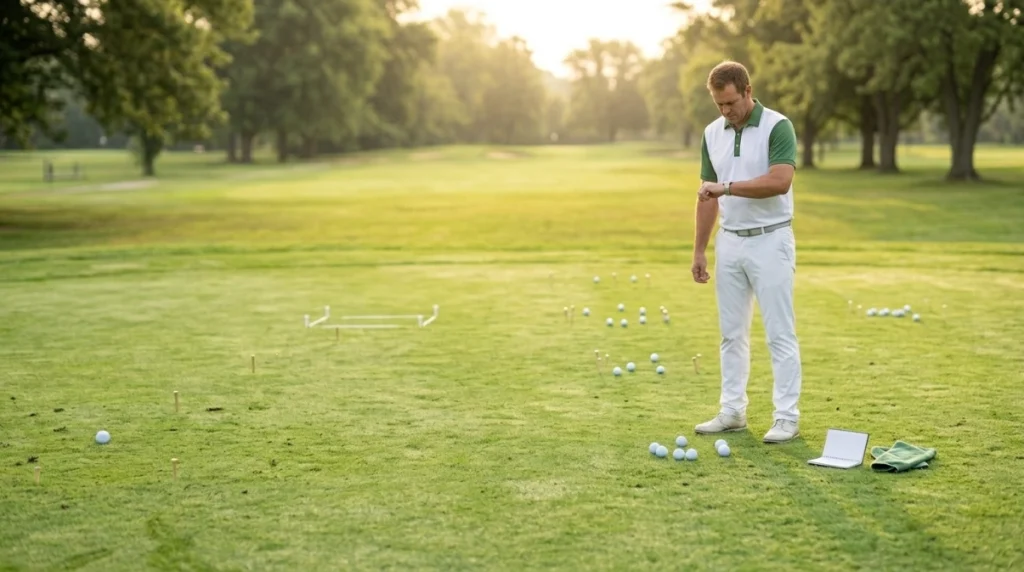
An effective practice plan assigns time to a specific skill and ends with a scored challenge. Twenty focused minutes can provide more value than an hour of random repetition.
Twenty-minute routine
- Minutes 1–4: Warm up with long putts to different edges of the green.
- Minutes 5–9: Complete a start-line gate drill from three to six feet.
- Minutes 10–14: Practice lag putts from three changing distances.
- Minutes 15–17: Make short putts from several points around the hole.
- Minutes 18–20: Play a scored one-ball challenge.
Forty-five-minute development session
- 10 minutes: Setup, centered contact, and start-line feedback.
- 10 minutes: Short putts from three, four, and five feet.
- 10 minutes: Ladder and random-distance lag putting.
- 10 minutes: Breaking putts from both directions.
- 5 minutes: A must-make pressure game.
Track the right statistics
Total putts alone can be misleading because approach-shot proximity affects putting opportunities. Track results by distance for a clearer picture.
- Three to five feet: Record makes from 20 attempts.
- Six to ten feet: Record makes and intended-line starts.
- Over 20 feet: Record balls finishing inside three feet.
- Practice games: Record three-putts and total score.
- On the course: Note the distance and cause of each first-putt miss.
Practice before a round
A pre-round session should calibrate speed rather than rebuild your technique. Start with long putts, then finish with a few short putts.
Avoid judging the entire day from whether warm-up putts fall. Learn the green’s pace and reinforce your routine.
Avoid common practice mistakes
- Using several balls constantly: This encourages correction through repetition instead of fresh reads.
- Practicing only straight putts: Real rounds include slopes and changing visual demands.
- Ignoring long putts: Lag putting often determines whether you avoid three-putts.
- Changing technique daily: Constant experimentation prevents reliable feedback.
- Never recording scores: Without data, improvement becomes difficult to verify.
As of 2026, putting aids range from simple gates and mirrors to electronic launch monitors. Technology can help, but tees, string, and disciplined scoring remain enough for productive practice.
Section Takeaway: Use a timed plan, measure performance by distance, and finish under pressure.
Putting Practice FAQs
How often should I practice putting?
Practice two or three times per week for 20–30 minutes when possible. Short, focused sessions usually support better learning than one long weekly session.
How many putts should I hit during practice?
Quality matters more than a fixed total. A focused session of 40–60 putts can cover start line, short putting, lag putting, and a scored challenge.
What putting distance should beginners practice most?
Beginners should divide time between three-to-six-foot putts and lag putts over 20 feet. The first group builds scoring confidence, while the second helps prevent three-putts.
Is putting on carpet useful?
Carpet practice can improve setup, centered contact, and start direction. It doesn’t reproduce outdoor green speed or break, so combine it with sessions on a real putting green.
Should I look at the ball or the hole when practicing?
Most golfers look at the ball during the stroke, but occasional target-focused drills can improve distance awareness. Experiment during practice and use the method that produces the most repeatable results.
Why do I putt well in practice but poorly on the course?
Practice often includes repeated putts without consequences. Use one ball, complete your routine, change locations, and add scored drills to create more realistic decisions and pressure.
Should I practice putting with training aids?
Training aids can provide useful feedback when they address a known problem. Start with simple tees or alignment string, then seek a qualified coach before buying complex equipment.
Turn Putting Practice Into Lower Scores
Better putting doesn’t come from collecting drills. It comes from identifying a weakness, choosing the right drill, and measuring whether that skill improves.
Begin with a 20-minute routine twice per week. Track short-putt makes, lag proximity, and pressure-game scores for one month before changing your plan.
Keep it simple and specific. When every putt has a target and purpose, practice starts feeling much more like golf.