
Driver Explained: A Practical Guide to Golf’s Longest Club

The driver is often the most exciting—and frustrating—club in a golf bag. It can produce your longest shots, but its long shaft and low loft make it harder to control than most other clubs.
This Driver Explained guide covers how a golf driver works, its main parts, how loft and shaft choice affect performance, and what beginners should consider before buying one. You will also learn when to use a driver, how to hit it more consistently, and when professional fitting is worthwhile.
Quick Answer
A driver is the longest, lowest-lofted club in most golf bags. It is mainly used from the tee to produce maximum distance on par-4 and par-5 holes. Its large clubhead offers forgiveness, but the long shaft can make accurate contact difficult. The right loft, shaft, and length depend on your swing.
What Is a Driver in Golf?
A driver is a type of wood designed to hit the golf ball as far as possible. It normally has:
- The longest shaft in the bag
- The largest clubhead
- Less loft than fairway woods
- A lightweight graphite shaft
- A wide face built for tee shots
Most golfers use a driver on longer holes where distance provides a clear advantage. The ball is placed on a tee, allowing the club to contact it near the center or slightly above the center of the face.
Modern drivers commonly have clubheads close to 460 cubic centimeters. Under the USGA Equipment Rules for clubheads, a wood-type clubhead cannot exceed 460cc, plus the permitted measurement tolerance.
A large head does not automatically produce longer drives. Its main benefit is forgiveness. It allows designers to distribute weight around the head, helping the club remain more stable when contact misses the exact center.
What Is a Driver Used For?
The driver is primarily used for the first shot on a par-4 or par-5 hole. Some golfers may also use it on a long par 3, although that is uncommon.
The goal is not simply to hit the ball as hard as possible. A useful drive should create a good combination of:
- Carry distance
- Total distance
- Accuracy
- Suitable launch height
- Controlled spin
- A playable position for the next shot
You do not have to use a driver on every long hole. A fairway wood, hybrid, or long iron may be a better choice when the fairway is narrow or trouble is within driver range.
The best tee club is the one that gives you the most reliable path to a good score—not necessarily the one that travels farthest.


The Main Parts of a Golf Driver
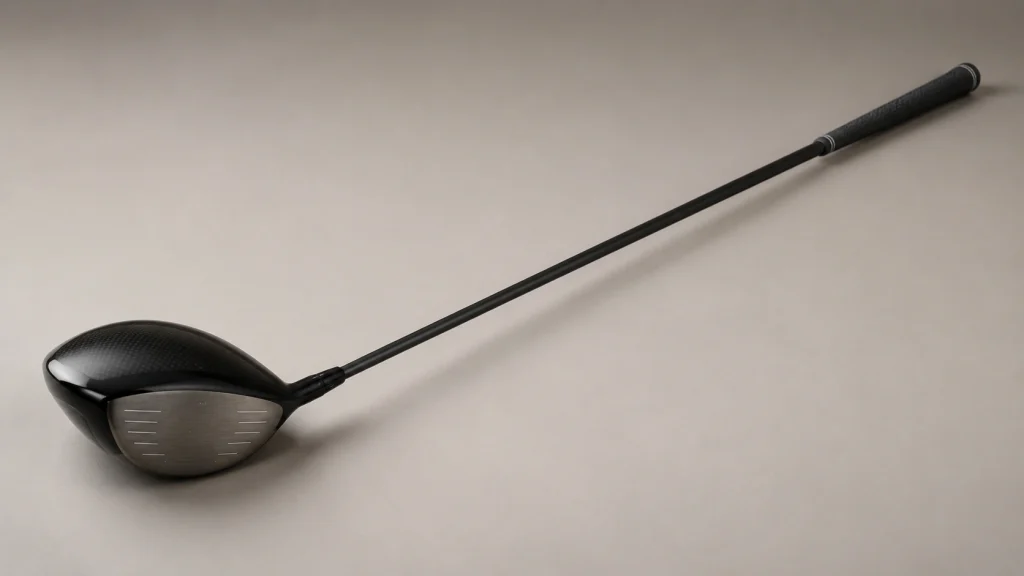
Understanding the driver’s components makes equipment descriptions easier to compare.
Clubhead
The clubhead includes the face, crown, sole, heel, and toe. Modern heads are large but relatively light.
A larger head can inspire confidence and provide more stability on off-center strikes. Compact-looking heads may appeal to skilled players who prefer a particular shape or ball-flight control.
Clubface
The face is the part that contacts the ball. It is slightly curved across its width and height.
Impact location matters. A strike close to the center normally provides the most predictable launch and ball speed. Contact toward the heel or toe can change both direction and spin.
Hosel
The hosel connects the shaft to the clubhead. Many current drivers have an adjustable hosel that allows golfers to change loft or lie settings.
These adjustments can influence launch, spin, face angle, and starting direction. They cannot correct a major swing problem, but they can help fine-tune a reasonably consistent shot.
Shaft
The shaft influences how the club feels, loads, and returns to the ball. Important shaft characteristics include:
- Flex
- Weight
- Length
- Torque
- Bend profile
Labels such as senior, regular, stiff, and extra stiff are useful starting points, but stiffness is not standardized perfectly across manufacturers. Two “regular” shafts can feel different.
Grip
The grip is the golfer’s only physical connection to the club. Its size, texture, and condition can affect comfort and control.
A worn, slick, or incorrectly sized grip may encourage excessive hand pressure. Replace it when it becomes hard, shiny, cracked, or difficult to hold securely.
How Driver Loft Affects Ball Flight
Loft is the angle of the clubface relative to a vertical position. Common driver lofts include 9, 10.5, and 12 degrees, although other options are available.
In general, more loft can help produce:
- A higher launch
- More carry for slower swings
- Additional backspin
- Greater control for some players
Less loft may create:
- A lower flight
- Less spin when properly fitted
- More roll on firm ground
- Poor carry if the golfer cannot launch it high enough
Many beginners choose too little loft because they associate a low number with greater distance. That can produce drives that fly low, curve excessively, or fall out of the air too soon.
TaylorMade’s official driver loft guidance notes that slower swing speeds often benefit from more loft, while also explaining that recommended ranges are only starting points. Impact location, attack angle, ball speed, and spin must also be considered.
Adjustable Loft
An adjustable driver may let you add or reduce loft through the hosel. However, changing the setting can also alter face angle and lie.
Always follow the instructions for your exact model. Tighten the screw with the supplied torque wrench until it clicks. Do not force an incompatible shaft adapter or continue tightening after the wrench signals that the connection is secure.
Choosing the Right Driver Shaft
The correct shaft should help you deliver the clubhead consistently. It should not feel like you must slow down or swing harder to make it work.
Shaft Flex
Flex describes how much the shaft bends during the swing. A simplified guide looks like this:
| Golfer or swing tendency | Possible starting flex | Important consideration |
|---|---|---|
| Smooth, slower swing | Light or senior | May help launch and clubhead speed |
| Moderate swing | Regular | Common starting point for recreational players |
| Faster or forceful swing | Stiff | May provide more control |
| Very fast swing | Extra stiff | Usually requires fitting and consistent speed |
| Inconsistent tempo | Test several options | Tempo can matter as much as raw speed |
This table is a starting point, not a fitting prescription. Flex labels alone do not describe shaft weight, torque, or bend profile.
Shaft Weight
A lighter shaft may help some golfers swing faster. However, going too light can reduce awareness of the clubhead and make timing inconsistent.
A heavier shaft may feel more stable, but it can become tiring or reduce speed. The best weight is one you can control throughout a full round.
Shaft Length
Longer shafts have the potential to create more clubhead speed. They are also harder to return to the same impact position.
Many recreational golfers strike the ball more consistently with a slightly shorter driver. Better center contact can recover—or exceed—the distance lost from a small reduction in theoretical swing speed.
Never assume that the longest available shaft will produce your longest playable drives.
Forgiveness, MOI, and Center of Gravity
Driver descriptions often mention moment of inertia, or MOI. In simple terms, MOI describes the clubhead’s resistance to twisting when the ball is struck away from the center.
A higher-MOI design may help preserve ball speed and reduce directional loss on imperfect contact. It will not turn a severely open or closed face into a straight shot.
Center of gravity, usually shortened to CG, is the clubhead’s balance point. Its location can influence:
- Launch
- Spin
- Forgiveness
- Ease of shaping shots
- How the clubface closes through impact
A rearward CG generally supports stability and launch. A forward CG may reduce spin but can make the club less forgiving. Beginners and many intermediate golfers usually benefit more from stability than from a low-spin, demanding design.
Draw-Bias, Neutral, and Low-Spin Drivers
Not every driver is designed for the same golfer.
Draw-Bias Driver
A draw-bias driver places weight or adjusts geometry to make a right-handed golfer’s shots less likely to curve right. For a left-handed golfer, the direction is reversed.
It may reduce a mild fade or slice, but it cannot fix a clubface that is dramatically open at impact.
Neutral Driver
A neutral head is intended to provide a balanced starting point. It suits golfers who do not need strong directional correction or who want to work on swing mechanics without significant built-in bias.
Low-Spin Driver
A low-spin head may benefit a fast-swinging player who creates excessive spin. For a golfer who already launches the ball too low, it can reduce carry and forgiveness.
Low spin is not automatically better. The goal is an efficient spin range for your speed and launch conditions.
Expert Tip: Apply removable impact tape or foot spray to the driver face during practice. Ten marked shots can reveal whether poor distance comes from the club’s specifications or repeated heel, toe, high, or low contact.
How to Hit a Driver More Consistently

A reliable driver swing does not need to be violent. Balance, face control, and centered contact matter more than maximum effort.
1. Tee the Ball at a Practical Height
As a starting point, tee the ball so approximately half of it sits above the driver’s crown when the club rests behind it.
A very low tee can encourage contact low on the face. An extremely high tee can lead to strikes near the crown or even damage from hitting under the ball.
2. Position the Ball Forward
For a right-handed golfer, place the ball near the inside of the left heel. Left-handed golfers should reverse this position.
This forward placement gives the club time to reach the ball later in the swing. Exact position can vary with stance width and swing pattern.
3. Create a Stable Stance
Use a stance slightly wider than shoulder width. Keep your balance centered and avoid stretching so far toward the ball that your posture becomes tense.
4. Make a Controlled Backswing
Turn your shoulders while maintaining balance. Do not lift the club with your arms alone or force it beyond your comfortable range.
5. Swing Through the Ball
Focus on a balanced finish rather than hitting at the ball with maximum force. Start at roughly 70–80% effort and increase speed only when contact remains consistent.
When Should You Leave the Driver in the Bag?
Driver is not always the best strategic choice. Consider another club when:
- A hazard sits within your normal driver distance
- The fairway narrows sharply in the landing area
- Out-of-bounds is close to your typical miss
- You need position more than maximum distance
- Your driver contact has become unreliable
- A shorter club still leaves a comfortable approach
Imagine a 350-yard par 4 with water beginning 230 yards from the tee. A 200-yard hybrid followed by a short iron may be safer than a driver that could reach the hazard.
Course management is not timid golf. It is choosing the shot that improves your chance of completing the hole with fewer strokes.
Driver Cost, Quality, and Durability
New premium drivers often cost several hundred dollars, while used or previous-generation models can cost much less. A higher price may provide adjustability, premium materials, or the newest face design, but it does not guarantee better results for your swing.
When comparing options, consider:
- Whether the loft suits your launch needs
- Whether the shaft is the correct length, weight, and flex
- Forgiveness on your normal miss
- Condition of the face, crown, shaft, and grip
- Availability of replacement adapters or weights
- Warranty coverage
- The cost of a fitting or future reshafting
A well-fitted older driver may perform better than an expensive new model with unsuitable specifications.
Buying a Used Driver
Inspect a used club carefully. Avoid a driver with:
- Cracks or dents in the head
- A loose head or rattling sound
- Deep face damage
- A split or heavily scratched shaft
- A damaged adjustable hosel
- Missing or incompatible weights
- Signs of an unauthorized face modification
If you play competitions, confirm that the exact model and loft appear on the USGA List of Conforming Driver Heads. This is especially important when buying an unusual, modified, or unfamiliar club.
Common Mistakes Golfers Should Avoid
- Choosing too little loft: Low loft can make it difficult to generate enough launch and carry.
- Buying by flex label alone: Shaft weight, length, torque, and profile also influence performance.
- Copying a professional’s setup: Tour players may have very different speed and impact conditions.
- Swinging at full effort: Extra effort often reduces balance and center contact.
- Changing several settings at once: Adjust one variable, test it, and record the result.
- Using driver on every par 4 and par 5: Select a club based on the hole’s hazards and landing area.
- Ignoring strike location: A fitting cannot fully help if contact moves randomly across the face.
- Buying only for advertised distance: Accuracy, dispersion, carry, and confidence also matter.
- Practicing toward people or property: Use a designated range or clear practice area and confirm that everyone is safely outside the hitting zone.
When to Get Help From a Golf Pro or Fitter
A golf professional can help when your main problem is technique. A fitter can help when your swing is reasonably repeatable but the club’s specifications appear unsuitable.
Consider a lesson when:
- Most drives curve severely in one direction
- You frequently top the ball or hit the ground first
- Contact spreads across the entire face
- You lose balance during the swing
- Adjusting the driver has not improved your pattern
Consider a professional fitting when:
- Your shots consistently launch too high or too low
- Spin appears excessive or unusually low
- You have reasonable contact but poor distance
- The driver feels too long, heavy, light, stiff, or flexible
- You want to compare heads and shafts objectively
- Physical limitations require changes to length, weight, or grip size
A good fitting examines ball speed, launch angle, spin, carry, total distance, impact location, and shot dispersion. Callaway’s driver buying guide also identifies loft, shaft flex, shaft length, and adjustability as important selection factors.
If both technique and equipment are uncertain, begin with a lesson or work with a professional who provides instruction and fitting. This reduces the risk of fitting a club around a temporary swing fault.
FAQs
Is a driver only used from the tee?
A driver is designed mainly for tee shots. Skilled golfers occasionally hit one from a good fairway lie, but this shot is difficult and offers little benefit for most beginners.
What driver loft is best for a beginner?
Many beginners benefit from approximately 10.5 to 12 degrees of loft because it can make launching the ball easier. Swing speed, attack angle, and impact quality may change the ideal choice.
Is a 460cc driver better?
A 460cc head can provide useful stability and confidence, but size alone does not determine performance. Head shape, weight placement, loft, shaft, and overall fit also matter.
Should a beginner use a regular or stiff shaft?
Regular flex is a common starting point, but the answer depends on speed, tempo, shaft weight, and the manufacturer’s design. Testing both under professional guidance is more reliable than choosing by label.
Why do I hit my 3-wood straighter than my driver?
A 3-wood is shorter and has more loft, which can make it easier to control. Your driver may be too long, poorly fitted, or exposing a face-control problem in your swing.
Can adjusting my driver fix a slice?
An upright, higher-loft, or draw-biased setting may reduce a mild rightward curve for a right-handed golfer. It will not permanently correct a major swing-path or clubface problem.
How often should I replace my driver?
There is no fixed replacement schedule. Keep using it while the head and shaft remain safe, the grip is serviceable, and the club suits your swing. Replace or refit it when it is damaged or no longer matches your needs.
Conclusion
A driver is built to deliver distance, but useful distance depends on launch, center contact, accuracy, and confidence. Loft, shaft flex, length, head design, and adjustability all influence how the club performs.
The most important lesson from this Driver Explained guide is that the newest or lowest-lofted model is not automatically the best. Start with a forgiving head, enough loft, and a controllable shaft. Practice at a balanced speed, track your strike location, and choose another tee club when the hole demands accuracy.
Before buying or changing settings, test the driver under realistic conditions. If the results remain unclear, book a lesson or professional fitting and make your decision using measured ball-flight data.