
What Is the Difference Between Laser and GPS Rangefinders?

Quick Answer
The main difference between laser and GPS golf rangefinders is how they calculate distance. A laser rangefinder measures the distance to a specific target, such as the flagstick, by directing a laser at it. A GPS rangefinder uses satellite positioning and digital course maps to provide distances to the front, middle, and back of the green, along with mapped hazards and layup points. Choose a laser for precise target distances, GPS for quick course information, or both for a more complete picture.
Which type should you choose?
- Laser precision: Measure the distance to a visible flag, bunker edge, tree, or other target.
- GPS convenience: Get mapped yardages without aiming at a physical target.
- Blind approaches: GPS can reveal mapped hazards and green distances when you cannot see them.
- Pin accuracy: Laser readings reflect the flag’s current position when you successfully target it; GPS usually reports mapped green points.
- Ongoing maintenance: Lasers typically need occasional battery replacement, while GPS watches and handhelds often need charging and suitable course maps.
- Best of both: A laser and GPS device can complement each other when you want both exact target measurements and broader hole information.
A quick buying tip
- Before buying, consider whether you usually need an exact flag distance or several yardages to plan your next shot.
- For tournament play, check the competition’s local rules and the device’s permitted features.
Choosing between laser and GPS rangefinders comes down to the information you want before each shot. As I look at golf equipment choices, I focus on how each device helps with club selection, course management, and confident decisions rather than assuming one technology suits every golfer.
This guide explains how both systems work, compares their strengths and limitations, and shows which option makes sense for different playing styles in 2026.
In This Guide
- What is the difference between laser and GPS rangefinders?
- How does a laser golf rangefinder work?
- How does a GPS golf rangefinder work?
- Which is more accurate: laser or GPS?
- What are the pros and cons of each type?
- Which golf rangefinder should you buy?
- What should you know about rules and maintenance?
- Frequently asked questions
What Is the Difference Between Laser and GPS Rangefinders?

A laser rangefinder measures the distance from your position to a specific target you can see. A GPS rangefinder calculates distances using your location and mapped golf-course features.
Both help golfers choose clubs and plan shots, but they answer slightly different questions. A laser tells you how far away an object is, while GPS helps you understand distances around the hole.
How the two technologies compare
| Feature | Laser rangefinder | GPS rangefinder |
|---|---|---|
| How it works | Measures laser travel time to a target | Uses satellite positioning and digital course maps |
| Flagstick distance | Measures the flag when you target it successfully | Usually provides mapped distances to green reference points |
| Line of sight | Required | Not required for mapped features |
| Hazard distances | Available for visible, targetable hazards | Available for hazards included in the course map |
| Blind shots | Limited by visibility | Useful when the relevant features are mapped |
| Typical format | Handheld optical device | Watch, handheld unit, phone app, or cart display |
| Main limitation | Requires aiming and a clear view of the target | Depends on mapping quality and available course data |
Neither device automatically chooses the right club for you. The reading still needs to fit your carry distances, the lie of your ball, wind, elevation, and the shot you intend to play.
What does a rangefinder actually measure?
A rangefinder provides a distance measurement, but the reference point matters. A laser can measure to a visible flag or bunker, whereas a GPS device commonly reports distances to mapped points such as the front, center, and back of the green.
That difference matters when a pin sits near the front edge. A GPS center-green number may be useful for planning, but it is not necessarily the distance to that day’s flag position.
How Does a Laser Golf Rangefinder Work?
A laser golf rangefinder sends a short pulse of light toward a target and measures the returning signal. Its electronics use the light’s travel time to calculate the distance between you and the target.
In practical terms, you look through the viewfinder, aim at the flagstick or another visible object, and press the measurement button. The device displays the calculated distance, usually in yards or meters.
What happens when you press the button?
- Aim: Point the rangefinder at the flagstick, bunker lip, tree, or other target you want to measure.
- Send a pulse: The device emits a laser pulse toward the target.
- Receive the return: Some of the reflected light returns to the instrument’s sensor.
- Calculate distance: The electronics calculate the distance using the light’s travel time.
- Display the reading: The screen shows the measured distance to the selected target.
Many golf models include features such as target-lock confirmation, vibration, or magnification. These features can make it easier to identify the flag, but availability and operation depend on the model.
Why is the flagstick an important target?
A laser rangefinder can measure the actual distance to the flagstick’s current position when it locks onto the correct target. This is particularly useful when the pin sits near the front or back of the green.
For example, imagine your GPS shows 148 yards to the center of the green. The flag could be several yards closer or farther away, so a laser reading to the pin gives you more specific information for that shot.
The laser also works beyond the flag. If you can see a bunker edge, a tree, or a layup point, you can measure that target instead.
What can affect a laser reading?
- Target selection: The device must lock onto the object you intend to measure.
- Steadiness: Shaky hands can make a small flagstick harder to target.
- Visibility: Fog, poor lighting, obstructions, and difficult viewing conditions can make aiming harder.
- Target reflectivity and distance: Small or less reflective targets can be more difficult to acquire than larger, clearer objects.
When a number looks unusual, take another reading and confirm that the device has locked onto the flag rather than trees or objects behind it. A repeatable reading to the wrong target is still the wrong distance.
Section takeaway: A laser rangefinder is ideal when you want a direct measurement to a visible target, especially the day’s pin position.
How Does a GPS Golf Rangefinder Work?
A GPS golf rangefinder determines your position using signals from navigation satellites and compares it with digital golf-course mapping data. It then calculates distances to mapped features such as greens, bunkers, and layup points.
Unlike a laser, GPS doesn’t need to see the flag. Once the device identifies your position and the correct hole, it can display useful distances with a glance or a tap.
How GPS calculates yardage
GPS stands for Global Positioning System, a satellite-based navigation system. Golf GPS devices combine position information with course maps that identify relevant points on each hole.
The basic process looks like this:
- Find your position: The device uses satellite signals to estimate where you are on the course.
- Identify the hole: The device matches your position to a mapped hole, automatically or through user selection.
- Read the course map: It accesses mapped green locations and other recorded features.
- Calculate distances: The device displays yardages from your position to the selected reference points.
GPS readings therefore depend on more than satellite positioning alone. The quality, coverage, and accuracy of the course map also matter.
What distances can a GPS device show?
Most golf GPS devices focus on green distances, but many also display mapped hazards and useful layup points. The exact information varies by device, software, and course coverage.
- Front of green: Helps you judge the distance needed to reach the putting surface.
- Middle of green: Gives you a consistent reference point for approach-shot planning.
- Back of green: Helps you avoid choosing a club that carries beyond the available putting surface.
- Hazards: Shows distances to mapped bunkers, water, or other course features.
- Layup points: Helps you plan where to leave the ball before an obstacle or a difficult approach.
These numbers are particularly helpful on unfamiliar courses. A GPS device may show a mapped hazard’s location even when a dogleg or hill hides it from view.
Do GPS rangefinders need internet access?
Not necessarily. Many dedicated golf GPS devices store course maps on the device, allowing them to display yardages without a continuous internet connection once the relevant maps are available.
Phone apps and connected devices can have different requirements. Check whether the product needs downloaded maps, a phone connection, a subscription, or an internet connection for particular features.
Section takeaway: GPS is strongest at providing quick, map-based course information without requiring you to aim at each target.
Which Is More Accurate: Laser or GPS?
A laser rangefinder generally provides the more direct measurement to a specific visible target, while GPS provides distances to mapped reference points. Neither is universally more accurate for every task because the two devices may measure different things.
It’s important to separate measurement accuracy from usefulness. A highly accurate laser reading to the flag and a reliable GPS reading to the center of the green can both help you choose a club, but they answer different questions.
Laser accuracy versus GPS accuracy
Laser rangefinders calculate distance to the object they target. Their performance depends on the device’s specifications, the target, visibility, and whether the instrument locks onto the correct object.
GPS devices estimate your position and calculate distances using stored course data. Their results depend on satellite reception, positioning performance, and the quality of the mapped points.
| Situation | More useful option | Reason |
|---|---|---|
| Measuring to today’s flag | Laser | Measures the actual target when correctly acquired. |
| Planning a shot to the center | GPS or laser | GPS gives a mapped center-green distance; a laser can target a visible point. |
| Assessing a hidden bunker | GPS | A mapped hazard can be measured without a direct view. |
| Measuring a visible layup target | Laser | You can measure the specific object rather than a general mapped point. |
| Getting several distances quickly | GPS | Multiple mapped distances can appear without repeated aiming. |
Why a more precise reading doesn’t always mean a better shot
Suppose you’re 160 yards from the flag, but a bunker guards the front of the green. Knowing the exact flag distance is useful, yet you also need to know how far you must carry the ball to clear the bunker.
GPS can help you evaluate the mapped hazard and green layout, while a laser can measure the flag or a visible bunker edge. Either reading becomes more valuable when you combine it with your own carry distances and a realistic assessment of the shot.
For example, a golfer who normally carries a 7-iron 150 yards shouldn’t automatically choose it because the display reads 150. The ball’s lie, wind, elevation, and required carry all affect the decision.
How to check whether a reading makes sense
- Compare the number with course yardage markers or a reliable scorecard reference.
- For laser readings, confirm that the device has acquired the intended target.
- For GPS, confirm the correct hole and check whether the course map covers the relevant features.
- Repeat a questionable measurement instead of choosing a club based on a number that doesn’t fit the situation.
Section takeaway: Laser is generally better for target-specific measurements, while GPS excels at mapped distances and broader course awareness.
What Are the Pros and Cons of Each Type?
Laser and GPS rangefinders each solve common on-course problems, but their practical trade-offs differ. The better option is the one that gives you useful information without slowing down your routine or adding unnecessary complexity.
Advantages and disadvantages of laser rangefinders
- Advantage — specific target measurements: You can measure the flag, a visible bunker edge, or another object rather than relying on a preset map point.
- Advantage — no course-map database required: A laser can measure suitable visible targets at a course even when digital golf-course mapping isn’t available.
- Advantage — simple core function: Many models focus on measuring distance and require little setup beyond aiming at a target.
- Disadvantage — line of sight: Hills, trees, and blind doglegs can prevent you from measuring the target directly.
- Disadvantage — aiming takes effort: A small flagstick can be difficult to acquire, especially if you struggle to hold the device steady.
- Disadvantage — fewer automatic course details: A basic laser won’t automatically provide a mapped overview of every hazard and green reference point.
Advantages and disadvantages of GPS rangefinders
- Advantage — fast access: A watch or handheld unit can display useful yardages without requiring you to aim at each target.
- Advantage — course management: Mapped hazards, layup points, and green distances can help you plan a route through the hole.
- Advantage — blind-shot support: You can get distances to mapped features even when the terrain hides them from view.
- Disadvantage — map dependence: Missing or outdated course data can limit the usefulness of particular readings.
- Disadvantage — charging: GPS watches and handhelds often need regular charging, depending on the device and how you use it.
- Disadvantage — pin-position limits: Standard GPS distances usually reference mapped green points rather than the exact location of the day’s flag.
What about cost and ongoing expenses?
Price varies considerably by brand, display, optics, course features, and included technology. Neither category is always cheaper, so compare current prices and the features you’ll actually use instead of relying on a fixed price assumption.
Before purchasing, check these potential costs:
- Purchase price: Compare devices with similar features rather than entry-level and premium models.
- Subscriptions: Some GPS services charge for advanced maps or features, while others include course access.
- Power: Check whether the device uses replaceable batteries or a rechargeable battery.
- Accessories: Consider a protective case, charging cable, or mounting accessory if it’s not included.
Manufacturers such as Garmin offer golf GPS products, while established optics brands such as Nikon make laser rangefinders. These are examples of the wider market, not a guarantee that every product from either brand uses only one technology.
Section takeaway: Laser devices prioritize target measurement, while GPS devices prioritize convenience and mapped course information. Compare specific models for costs, battery needs, and features.
Which Golf Rangefinder Should You Buy?
Choose a laser rangefinder if you regularly want the exact distance to a visible flag or target. Choose GPS if you prefer quick yardages and a broader view of hazards, green dimensions, and layup options.
Your playing habits matter more than your handicap alone. A beginner can benefit from precise flag distances, and an experienced golfer can still find a GPS watch more convenient than aiming a handheld device.
Choose a laser rangefinder if you value precision to the target
A laser is a strong fit if you like measuring a specific target before choosing a club. It can be particularly helpful when the flag sits near an edge or you want a distance to a visible landing-area feature.
Consider laser if you:
- Play familiar courses and already understand their general layouts.
- Want a direct measurement to the flag rather than a center-green estimate.
- Prefer a dedicated handheld device with straightforward distance-measuring controls.
- Don’t mind pausing briefly to aim and confirm each reading.
Choose GPS if you value speed and course management
GPS is often the better fit for golfers who play different courses or want to understand the hole before hitting. A mapped view can help you plan around a dogleg, a hidden hazard, or a landing area you can’t see from the tee.
Consider GPS if you:
- Play unfamiliar courses and need a quick overview of each hole.
- Want front, middle, and back green distances at a glance.
- Prefer wearing a watch or checking a handheld screen instead of aiming through optics.
- Want mapped hazard and layup distances, provided the course data includes them.
Can you use both laser and GPS?
Yes. Many golfers can benefit from combining GPS course awareness with laser measurements to specific targets.
For example, GPS can help you assess the landing area on a blind par 4. Once you reach a position with a clear view of the flag, a laser can give you the distance to the actual pin.
This combination isn’t essential for everyone. If you play casually and only need a dependable distance to the green, one suitable device may provide everything you need.
A simple buying decision
| Your priority | Best starting point | Why |
|---|---|---|
| Exact distance to the flag | Laser | Measures a selected visible target. |
| Fast green yardages | GPS watch or handheld | Shows mapped reference distances without aiming. |
| Planning around blind hazards | GPS | Provides mapped distances when features aren’t visible. |
| Both precision and layout | Laser plus GPS | Combines target measurements with broader course information. |
For more equipment-buying guidance, compare the actual specifications and operating requirements of individual devices before paying extra for features you may never use.
Section takeaway: Start with the type of information you need most often. Buy the simplest device that answers that question reliably.
What Should You Know About Rules and Maintenance?
Laser and GPS rangefinders can generally be used in golf under the Rules of Golf, subject to restrictions on certain functions and any applicable Local Rule. Always check the competition conditions before relying on a device during a round.
Are laser and GPS rangefinders legal in tournaments?
Under Rule 4.3a, distance-measuring devices are generally permitted unless a Committee adopts a Local Rule prohibiting them. However, the Rules restrict using features that measure or calculate other playing conditions or provide prohibited advice.
The USGA’s distance-measuring device guidance explains the general framework. Before a competition, confirm whether devices are permitted and which features you may access.
Pay particular attention to these functions:
- Slope compensation: Elevation-adjusted playing distances can be restricted during a stipulated round.
- Wind measurements: Measuring wind conditions for playing decisions may violate the Rules.
- Club recommendations: Advice generated by a device can be prohibited.
- Local restrictions: A competition or course may impose rules that affect device use.
Some devices include a tournament mode that disables particular functions. Don’t assume the feature alone makes a device compliant; check its operation and the competition’s requirements.
How do you maintain a laser rangefinder?
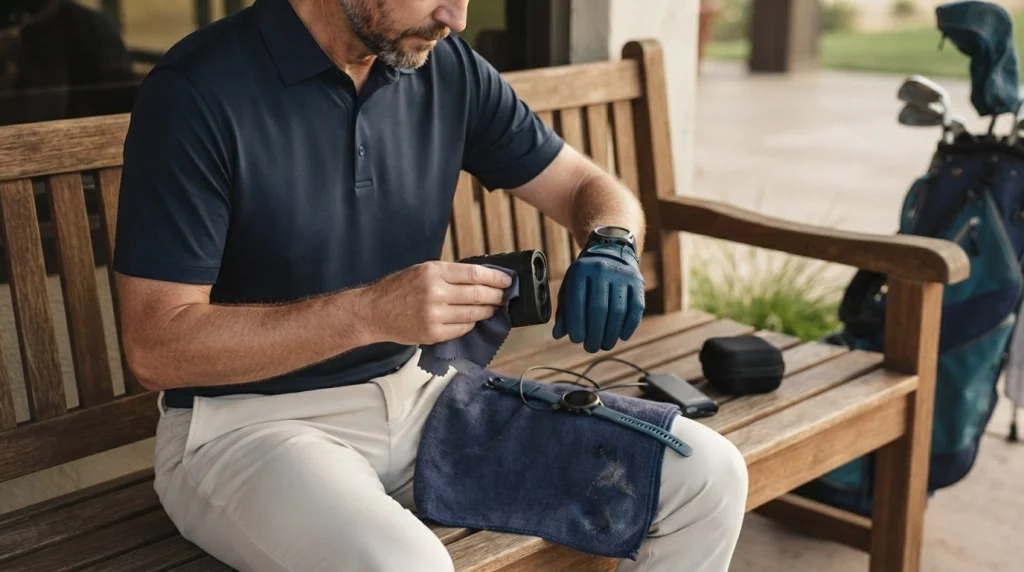
Laser rangefinders generally need little routine maintenance, but keeping their optics and housing in good condition helps preserve usability.
- Clean the lenses with a suitable lens cloth rather than abrasive materials.
- Protect the device from drops, excessive moisture, and dirt.
- Replace or recharge the battery as directed by the manufacturer.
- Store it securely in its case when it isn’t in use.
How do you maintain a GPS rangefinder?
GPS maintenance focuses on battery management, software, and course-map coverage. Following the manufacturer’s instructions can help you avoid a dead battery or missing map data during a round.
- Charge the device before playing and monitor battery life.
- Install course-map or software updates when required.
- Check course coverage before travelling to an unfamiliar venue.
- Review subscription requirements and offline functionality before relying on particular features.
For either type, test the device before your round rather than discovering an operational problem on the first tee.
Section takeaway: Both technologies can support distance measurement, but competition rules, device features, battery condition, and course coverage deserve a quick check.
Frequently Asked Questions
Is a laser rangefinder better than a GPS rangefinder?
A laser rangefinder is better when you want a direct distance to a specific visible target, such as the flagstick. GPS is better for quickly viewing mapped green distances and hazards. The best choice depends on whether you prioritize target-specific measurements or course-wide information.
Does GPS give the exact distance to the golf flag?
Most golf GPS devices display distances to mapped reference points, such as the front, middle, and back of the green. They usually don’t identify the flag’s exact daily position. Some products offer additional features, so check the model’s specifications before purchasing.
Can a laser rangefinder measure bunker distances?
Yes. A laser rangefinder can measure a visible bunker edge or another target it successfully acquires. It cannot directly measure a hidden bunker behind a hill or obstruction, so GPS mapping can be more useful when you need information about hazards outside your line of sight.
Does a golf GPS rangefinder work without internet?
Many dedicated golf GPS devices work without continuous internet access after they obtain the necessary course maps. However, requirements vary by device and app. Check whether maps must be downloaded beforehand and whether specific features require a phone connection, internet access, or subscription.
Are laser and GPS rangefinders allowed in tournament golf?
Distance-measuring devices are generally permitted under Rule 4.3a unless a Committee adopts a Local Rule prohibiting them. Certain functions, including prohibited slope-based calculations or playing advice, cannot be used during a stipulated round. Always confirm the competition’s conditions.
Do professional golfers use laser or GPS rangefinders?
Usage depends on the tour, competition, and applicable rules. Some professional events restrict distance-measuring devices even though many amateur competitions permit them. Check the specific event regulations rather than assuming that a device permitted at a local club is allowed on every tour.
Can a beginner benefit from a golf rangefinder?
Yes. A rangefinder can help beginners learn distances and make more informed club selections. GPS may be easier when learning unfamiliar holes, while a laser can help develop a clearer understanding of distances to specific targets. Neither replaces practice or knowledge of personal carry distances.
Final Takeaway: Laser or GPS?
The difference between laser and GPS rangefinders comes down to target measurement versus mapped course information. A laser measures a visible object directly, while GPS calculates distances using your position and stored golf-course data.
Choose laser if exact flag distances are your priority. Choose GPS if you want quick green yardages and help planning around mapped hazards.
If you want both capabilities and the extra cost makes sense for your game, consider using the two technologies together. Whichever device you choose, learn your carry distances, confirm questionable readings, and check competition rules before playing.
Good distance information helps you make a better-informed decision. The right club still depends on the shot in front of you.