
How Does a Laser Golf Rangefinder Work?

Quick Answer
A laser golf rangefinder works by sending a brief pulse of laser light toward a target, such as a flagstick, and measuring how long the reflected light takes to return. Its processor uses the speed of light and the round-trip travel time to calculate the distance. Modern golf rangefinders also use magnified optics and target-locking technology to help golfers identify the flag instead of trees or other objects behind it.
What happens inside the device?
- Laser emission: The rangefinder sends a short pulse of light toward the target.
- Light reflection: Some of that light reflects off the target and returns to the device.
- Time measurement: An electronic sensor measures the pulse’s travel time.
- Distance calculation: A processor converts the travel time into a distance measurement, accounting for the light’s outward and return journey.
- Target confirmation: Pin-seeking features help distinguish a flagstick from objects farther behind it.
- Distance display: The result appears in the eyepiece, usually in yards or metres.
How can you get a reliable reading?
- Hold the device steady, aim at the flagstick, and activate the measurement.
- Confirm the target-lock signal or vibration, then repeat the reading if the result seems unexpected.
A laser golf rangefinder can take much of the guesswork out of choosing a club, but the technology behind that little number is worth understanding. I’ll explain how the laser measures distance, how pin-lock features work, and what can affect a reading, including slope, weather, and the target itself.
I’ll also compare laser rangefinders with GPS golf devices so you can see which option makes more sense for your game in 2026.
In This Guide
- How does a laser rangefinder measure distance?
- What happens inside a golf laser rangefinder?
- How does pin-lock technology find the flag?
- What affects a laser rangefinder’s accuracy?
- How does slope compensation work?
- Laser rangefinder vs. GPS: What’s the difference?
- How do you use a laser rangefinder on the course?
- Laser golf rangefinder FAQs
- Final takeaway
How Does a Laser Rangefinder Measure Distance?
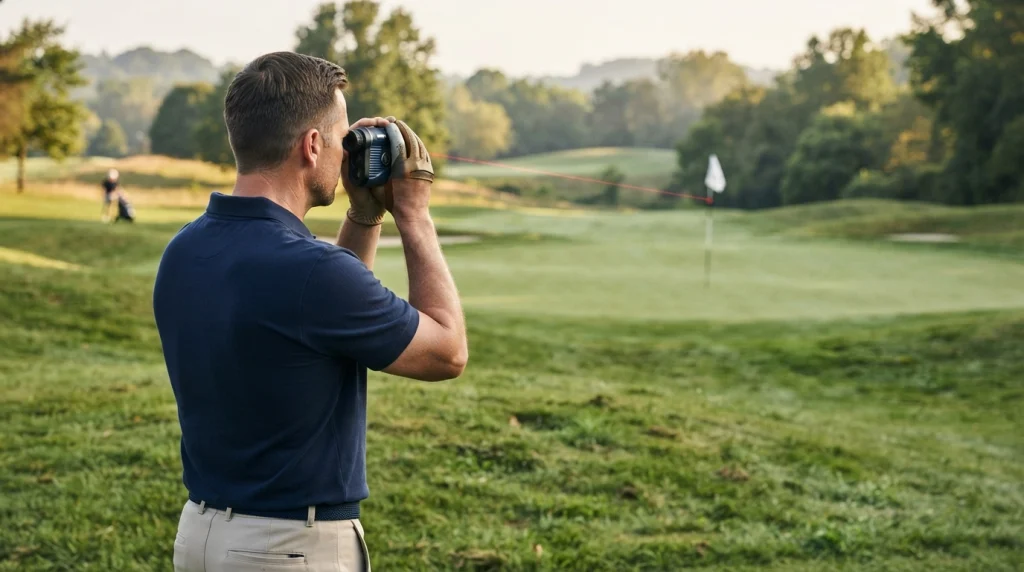
A laser golf rangefinder measures distance using a technique called time of flight. It sends a pulse of light toward an object, detects the returning reflection, and calculates how far away the object is.
The basic principle is straightforward. Light travels at approximately 299,792 kilometres per second in a vacuum, so measuring its travel time allows the device to calculate distance with remarkable precision.
The simple science behind the reading
Imagine standing 150 yards from a flagstick. You point your rangefinder at the flag, press its measurement button, and wait for the distance to appear.
The device performs several operations in a fraction of a second:
- It emits a laser pulse. The pulse travels toward the flagstick.
- The light reflects. A portion of the emitted light bounces off the target and returns.
- The sensor detects the return. The electronics measure the elapsed time between transmission and reception.
- The processor calculates distance. It uses the speed of light and the measured round-trip time.
- The display shows the result. You see the measured distance in your selected unit.
The important detail is that light travels to the target and back. The device must account for both directions, rather than treating the round-trip time as a one-way measurement.
The underlying calculation is:
Distance = (Speed of light × Round-trip time) ÷ 2
For example, light takes roughly one billionth of a second to travel 30 centimetres one way in a vacuum. At golf distances, the round-trip time remains extremely short, which is why the electronics need precise timing.
Why the device doesn’t measure every object equally
The laser pulse may encounter several objects, including leaves, tree trunks, the flagstick, and the ground behind the green. Each object can reflect some of the light back toward the receiver.
The rangefinder must process those returns and identify the measurement that best matches the intended target. Basic devices may be more sensitive to what you hit with the laser, while advanced models use target-priority algorithms to help isolate the flag.
For a technical overview of the underlying optics, Nikon explains the principles of how laser rangefinders work.
**Section takeaway:** A laser rangefinder doesn’t estimate yardage from a picture. It calculates distance from the travel time of reflected light, then uses its electronics to turn that measurement into a useful golf reading.
What Happens Inside a Golf Laser Rangefinder?
A golf laser rangefinder combines optical components, a light source, a receiver, a timing circuit, and a small processor. Each part contributes to the distance reading you see through the eyepiece.
The laser does the measuring, but the other components help you aim, capture the returning light, and interpret the result.
Five key components explained
- Laser emitter: Sends short pulses of light toward the selected target.
- Objective lens: Collects incoming light and helps you view the flagstick through the device.
- Receiver and sensor: Detect the reflected laser energy returning from the target.
- Processor and timing electronics: Determine the elapsed travel time and calculate distance.
- Eyepiece display: Shows the distance reading, targeting indicators, and other supported information.
Some models also include an accelerometer, a vibration mechanism, or additional sensors for features such as slope compensation. The exact components and algorithms vary by manufacturer and model.
What does magnification actually do?
Magnification makes distant objects appear larger through the eyepiece, helping you line up the device with a narrow flagstick. It doesn’t, by itself, make the distance measurement more accurate.
For example, when a flag sits in front of trees, magnification helps you position the aiming point on the flag rather than the background. The ranging electronics still need to identify the correct reflected signal.
Optical clarity matters, too. A clear image and comfortable eyepiece make it easier to aim consistently, particularly when you’re trying to measure a small target from across a wide fairway.
Why does the reading appear so quickly?
Light travels extremely fast, and modern electronics can measure very short time intervals. The processor performs the calculation and displays the result without requiring you to estimate anything manually.
However, the speed of light doesn’t mean every reading will be correct. A poor aim, weak reflection, or mistaken target can still produce a distance that doesn’t represent the flagstick.
**Section takeaway:** The emitter and receiver provide the measurement, while the optics, processor, and display make that measurement usable on the course.
How Does Pin-Lock Technology Find the Flag?
Pin-lock technology helps a golf rangefinder identify the flagstick when other objects sit behind it. Depending on the model, the feature may use target-priority processing, a visual indicator, a vibration, or a combination of these signals.
This matters because a laser can reflect from the trees behind a green instead of the flag you intended to measure.
Why measuring the flag can be tricky
Picture a par-three hole with a flag in front of a wooded hillside. You aim through the eyepiece, but the background fills much more of your view than the narrow flagstick.
The device receives reflections from the objects in its ranging path. If it reports the hillside’s distance instead of the flag’s, you could select the wrong club.
Target-lock technology helps reduce that risk by prioritizing returns associated with the intended small target. The exact approach varies between manufacturers, so pin-lock performance isn’t identical across every rangefinder.
How pin-seeking features work
- Target the flag. Use the magnified view to place the aiming point on the flagstick.
- Activate ranging. The device emits its laser pulse and detects returning reflections.
- Process the returns. The electronics apply the model’s target-selection logic to identify a likely flagstick reading.
- Confirm the lock. Depending on the model, a vibration or visual indicator signals that the device has acquired the target.
- Check the result. Confirm that the displayed distance makes sense for the hole and your position.
A vibration is useful because you can feel it without taking your eye away from the eyepiece. Still, it isn’t a guarantee that every reading is correct, so confirm unusual measurements before choosing a club.
Pin-lock versus a standard distance reading
A standard ranging function measures a reflected target, while a pin-seeking function attempts to identify the flagstick among competing targets. Some entry-level models offer simpler target selection, whereas premium models may provide more sophisticated confirmation features.
These terms are often brand-specific. Names such as PinSeeker, PinLock, and similar labels describe related goals, but their precise behaviour depends on the manufacturer’s design.
**Section takeaway:** Pin-lock technology makes flag measurements easier in visually busy settings, but steady aiming and a sensible reading remain important.
What Affects a Laser Rangefinder’s Accuracy?
A laser golf rangefinder can provide precise distance measurements, but the result depends on the target, the device, and how you use it. A clear line of sight and a stable aim generally make it easier to obtain a dependable reading.
It’s useful to separate the device’s measurement capability from your ability to aim at the correct object.
Common factors that affect readings
| Factor | How it affects measurement | What to do |
|---|---|---|
| Unsteady hands | The aiming point may move off the flagstick. | Brace your arms and take another reading. |
| Small target | The flagstick can be harder to isolate at long distances. | Use magnification and confirm the target lock. |
| Trees or objects behind the flag | The device may select a background object. | Use pin-seeking mode and repeat the measurement. |
| Rain, mist, or haze | Visibility and the returning signal may deteriorate. | Clean the lenses and try again when visibility improves. |
| Dirty lenses | A hazy view makes accurate aiming harder. | Clean the optics with a suitable lens cloth. |
| Low battery | Some models may show warnings or stop operating reliably. | Replace or recharge the battery as instructed. |
Does distance itself affect the reading?
Longer shots can make the flagstick harder to target because it occupies a smaller part of your view. Whether a device can range that target depends on its specifications, the target’s reflectivity, and the surrounding conditions.
A manufacturer’s maximum ranging distance doesn’t guarantee that every flagstick can be measured at that distance. Advertised range and practical flag-locking range are different considerations.
How can you verify a questionable reading?
Use a repeatable process rather than trusting a number that looks unusual. I recommend checking three things before committing to a club:
- Repeat the measurement: Aim at the flagstick again and compare the displayed distances.
- Check the target: Confirm that the device locked onto the flag rather than the green’s background.
- Compare course information: Use a marked yardage point or another reliable distance reference when available.
Remember that a correct laser measurement only tells you the distance to the target you selected. It doesn’t automatically account for wind, lie, temperature effects on ball flight, or every other factor that influences your shot.
**Section takeaway:** Accurate aiming matters as much as the technology. Repeat questionable readings, confirm the target, and treat distance as one part of your club-selection decision.
How Does Slope Compensation Work?
Slope compensation estimates how elevation changes affect the playing distance of a shot. A slope-enabled rangefinder uses additional information, typically including the angle between the device and the target, to calculate an adjusted distance.
This differs from basic laser ranging, which measures the direct distance between the device and the target without automatically adjusting for the shot’s elevation.
Actual distance versus adjusted distance
Imagine your ball sits below an elevated green. The laser might measure 150 yards to the flag, but the uphill shot could play longer than a level shot of the same measured distance.
A slope feature uses the measured distance and elevation angle to estimate a more useful playing-distance figure. The adjusted figure is an estimate, not a guarantee of how far your ball will travel.
Consider these illustrative examples, which explain the concept rather than predict any particular device’s output:
- Level shot: The measured distance and slope-adjusted distance may be similar.
- Uphill shot: The adjusted figure may be longer than the direct measured distance.
- Downhill shot: The adjusted figure may be shorter than the direct measured distance.
The actual difference depends on the slope, distance, device algorithm, and other factors. There is no single adjustment that applies to every uphill or downhill shot.
Does every laser rangefinder have slope?
No. Some models measure distance only, while others include elevation measurement and slope-adjusted yardage. Before buying, check the manufacturer’s specifications and confirm which functions the particular model supports.
For tournament play, the distinction matters. Under Rule 4.3 of the R&A Rules of Golf, players generally may obtain distance information, but measuring elevation changes or using prohibited interpretation features during a round can breach the equipment rules.
The competition committee may also adopt a Local Rule prohibiting distance-measuring devices altogether. Check the applicable rules before playing rather than assuming every feature is permitted.
**Section takeaway:** Slope compensation can help you judge elevation changes, but the adjusted distance is an estimate and slope functions may be restricted during competition.
Laser Rangefinder vs. GPS: What’s the Difference?
A laser rangefinder measures the distance to a target you aim at, while a GPS golf device uses satellite positioning and course data to estimate distances to mapped locations. Both can help with club selection, but they answer slightly different questions.
The best choice depends on whether you want to measure a specific flagstick or quickly view distances around the hole.
Side-by-side comparison
| Feature | Laser rangefinder | GPS golf device |
|---|---|---|
| Measurement method | Measures reflected laser light. | Uses satellite positioning and mapped course data. |
| Target selection | You aim at a visible target. | You select or view mapped course points. |
| Distance to the flag | Can measure the actual flagstick when successfully targeted. | Depends on available map data and the device’s features. |
| Blind shots | Needs a suitable line of sight to the target. | Can show mapped distances without seeing the target. |
| Typical workflow | Raise, aim, measure, and read. | Check the screen or watch display. |
| Course-data dependence | Measures visible targets without needing a mapped hole. | Relies on satellite positioning and suitable course mapping. |
Which option makes more sense for your game?
- Choose a laser rangefinder if you want to measure a visible flagstick, bunker edge, tree, or other specific target.
- Choose a GPS device if you want convenient front, middle, and back-of-green distances or information on a hole you cannot see.
- Consider both if you want direct target measurements and a broader overview of the hole.
Neither technology automatically chooses the right club. You still need to consider your own carry distances, the lie, wind, hazards, and the position of the pin.
**Section takeaway:** Laser devices are useful for measuring visible targets directly, while GPS devices are convenient for mapped course information and blind shots.
How Do You Use a Laser Rangefinder on the Course?
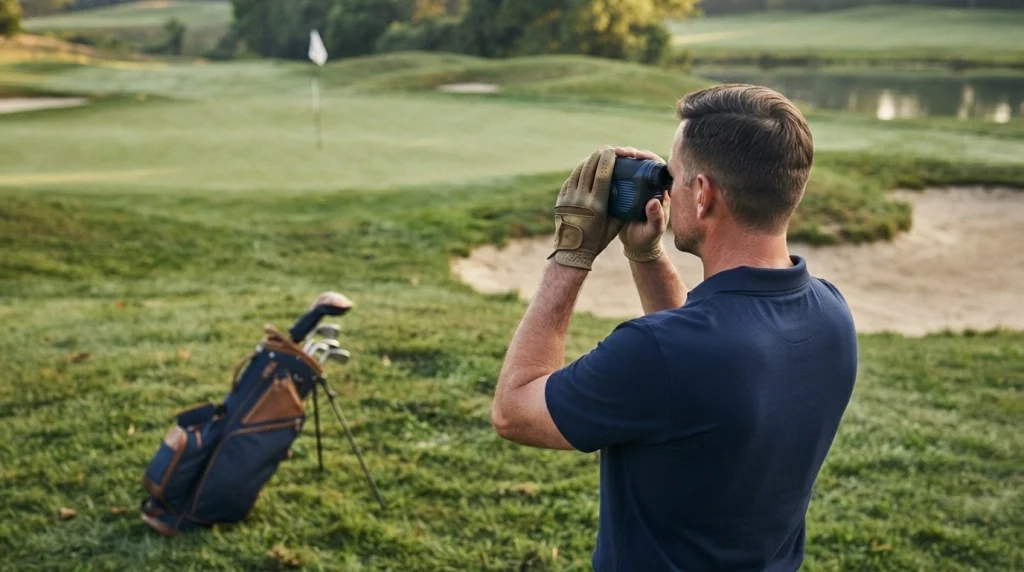
Using a laser golf rangefinder is straightforward once you understand how to aim and confirm the target. A consistent routine helps you get dependable readings without delaying play.
A simple five-step routine
- Check your battery and settings. Confirm that the device works and displays yards or metres as intended.
- Find your target. Identify the flagstick or another specific point relevant to your next shot.
- Look through the eyepiece. Centre the aiming point on the target and steady the device with both hands if comfortable.
- Trigger the measurement. Press the ranging button and wait for the reading or target-lock signal.
- Apply the information. Use the distance alongside your normal club-selection process.
What should you measure besides the flag?
The flag is important, but it isn’t always the only useful target. Measuring other visible objects can help you plan an approach or avoid trouble.
- Bunker edges: Estimate the distance to a visible hazard before selecting a landing area.
- Water hazards: Measure a visible edge when planning a safe carry or layup.
- Trees and landmarks: Establish a distance reference when the flag is difficult to isolate.
- Practice targets: Measure a marker on the driving range to help build a more reliable picture of your club distances.
Make sure you know which point the rangefinder measured. A distance to the front edge of a bunker isn’t the same as the distance required to carry it, and neither necessarily tells you the distance to the flag.
How can you use readings to improve club selection?
A rangefinder gives you a distance, not a club recommendation. Your next task is to compare that distance with the carry distances you know for your clubs.
For example, suppose the flag measures 145 yards away. If you know how far your 7-iron and 8-iron typically carry, you can consider the target distance alongside elevation, wind, and the lie before choosing.
Don’t confuse total distance with carry distance. A ball may roll after landing, but that extra distance depends on the club, landing surface, turf conditions, and shot shape.
One practical habit is to record the actual carry distances you achieve during practice sessions. Over time, that information helps you make better use of the readings you obtain on the course.
**Section takeaway:** Aim at a clearly identified target, confirm the measurement, and combine the number with your own club distances and course conditions.
Laser Golf Rangefinder FAQs
1. How accurate is a laser golf rangefinder?
Accuracy varies by model and conditions. Many golf rangefinders specify accuracy within approximately one yard, but you should check the manufacturer’s stated tolerance for your particular device. Correct target selection, steady aiming, and visibility also affect the usefulness of a reading.
2. Is the laser in a golf rangefinder visible?
Many golf rangefinders use infrared laser light that you cannot see with your eyes. The device detects the returning light electronically, so you can measure distance without seeing a visible beam. Never look into the laser aperture or aim the device at anyone’s eyes.
3. Can a laser rangefinder measure distance to anything on a golf course?
It can measure many visible targets that reflect enough light for the device to detect, provided they fall within its operating range. You can often measure flags, trees, bunkers, and other landmarks. A clear line of sight and correct aiming help you obtain a useful result.
4. Why does my rangefinder give different readings when I aim at the same flag?
Different readings can occur when your aim shifts between the flagstick and background objects. Hand movement, poor visibility, and difficult target conditions can also affect the result. Steady the device, use its target-lock feature if available, and repeat the measurement to check consistency.
5. Does a laser golf rangefinder work in rain or fog?
It may work in light rain, but heavy rain, fog, and mist can reduce visibility and interfere with reliable ranging. Performance depends on the device and conditions. Keep the lenses clean, follow the manufacturer’s weather guidance, and avoid relying on a questionable reading.
6. Is slope compensation necessary in a golf rangefinder?
No. A standard laser rangefinder can measure direct distance without slope compensation. Slope features can help estimate how elevation changes affect a shot, but they aren’t essential for every golfer. Check competition rules before using slope functions during a round.
7. Can I use a laser golf rangefinder in a tournament?
Distance-measuring devices are generally permitted under Rule 4.3 unless a committee adopts a Local Rule prohibiting them. However, using functions that measure elevation changes or provide prohibited playing advice can breach the Rules of Golf. Check the competition’s specific conditions before play.
Final Takeaway: How a Laser Rangefinder Helps Your Game
A laser golf rangefinder works by measuring how long a pulse of light takes to travel to a target and return. Its processor converts that time into distance, while optical magnification and pin-lock features help you identify the flagstick.
Understanding the technology helps you use the device more confidently. It also helps you recognize why an incorrect target, shaky aim, or poor visibility can produce an unhelpful reading.
When choosing a rangefinder, focus on clear optics, dependable target acquisition, straightforward controls, and an accuracy specification that suits your needs. Slope compensation can be useful, too, if you understand its limitations and the rules governing its use.
My main advice is simple: measure the target carefully, confirm the result, and combine the distance with your own club carry numbers. A rangefinder won’t make the shot for you, but it can give you better information for making the decision.