
How Does a Golf Rangefinder Work? A Complete Guide to Laser Technology

Quick Answer
A golf rangefinder works by sending a short pulse of laser light toward a target, such as a flagstick, and measuring how long the reflected light takes to return. Its processor converts that travel time into a distance, which appears as yardage or meters through the eyepiece. Advanced models add features such as flag-lock technology and slope compensation to help golfers choose the right shot distance.
What makes a golf rangefinder work?
- Laser emitter: Sends a brief pulse of light toward the target.
- Light receiver: Detects the reflected signal returning from the target.
- Distance processor: Calculates the distance using the light’s travel time.
- Target-lock system: Helps distinguish the flagstick from trees or other objects behind it.
- Slope sensor: Measures elevation angle so compatible models can calculate an adjusted playing distance.
How to get a reliable reading
- Aim at the flagstick, hold the device steady, and press the measurement button.
- Check for a pin-lock confirmation, then compare the reading with your expected yardage.
- Remember that measured distance is only one factor in club selection; elevation, wind, temperature, and your carry distance also matter.
A golf rangefinder can turn a rough estimate into a precise measurement in seconds. But understanding how a golf rangefinder works helps you use that number correctly, especially when the flag sits in front of trees or on an elevated green.
In this guide, I’ll explain the laser technology, the components inside the device, how slope and flag-lock features affect readings, and how rangefinders compare with GPS golf devices. I’ll also cover common measurement mistakes and the rules you should know before taking one into competition.
In This Guide
- How does a golf rangefinder measure distance?
- What parts make a golf rangefinder work?
- How do pin-lock and slope technologies work?
- What is the difference between a laser rangefinder and GPS?
- How do you use a golf rangefinder correctly?
- How accurate are golf rangefinders, and what can affect them?
- Golf rangefinder FAQs
How Does a Golf Rangefinder Measure Distance?
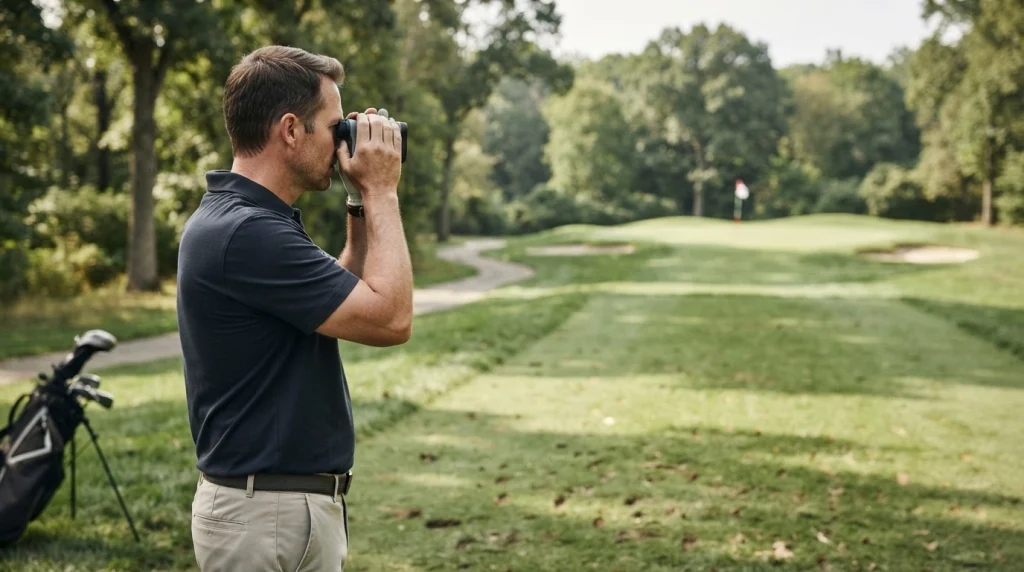
A laser golf rangefinder measures distance by timing how long a light pulse takes to travel to a target and return. This method is called time-of-flight measurement, and it allows the device to calculate distance without touching the target or relying on a course map.
The science behind the laser
Light travels at approximately 299,792,458 meters per second in a vacuum. A rangefinder’s electronics measure the extremely short return time and use the known speed of light to calculate the distance.
The basic formula is straightforward:
Distance = (Speed of light × Round-trip time) ÷ 2
The division by two matters because the light travels to the target and back. Without that adjustment, the calculation would represent the total light-travel distance rather than the one-way distance you need on the course.
What happens when you press the button?
A typical laser measurement follows this sequence:
- You aim: The optical system helps you identify the flagstick or another visible target.
- The laser fires: The emitter sends a brief pulse toward the target.
- The reflection returns: Some of the light reflects from the target toward the device.
- The processor calculates: Electronics determine the travel time and convert it into distance.
- The display updates: The result appears in yards or meters, depending on your settings.
The whole process typically takes only a short moment. The device doesn’t need to know the course layout or your GPS coordinates to measure a visible flag.
How does a rangefinder know the distance to the flag?
It doesn’t automatically know that you’re aiming at a flag. The laser measures reflected light from objects within its field of view, so a tree, bunker face, or hillside can also produce a reading.
Golf-specific target-priority technology helps identify the flagstick, particularly when other objects sit behind it. This distinction is important because a perfectly functioning rangefinder can still return an unwanted distance if you aim at the wrong object.
For a deeper technical overview, Nikon explains the underlying principles in its guide to how laser rangefinders work.
Section takeaway: A golf rangefinder calculates distance from a laser’s return time. The measurement is only useful when the device receives a reliable reflection from the target you intended to measure.
What Parts Make a Golf Rangefinder Work?
A golf rangefinder combines optical components, a laser system, electronic processing, and a display in one handheld device. Each component has a different job, from helping you see the flag clearly to converting the reflected signal into a readable yardage.
The main components explained
- Laser emitter: Produces the outgoing light pulse used for distance measurement.
- Receiving sensor: Detects returning light and supplies the signal needed for measurement.
- Objective lens: Collects incoming light and supports the viewing system.
- Eyepiece: Lets you look through the device and frame the target.
- Processor: Calculates the measured distance and manages features such as target lock.
- Display: Shows the distance, measurement status, and other supported information.
- Battery: Supplies the power needed by the electronics and optical systems.
Not every model uses identical components or arrangements. Higher-end devices may include image stabilization, brighter displays, or additional sensors that basic models don’t have.
Why magnification matters
Magnification makes distant objects appear larger through the eyepiece. Many golf rangefinders offer around 6x magnification, although specifications vary by model.
Clear magnification helps you place the aiming reticle on a narrow flagstick rather than a larger object behind it. However, magnification alone doesn’t guarantee a correct distance; stable aiming and reliable target detection matter just as much.
Why some rangefinders vibrate
Many golf models use a brief vibration or visual indicator to confirm that the device has locked onto a target. This feedback helps you recognize a successful pin measurement without needing to guess whether the reading came from the background.
Stabilization is a separate feature. It reduces the apparent movement of the view when your hands shake, making it easier to hold the reticle on the flag while measuring.
These features can make the device easier to operate, but they don’t eliminate every measurement error. If the flag is obscured or the light reflection is weak, you may need to aim again.
Section takeaway: Optics help you aim, the laser system measures, and the processor calculates the result. Target confirmation and stabilization improve usability rather than replacing the underlying measurement process.
How Do Pin-Lock and Slope Technologies Work?
Pin-lock and slope functions solve two different problems. Pin-lock helps the rangefinder identify the flag, while slope technology estimates how elevation changes affect the distance relevant to a shot.
How does pin-lock technology identify the flag?
Pin-lock systems use signal-processing methods to help distinguish a nearby, narrow target from larger objects farther away. Manufacturers use different names and implementations, so performance can vary between models.
Imagine a flag positioned 150 yards away, with trees behind the green at 180 yards. If the device locks onto the trees instead of the flag, the displayed distance may be misleading.
A pin-lock feature may prioritize the flagstick and confirm the result with a vibration or on-screen indicator. Look for that confirmation, especially when the background is cluttered.
How does slope compensation calculate playing distance?
A slope-enabled rangefinder measures the direct distance to the target and uses an angle sensor to estimate the elevation difference. It then calculates an adjusted distance, often described as “plays-like” yardage.
For example, a flag might measure 150 yards away on a steep uphill approach. A slope-enabled device may display a longer adjusted distance because the elevation makes the shot play differently from a level approach.
A downhill shot can produce the opposite effect. The adjusted figure depends on the measured angle and the device’s calculation method, so it isn’t a universal conversion that applies equally to every club or golfer.
Measured distance versus slope-adjusted distance
| Reading type | What it means | Best use |
|---|---|---|
| Line-of-sight distance | The direct measured distance from the device to the target. | Knowing the target’s measured yardage. |
| Slope-adjusted distance | An estimated playing distance that accounts for elevation. | Practice and permitted casual play. |
| GPS yardage | A distance calculated from your position and mapped course points. | Checking green distances and course features. |
Neither the laser measurement nor the slope-adjusted number tells you exactly how far your ball will travel. Wind, temperature, lie, ball flight, and your own carry distances still affect the shot.
Can you use slope mode in a golf tournament?
Under the Rules of Golf, distance-measuring devices may be permitted when the relevant committee allows them. However, measuring slope or accessing other prohibited features during a round can violate the applicable rules.
Check the competition’s conditions and consult the USGA’s equipment FAQ before playing. If the event requires distance-only functionality, switch slope off and confirm that the device complies with the competition rules.
Section takeaway: Pin-lock helps you measure the intended target, while slope estimates how elevation affects the shot. Treat adjusted yardage as useful guidance, not a guarantee of the club or swing you should choose.
What Is the Difference Between a Laser Rangefinder and GPS?
A laser rangefinder measures the distance to a specific object you can see, while a GPS golf device calculates distances from your location to mapped points on the course. Both help with club selection, but they answer slightly different questions.
How the two technologies compare
| Feature | Laser rangefinder | GPS golf device |
|---|---|---|
| How it measures | Times a reflected laser signal. | Uses satellite positioning and course maps. |
| Target | A visible flag, tree, bunker edge, or other object. | Mapped points such as green edges and hazards. |
| Aiming required | Yes. | Usually not for displayed mapped distances. |
| Today’s pin position | Measures the flag where it currently stands. | May not reflect the exact pin position unless supported by updated pin data. |
| Visibility limitations | Needs a usable line of sight to the target. | Can show mapped distances when the target isn’t visible. |
| Typical strength | Measuring a particular target precisely. | Viewing several course distances quickly. |
For example, a laser can tell you the distance to a visible flag on a par-three hole. A GPS watch can show the front, middle, and back of the green without requiring you to aim at each point.
Neither technology automatically improves club selection. The benefit comes from combining reliable yardage with a realistic understanding of your own distances.
Which option makes more sense for your game?
- Choose a laser rangefinder if you want the distance to a specific flagstick or visible hazard.
- Choose a GPS watch or handheld if you prefer quick green distances and an overview of unfamiliar holes.
- Use both if you want mapped course information alongside direct measurements to individual targets.
GPS readings depend on positioning and map quality, while laser readings depend on target visibility and successful measurement. Neither is universally better for every course or golfer.
Garmin provides a useful explanation of the differences in its guide to GPS versus laser distance measurement.
Section takeaway: A laser measures the object you aim at, while GPS provides distances to mapped course locations. Choose the technology that gives you the information you need with the least disruption to your pre-shot routine.
How Do You Use a Golf Rangefinder Correctly?
Using a golf rangefinder correctly means selecting the intended target, holding the device steady, confirming the reading, and interpreting the result in context. You don’t need advanced technical knowledge to get started.
A simple on-course routine
- Identify your target. Decide whether you need the distance to the flag, a bunker edge, a layup point, or another visible landmark.
- Bring the eyepiece to your eye. Adjust the focus or diopter if your model supports it and the view looks blurry.
- Center the target. Place the reticle over the flagstick or the specific object you want to measure.
- Press the measurement button. Follow your device’s instructions for a single reading or continuous scan.
- Confirm the result. Check for a lock indicator, vibration, or other target-confirmation signal.
- Choose your shot. Compare the yardage with your carry distances, the lie, wind, elevation, and the safest landing area.
If you receive a suspicious reading, don’t immediately trust the displayed number. Aim again, take another measurement, and compare the result with course markers or a GPS device if available.
How do you measure a bunker or water hazard?
You can use a laser rangefinder to measure visible hazards just as you measure the flag. The key is to aim at the correct edge or landmark rather than an object beyond the hazard.
For a water carry, you might measure the near edge and far edge when both are visible. Those distances help you judge whether your normal carry can clear the water safely.
For a bunker, measuring the front edge can help you plan a layup or determine whether your intended landing area leaves enough room. Remember that a measurement to a visible point doesn’t reveal every contour or obstacle around it.
How should you use the reading for club selection?
Start with your own reliable carry distances rather than the maximum distance you once achieved with a club. Carry distance is how far the ball travels through the air before landing, which matters when you need to clear a hazard or reach a raised green.
Consider a practical example: your rangefinder measures 145 yards to the flag, but your ball sits in a poor lie and the green is elevated. Your usual 145-yard club may not be the safest choice because the conditions can change the shot.
Use the measurement as one input, then account for:
- Elevation: Whether the target sits uphill or downhill.
- Wind: The direction and strength of the breeze.
- Lie: Whether the ball rests on a fairway, in rough, or in a bunker.
- Landing area: Where you want the ball to finish, not just where the flag stands.
- Personal distance: How far you reliably carry each club.
That approach helps prevent a common mistake: treating the pin distance as an automatic instruction to hit the club that carries exactly that number.
Section takeaway: Measure deliberately, confirm the target, and connect the yardage to your actual carry distances. A repeatable routine is more useful than taking several rushed readings before every shot.
How Accurate Are Golf Rangefinders, and What Can Affect Them?
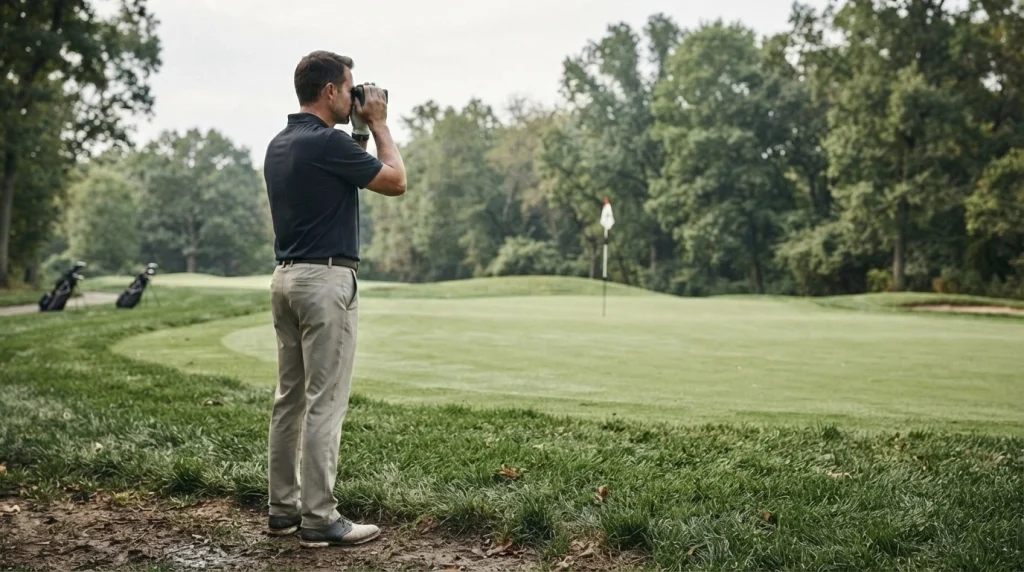
Many golf laser rangefinders advertise accuracy around one yard under suitable conditions, although the stated tolerance varies by model. Real-world reliability depends on the device’s specifications, the target, the environment, and how steadily you aim.
What affects a rangefinder’s reading?
- Target size: A large tree can provide a stronger reflection than a thin flagstick, making target selection important.
- Background objects: Trees or buildings behind the flag can interfere with identifying the intended target.
- Hand movement: An unsteady reticle can move off the flag before the device completes its measurement.
- Visibility: Fog, rain, and poor lighting can make the target harder to identify or the return signal harder to obtain.
- Surface and angle: The target’s reflective characteristics and your line of sight can influence signal reception.
- Device condition: A low battery, dirty lens, or damaged unit may affect operation.
Range specifications also need context. A manufacturer’s maximum measurement range usually describes the device’s ability to measure a suitable target under specified conditions; it doesn’t guarantee equally easy flag-locking at that distance.
How can you check whether a reading is reliable?
Repeat the measurement when the result seems inconsistent with the hole layout. If the device repeatedly gives a distance that appears too long, check whether you’re locking onto trees or another background object.
Clean the lenses using the method recommended by the manufacturer, check the battery, and verify that the distance units are set correctly. If readings remain inconsistent across clear, stable targets, consult the device manual or manufacturer support.
Does a rangefinder measure how far your golf ball will travel?
No. A conventional golf rangefinder measures the distance from your current position to a selected target; it doesn’t predict your ball’s exact flight distance.
Some advanced devices combine distance measurements with other information, but the measured yardage alone doesn’t account for your swing, strike quality, ball speed, spin, or launch angle. A launch monitor is a different type of equipment designed to measure or estimate ball-flight and swing data.
Section takeaway: A rangefinder can provide a highly useful measurement, but accuracy claims assume suitable conditions. Confirm the target and repeat questionable readings instead of treating every displayed number as infallible.
Golf Rangefinder FAQs
Does a golf rangefinder use GPS?
A standard laser golf rangefinder doesn’t need GPS to measure distance. It calculates the distance to a visible target using the return time of a laser pulse, although some hybrid devices combine laser measurement with GPS features.
Can a golf rangefinder measure through trees?
A laser rangefinder needs a usable line of sight to the target. It can’t reliably measure a hidden flag through solid tree trunks or dense foliage, although it may measure a visible opening or another exposed object instead.
Why does my rangefinder show different distances to the same flag?
Different readings can result from unstable aiming, background interference, a weak reflection, or accidentally targeting different parts of the scene. Hold the device steady, center the flagstick, check the lock indicator, and repeat the measurement.
What does slope mean on a golf rangefinder?
Slope refers to elevation change between your position and the target. A slope-enabled rangefinder uses an angle sensor and calculation to estimate a playing distance that accounts for uphill or downhill conditions, rather than showing only the direct measured distance.
Are golf rangefinders legal in tournament play?
Distance-measuring devices can be permitted under the Rules of Golf when the applicable conditions allow them. Slope and other features that measure playing conditions may not be used during a round, so check the event’s rules and confirm that your device complies.
Can a rangefinder measure distances to trees and bunkers?
Yes, provided the target is visible and the device can obtain a usable reflection. You can measure a tree, bunker edge, or other landmark to help plan a layup, assess a carry, or identify a useful reference point on the hole.
Is a golf rangefinder worth it for beginners?
It can be helpful for beginners because it provides a consistent measurement instead of relying entirely on visual estimates or guessing from course markers. The biggest benefit comes when you combine the yardage with realistic club carry distances and sensible shot choices.
For anyone learning to use one, simple features such as clear optics, reliable target confirmation, and easy-to-read yardages may matter more than advanced functions you’ll rarely use.
Final Takeaway: Understand the Number Before Choosing Your Club
A golf rangefinder works by measuring the travel time of reflected laser light, then converting that measurement into a distance you can use on the course. Pin-lock systems help identify the flag, while slope functions estimate how elevation changes affect the shot.
The most important habit is to verify the target and interpret the reading rather than relying on the number alone. Start with accurate yardage, match it to your normal carry distances, and account for the conditions before selecting a club.
As of 2026, laser rangefinders and GPS golf devices both offer useful ways to manage distance. If you prefer measuring individual targets, a laser rangefinder is a practical tool; if you want a broader view of each hole, GPS may suit your routine better.
Whichever device you choose, use it to make better-informed decisions, not to replace course awareness or sound judgment. That is where distance-measuring technology becomes genuinely useful.