
Golf Etiquette: A Complete Guide for Beginners

Quick Answer
Golf etiquette means playing safely, keeping pace, respecting other golfers, and caring for the course. You should be ready when it is your turn, remain quiet during another player’s shot, repair any damage you cause, and follow the facility’s local rules. These habits reflect the principles in Rule 1 of the Rules of Golf.
The essential golf etiquette rules
- Protect everyone: Never swing or hit until people ahead are safely out of range.
- Keep moving: Prepare early, limit practice swings, and stay near the group ahead.
- Respect each shot: Stand still, stay quiet, and avoid another player’s sightline.
- Care for the course: Replace divots, repair ball marks, and rake bunkers.
- Follow local customs: Check dress, cart, phone, and pace policies before starting.
- Manage bad holes: Pick up when appropriate during casual play instead of delaying everyone.
The simplest test
- Ask whether your action is safe, prompt, considerate, and kind to the course.
Golf etiquette can feel more intimidating than the swing itself when you’re new. I remember worrying about where to stand and whose turn it was more than the score on my card.
The good news is that most etiquette follows common sense. This guide explains what to do from the parking lot to the final handshake.
In This Guide
What Is Golf Etiquette?
Golf etiquette is the set of habits that helps everyone play safely, efficiently, and enjoyably. It covers player conduct, pace of play, course care, noise, positioning, and respect.
Definition: Golf etiquette is the customary behavior golfers follow to protect people, preserve playing surfaces, prevent delays, and avoid distracting other players.
Etiquette and the formal Rules of Golf overlap, but they aren’t identical. A rules breach may carry a penalty, while poor etiquette often leads to a reminder or an uncomfortable conversation.
Some conduct can cross that line. A committee may adopt a code of conduct with penalties for serious or repeated misconduct.
The four principles behind good etiquette
- Safety: Avoid swings, shots, and cart movements that could hurt someone.
- Consideration: Don’t distract, pressure, endanger, or inconvenience other golfers.
- Prompt play: Stay prepared and maintain your position behind the group ahead.
- Course care: Leave every playing area as good as you found it, or better.
You don’t need a low handicap to be a welcome playing partner. A beginner who watches safety and keeps moving is usually easier to play with than a skilled golfer who delays every shot.
I’ve played with new golfers who shot well over 100 yet never held up the group. They carried an extra ball, chose clubs early, and picked up when a hole stopped being fun.
Etiquette can change by course and format
A private club may enforce clothing and phone rules that a municipal course doesn’t use. Tournament golf also follows a stricter order of play than many casual rounds.
Check the scorecard, booking confirmation, clubhouse notice, and starter’s instructions. Local guidance takes priority when it addresses carts, restricted areas, pace, or course conditions.
Section Takeaway: Good golf etiquette comes down to safety, consideration, prompt play, and course care. Your score matters far less than how your behavior affects everyone else.
What Should You Do Before Your Round?

Arrive early enough to check in, organize your equipment, and reach the first tee before your assigned time. Fifteen to 30 minutes is a practical minimum at an unfamiliar facility.
A busy course treats tee times like appointments. Arriving at the parking lot at your scheduled time can delay every group behind you.
Check the course’s policies
Course rules differ, so review them before leaving home. If anything is unclear, call the golf shop instead of guessing.
- Dress code: Confirm whether the course requires collared shirts, prohibits denim, or has specific shoe rules.
- Cart policy: Look for cart-path-only restrictions, a 90-degree rule, or walking limitations.
- Outside food: Many facilities restrict personal coolers and alcoholic drinks.
- Practice areas: Learn whether range balls are included and when the range closes.
- Cancellation terms: Check weather, no-show, and player-count policies.
Bring enough equipment to avoid delays
You don’t need a tour-sized bag. You do need enough essentials to solve small problems without repeatedly borrowing from your partners.
- Golf balls marked with an identifying symbol
- Tees in more than one length
- A divot-repair tool and ball marker
- A glove and a small towel
- Water, sunscreen, and weather protection
- A pencil or digital scoring method
Marking your ball matters because several players may use the same model and number. Identify it before the first tee to prevent confusion later.
Choose suitable tees
Use tees that let you reach most holes without repeated maximum-effort shots. Tee choice should reflect playing distance and ability, not age, gender, or pride.
Moving forward can reduce lost balls and long waits. It often makes approach shots more varied and the round more enjoyable.
Introduce yourself on the first tee
If you’re paired with strangers, offer your name and a simple greeting. You don’t need to explain your handicap or apologize for being new.
Confirm which tees everyone will use and how the group wants to handle ready golf. Also mention any safety concern that partners should know, such as limited visibility.
Section Takeaway: Arrive prepared, learn the local policies, and select sensible tees. A smooth first tee usually leads to a smoother round.
How Do You Maintain a Good Pace of Play?

Maintain pace by staying close to the group ahead, preparing before your turn, and moving promptly between shots. Your position on the course matters more than the number of minutes on your watch.
The USGA guidance on ready golf supports playing out of turn in stroke play when it is safe and responsible. Formal match play requires more care because playing out of turn has different consequences.
Ready golf versus traditional order
| Situation | Traditional order | Ready-golf approach |
|---|---|---|
| Starting a hole | Lowest score on the previous hole has the honor | A prepared player hits first when safe |
| Fairway or rough | Ball farthest from the hole plays first | A ready player may hit if no one is endangered or distracted |
| Near the green | Farthest player normally plays first | A player may finish a short putt when it saves time |
| Best use | Match play and formal competition | Casual stroke play and many club events |
Ready golf isn’t permission to rush into someone’s line or hit without warning. Say “go ahead” when the order isn’t obvious.
Be ready before it is your turn
Start planning while another golfer plays, provided you can do so quietly. Estimate the yardage, study the wind, and select a likely club.
- Walk or ride toward your ball without moving ahead of someone who is hitting.
- Check your lie and yardage while others prepare.
- Select your club before the previous shot finishes.
- Use one purposeful practice swing when possible.
- Hit, watch the ball, and move toward the next shot.
Rule 5 recommends making a stroke within 40 seconds once you can play without interference or distraction. Most routine shots should take less time.
You don’t need to sprint. Efficient golf comes from decisions made early, not hurried swings.
Watch the group ahead, not only the group behind
Your group is usually in position when it remains close behind the group ahead. A completely open hole in front often signals that you have fallen behind.
If you lose ground, shorten routines and help partners locate shots. Record scores at the next tee rather than beside the completed green.
Handle lost balls efficiently
Help watch every shot and choose a landmark near where the ball finished. Looking away after impact wastes valuable search time.
Under the Rules of Golf, the search period is three minutes. In casual golf, you can often move sooner by dropping another ball when the original score isn’t important.
- Play a provisional ball when the original may be lost outside a penalty area or out of bounds.
- Carry a spare ball in your pocket when walking away from your bag or cart.
- Limit the search when your group is already out of position.
- Wave a faster group through only when course conditions and local practice make it safe.
Pro tip: Ask a PGA professional or certified instructor to help build a short, repeatable pre-shot routine if decision-making is slowing your play.
Section Takeaway: Stay near the group ahead, prepare early, and use ready golf safely. Fast golf isn’t rushed golf—it is organized golf.


Where Should You Stand While Someone Is Playing?
Stand several yards away, outside the player’s swing path and peripheral vision. Face the player quietly so you can track the shot without creating a distraction.
Never stand directly behind the ball, behind the hole, or close to the target line during a stroke. Avoid standing where a club, ball, stone, or broken branch could reach you.
Stay quiet and still during a shot
Stop walking, talking, and handling equipment when a golfer begins preparing to hit. Silence your phone before reaching the first tee.
- Don’t jingle coins, tees, or keys.
- Don’t make practice swings in the player’s view.
- Don’t cast a moving shadow across the ball.
- Don’t start a cart during the swing.
- Don’t stand close enough to make the player feel crowded.
A golfer’s routine generally begins before the club moves. Pause when the player addresses the ball rather than waiting for the backswing.
When should you shout “fore”?
Shout “fore” immediately when your ball may hit or land near another person. Don’t wait to see whether the shot finishes safely.
Call loudly and point toward the danger when possible. If you hear the warning, cover your head, turn away from the voice, and crouch without looking for the ball.
Don’t hit into the group ahead
Wait until people are beyond the longest distance you could realistically hit. Include an extra margin for firm ground, downhill slopes, wind, and unusually strong contact.
A shot doesn’t need to strike someone to be dangerous. A ball rolling between players can frighten them and trigger a confrontation.
Respect boundaries and nearby property
Don’t enter private yards, environmentally protected areas, or maintenance zones to retrieve a ball. A golf ball isn’t worth trespassing or risking an injury.
Follow signs near roads, homes, water, and construction. Take the required relief or abandon the ball when access is prohibited.
Manage emotions without affecting others
Frustration happens, but throwing clubs, striking the ground, and shouting can endanger or unsettle people nearby. Take a breath and move on.
Don’t give swing advice unless someone requests it. Unwanted instruction can make a difficult round feel worse and may slow the group.
Section Takeaway: Give every player space, silence, and a clear view. Warn people immediately after a dangerous shot and never hit while anyone may be within range.
How Should You Care for the Golf Course?
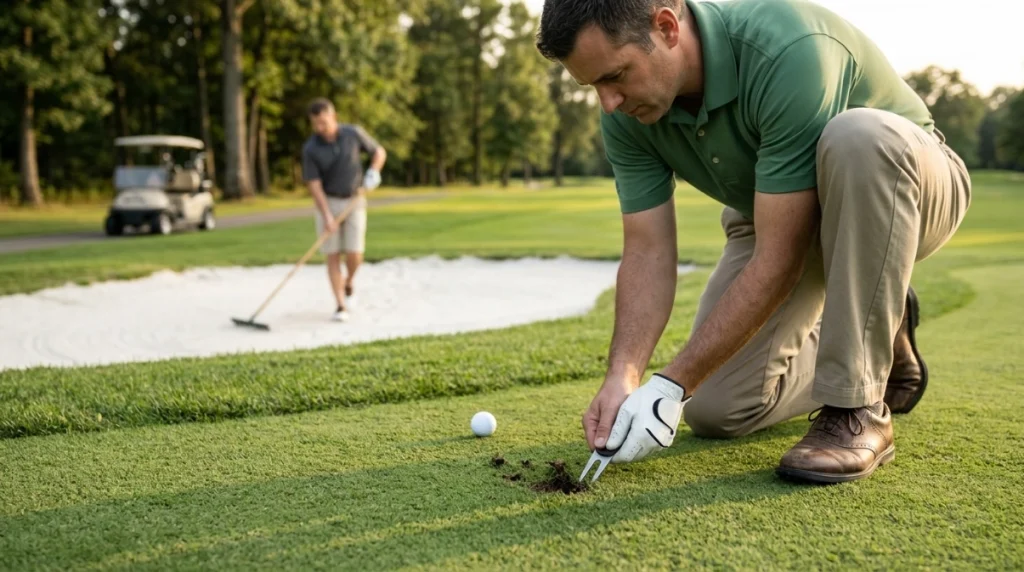
Repair the damage you create and avoid causing damage that isn’t necessary. Divots, ball marks, bunker footprints, tire tracks, and careless foot traffic affect golfers long after your group leaves.
The USGA course-care etiquette collection explains how individual behavior influences playing surfaces and golfer enjoyment. Small repairs add up across thousands of rounds.
How do you repair a divot?
Follow the course’s preferred method. Some courses ask players to replace intact turf, while others provide a sand-and-seed mixture.
- Replaceable turf: Set the piece in its original direction and press it level with your foot.
- Sand mixture: Fill the scar to the soil line and smooth it without creating a mound.
- Exploded divot: Use the supplied mixture because scattered pieces may not survive.
- Teeing area: Use the repair mix provided rather than replacing loose fragments unless instructed.
Never take a divot during a practice swing on a teeing area. Make rehearsal swings beside the ball without striking the turf.
How do you repair a ball mark?
Repair a fresh pitch mark by working its edges gently toward the center. Finish by tapping the surface level with your putter.
Don’t pry the center upward. That motion can tear roots and leave a dead patch.
- Insert the tool just outside the depression.
- Push the surrounding turf toward the center.
- Repeat from several sides.
- Tap the repaired spot until it is smooth.
Repair your own mark and one extra when time allows. Avoid delaying play to search the entire green for damage.
What is proper bunker etiquette?
Enter from the lowest practical side near your ball, avoiding steep bunker faces. Take the rake with you so you don’t make another trip.
- Keep carts and pushcarts outside the bunker.
- Make only the stance and swing movements needed for the shot.
- Rake footprints, the impact area, and your entry path.
- Blend the sand without leaving deep furrows or piles.
- Place the rake where the course directs.
Exit using the same low route when possible. Climbing a steep face can damage the bunker edge and create a slipping hazard.
How should carts and bags be positioned?
Follow all signs, ropes, painted lines, and daily restrictions. Keep motorized carts away from greens, tees, bunkers, and wet ground unless a marked path allows access.
Park your cart or set your bag on the side of the green nearest the next tee. This lets your group leave without walking backward.
Never drive between a bunker and a nearby green. Those narrow areas receive heavy traffic and compact easily.
Protect the putting green
Walk carefully and avoid dragging your feet. Don’t lean on a putter or step close to the hole when retrieving a ball.
Be aware of another player’s putting line, which is the intended path between the ball and hole. Walking across it can leave temporary impressions, especially on soft turf.
Modern rules allow a player to repair many forms of damage on the green. Good etiquette still means preventing damage rather than repairing careless behavior afterward.
Section Takeaway: Repair divots and ball marks, rake bunkers, and direct traffic away from sensitive turf. Leave each playing surface ready for the next group.
What Should You Do in Common On-Course Situations?
Use safety and consideration when a situation isn’t covered by a familiar custom. Communicate clearly instead of assuming everyone shares the same expectation.
Should you let another group play through?
Let a faster group through when there is open space ahead and your group is causing a delay. Choose a safe point where both groups understand the plan.
- Move to a protected position.
- Signal clearly for the group to play.
- Wait until all their shots finish.
- Let them move beyond your range.
- Resume play without hitting too soon.
Playing through won’t solve a backup when several groups are stacked together. In that case, maintain position and follow any marshal’s instructions.
Can you talk while walking between shots?
Conversation is part of the game, and friendly talk is welcome between shots. Lower your voice when nearby players are preparing to hit.
Avoid discussing someone’s score, match status, or poor shot unless they bring it up. Read the group’s mood before starting a long story.
What is proper phone etiquette?
Set your phone to silent and keep calls brief. Move away from players when you must answer an urgent call.
Ask before photographing or recording anyone. Never post another golfer’s image, scorecard, or location without permission.
Who tends the flagstick?
Players may generally leave the flagstick in the hole while putting. Agree on a preference before someone plays to avoid last-second movement.
If you remove it, place it away from all putting lines. Hold loose material against the pole during strong wind so it doesn’t flap.
When should you mark your ball?
Mark and lift your ball when it may help, interfere with, or distract another player. Place a small marker directly behind or beside the ball before lifting it.
Move the marker when it lies on someone’s putting line. Use a fixed reference, such as a tree, to replace it accurately afterward.
How should scoring be handled?
Record scores after leaving the green, preferably at the next tee while others prepare. Don’t remain beside the completed hole doing arithmetic.
In competition, confirm scores carefully and follow the event’s return procedure. Casual players can agree before starting whether to use strict scoring, maximum scores, or friendly pickups.
What if a course marshal asks your group to speed up?
Respond politely, even when you believe the delay started elsewhere. Ask what position the marshal wants your group to regain.
- Shorten pre-shot routines.
- Use ready golf when allowed.
- Watch every player’s ball.
- Limit searches.
- Pick up during casual play when a hole is no longer competitive.
- Move directly to the next tee.
The R&A’s player-behavior guidance emphasizes awareness of a group’s position. Every golfer shares responsibility for recovering lost ground.
Section Takeaway: Communicate clearly, cooperate with course staff, and adapt to the group around you. Considerate decisions solve most awkward situations quickly.
Golf Etiquette FAQ
What are the five main rules of golf etiquette?
The five essentials are playing safely, maintaining pace, staying quiet during shots, caring for the course, and following local policies. These habits protect people, prevent delays, preserve playing surfaces, and make the round more enjoyable.
Who plays first in golf?
On the first tee, the order may be selected by a draw, agreement, or the starter. Afterward, the player with the lowest previous-hole score normally has the honor, while the ball farthest from the hole generally plays first. Safe ready golf is common in casual stroke play.
Is it rude to play music on a golf course?
Music is acceptable only when the course permits it and everyone nearby can’t hear it. Ask your partners first, keep the volume low, and turn it off near other groups, homes, the clubhouse, and anyone preparing to play.
Can beginners play slowly if they are learning?
Beginners can take enough time to play safely, but they should remain aware of the group’s position. Prepare early, carry spare balls, limit searches, and pick up during casual play when reaching a set maximum score.
Should I apologize after a bad golf shot?
You don’t need to apologize for ordinary poor shots. Say something only if your ball endangered someone, your actions caused a delay, or you distracted another player. A quick warning or sincere apology is enough.
Is golf etiquette part of the official Rules of Golf?
Some etiquette principles appear within the Rules, including integrity, consideration, course care, safety, and prompt play. Other customs depend on the facility or group. A committee can also establish a code of conduct with penalties.
What should I do if I accidentally break an etiquette rule?
Acknowledge it, apologize briefly when appropriate, and correct the problem. Repair the damage, move to a safer position, or speed up. Most golfers respond well when a beginner listens and makes an honest effort.
Good etiquette doesn’t require perfect golf. It requires awareness of your surroundings and respect for the people who share them.
Start with four habits: play safely, be ready, stay quiet, and repair your damage. Once those become automatic, you’ll feel comfortable at almost any course.
If you’re preparing for your first round in 2026, review the PGA’s beginner golf guidance and ask the starter about local expectations. Then enjoy the game—every experienced golfer was new once.