
Are Microfiber Golf Towels Good? A Golfer’s Practical Guide

Quick Answer
Yes, microfiber golf towels are good for most golfers. Their fine fibers help collect moisture, mud, grass, and loose debris, while the fabric usually dries quickly between uses. Much of their water-moving ability comes from capillary action through tiny spaces within the material.
Why golfers choose microfiber
- Good cleaning: Fine fibers can lift moisture and loose debris from clubfaces and golf balls.
- Quick drying: Lightweight microfiber usually dries faster than a thick, saturated cotton towel.
- Low bulk: You can carry a useful cleaning towel without taking much bag space.
- Useful when damp: Wetting one section gives you an effective area for loosening dried dirt.
- Easy to carry: Many golf versions include a loop, clip, or center slit for bag attachment.
The main trade-off
- Microfiber can feel less plush than cotton, so golfers who value traditional towel feel may still prefer cotton.
I’ve used golf towels for everything from muddy wedges to dew-covered golf balls, and material matters more than it first appears. A good microfiber golf towel, or microfibre golf towel, is especially useful when the course is wet or your grooves fill with soil.
That doesn’t mean microfiber wins in every situation. This guide explains where it performs well, how it compares with cotton, and what I’d look for before buying one in 2026.
In This Guide
- What Makes Microfiber Golf Towels Good?
- Microfiber vs. Cotton Golf Towels: Which Is Better?
- When Are Microfiber Golf Towels Best on the Course?
- Are There Any Downsides to Microfiber Golf Towels?
- What Should You Look for in a Microfiber Golf Towel?
- How Should You Wash a Microfiber Golf Towel?
- Frequently Asked Questions
What Makes Microfiber Golf Towels Good?
Microfiber works well for golf because its extremely fine fibers create lots of contact with the surface being wiped. That structure helps the towel collect water and loose material instead of merely moving it around.
Definition: Microfiber is a textile made with exceptionally fine synthetic filaments, commonly using polyester and polyamide. Cleaning-grade versions may use split fibers that increase surface area and create tiny spaces for collecting moisture and debris.
Why does that matter on a golf course?
A wedge face can collect soil in several grooves after one wet approach shot. Your putter and golf ball can also pick up moisture, sand, or grass during a round.
Microfiber gives you a practical way to deal with those small messes before the next shot.
- Clubface cleaning: A damp section helps loosen dirt sitting across grooves.
- Golf-ball cleaning: The fabric works well for wiping surface moisture and loose dirt.
- Grip drying: A clean, dry section can remove rain or condensation before a shot.
- General bag cleanup: It is useful for wiping wet headcovers, shafts, or accessories.
Research on microfiber cloths has also found that fiber structure varies significantly between products. In other words, the word “microfiber” by itself doesn’t guarantee that every towel will perform identically.
You can read more about microfiber structure and cleaning behavior in this published microfiber cloth study.
A wet-and-dry setup works best
I prefer using one section damp and keeping another section dry. The damp side handles mud, while the dry side finishes the job.
That simple routine is useful around wet greens and bunkers. It also keeps me from soaking the entire towel early in the round.
Microfiber vs. Cotton Golf Towels: Which Is Better?
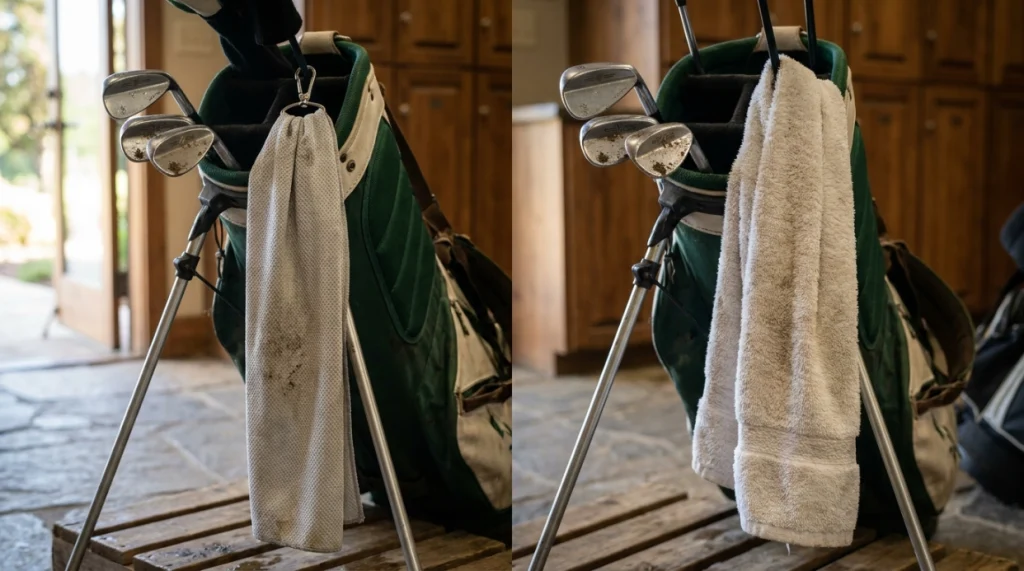
Microfiber is usually the better all-around choice for golfers who prioritize low bulk, quick drying, and efficient cleaning. Cotton still has an advantage for golfers who prefer a softer, more traditional towel feel.
The difference starts with the fibers themselves. Cotton is a natural cellulose fiber, while golf microfiber is normally synthetic.
| Feature | Microfiber Golf Towel | Cotton Golf Towel |
|---|---|---|
| Typical fiber | Polyester/polyamide microfiber | Natural cotton fiber |
| Water handling | Fine spaces help draw and distribute moisture | Cotton fibers and towel loops absorb water |
| Drying tendency | Generally quicker, especially in lightweight designs | Often slower when thick and heavily saturated |
| Feel | Thin, light, sometimes slightly grabby | Soft, plush, traditional towel feel |
| Bag bulk | Usually lower for a similar usable size | Can become bulky in thicker constructions |
| Best fit | Cleaning, wet rounds, walking, quick drying | Softness, traditional feel, general drying |
The American Chemical Society explains how fabric structure affects water absorption, including why cotton towel loops provide many places for water to collect.
That helps explain why cotton remains an excellent towel material. Microfiber simply gives golfers a different combination of cleaning ability, portability, and drying characteristics.
Which one would I carry?
For one-towel simplicity, I lean toward microfiber. It handles the messy jobs well without becoming a heavy piece of wet fabric hanging from the bag.
If I wanted maximum softness, I’d consider cotton instead. Some golfers also carry one of each.
When Are Microfiber Golf Towels Best on the Course?
Microfiber becomes most useful when your equipment repeatedly gets wet or dirty. Damp mornings, rainy rounds, muddy fairways, and bunker-heavy courses are obvious examples.
- Wet conditions: Use a damp area for dirt and reserve a dry section for grips.
- Muddy approaches: Wipe the clubface before dirt dries inside the grooves.
- Walking rounds: Lightweight towels add little bulk to a carry bag.
- Hot weather: Faster drying is useful when you repeatedly wet part of the towel.
- Practice sessions: One towel can handle dozens of routine clubface cleanups.
Clean grooves matter more than having a fancy towel
The towel’s real job is equipment maintenance between shots. You don’t need an expensive fabric to benefit from keeping dirt off a clubface.
I normally wipe a wedge soon after a muddy strike instead of waiting several holes. Fresh dirt is easier to remove than dried material packed into the grooves.
The Rules of Golf also recognize towels as ordinary equipment. Under The R&A’s Rule 4 guidance, a towel may even be wrapped around a grip as an allowed use of equipment.


Are There Any Downsides to Microfiber Golf Towels?
Yes. Microfiber’s strengths don’t make it perfect, and quality varies widely between towels.
The biggest issue for me is feel. Some microfiber fabrics feel slightly clingy against dry hands, especially compared with soft cotton terry.
- Variable quality: Cheap microfiber can be thin, poorly finished, or less effective at picking up moisture.
- Less plush feel: Golfers who love thick cotton may find microfiber less comfortable.
- Lint attraction: Fine fibers can collect lint if washed with lint-producing fabrics.
- Care matters: Excessive heat or unsuitable laundry products may affect some microfiber towels.
- Synthetic construction: Golfers specifically seeking natural fibers may prefer cotton.
Microfiber also holds onto debris
The same fine structure that helps collect dirt can retain small particles. Shake or rinse a heavily soiled towel before aggressively rubbing polished or delicate surfaces.
For golf clubs, I rinse muddy towels regularly rather than letting grit accumulate for several rounds.
What Should You Look for in a Microfiber Golf Towel?
Choose based on construction and convenience, not just the word “microfiber” on the label. Size, texture, attachment style, and washing instructions can matter every round.
Focus on these five features
- Useful size: Pick enough surface area to maintain separate wet and dry sections.
- Textured weave: Waffle-style surfaces are popular because their texture gives dirt somewhere to move during wiping.
- Secure attachment: A carabiner, reinforced loop, or center opening can keep the towel accessible.
- Finished edges: Good stitching helps prevent premature fraying after repeated washing.
- Clear care label: Follow the manufacturer’s temperature and drying instructions.
Does microfiber blend percentage matter?
Many microfiber cleaning towels use polyester and polyamide together. You may see blends such as 80/20, although the exact construction varies by manufacturer.
I wouldn’t choose a golf towel from blend numbers alone. Weave, fiber splitting, density, size, and overall construction can change how two towels feel and perform.
What size should a golf towel be?
There is no universal perfect size. A compact towel works for light cleaning, while a larger towel makes it easier to maintain separate wet and dry zones.
Walking golfers may value lower weight more than cart golfers. The best size is the one you can reach quickly without the towel dragging on the ground.
How Should You Wash a Microfiber Golf Towel?

Start with the manufacturer’s care label because microfiber constructions differ. For routine golf dirt, regular washing with an appropriate detergent is normally enough.
- Shake out loose debris. Remove grass, sand, and dried soil before washing.
- Separate lint-heavy items. Washing microfiber away from fluffy cotton towels can reduce lint pickup.
- Use normal detergent. Follow the towel and detergent instructions rather than overdosing the wash.
- Be cautious with softener. Some microfiber care labels advise against products that may coat the fibers.
- Avoid unnecessary high heat. Use the drying method and temperature recommended by the manufacturer.
- Dry completely before storage. Don’t leave a damp, dirty towel compressed inside your golf bag.
I also rinse a towel during the round if it becomes loaded with mud. That keeps one dirty corner from spreading grit over the rest of the fabric.
Replacing a towel isn’t about age alone. If it stays dirty after washing, loses useful texture, develops damaged stitching, or no longer cleans effectively, replacement makes sense.
Frequently Asked Questions
Are microfiber towels good for cleaning golf clubs?
Yes. Microfiber golf towels are well suited to routine club cleaning because the fine fabric can collect moisture and loose debris from the clubface. For dried mud, dampen part of the towel first, then use a cleaner section to finish wiping.
Is microfiber better than cotton for a golf towel?
Microfiber is often better for golfers prioritizing quick drying, low bulk, and cleaning efficiency. Cotton is a strong alternative when softness and a traditional towel feel matter more. Neither material is automatically best for every golfer or playing condition.
Can microfiber golf towels clean golf balls?
Yes. A damp microfiber towel can remove ordinary soil, grass, and surface moisture from a golf ball. Keep one portion relatively clean so you aren’t transferring gritty material from muddy clubfaces directly onto the ball.
Do microfiber golf towels dry quickly?
Lightweight microfiber towels generally dry quickly because their fine synthetic construction distributes moisture across substantial surface area. Actual drying time still depends on towel thickness, weave, humidity, airflow, temperature, and how saturated the towel becomes.
Should a golf towel be wet or dry?
For most rounds, use both. Dampen one section for loosening dirt from golf balls and clubfaces, while keeping another section dry for final wiping and grip drying. This gives one towel two useful jobs.
Can you put a microfiber golf towel in the washing machine?
Many microfiber golf towels are machine washable, but always check the specific care label. Washing instructions can vary by fabric construction, printing, embroidery, attachment hardware, and manufacturer, so the product label should take priority over generic advice.
How often should you wash a golf towel?
Wash it whenever dirt, odor, or heavy moisture buildup makes continued use unpleasant or ineffective. A towel used on muddy clubs may need washing after one round, while a lightly used dry-weather towel can remain serviceable longer.
So, are microfiber golf towels good? For most golfers, yes.
They combine useful cleaning performance, low bulk, and quick-drying convenience in a simple accessory. That makes microfiber an easy choice for wet rounds, walking bags, practice sessions, and everyday club maintenance.
I’d choose a well-made towel with enough size for separate wet and dry sections. Keep it clean, attach it where you can reach it, and it should earn its place on the bag throughout the season.