
One Plane vs Two Plane Swing: Which Golf Swing Fits You Best?

Quick Answer
In a one-plane swing, the lead arm and shoulder line work on a relatively similar plane near the top of the backswing. In a two-plane swing, the arms typically lift onto a steeper plane than the shoulders. Neither method is automatically better, and the right choice depends on your body, grip, posture, rotation, and natural movement pattern. Jim Hardy’s original one-plane vs two-plane swing framework describes both as legitimate ways to swing a golf club.
Main Differences
- Arm position: One-plane swings keep the lead arm closer to the shoulder plane, while two-plane swings generally place it higher.
- Body rotation: One-plane players often rely heavily on torso rotation to move the club.
- Arm lift: Two-plane players usually allow more independent upward movement of the arms.
- Posture: Your spine angle, flexibility, and setup can influence which pattern feels natural.
- Best choice: Use the pattern that produces repeatable contact and ball flight without forcing positions.
What to Do First
- Record your swing from down the target line before trying to rebuild it around either model.
If you’ve watched enough swing videos, you’ve probably heard golfers argue about one-plane and two-plane swings. The labels sound technical, but the basic difference is easy to see once you know what you’re looking for.
I find these concepts most useful as diagnostic tools, not strict rules. This guide explains both patterns, how they differ, and how to identify the motion that suits your own swing.
In This Guide
What Does One Plane vs Two Plane Swing Mean?
A one-plane or two-plane swing describes how the golfer’s arms relate to the body’s turning motion, especially near the top of the backswing. The terms don’t mean the club literally travels along one or two perfect geometric planes.
That distinction matters. A golf swing is a three-dimensional movement involving rotation, side-to-side motion, bending, and extension.
Modern biomechanical discussion also treats the swing as movement through multiple planes. Golf Digest, for example, discusses three planes of body motion in the golf swing.
- Shoulder plane: The angle created by the shoulders as the torso turns.
- Arm plane: The general orientation of the lead arm near the top.
- Shaft plane: The angle of the clubshaft at different points during the motion.
- Club path: The direction the clubhead travels through impact relative to the target line.
Those ideas are related, but they aren’t interchangeable. A golfer can have a relatively flat backswing and still deliver the club differently on the downswing.
The one-plane and two-plane labels therefore work best as broad swing-pattern descriptions. They help explain how the arms and torso coordinate rather than prescribing one perfect clubshaft angle.
Section Takeaway: One-plane and two-plane describe different ways of coordinating the arms and body. They aren’t rigid geometric rules for the entire swing.
What Is a One-Plane Golf Swing?

A one-plane golf swing generally places the lead arm close to the shoulder plane near the top of the backswing. The arms and rotating torso tend to look more connected.
For a right-handed golfer, imagine viewing the swing from behind the target line. The left arm often appears to run across the chest rather than rising dramatically above the shoulders.
What does a one-plane backswing look like?
The golfer usually turns the chest while the hands travel around the body. The backswing can look flatter than a classic upright motion.
- Deeper hands: The hands often move farther behind the golfer.
- More body turn: Torso rotation plays a major role in creating depth.
- Lead arm position: The lead arm tends to sit near the shoulder line.
- Connected appearance: The arms can look closely synchronized with the chest.
- Less obvious vertical lift: The hands may not appear as high at the top.
Don’t confuse a one-plane pattern with simply dragging the club too far inside. Excessive inside movement can leave the club trapped behind you regardless of the model you’re trying to use.
How does the downswing usually work?
A functional one-plane pattern normally depends on continued rotation through the ball. The chest keeps turning while the arms and club move into the hitting area.
This is why copying only the backswing position can cause problems. A flatter top position needs compatible downswing movements.
One famous example often associated with a single-plane concept is Moe Norman. A PGA feature on Moe Norman’s distinctive swing explains some of the unusual mechanics behind his highly repeatable motion.
His swing shouldn’t become a template for everyone. It does show how effective ball striking can come from a pattern that looks different from conventional instruction.
Section Takeaway: A one-plane swing generally combines a flatter arm position with strong torso rotation. It works best when the backswing and downswing movements match each other.
What Is a Two-Plane Golf Swing?
A two-plane swing generally places the arms on a steeper plane than the shoulders near the top. The golfer’s arms appear to lift more independently while the body turns.
This doesn’t mean the arms disconnect completely. It means their vertical movement is more noticeable than in a typical one-plane pattern.
What does a two-plane backswing look like?
From a down-the-line camera angle, the lead arm can appear above the shoulder line. The hands may also finish higher relative to the golfer’s head.
- More vertical arm action: The arms rise while the torso rotates.
- Higher hands: The top can look more upright.
- Clear plane separation: Arm position differs more from shoulder orientation.
- Less depth required: The hands don’t always travel as far behind the body.
- Transition matters: The golfer must organize the arms and club before impact.
A two-plane player may feel the arms lifting before they work down again during transition. That feeling doesn’t mean the player should chop vertically at the ball.
Does a two-plane swing require perfect timing?
Every golf swing requires sequencing, so it’s misleading to say two-plane swings work only for players with exceptional timing. Plenty of effective golfers use noticeable arm lift without relying on hand manipulation.
The important part is how the pieces match. Body rotation, arm motion, wrist angles, and clubface control still need to arrive at impact in a functional sequence.
I wouldn’t change a golfer merely because the hands look high on video. If contact, start direction, curvature, and strike location are repeatable, the appearance alone isn’t a fault.
Section Takeaway: Two-plane swings use more visible arm lift relative to the shoulder turn. That pattern can be highly effective when transition and rotation remain coordinated.


One Plane vs Two Plane Swing: What Are the Main Differences?
The clearest difference is the relationship between the lead arm and shoulder plane near the top. Other differences usually develop from that basic pattern.
| Swing Feature | One-Plane Pattern | Two-Plane Pattern |
|---|---|---|
| Lead arm at top | Closer to shoulder plane | More noticeably above shoulder plane |
| Hand depth | Often deeper behind the body | Often less deep and more upward |
| Arm movement | More around the torso | More vertical lift |
| Visual appearance | Flatter and more rotational | More upright at the top |
| Common feel | Arms moving with chest rotation | Arms lifting as body turns |
| Primary risk when exaggerated | Getting excessively flat or stuck behind | Becoming excessively steep in transition |
Does one plane mean a flatter golf swing?
Usually, yes, when comparing two golfers with otherwise similar setups. A one-plane player generally shows a flatter lead-arm position relative to the ground.
However, body proportions change the picture. A tall golfer and shorter golfer can use the same general pattern while producing different visual angles.
Is two plane the same as an upright swing?
Not exactly. An upright swing describes the general steepness or vertical appearance of the club and arms.
Two-plane specifically describes a relationship between arm motion and body turn. A swing can look upright without fitting every characteristic of a textbook two-plane model.
What happens during transition?
Transition is where golfers often create trouble by mixing incompatible ideas. A player may copy a deep one-plane backswing but then use a downswing feel designed for a much more upright pattern.
- Too flat: The club can become trapped too far behind the body.
- Too steep: The shaft can move excessively toward the ball early in transition.
- Too much manipulation: The golfer may depend on late hand action to square the face.
- Poor sequence: Arms and torso can compete instead of working together.
The lesson is simple. Match the components instead of collecting isolated swing tips.
Section Takeaway: The biggest difference is arm-to-shoulder orientation, but that difference influences hand depth, rotation, transition, and the overall look of the swing.
Which Swing Plane Is Better for You?
Neither swing plane is universally better. Your best pattern is the one your body can repeat while producing functional impact and predictable ball flight.
As of 2026, I wouldn’t recommend choosing a swing model because a favorite professional uses it. Tour players succeed with many different backswing shapes and movement patterns.
Your body structure matters
Arm length, torso length, hip mobility, shoulder mobility, and posture can influence how your backswing naturally develops. Trying to copy another golfer’s top position can work against those differences.
Golf Digest makes a similar point when discussing how golfers should match the backswing to body characteristics and grip rather than pursue one universal position.
- Mobility: Limited rotation may change how much arm lift feels comfortable.
- Posture: More or less forward bend affects the visual plane of the swing.
- Arm length: Longer or shorter arms can change hand height and depth.
- Grip: Grip orientation influences wrist conditions and clubface control.
- Existing pattern: A repeatable natural motion may need refinement rather than replacement.
Your ball flight matters more than appearance
Video is helpful, but the golf ball gives you important feedback. Watch start direction, curve, trajectory, strike location, and consistency.
A swing that looks unconventional can still produce excellent impact. A beautiful-looking swing can also send balls into both trees.
Should beginners choose one plane or two plane?
Most beginners don’t need to choose either model immediately. Building a comfortable grip, athletic setup, balanced turn, and repeatable contact matters more.
Once a pattern develops, the labels can help diagnose why certain swing changes work or fail. That’s more useful than forcing a beginner into a predetermined top position.
Section Takeaway: Choose your swing pattern around repeatability, comfort, and ball flight. Don’t choose it because one model looks more technically impressive.
How Do You Identify and Practice Your Swing Plane?
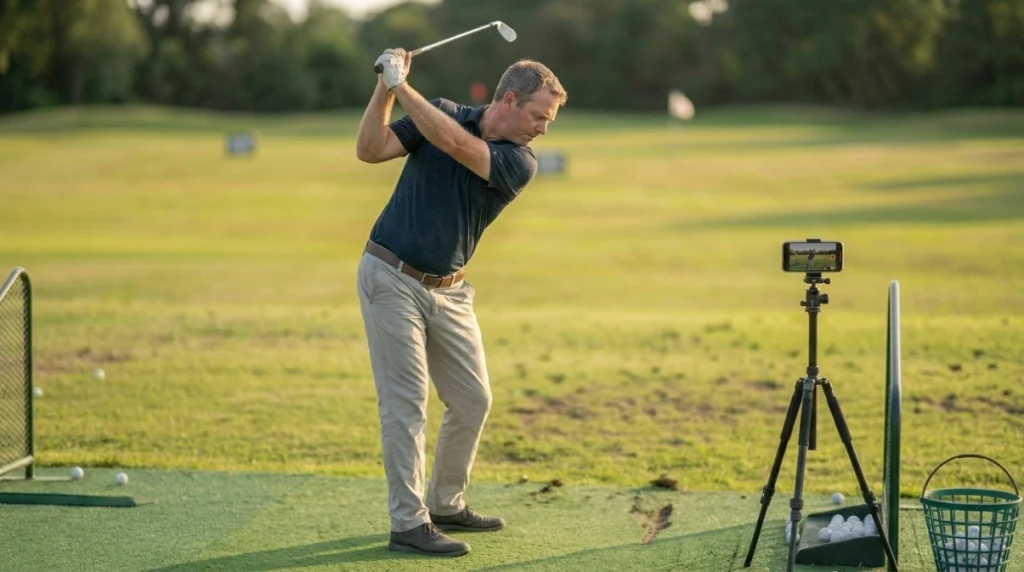
The easiest starting point is a down-the-line video. Record a normal swing rather than trying to demonstrate what you think your swing should look like.
Step 1: Record from the correct angle
Place the camera behind your hands at roughly hand height. Aim it parallel to the target line rather than directly behind the golf ball.
A poor camera angle can make the same swing appear flatter or steeper. Consistency matters when comparing recordings.
- Choose a mid-iron: A 7-iron is easier to evaluate than an extreme club.
- Use normal posture: Don’t pose differently because the camera is running.
- Hit several shots: One swing may not represent your normal pattern.
- Review the top: Compare the lead arm with the shoulder line.
Step 2: Look at the lead arm and shoulders
Pause the video near the completion of the backswing. You don’t need complicated drawing software for an initial check.
- Similar orientation: Your pattern leans toward one plane.
- Lead arm noticeably higher: Your pattern leans toward two plane.
- Position changes every swing: Consistency may be the bigger issue than classification.
Don’t obsess over matching two lines perfectly. Real swings are dynamic, and small differences don’t automatically require correction.
Step 3: Check what happens after the top
A backswing label means little if you ignore transition. Watch whether the club shallows, steepens, stays behind you, or moves toward the ball.
Also look at your chest and lower body. The arms shouldn’t be evaluated in isolation from the motion producing them.
Step 4: Experiment with simple feels
If you’re testing which pattern feels more natural, use half-speed swings first. Avoid making a full-speed overhaul on the course.
- One-plane feel: Let the chest turn while the arms feel more around you.
- Two-plane feel: Let the arms gain some height while maintaining your body turn.
- Contact check: Notice strike location before worrying about appearance.
- Ball-flight check: Compare start line and curve across several shots.
I like making these experiments with a short or mid-iron because poor contact becomes obvious quickly. The goal isn’t to declare a winner after three swings.
Instead, look for the motion that needs fewer compensations. A good pattern usually feels easier to repeat once you stop forcing positions.
Section Takeaway: Film your natural swing first, then evaluate the arm-to-shoulder relationship and transition together. Use the labels to understand your motion rather than force a textbook pose.
Frequently Asked Questions
Is a one-plane swing better than a two-plane swing?
No. Both patterns can produce excellent golf shots when their backswing, transition, rotation, and clubface movements work together.
The better swing is the one that fits your movement and gives you predictable contact without unnecessary compensations.
Who should use a one-plane golf swing?
A golfer who naturally turns well and prefers moving the arms more around the torso may feel comfortable with a one-plane pattern. However, physical structure and mobility differ, so the decision shouldn’t be based on one characteristic alone.
Who should use a two-plane golf swing?
Golfers who naturally create more arm lift during the backswing may fit a two-plane pattern. High hands aren’t automatically a problem if the golfer transitions efficiently and produces consistent impact.
Do professional golfers use one-plane swings?
Professional golfers display many different swing shapes, including relatively flat and highly rotational patterns. The important lesson isn’t to copy one player’s position, but to understand how that player’s movements work together as a complete system.
Can I change from a two-plane swing to a one-plane swing?
Yes, but a successful change involves more than lowering your hands at the top. Your takeaway, body rotation, arm depth, transition, and release may all need compatible adjustments.
Can swing plane cause a slice?
Swing plane can contribute to the movement pattern behind a slice, but it isn’t the complete cause. Ball curvature depends heavily on the relationship between clubface direction and club path at impact, so changing plane alone may not fix the shot.
The bottom line: One plane vs two plane swing isn’t a contest with one correct winner. They’re two broad ways golfers can organize the relationship between their arms and body.
Start with the swing you already own. Identify its pattern, watch your ball flight, and make changes only when they solve a real problem.
If your current motion produces solid contact, predictable curvature, good balance, and no pain, don’t rebuild it simply because another swing looks better on video. Golf rewards repeatable impact far more than textbook appearance.