
How the Golf Swing Works: A Complete Step-by-Step Guide

Quick Answer
The golf swing works by moving the club through a coordinated chain of setup, backswing, transition, downswing, impact, and follow-through. Your body creates and transfers motion while your arms and hands deliver the club to the ball. Good sequencing matters more than simply trying to swing harder, which is why working with a qualified PGA coach can help when your own swing feels difficult to diagnose.
How the swing works in six steps
- Set up: Build a balanced stance, functional grip, correct posture, and suitable ball position.
- Move back: Turn your body while the arms and club move together into the backswing.
- Change direction: Begin transferring pressure toward the target as the backswing finishes.
- Swing down: Let the lower body, torso, arms, and club accelerate in a coordinated sequence.
- Deliver the club: Control the clubface, swing path, and low point through the hitting area.
- Finish balanced: Continue rotating until your body faces the target and your weight is supported mainly by the lead side.
The key idea
- Think sequence, not positions: A useful swing connects each phase smoothly instead of forcing isolated body parts into perfect-looking positions.
If you’ve ever watched a good golfer swing in slow motion, the movement can look complicated. When I simplify my own swing, however, I think of it as one connected motion with a few important jobs.
This guide explains how the golf swing works from address through the finish. I’ll also show why irons and drivers need different impact conditions and where common swing faults usually begin.
In This Guide
What Actually Happens During a Golf Swing?
A golf swing is a coordinated movement that sends the club around your body and into the ball. The body, arms, hands, and club all contribute, but they don’t move at maximum speed at the same moment.
Biomechanics research describes the full swing as a sequence of linked rotational movements. The exact motion varies between golfers, which is one reason copying another player’s positions rarely solves every problem.
The golf swing has six practical phases
I find it easier to understand the motion when I divide it by each phase’s job. These phases blend together during a real swing.
- Address: Establish grip, alignment, stance, posture, and ball position.
- Backswing: Move the club away while creating turn, width, and a stable base.
- Transition: Reverse direction without throwing the club immediately from the top.
- Downswing: Build speed while moving the club toward a useful delivery position.
- Impact: Match clubface, path, low point, and strike location to the intended shot.
- Follow-through: Allow the body’s rotation and the club’s momentum to continue into a balanced finish.
| Swing phase | Main job | Common amateur fault | Simple checkpoint |
|---|---|---|---|
| Setup | Create balance and geometry | Poor alignment or posture | Feel athletic, not rigid |
| Backswing | Turn and organize the club | Swaying instead of turning | Keep pressure inside the trail foot |
| Transition | Change direction smoothly | Pulling hard with the hands | Let pressure begin moving forward |
| Downswing | Transfer and release speed | Upper body outraces lower body | Body leads while arms respond |
| Impact | Deliver the club to the ball | Low point occurs too early | Match strike to the club being used |
| Finish | Complete rotation and decelerate | Falling away from the target | Hold a balanced finish |
Why sequencing matters more than brute force
Your strongest swing isn’t necessarily your fastest-looking swing. Efficient movement lets one part of the system pass energy to the next.
A systematic review of golf swing biomechanics describes the importance of coordinated pelvis and torso movement in full-swing kinematics. The research also shows why there isn’t one identical motion every golfer must copy.
When I strike the ball well, I rarely feel as if I’m forcing the club. The swing feels organized first and fast second.
What actually controls the golf ball?
The ball responds to what the club is doing at impact. Your body movements matter because they influence those impact conditions.
- Clubface orientation: Strongly influences the ball’s starting direction.
- Swing path: Helps determine curvature when combined with the face angle.
- Strike location: Affects speed, feel, launch, and consistency.
- Low point: Determines where the club reaches the bottom of its arc.
- Clubhead speed: Contributes to potential ball speed and distance.
- Dynamic loft: The effective loft presented by the club at impact.
This is an important distinction. You aren’t trying to manufacture a beautiful swing for its own sake.
You’re building movement that repeatedly delivers the club well enough to produce the shot you want.
Section Takeaway: The golf swing works as a linked motion whose real purpose is controlling the club at impact. Better sequencing usually gives you more useful speed and consistency than simply adding effort.
How Does Your Setup Control the Golf Swing?

Your setup doesn’t hit the ball, but it strongly influences what happens next. Many swing problems become easier when grip, posture, alignment, and ball position improve first.
Start with a functional grip
The grip connects your body to the club. It needs enough pressure to control the club without creating unnecessary tension through your forearms and shoulders.
A neutral grip is a useful starting point for many golfers. Both hands should feel like they can work together rather than fighting each other.
- Lead hand: Sits higher on the handle and helps support the club.
- Trail hand: Fits below the lead hand without dominating the motion.
- Pressure: Secure enough to maintain control but not a maximum squeeze.
- Connection: Overlap, interlock, and ten-finger styles can all work when the hands function together.
A grip that’s dramatically strong or weak can change how the clubface behaves. That may force compensations later in the swing.
Build posture from the hips
Good golf posture looks athletic rather than crouched. Bend forward from the hips, allow modest knee flex, and let your arms hang naturally.
PGA coaching guidance on maintaining useful spine posture emphasizes staying organized from setup through impact. You don’t need to freeze your spine angle, but you do need enough structure to create room for the club.
When golfers stand too close, their arms often have little space to move. Standing too far away can create reaching and balance problems.
Alignment sets the direction of the motion
Your body doesn’t need to point directly at the target. For a basic square setup, the clubface points toward the target while the feet, knees, hips, and shoulders sit roughly parallel to that target line.
Alignment mistakes can fool you into changing a perfectly serviceable swing. A golfer aimed well right, for example, may subconsciously pull the club left just to send the ball toward the target.
Ball position changes the strike
Ball position should change as club length and shot requirements change. Moving the ball changes where contact occurs relative to the swing arc.
- Short irons: Usually played around the middle portion of the stance.
- Mid-irons: Often move slightly forward from center.
- Long clubs: Generally sit farther forward as shaft length increases.
- Driver: Commonly sits near the lead heel because the ball is teed up and contacted later in the arc.
These are starting points, not laws. Body proportions, swing pattern, shot shape, and intended trajectory can justify adjustments.
Balance gives the swing somewhere to go
At address, I like to feel pressure through the middle of my feet rather than sitting heavily on my heels or toes. That sensation gives me room to turn without feeling as if I’m catching my balance during the swing.
Your stance can widen with longer clubs because the motion becomes faster and the swing arc grows. Short shots usually need less width and less body motion.
Pro tip: If changing grip, posture, or ball position causes pain or makes your motion feel restricted, have a certified PGA Professional or qualified golf instructor check your setup in person.
Section Takeaway: Setup creates the conditions for the swing. A functional grip, athletic posture, predictable alignment, suitable ball position, and stable balance reduce the number of compensations you need later.
How Does the Backswing Work?
The backswing moves the club away from the ball while your body turns and organizes itself for the change of direction. Its job isn’t to create the longest possible motion.
A useful backswing creates enough turn, width, and structure to let the downswing happen without a rescue move.
The takeaway starts the chain
During the first part of the swing, the chest, arms, hands, and club begin moving together. You don’t need to lock them into one rigid unit.
What you want to avoid is an immediate independent hand action that whips the club dramatically inside or outside. Early extremes often demand a correction later.
- Clubhead: Begins moving away from the ball without being snatched back.
- Chest: Starts turning away from the target.
- Arms: Stay connected to the body’s motion without being pinned against it.
- Pressure: Begins moving toward the trail side while you remain balanced.
Turn rather than sway
A backswing includes movement, so trying to keep every body part perfectly centered can make you stiff. The key is avoiding an uncontrolled slide that moves your entire upper body far away from the target.
I think of pressure moving into my trail foot while my torso turns. That feels much more stable than pushing my trail hip sideways.
What does “width” mean in a golf swing?
Swing width describes how much space exists between your hands or club and your body during parts of the motion. Useful width can create room and a larger swing arc without requiring you to lock the lead arm.
Width should come from coordinated turning and arm movement. Simply reaching the hands away can produce a sway instead of a turn.
What should happen at the top?
The top of the backswing is a change-of-direction area, not a pose you need to hold. Your shoulders have turned, your hips have turned to a lesser or different degree, and the club has reached the end of its backswing travel.
Your flexibility and club choice affect how long the backswing becomes. A golfer with a shorter backswing can still create plenty of speed.
- Stay balanced: Don’t let pressure roll onto the outside edge of the trail foot.
- Keep turning: Avoid lifting the arms without enough torso rotation.
- Respect mobility: Don’t force your shoulders or spine beyond a comfortable range.
- Prepare to change direction: The lower body can begin reorganizing before the club appears completely finished going back.
One of my favorite checkpoints is surprisingly simple. If I can pause at the top without feeling as though I’m about to fall, the backswing usually has enough balance to support the downswing.
Pro tip: A longer backswing isn’t automatically better. If you feel joint strain, pain, or an extreme stretch, ask a certified instructor to help you build a motion that matches your mobility.
Section Takeaway: The backswing should organize the club and body, not chase maximum length. Turn with balance, create usable width, and arrive at transition without needing a major correction.


How Do Transition and the Downswing Create Speed?
Transition is where the swing changes from moving away from the target to moving toward it. A well-timed transition lets the body and club accelerate in sequence rather than all at once.
The downswing doesn’t start with a violent hand pull
Many golfers reach the top and immediately yank the handle toward the ball. That can make the shoulders and arms outrun the rest of the motion.
Instead, pressure begins moving toward the lead side while the body changes direction. The torso, arms, and club then respond as the downswing develops.
This doesn’t mean you should freeze your arms. Golf is too fast for that kind of conscious separation.
The useful concept is simply that the whole system shouldn’t fire at maximum effort simultaneously.
What is the kinematic sequence?
Kinematic sequence is the order and timing in which body segments and the club accelerate and decelerate. In golf research, pelvis, torso, arms, and club are commonly studied as connected parts of that sequence.
Good players aren’t identical. Still, coordinated transfer through those segments helps explain how a golfer can create high clubhead speed without looking as though every muscle is straining.
- Pressure shifts: The golfer begins using the ground and moving pressure toward the lead side.
- Pelvis responds: The lower body begins opening toward the target.
- Torso follows: The upper body accelerates while remaining coordinated with the pelvis.
- Arms deliver: The arms move down and around as space opens.
- Club accelerates: The clubhead reaches its highest useful speed near the hitting area rather than at the top.
Why golfers “come over the top”
An over-the-top pattern happens when the club approaches the ball excessively from outside the intended delivery path. It often pairs with an open clubface and leftward path for a right-handed golfer.
The result can be a pull, pull-slice, weak fade, or steep strike. The visible downswing isn’t always the original cause.
A poor grip, open clubface, narrow backswing, loss of posture, or rushed transition can all contribute. Fixing only the downswing shape may therefore miss the real problem.
Where does golf swing speed come from?
Clubhead speed comes from coordinated force, rotation, arm movement, and the club’s own angular motion. Ground interaction also plays an important role in producing and transferring force.
Trying harder isn’t the same as moving faster. Excess tension can disrupt timing and prevent the club from accelerating freely.
I’ve seen this in my own range sessions. When I try to “hit” a driver from the top, my effort rises while strike quality often falls.
A smoother transition usually makes the club feel faster near the bottom. That’s where the speed becomes useful.
Section Takeaway: Transition organizes the direction change, while the downswing transfers speed toward the club. Pressure, rotation, arms, and club must cooperate; pulling harder from the top usually isn’t the shortcut golfers hope it is.
What Happens at Impact and Through the Finish?
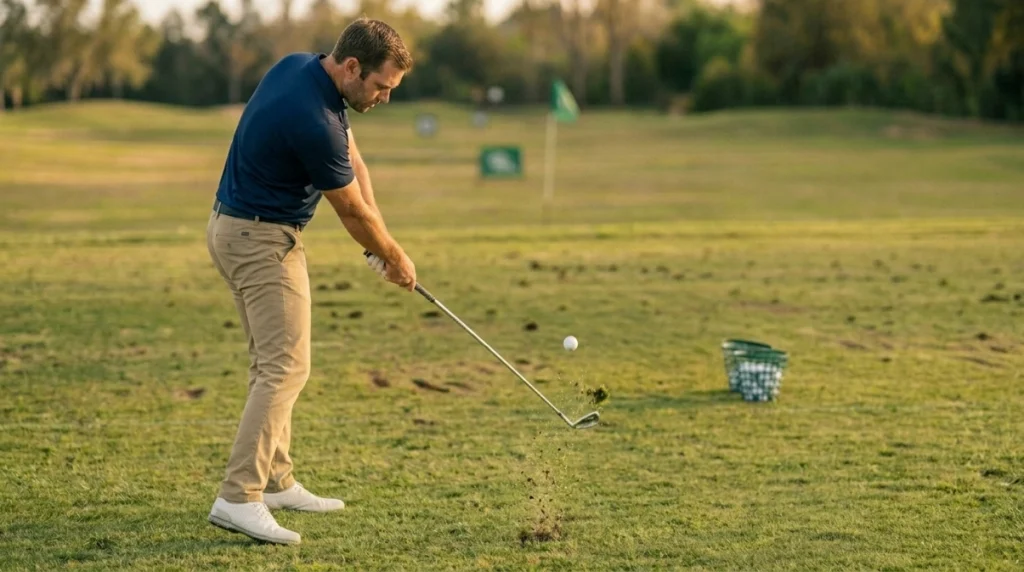
Impact is the brief moment when the clubhead meets the ball. The swing before impact exists largely to create useful conditions during this tiny window.
You shouldn’t try to freeze in an “impact position.” The club is traveling quickly, and impact is part of a continuous motion.
Iron contact and driver contact are different
With an iron played from the ground, you generally want the club to contact the ball before reaching the bottom of its arc. The turf interaction then occurs after the ball.
PGA instruction on iron contact and low-point control reinforces the ball-first, ground-second concept. This is why trying to scoop an iron upward can create thin and heavy strikes.
The driver changes the geometry because the ball is elevated on a tee. A typical driver setup moves the ball forward and allows the club to meet it later in the swing arc.
| Impact factor | Typical iron | Driver from a tee |
|---|---|---|
| Ball position | Center to forward of center, depending on club | Typically near the lead heel |
| Ball height | Resting on the turf | Elevated on a tee |
| Low point | Normally after ball contact | Can occur before the club reaches the teed ball |
| Useful feel | Ball first, turf second | Sweep or strike upward through the teed ball |
PGA coaching guidance for driver setup and swing-arc control specifically discusses moving the bottom of the arc behind the ball. That differs from the ball-first, ground-second strike wanted with a normal iron shot.
The clubface and path work together
At impact, the relationship between clubface direction and swing path strongly influences starting direction and curvature. That’s why “swing straight at the target” isn’t a complete explanation of ball flight.
A clubface open relative to the path tends to produce fade or slice curvature for a right-handed golfer. A face closed relative to the path tends to produce draw or hook curvature.
Strike location matters too. Driver contact away from the center of the face can alter both ball speed and curvature behavior.
Why the follow-through matters
The ball is already gone during most of the follow-through, so the finish doesn’t physically change that shot. It still tells you a great deal about what happened earlier.
A balanced finish often indicates that speed, pressure, and rotation remained manageable. Falling backward can reveal poor pressure movement or a swing that was too aggressive for your balance.
- Chest: Continues turning toward the target.
- Trail heel: Can release as the body rotates.
- Lead side: Supports most of your pressure by the finish.
- Club: Continues around the body as momentum dissipates.
- Balance: Should be stable enough to hold the finish briefly.
I often use the finish as a quick self-test. If I can’t hold it for two seconds, I was probably swinging harder than my motion could support.
Section Takeaway: Impact requirements depend on the club. Irons normally need ball-first contact with the low point beyond the ball, while a teed driver is designed for contact later in the arc.
How Do You Make the Golf Swing More Repeatable?
A repeatable swing isn’t one that looks identical on every video frame. It’s one that produces predictable contact, direction, and balance often enough to play useful golf.
For most golfers, consistency improves faster when practice focuses on a few controllable fundamentals instead of ten swing thoughts.
Start with tempo instead of maximum speed
Tempo describes the timing relationship between parts of the swing. It isn’t the same thing as clubhead speed.
PGA guidance on swing rhythm and tempo discusses a commonly used 3-to-1 backswing-to-downswing timing concept. You don’t have to obsess over an exact stopwatch measurement to benefit from a consistent rhythm.
A simple verbal count works well. Try “one-two-three” going back and “go” through the ball.
Use half-swings to improve contact
Full-speed drivers can hide the cause of a problem because too many things happen quickly. A waist-high to waist-high swing slows the task enough to feel contact and balance.
- Use a wedge or short iron. Start with a club you can control comfortably.
- Make a small backswing. Let your chest turn while your arms remain relaxed.
- Shift pressure forward. Avoid hanging completely on the trail foot.
- Strike ball then turf. Place your attention on the ground just beyond the ball.
- Finish in balance. Hold the finish before repeating the shot.
Once contact becomes predictable, lengthen the motion gradually. Keep the same rhythm as the swing gets bigger.
Use a line drill for low point
Draw a straight line on the turf of a practice area where permitted, or use a visual reference on a mat. Make swings that brush the ground on the target side of the line.
Then place the ball just behind the line and keep the same intention. This gives immediate feedback without requiring a launch monitor.
Use your phone carefully
Video can reveal alignment, balance, posture loss, and obvious path changes. It can also create problems when you chase cosmetic positions that don’t relate to your ball flight.
Record from a consistent angle. Compare the motion to your own successful swings before comparing yourself with a tour professional.
Diagnose the miss before changing the swing
The ball gives you information. Start with contact, start direction, curvature, and turf interaction before deciding what to change.
- Heavy shots: The swing’s low point may be occurring too early.
- Thin shots: You may be raising the arc or failing to reach the ground consistently.
- Pulls: Check alignment, clubface, and path before rebuilding the whole swing.
- Slices: Examine both face direction and swing path instead of blaming path alone.
- Hooks: Check whether the face is closing too much relative to the path.
- Wild contact: Reduce swing length and speed until balance returns.
Practice one priority at a time
I get worse quickly when I take four technical thoughts onto the range. My best practice sessions usually have one movement goal and one ball-flight goal.
For example, I might work only on finishing in balance while trying to start ten 7-irons through a defined target window. That produces feedback I can understand.
A useful practice structure is simple:
- Warm up: Make short, relaxed swings without chasing distance.
- Train one skill: Work on contact, balance, path, or another single priority.
- Add variability: Change targets or clubs so the skill survives different situations.
- Finish with golf shots: Imagine holes and switch clubs instead of beating the same ball repeatedly.
Pro tip: If the same miss survives several focused sessions, a lesson can save weeks of guessing. A certified instructor can identify whether the visible fault is the cause or merely a compensation.
Section Takeaway: Repeatability grows from good feedback. Control tempo, train contact with shorter swings, diagnose the actual miss, and change one priority at a time.
Frequently Asked Questions
What is the most important part of the golf swing?
Impact is the moment that determines what the club does to the ball, but impact depends on everything that happened beforehand. For most golfers, improving setup, balance, strike location, and low-point control produces more practical benefit than trying to copy one perfect position.
What starts the golf downswing?
The downswing begins as the golfer changes direction and pressure starts moving toward the lead side. The pelvis, torso, arms, and club then accelerate in a coordinated sequence rather than every part being pulled toward the ball at once.
Should your arms or body control the golf swing?
Both contribute. The body provides movement, rotation, support, and force, while the arms and hands help deliver the club. Trying to remove either one completely usually creates an unnatural motion rather than a more efficient swing.
Should you keep your head completely still?
No. Your head can move naturally as your body turns and shifts pressure. The useful goal is avoiding excessive movement that makes your swing bottom inconsistent, not forcing your head to remain frozen in exactly the same spot.
Why do I hit the ground before the golf ball?
Your swing’s low point is probably occurring behind the ball. Common contributors include hanging back on the trail side, losing posture, poor ball position, or changing the swing radius. Short iron swings and low-point drills can help identify the cause.
Why is the driver swing different from the iron swing?
An iron ball normally rests on the ground, so you want to strike the ball before the club reaches its lowest point. A driver ball is elevated on a tee and positioned farther forward, allowing contact later in the arc and often with an upward strike.
How long does it take to learn a consistent golf swing?
There is no universal timeline because coordination, practice quality, mobility, instruction, and previous athletic experience differ. Focus first on improving contact and predictable ball flight instead of waiting for a swing that feels permanently “finished.”
The big takeaway: The golf swing works best when you treat it as a connected sequence rather than a collection of frozen positions. Build a sound setup, turn with balance, change direction smoothly, control your low point, and let the club accelerate through the hitting area.
Start your next practice session at half speed with a mid-iron. If you can repeatedly strike the ball, finish balanced, and predict where the shot starts, you already understand the most useful part of how the golf swing works.