
Should You Take Golf Lessons? A Practical Guide for Beginners
Quick Answer
Yes, most beginners should take at least a few golf lessons. A qualified instructor can correct grip, setup, alignment, contact, and swing problems before they become habits. You can find individual lessons and beginner programs through the PGA of America coach directory.
Lessons are especially useful when:
- You are new: Good instruction gives you a reliable starting point.
- Contact is inconsistent: A coach can identify setup or swing problems quickly.
- One miss repeats: Constant slices, hooks, tops, or fat shots deserve diagnosis.
- You feel stuck: Feedback can reveal problems you cannot see yourself.
- Movement hurts: Stop forcing the swing and get qualified guidance.
When self-practice may be enough:
- You are only trying golf casually and want to learn whether you enjoy it first.
- You already have sound fundamentals and are practicing a specific skill between lessons.
If you are wondering, “Should you take lessons?” golf is one activity where early feedback can save plenty of frustration. The swing feels different from what it looks like, which makes self-diagnosis difficult.
I prefer a simple approach. Use lessons to understand what needs changing, then spend most of your time practicing that change rather than collecting more swing tips.
In This Guide
Are Golf Lessons Worth It for Beginners?
Golf lessons are worth considering because they give you something solo practice cannot provide: informed feedback. A coach watches the ball, clubface, setup, and movement together.
That matters because the result of a golf shot does not always reveal the true problem. A slice, for example, can develop from several different combinations of clubface and swing path.
Lessons Can Stop Bad Habits Early
Beginners often judge a swing by whether the ball went forward. That is understandable, but a temporary good result can still come from an inefficient movement.
A coach can help establish fundamentals such as:
- Grip pressure and hand position
- Posture and balance
- Alignment
- Ball position
- Clubface awareness
- Basic swing direction
- Centered contact
Those basics affect almost every club. Fixing them early is usually easier than rebuilding them after months of repetition.
Lessons Do Not Replace Practice
A lesson can identify a problem, but the instructor cannot build the new habit for you. Repetition between sessions matters.
I think of instruction as a map. The coach helps identify the correct road, while your practice time covers the distance.
That is why taking lesson after lesson without practicing can provide poor value. You need enough time between sessions to test and understand each change.
Pro tip: If a swing change causes sharp pain or worsening physical discomfort, stop and consult an appropriate qualified professional before continuing.
Who Should Take Golf Lessons?
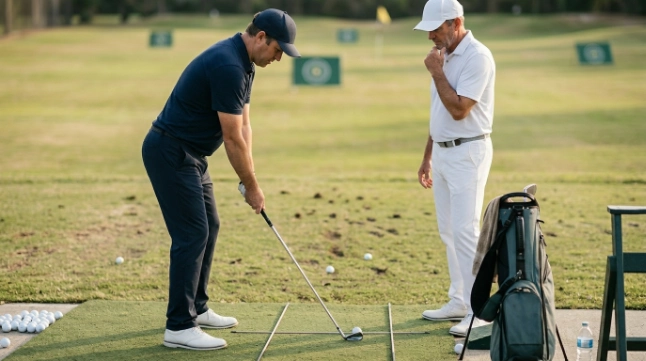
You do not need to be a serious competitive golfer to benefit from instruction. Lessons can help complete beginners, recreational players, and experienced golfers with one persistent problem.
Complete Beginners
An early lesson can be especially useful if you have never held a golf club. You can learn safe movement without guessing through dozens of conflicting videos.
A beginner session should usually concentrate on a few fundamentals rather than a complicated swing theory.
- How to hold the club
- How to stand to the ball
- How to aim
- How to make a controlled swing
- How to practice safely
Golfers With a Repeating Miss
Consider instruction when nearly every poor shot follows the same pattern. Repeated slices, hooks, topped shots, and heavy contact often have identifiable causes.
Video can help you see the movement. A good instructor can then explain which part matters and which visible quirks can safely be ignored.
Golfers Who Have Stopped Improving
A plateau is another good reason to take a lesson. You may be practicing regularly but reinforcing the same movement every session.
Outside feedback can give your practice a clearer purpose. One useful priority is better than six new swing thoughts.
Players Returning After a Long Break
You may also benefit from coaching after several years away from golf. Your mobility, strength, equipment, or goals may have changed.
The R&A’s Playing Golf resources emphasize how adaptable the game can be for different ages, backgrounds, and abilities. Your swing does not need to look like a tour player’s swing to be functional.
Golf Lessons vs. Self-Teaching: Which Is Better?
Neither method needs to stand alone. For many recreational golfers, the best approach combines professional feedback with independent practice.
Lessons provide diagnosis. Self-practice provides repetition.
| Learning Method | Feedback | Personalization | Relative Cost | Best Use |
|---|---|---|---|---|
| Private lesson | Immediate | High | Higher | Specific swing problems and individual goals |
| Group clinic | Regular but shared | Moderate | Moderate | Beginners learning basic skills socially |
| Self-teaching | Limited | Self-directed | Lowest | Practice and experimentation between lessons |
When Self-Teaching Works Well
Self-teaching can work when you already understand the basics. It is especially useful for putting, chipping, distance control, and repeating drills assigned by a coach.
Recording your swing can also provide helpful feedback. Use both down-the-line and face-on views when possible, and keep the camera position consistent.
Where Online Golf Tips Can Go Wrong
The biggest problem with random swing advice is not that every tip is bad. The problem is that the tip may solve a problem you do not have.
A golfer with an open clubface needs different priorities from someone whose face is already closed. Copying the same drill could help one player and hurt the other.
Try to avoid changing grip, backswing, downswing, posture, and release at the same time. You will struggle to discover which adjustment changed the ball flight.
Section Takeaway: Use coaching for diagnosis and direction. Use independent practice to turn that direction into a repeatable skill.


What Happens During a Golf Lesson?
A good golf lesson normally begins with questions rather than immediate swing changes. Your coach needs to understand your goals and normal misses first.
You may discuss:
- Your playing experience
- Typical scores or current skill level
- Your most frustrating shots
- Previous instruction
- Practice frequency
- Physical limitations
- Your short-term goals
The Coach Will Observe Your Ball Flight
Your shots provide useful clues. Starting direction, curve, launch, strike location, and turf contact can all help identify priorities.
Many instructors also use video or launch-monitor data. Technology can help, but the explanation should still make sense to you.
You Should Leave With a Clear Practice Plan
A productive lesson should not leave you with ten technical commands. You should understand the main change and know how to practice it.
Before finishing, ask:
- What is my main priority?
- Which drill should I practice?
- How will I know I am doing it correctly?
- What ball-flight change should I expect?
- What should I avoid changing?
Instruction does not need to focus only on the swing. Beginners should also learn common rules and course situations.
The USGA Rules 101 course is a free resource designed for golfers who are new to the Rules.
How Many Golf Lessons Should You Take?
There is no universal number of golf lessons. Your goals, practice time, starting ability, and learning style matter more than hitting a fixed total.
For a beginner, a short series is often more useful than one isolated lesson followed by months of guessing.
A Practical Beginner Progression
- Lesson one: Learn grip, setup, alignment, contact, and a simple swing concept.
- Practice: Repeat the assigned drill during several focused sessions.
- Lesson two: Review progress and correct the biggest remaining issue.
- Practice: Work on contact and basic ball-flight control.
- Later lesson: Add longer clubs, short-game skills, or course strategy as needed.
Spacing matters. Taking several lessons rapidly can overload you before the earlier changes have settled.
How Often Should You Practice Between Lessons?
Quality matters more than simply hitting a large bucket. Short practice sessions with one clear goal can be productive.
A focused session might include:
- Five minutes of setup rehearsals
- Several slow practice swings
- Short shots at reduced speed
- Normal swings using the same cue
- A few shots to different targets
Stop when fatigue destroys the movement you are trying to learn. Hitting another 60 poor shots rarely improves the session.
Pro tip: For hands-on swing changes, work with a qualified instructor who can adapt the motion to your mobility rather than forcing your body into a position.
How Do You Choose the Right Golf Instructor?
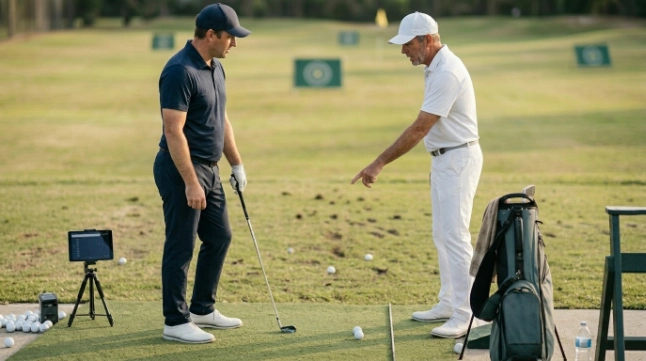
The best golf coach is not automatically the most famous instructor nearby. You need someone who can understand your goal and explain changes in language you understand.
Look for Clear Communication
A coach should be able to explain why a change matters. Technical language is fine when it is translated into something useful.
If every explanation leaves you more confused, the teaching style may not fit you.
Choose Coaching That Matches Your Goals
A complete beginner has different needs from a single-digit handicap golfer. Tell the coach what you are trying to accomplish before the session.
Your goal could be:
- Learning the game safely
- Making more consistent contact
- Stopping a slice
- Improving wedges
- Putting better
- Preparing for your first round
- Lowering your handicap
Do Not Judge a Coach by Technology Alone
Launch monitors, pressure plates, and high-speed cameras can provide valuable information. They are tools, not substitutes for good teaching.
A useful instructor knows which information matters to your problem. You should not need to understand every number on a screen.
Ask What to Practice Afterward
I would rather leave a lesson with one drill I understand than five drills I cannot remember. Simplicity makes independent practice much easier.
The PGA of America’s coaching resources can also help you understand common golf concepts between sessions without changing everything at once.
Section Takeaway: Choose an instructor who simplifies your biggest problem, explains cause and effect clearly, and gives you a practice plan you can repeat alone.
Frequently Asked Questions
Should a complete beginner take golf lessons?
Yes, a complete beginner can benefit from taking lessons early. A coach can introduce grip, posture, alignment, safety, and basic contact before inefficient habits develop. You do not need to become technically perfect before practicing independently or visiting a beginner-friendly course.
Can you learn golf without lessons?
Yes, golfers can learn without formal instruction. Books, videos, practice, and playing experience can all help. However, self-teaching makes diagnosing your own swing harder. Even one professional assessment may clarify which problem deserves your attention and which movements do not need fixing.
Are group golf lessons good for beginners?
Group clinics can be a good introduction because they combine instruction with a lower-pressure social setting. They are particularly useful for grip, setup, putting, chipping, safety, and basic etiquette. Private lessons provide more individual attention when you have a specific swing problem.
Should I take golf lessons before buying clubs?
You can take your first lessons using borrowed, rented, or basic clubs. Early instruction may even help you understand what equipment feels comfortable. Avoid assuming expensive clubs will correct swing problems before you understand your technique and long-term playing goals.
Should I practice before my first golf lesson?
You do not need to practice first. In some cases, starting with a coach can prevent you from developing unnecessary habits. If you have already practiced, simply swing normally during the lesson rather than trying to create a perfect motion for the instructor.
Can older adults benefit from golf lessons?
Yes. Good instruction can adapt the golf swing around mobility, balance, strength, and personal goals. Older beginners do not need to copy the long swings of professional golfers. A shorter, comfortable motion that produces controlled contact can be a much better target.
When should I stop taking golf lessons?
You do not need continuous lessons forever. Reduce the frequency when you understand your swing priorities and can practice effectively alone. Return for feedback when a recurring problem appears, your progress stalls, or you want structured help with another part of your game.
So, should you take lessons? For most new golfers, the answer is yes—but use coaching strategically.
Find a coach who gives you a simple priority. Practice that priority until it becomes familiar, then return when you need new feedback.
You do not need a perfect golf swing to enjoy the game. You need enough control to play safely, make progress, and understand why your shots behave the way they do.
Your next step can be simple: book one beginner lesson or clinic, arrive with one clear goal, and leave with one specific skill to practice.