
Beginner Practice Drills: A Simple Golf Routine That Works

Quick Answer
The best beginner practice drills develop contact, direction, distance control, and confidence. Divide each session between putting, chipping, pitching, irons, and tee shots instead of hitting one club repeatedly. A lesson with a certified instructor from the PGA of America can also prevent small setup mistakes from becoming lasting habits.
A simple 60-minute beginner routine
- Putting, 15 minutes: Practice short putts and long-distance control.
- Chipping, 15 minutes: Learn to land the ball on a chosen spot.
- Pitching, 10 minutes: Hit controlled half-swings to different targets.
- Irons, 10 minutes: Prioritize centered contact over maximum distance.
- Tee shots, 10 minutes: Practice finding a fairway-sized target.
How to measure improvement
- Record successful shots out of 10 and try to beat your score during the next session.
Beginner golf practice can feel confusing because every part of the game seems urgent. I learned faster when I stopped hitting random range balls and gave every shot a target.
This guide provides simple drills for the range, practice green, short-game area, and home. You can complete most of them with a few balls, tees, and the clubs already in your bag.
In This Guide
- How Should a Beginner Practice Golf?
- What Putting Drills Should Beginners Practice?
- Which Chipping and Pitching Drills Improve Contact?
- What Should Beginners Practice at the Driving Range?
- Can Beginners Practice Golf at Home?
- What Is a Good Weekly Golf Practice Plan?
- Frequently Asked Questions
- Build a Practice Routine You Can Repeat
How Should a Beginner Practice Golf?
Beginners should practice one clear skill at a time and measure the result. Each shot needs a target, routine, and simple success standard.
Golf practice is structured repetition designed to improve a skill you can use on the course. It differs from warming up, which prepares your body and helps you learn the day’s ball flight.
Build skills in the right order
Start with contact before trying to add speed. A ball that travels a predictable direction is more useful than an occasional long shot.
Develop these beginner skills in order:
- Setup: Learn consistent posture, alignment, ball position, and grip pressure.
- Contact: Strike the ball and ground in a repeatable place.
- Direction: Start more shots near the intended line.
- Distance control: Learn how far different swings and clubs send the ball.
- Shot selection: Choose a safe target and club before every swing.
Use block and random practice
Block practice means repeating the same shot from one position. It helps beginners feel a new movement without constantly changing the task.
Random practice means changing the club, target, or distance after each shot. This better resembles playing a round.
| Practice Type | Best Use | Beginner Example |
|---|---|---|
| Block practice | Learning contact or a new movement | Ten short shots with a 9-iron |
| Random practice | Transferring skills to the course | Driver, 7-iron, wedge, then repeat |
| Pressure practice | Building focus and routine | Make five short putts in a row |
Use block practice for the first half of a session. Switch to changing targets and clubs during the second half.
Pro tip: Ask a certified golf instructor to check your grip, alignment, and posture before you repeat a major swing change.
Section Takeaway: Practice contact first, then test it by changing targets and clubs.
What Putting Drills Should Beginners Practice?

Beginners should practice start direction, short-putt confidence, and long-putt speed. These skills reduce missed short putts and unnecessary three-putts.
Gate drill for start direction
Place two tees slightly wider than your putter head. Position the ball between them and make a normal stroke without touching either tee.
Add another gate about 12 inches ahead of the ball. The ball must roll through that second gate.
- Start from three feet on a straight putt.
- Hit 10 putts through both gates.
- Score one point when the ball passes through the forward gate.
- Move to four or five feet after scoring at least eight points.
The hole is optional for this drill. Starting the ball on your chosen line matters more.
Three-foot circle drill
Place five or six balls around a hole at roughly three feet. Putt each ball using your full pre-shot routine.
Count how many you make. Your first goal is completing the circle without rushing or changing your routine after a miss.
Distance-control ladder
Place markers at 10, 20, and 30 feet. Roll one ball toward each marker without trying to hole it.
The ball should stop within about three feet of the target. Repeat the ladder in reverse order so your required stroke length keeps changing.
Two-putt challenge
Choose nine locations between 20 and 40 feet from different holes. Play every location as a miniature putting hole.
- Award two points for a one-putt.
- Award one point for a two-putt.
- Award no points for a three-putt.
- Record your total out of 18 points.
I like this drill because it exposes poor speed control quickly. The second putt also creates a consequence for leaving the first ball too far away.
Review the equipment and playing standards published by the USGA if you use putting aids and want to understand when they are permitted.
Section Takeaway: Combine short-putt repetition with long-putt distance control during every putting session.
Which Chipping and Pitching Drills Improve Contact?
The best beginner short-game drills reward a predictable landing spot. A chip spends more time rolling, while a pitch normally flies higher and farther.
Towel landing drill
Place a folded towel or create a tee circle on the practice green. Begin about five yards away with a pitching wedge or 9-iron.
Try to land the ball on the target. Ignore where it finishes during the first few attempts.
- Hit five balls with a pitching wedge.
- Hit five balls with a 9-iron.
- Count how many land on the target.
- Notice how each club changes the flight-to-roll ratio.
Practicing several clubs teaches useful options. You can select a lower shot when plenty of green lies between you and the hole.
Brush-the-grass drill
Draw a short line on the turf where permitted or use a blade of grass as a reference. Make small swings and brush the ground on the target side of the line.
Add a ball once the club reaches the same area repeatedly. The goal is ball-first contact followed by a light turf interaction.
Three-distance pitching ladder
Choose targets around 20, 30, and 40 yards away. Use one wedge and change swing length instead of trying to hit every shot hard.
- Short target: Make a compact swing with a smooth finish.
- Middle target: Allow a longer backswing while keeping the same rhythm.
- Long target: Lengthen the motion again without forcing extra speed.
Hit only one ball to each target before changing distances. This prevents your body from memorizing a single repeated motion.
Up-and-down game
Drop one ball in five different lies around a practice green. Chip or pitch toward a hole, then putt out.
Count one successful up-and-down whenever you finish in two strokes. This drill combines technique, decision-making, and putting under mild pressure.
Avoid practicing repeatedly from perfect grass. Include fairway lies, light rough, slopes, and different amounts of green when the facility permits it.
Pro tip: A PGA professional can help you choose a safe technique for bunkers, thick rough, and tight lies.
Section Takeaway: Pick a landing spot first, then use club selection and swing length to control the rollout.

What Should Beginners Practice at the Driving Range?
Beginners should use the range to improve contact and directional control. Start with short clubs before progressing to irons, hybrids, fairway woods, and the driver.
Half-swing contact drill
Begin with a wedge or 9-iron. Make waist-high swings at about half speed and finish in balance.
Place a towel several inches behind the ball if the range surface allows it. Strike the ball without touching the towel to receive immediate feedback on low-point control.
- Hit sets of five balls.
- Choose a specific target for every set.
- Count solid strikes rather than perfect shots.
- Move to a longer club after at least three solid contacts.
Alignment station
Lay one alignment stick or club along your target line. Place a second stick parallel to it near your toes.
Your feet, hips, and shoulders should appear generally parallel to the target line. The clubface aims toward the target rather than along your toe line.
Fairway-width challenge
Select two range markers that create an imaginary fairway. Pick a width that looks realistic for your current ability.
Hit 10 tee shots and record how many finish inside the corridor. A shorter club is acceptable if it produces a higher score.
Play imaginary holes
Finish the range session by simulating three or four holes. Change clubs after every shot based on the imaginary result.
A par-4 sequence might include:
- A driver or fairway wood toward a defined fairway.
- An iron toward a smaller approach target.
- A wedge toward a short target if the approach missed.
Use your normal pre-shot routine each time. Step behind the ball, choose a target, make one rehearsal, and then swing.
Range balls can fly differently from the balls you use on the course. Treat range distances as estimates unless the facility provides premium practice balls.
For formal playing rules and global equipment guidance, consult The R&A.
Section Takeaway: Use targets, change clubs, and finish with simulated holes instead of emptying the basket with one club.
Can Beginners Practice Golf at Home?
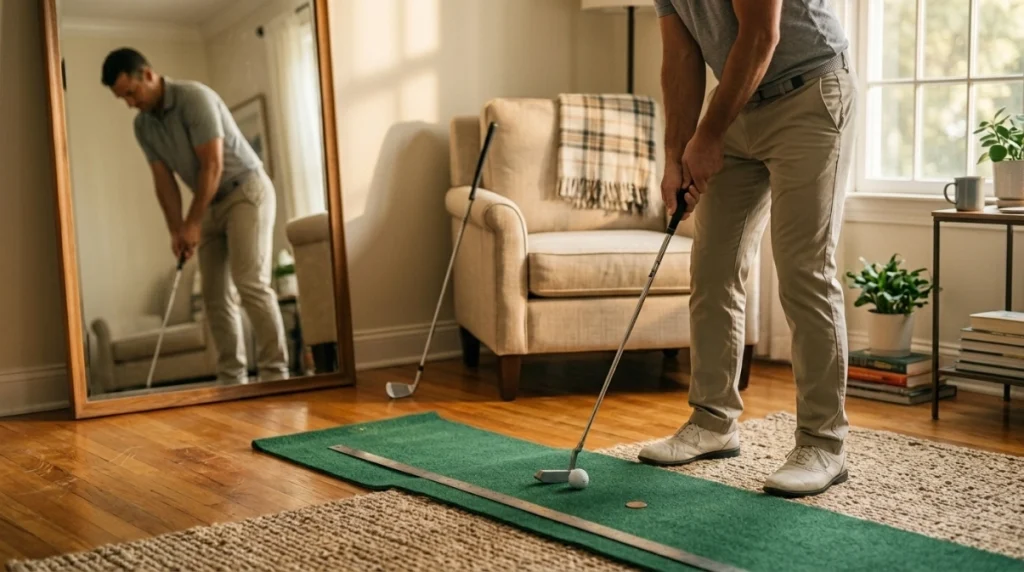
Beginners can improve putting setup, start direction, balance, and slow-motion swing awareness at home. Full-speed shots require enough space and suitable safety equipment.
Coin start-line drill
Place a coin 12 to 18 inches in front of the ball on a flat carpet or putting mat. Roll the ball directly over it.
Complete three sets of 10 putts. Record how many balls cross the coin instead of judging success only by whether they reach a cup.
Putting ruler drill
Place the ball at one end of a metal ruler or yardstick. Roll it along the ruler without allowing it to fall off either side.
This narrow track provides clear feedback about face control. Start with short strokes and increase the distance gradually.
Mirror setup check
Use a mirror to inspect your posture without hitting a ball. Check whether your weight feels balanced and your arms hang naturally.
For putting, position your eyes comfortably near the ball’s target line. Avoid forcing a position that creates neck or back tension.
Slow-motion balance drill
Make a golf swing at roughly 25% speed without a ball. Hold the finish for three seconds.
- Keep your feet stable throughout the motion.
- Finish with most pressure on the lead foot.
- Allow your chest to face the imaginary target.
- Stop if the movement creates pain.
Never hit hard balls indoors unless you have a properly installed net and enough clearance. Foam balls reduce risk, but they can still damage fragile objects.
Pro tip: Get professional guidance if a swing drill causes wrist, elbow, shoulder, or back discomfort.
What Is a Good Weekly Golf Practice Plan?

A useful beginner plan includes two short practice sessions and one playing session each week. Consistency matters more than completing a long session once a month.
| Day | Time | Practice Focus |
|---|---|---|
| Session 1 | 45 minutes | Putting, chipping, and pitching |
| Session 2 | 45–60 minutes | Iron contact, tee shots, and simulated holes |
| Session 3 | Nine holes | Course decisions, routine, and skill testing |
| Optional home session | 10–15 minutes | Putting start line and slow-motion balance |
Track only a few numbers
A complicated practice journal often gets abandoned. Record three or four numbers that connect directly to your current goals.
- Short putting: Makes out of 10 from three feet.
- Lag putting: Balls out of 10 finishing within three feet.
- Chipping: Balls out of 10 landing inside the target zone.
- Full swing: Shots out of 10 starting inside the target corridor.
Adjust practice from your last round
After playing, identify the skill that created the most avoidable strokes. Turn that weakness into the first drill of your next session.
Do not rebuild your entire swing after one difficult round. Weather, uneven lies, fatigue, and course conditions can produce temporary problems.
As of 2026, launch monitors and golf apps offer detailed data. Beginners still benefit most from simple measures like solid contact, penalties, three-putts, and shots near the green.
Section Takeaway: Follow a repeatable weekly schedule and let your on-course mistakes guide the next practice session.
Frequently Asked Questions
How often should a beginner practice golf?
Two focused sessions and one round or nine-hole practice session per week provide a practical starting point. Even 20-minute sessions can help when each drill has a target and recorded score.
How many range balls should a beginner hit?
About 40 to 70 balls are enough for many beginner sessions. Take time between shots, change targets, and stop when fatigue causes your setup or balance to deteriorate.
Should beginners practice with a driver?
Yes, but the driver should not dominate every session. Build contact with wedges and irons first, then practice controlled tee shots toward a fairway-sized target.
Is putting or driving more important for beginners?
Both matter for different reasons. Driving keeps the ball in play, while putting finishes every hole. A balanced routine should include full-swing practice and short-game practice rather than choosing only one.
What golf club is best for beginner practice?
A 7-iron or 9-iron is a useful starting club because it supports controlled swings and visible ball flight. For chipping, compare a 9-iron with a pitching wedge to learn different rollout patterns.
Can practice drills fix a golf slice?
Drills can improve alignment, face control, and contact, but a slice may have several causes. A certified instructor can identify whether the main problem comes from setup, clubface position, swing path, or impact location.
How can a beginner make range practice feel like real golf?
Change clubs after each shot and play imaginary holes. Choose fairway and green targets, follow your pre-shot routine, and accept each result before selecting the next club.
Build a Practice Routine You Can Repeat
The best beginner practice drills are simple enough to repeat and specific enough to score. Use clear targets, change clubs regularly, and record a small number of results.
Start with contact and distance control. Then add random practice, simulated holes, and mild pressure as your confidence improves.
Choose three drills from this guide for your next session. Record your scores, repeat them the following week, and let steady progress shape the golfer you become.