
Golf Hook Explained: Causes, Ball Flight, and Simple Fixes

Quick Answer
A golf hook is a shot that curves hard toward the golfer’s lead side. For a right-handed golfer, it curves sharply left. For a left-handed golfer, it curves right. The PGA golf glossary uses the same basic definition.
What usually causes a hook?
- Closed clubface: The face points left of the swing path at impact for a right-handed player.
- Strong grip: Hands turned too far away from the target can close the face early.
- Inside-out path: The club travels too far toward the right of the target through impact.
- Fast hand action: The hands rotate the clubface shut before contact.
- Poor alignment: A closed stance can encourage an excessive inside-out swing.
Quick way to confirm it
- Note where the ball starts and how it curves. A ball that starts near the target and bends sharply left shows a closed face relative to the club path.
A hook can feel confusing because the swing may seem solid. The ball often flies far before turning into trouble.
I have found that the fastest fix starts with ball flight, not a complete swing rebuild. This guide explains what the ball is telling you and which adjustment to test first.
In This Guide
What Is a Hook in Golf?

A hook is a golf shot with strong sideways curve toward the golfer’s lead side. Right-handed shots hook left, while left-handed shots hook right.
The curve comes from the relationship between the clubface angle and club path at impact. That relationship matters more than how the swing looks.
What happens at impact?
The clubface mainly controls where the ball starts. The face-to-path relationship creates much of the curve.
- Open face relative to path: The ball tends to curve right for a right-handed golfer.
- Square face relative to path: The ball flies with little sideways curve.
- Closed face relative to path: The ball tends to curve left for a right-handed golfer.
Imagine the club travels five degrees right while its face points only one degree right. The face is four degrees closed to that path, so the ball can curve left.
A hook may therefore start right, straight, or even left. Its starting direction alone does not define it.
Is every left-curving shot a hook?
No. A small, controlled right-to-left curve is normally called a draw for a right-handed player.
A hook curves more sharply and is harder to control. It may cross the fairway or finish behind trees despite solid contact.
I often judge the difference by predictability. A useful draw finishes near its planned target, while a hook keeps turning beyond it.
Section Takeaway: A hook is caused by a clubface that is too closed relative to the swing path. The ball’s starting line helps reveal whether the path, face, or both need attention.
Why Do I Hook the Golf Ball?
Most hooks come from a closed clubface, an excessive inside-out path, or both. Grip, alignment, and body motion often create those impact conditions.
Your grip is too strong
A “strong” grip does not describe grip pressure. It means the hands are rotated too far away from the target on the handle.
For a right-handed golfer, you may see three or four knuckles on the left hand. The right hand may also sit too far under the grip.
This position can make the clubface close quickly through impact. It becomes a larger problem when the hands are active near the ball.
Your club path travels too far from inside to out
A slight inside-out path can create a draw. Too much of it increases the difference between the path and clubface.
This often happens when the club drops too far behind the body. The golfer may then push the hands toward right field and rotate the face shut.
Your body stops turning
A stalled body forces the hands and arms to take over. The clubhead can pass the hands and close too early.
I have seen this appear late in a round when the legs become tired. The swing feels slower, yet the ball suddenly hooks harder.
Your stance is closed
A closed stance points the feet, knees, and hips right of the target for a right-handed golfer. This setup can send the swing path too far right.
The problem is easy to miss on the course. Tee-box edges and nearby trees can distort how square alignment looks.
The ball is too far back
A back ball position can encourage contact while the club still travels outward. Some golfers then rotate their hands to prevent a push.
That combination creates a low hook. With a driver, however, other setup changes can produce different starting lines.
You are trying to steer the shot
Trouble on the left can make a golfer guide the club. Ironically, that protective action may stop body rotation and produce a hook.
- Grip pressure increases.
- The lower body slows down.
- The hands release early.
- The clubface closes before impact.
Section Takeaway: Check grip and alignment before changing your swing. These simple setup faults can create the same hook as a deeper swing-path problem.
How Do You Diagnose a Golf Hook?
Start by recording the ball’s launch direction and curve. Those two details provide a clearer diagnosis than feel alone.
Use the start-line test
Place an alignment stick safely on the ground, parallel to the target line. Never position it where the club could strike it.
Hit five balls with one club. Record each shot using these simple labels:
- Start: Left, center, or right of the target.
- Curve: Slight left, strong left, straight, or right.
- Contact: Heel, center, or toe.
- Height: Low, normal, or high.
What does each ball flight suggest?
| Ball Flight | Likely Impact Condition | First Check |
|---|---|---|
| Starts right, curves left | Inside-out path with face closed to path | Path and stance alignment |
| Starts straight, curves left | Face near target but closed to path | Grip and hand rotation |
| Starts left, curves farther left | Face left and closed to path | Clubface control and alignment |
| Starts left, stays left | Face and path both travel left | Possible pull, not a hook |
Check where the ball hits the face
Face contact also changes ball flight. With a driver, a toe strike can add hook spin because of the clubhead’s gear effect.
Use foot spray made for practice or impact tape. Apply it according to its directions, then hit several shots.
Do not diagnose your swing from one ball. Look for a pattern across five to ten shots.
Record the swing from two angles
Film one view from behind the target line and another facing your chest. Keep the camera far enough away for safe use.
Look for setup clues rather than trying to judge every movement:
- Are your feet aimed right of the target?
- Is the ball farther back than normal?
- Does the club disappear behind your body?
- Does your chest stop turning before impact?
Pro tip: Ask a certified PGA professional to assess persistent hooks. A short lesson can prevent you from fixing the wrong movement.
Section Takeaway: Diagnose the start line, curve, and contact before making changes. A hook is an impact pattern, but several different swing faults can create it.

How Do You Stop Hooking the Golf Ball?
Make one small change at a time. Start with grip and alignment, then test path and body rotation.
Step 1: Neutralize your grip
Set the club diagonally across the fingers of your lead hand. Avoid placing it deep in the palm.
For many right-handed golfers, seeing about two knuckles offers a useful starting point. Hand shape varies, so treat that as a guide.
Place the trail hand on the club without turning it far underneath. Hold firmly enough to control the club without squeezing it.
Step 2: Build a square practice station
Place one alignment stick along the target line. Set another parallel to it near your toes.
Check your feet, knees, hips, and shoulders. The shoulders can aim right even when the feet look square.
Step 3: Use a shorter backswing
Hit waist-high to waist-high shots with a short iron. Try to start the ball near the target without strong curve.
Do not chase distance. The goal is predictable face control.
- Choose an eight-iron or nine-iron.
- Use a narrow, square stance.
- Swing the club back to waist height.
- Turn your chest through the shot.
- Finish with the club near waist height.
Step 4: Keep your body turning
Feel your belt buckle and chest continue toward the target. This can reduce the need for a sudden hand release.
Avoid forcing your hips open as fast as possible. Use a balanced turn that matches your mobility.
Step 5: Test a path-control drill
Place a soft headcover outside and slightly behind the ball. Leave enough space for the clubhead to reach the ball safely.
An exaggerated inside-out path may hit the headcover. Move it farther away if the drill changes your natural contact too much.
After three practice swings, hit one ball. Alternate rehearsals and shots instead of making dozens of fast repetitions.
Step 6: Take the fix onto the course
Use one simple cue during play. Multiple swing thoughts can make timing worse.
- Before the shot: Check the grip and target line.
- During the swing: Focus on a balanced chest turn.
- After the shot: Note the start line and curve.
I prefer testing a change on the range before trusting it beside an out-of-bounds line. A range fix must survive different clubs and targets.
Pro tip: Stop if a drill causes wrist, elbow, back, or shoulder pain. A certified instructor can adapt the movement to your body.
Section Takeaway: Neutral grip, square alignment, and steady body rotation solve many hooks. Change one variable and judge it through a repeatable group of shots.
Hook vs. Draw vs. Pull: What Is the Difference?
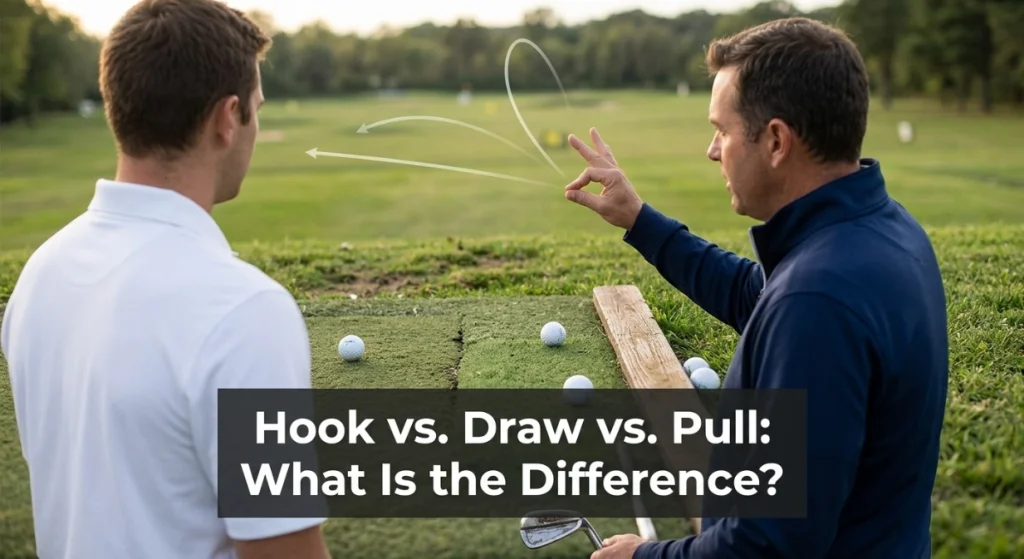
A draw curves gently toward the lead side, while a hook curves much more. A pull starts left and usually stays left for a right-handed golfer.
| Shot Shape | Typical Right-Handed Flight | Control Level |
|---|---|---|
| Draw | Starts slightly right and curves gently left | Usually planned and repeatable |
| Hook | Curves sharply left | Often excessive and costly |
| Pull | Starts left and remains fairly straight | Directional error without large curve |
| Pull hook | Starts left and curves farther left | Most severe left miss |
Can equipment cause a hook?
Equipment can influence a hook, but it rarely explains every hooked shot. Check technique before buying a replacement club.
An upright lie angle can send iron shots farther left for some golfers. The PGA’s fitting guidance explains why lie angle affects ball flight.
A driver’s adjustable settings may also encourage a more closed appearance or draw bias. Shaft length, total weight, and grip size can influence delivery and timing.
- Upright iron lie: May point the face left at impact.
- Draw-biased head: May make a left miss easier to produce.
- Long driver shaft: Can make center contact and face control harder.
- Poorly sized grip: May affect comfort and hand action.
Any club used in competition must meet the applicable rules. Golfers can review the USGA Equipment Rules or consult The R&A for broader rules guidance.
A qualified fitter can measure lie angle, shaft behavior, length, and impact pattern. Bring your normal swing instead of trying to hit perfect shots during the session.
Section Takeaway: A draw, hook, and pull have different start-and-curve patterns. Equipment may influence the miss, but impact conditions still create the final ball flight.
Frequently Asked Questions
Why do I hook my driver but not my irons?
A driver has less loft and a longer shaft, which can make sideways curve more visible. Toe contact may also add hook spin through gear effect. Check face contact, tee height, grip, and alignment before changing the driver’s settings.
Can standing too close to the ball cause a hook?
Yes. Standing too close can restrict the arms and encourage the club to move behind the body. The golfer may then rotate the hands quickly to square the face. However, distance from the ball is only one possible cause.
Can standing too far from the ball cause a hook?
It can. Reaching for the ball may create a flat swing and an excessive inside-out path. Check whether your arms hang naturally at address instead of stretching them toward the club.
Does a strong grip always cause a hook?
No. Many skilled golfers play well with a strong grip because their body motion and clubface control match it. A strong grip becomes a problem when it closes the face too much relative to your path.
Why does my hook appear late in the round?
Fatigue can reduce body rotation and increase hand action. Alignment may also drift as concentration falls. Recheck your grip, shoulder line, and finish when the hook appears on later holes.
Should I weaken my grip to fix a hook?
A small move toward neutral may help if your hands sit far under the handle. Avoid making a large change at once. Test the adjustment with short shots before using a driver.
Is a hook better than a slice?
Neither miss is automatically better. A hook may travel farther because it often launches with less spin, but it can run into deeper trouble. The best shot is one with a predictable start line and manageable curve.
Final Takeaway
A golf hook is not a mystery once you read the ball flight. The clubface is closed relative to the path, creating strong curve toward the lead side.
Begin with grip, alignment, and face contact. Then test a shorter swing with steady body rotation.
Avoid rebuilding everything after one bad shot. Record five to ten attempts and let the pattern guide your next adjustment.
If the hook remains, work with a certified instructor or club fitter. Clear impact data can turn a frustrating left miss into a controlled, useful draw.