
How Strong Should a Golf Towel Magnet Be?

Quick Answer
A golf towel magnet should be strong enough to hold the fully loaded towel on a compatible metal surface without sliding during normal movement, but not so strong that removing it becomes awkward. For a typical compact microfiber towel, roughly 5–10 pounds of tested straight-pull holding force can be a useful starting range, while larger or heavier wet towels may benefit from roughly 8–12 pounds or more. Some commercial magnetic golf accessories advertise 20–25 pounds, but a higher number alone does not guarantee better real-world retention. For general golf equipment guidance, you can also review the USGA.
What Matters Most
- Wet towel weight: Test the magnet with the towel wet, because water can add substantial weight.
- Shear resistance: A towel may slide sideways on a vibrating cart even when straight-pull strength sounds impressive.
- Surface contact: Paint, dirt, fabric, coatings, and curved tubing can reduce magnetic holding performance.
- Easy removal: You should still be able to detach the towel comfortably with one hand.
- Real-world testing: The finished towel matters more than the magnet’s catalogue rating by itself.
Simple Buying Test
- Wet the towel, attach it to the surface you normally use, shake or move the setup, then confirm it stays secure but releases without a struggle.
Magnetic golf towels are convenient until the magnet lets go halfway down a bumpy cart path. Go too far in the other direction, though, and you’ll wrestle with the towel every time you need it.
I’ve found that the useful question isn’t simply, “How many pounds of pull force do I need?” The better question is whether the complete towel stays attached when it’s wet, dirty, swinging, and being bounced around during an actual round.
In This Guide
- How strong should a golf towel magnet actually be?
- What does magnet pull force mean?
- Is a stronger golf towel magnet always better?
- How does towel size affect the magnet strength you need?
- How can you test a golf towel magnet?
- What should you look for when buying a magnetic golf towel?
- Frequently asked questions
How Strong Should a Golf Towel Magnet Actually Be?
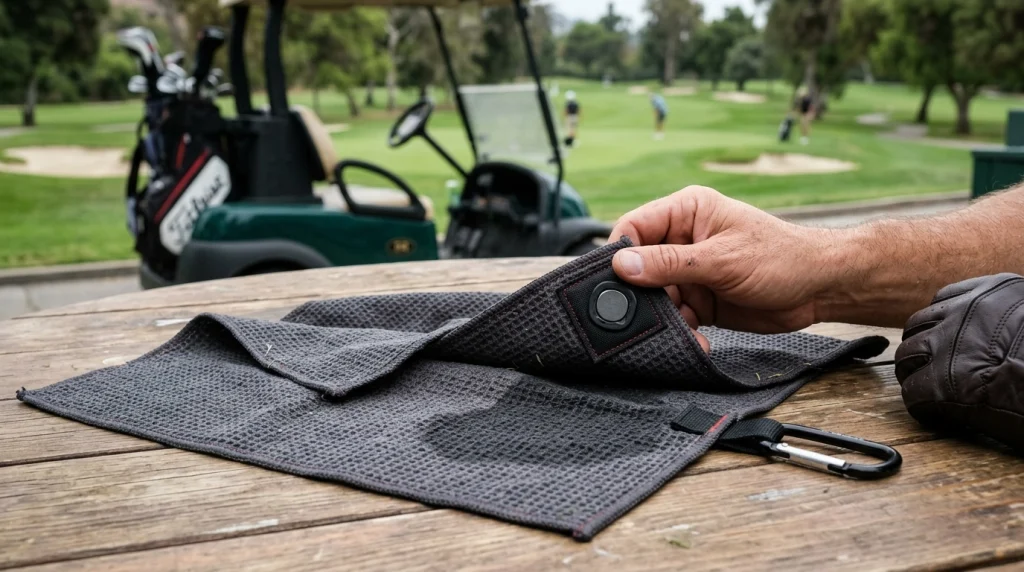
A golf towel magnet needs enough usable holding force to support the towel when wet and moving. For many compact microfiber towels, a finished assembly in roughly the 5–10 pound straight-pull range can be a sensible starting point.
Larger towels may need more. A long caddie towel carrying water, grass, and mud puts a greater load on the attachment than a light 16-inch microfiber towel.
As a practical 2026 shopping guide, I would think about magnet strength this way:
| Towel Setup | Practical Starting Range | Main Concern |
|---|---|---|
| Small microfiber towel | About 5–8 lb straight pull | Easy removal with enough security |
| Medium magnetic towel | About 7–10 lb | Wet weight and cart vibration |
| Large or heavier towel | About 8–12+ lb | More fabric and greater wet weight |
| 20–25 lb marketed system | High-strength attachment | May be more strength than the towel requires |
These figures aren’t an industry standard. Pull-force test methods, steel thickness, contact area, coatings, magnet shape, and housing can all change the result.
That’s why I wouldn’t reject a towel simply because its published number looks lower. I also wouldn’t buy one solely because the package says “25-pound magnet.”
Think in terms of safety margin
The towel itself might weigh only a few ounces when dry. That doesn’t mean a magnet rated for barely more than the towel’s static weight is enough.
Golf creates dynamic loads. The towel swings, the cart turns, and the attachment gets hit with vibration over rough ground.
- Dry weight: The lightest condition the magnet will face.
- Wet weight: A more realistic worst-case load.
- Movement: Swinging fabric can pull sideways against the attachment.
- Contact quality: Curved or painted surfaces usually give less ideal contact than clean flat steel.
I want enough reserve that a wet towel doesn’t sit near the magnet’s limit. At the same time, I want to remove it without yanking hard enough to move other accessories.
What Does Magnet Pull Force Mean?
Magnet pull force is typically the force required to separate a magnet straight away from a specified steel surface under controlled conditions. It doesn’t automatically tell you how well a towel will stay on a golf cart.
This distinction matters more than most product descriptions make obvious.
Pull force and shear force aren’t the same
Imagine a magnet attached to a vertical steel cart support. Pulling it directly toward you tests something close to straight pull.
Now imagine the towel hanging downward while the cart rattles over a path. Much of that real load tries to make the magnet slide sideways.
- Pull: Force acting directly away from the metal surface.
- Shear: Force trying to slide the magnet along the surface.
- Peel: Force lifting one edge first instead of separating everything evenly.
- Vibration: Repeated small movements that can gradually reduce secure contact.
A magnet that feels almost impossible to pull straight off may still slide on smooth paint. Moisture and dirt can make that situation worse.
This is why real golf-towel testing should include movement. A static magnet specification gives only part of the story.
Air gaps weaken the connection
Magnets work best with close contact to a suitable ferromagnetic material such as steel. Even a small gap can reduce usable attraction.
On a golf towel, that gap may come from fabric, rubber, protective housing, paint, dirt, or a textured cart surface.
A higher-grade magnet can help compensate, but construction still matters. Good design gets the magnet close to the target while protecting it from impact and moisture.
For broader rules and equipment information, the R&A provides current golf rules and equipment resources.
Is a Stronger Golf Towel Magnet Always Better?
No. Once the magnet reliably holds the towel through normal use, extra strength gives diminishing benefits and may make the towel less convenient.
I want secure attachment, not maximum possible attraction.
Problems with excessive magnet strength
- Harder removal: A powerful magnet can take an uncomfortable tug to detach.
- Pinched fingers: Strong magnets can snap aggressively onto steel hardware.
- Awkward handling: A magnet that grabs nearby metal unexpectedly becomes annoying around clubs and carts.
- Housing stress: Repeated hard impacts can stress stitching, plastic housings, or mounting patches.
- Unnecessary weight: Larger magnet assemblies can make a compact towel bulkier.
I notice this most when moving a towel repeatedly around the green. Easy one-handed removal matters almost as much as staying attached.
Magnet grade isn’t the same as holding force
You may see neodymium grades such as N42 or N52 in product descriptions. The grade describes magnetic material characteristics, but it doesn’t independently tell you the finished attachment’s pull force.
Magnet dimensions and geometry matter too. So do the housing, steel target, coating, and air gap.
An N52 label can therefore be useful information, but it shouldn’t end your comparison. Look for finished-product testing whenever a manufacturer provides it.


How Does Towel Size Affect the Magnet Strength You Need?
As towel size and saturated weight increase, the magnet usually needs a larger performance margin. A compact greenside towel creates a different load from a full caddie towel.
Material matters as well.
- Compact microfiber: Usually light and quick drying, so the magnet carries less mass.
- Large microfiber: More surface area means more water can remain in the towel.
- Heavy cotton: Can become substantially heavier once saturated.
- Wet/dry designs: Extra layers, membranes, or pockets can add weight.
- Attached accessories: Brushes, clips, rings, and ball-cleaning sections add to the load.
Don’t choose from dry weight alone
This is one mistake I would avoid. A towel that feels feather-light in a store can be a different accessory after cleaning muddy wedges for nine holes.
Wet the towel before deciding whether its magnetic attachment feels secure. That’s closer to how the product gets used.
Where you attach it also matters
A magnet sitting flat against broad steel has an easier job than one touching a narrow curved tube. Cart construction varies, so there’s no guarantee the same towel will grip every cart equally.
Some golf bags, push carts, and riding carts also use aluminum or plastic parts. Those surfaces may provide little or no attraction to a normal magnet.
For technique, instruction, and general golf education, the PGA of America is another useful reference.
How Can You Test a Golf Towel Magnet?
The best test uses your complete towel on the equipment and surfaces you normally use. I care more about that result than a large number printed on packaging.
A simple test takes only a few minutes.
- Test it dry. Attach the towel to your normal cart, bag attachment, or steel target.
- Pull downward gently. Check whether it immediately slides under modest sideways force.
- Wet the towel. Saturate the cleaning area as you might during a damp round.
- Repeat the attachment test. Make sure the added water doesn’t cause creeping or sliding.
- Add movement. Shake the mounting point or drive slowly over a normal uneven surface where appropriate.
- Test removal. Confirm you can detach the towel naturally with one hand.
- Repeat several times. A useful attachment should behave consistently.
Try a club-pickup test
Many magnetic towels are designed so you can retrieve them with a compatible iron, wedge, or putter. Test that feature before depending on it around the green.
Set the towel down with its magnetic section exposed. Touch the compatible metal area of the club to the magnet and lift gently.
Not every clubhead construction provides the same magnetic attraction. Don’t assume a towel will stick equally well to every putter or wedge.
Check the attachment after washing
A golf towel lives around water, detergent, dirt, sand, and repeated impacts. The magnet system has to survive more than one strong pull test.
Follow the manufacturer’s washing instructions. Remove detachable magnetic hardware when required.
If the housing cracks, corrodes, loosens, or starts pulling away from the fabric, stop relying on it. A strong magnet isn’t useful when its mounting point fails.
What Should You Look for When Buying a Magnetic Golf Towel?

Choose the towel as a complete cleaning system rather than buying the biggest magnet specification you can find. Fabric, attachment construction, washability, and usable size all matter.
These are the features I would check first:
- Real holding information: Published pull force is useful when the test method is explained.
- Wet-use performance: Look for evidence that the complete towel remains secure after getting wet.
- Protected magnet: The magnet should sit inside a durable housing or reinforced attachment area.
- Useful towel fabric: Waffle microfiber is popular for lifting grass and dirt from clubfaces.
- Practical size: Make sure the towel provides enough surface for separate damp and dry zones.
- Backup attachment: A carabiner or clip can be handy when no magnetic surface is available.
- Clear washing instructions: Know whether the magnetic component needs removal.
Don’t buy from the pull-force number alone
Current magnetic golf accessories show how wide the numbers can get. Some systems advertise around 25 pounds of straight pull, while useful smaller assemblies can operate with much lower figures.
Neither figure proves how the towel behaves on your cart. The mounting surface and direction of load still matter.
That’s why I would choose the lowest sensible strength that stays confidently attached in wet, moving conditions. Convenience should remain part of the design.
If you play tournaments or have questions about how an unusual accessory may be used during play, check the current Rules of Golf resources or ask a rules official.
Section Takeaway: A good magnetic golf towel balances secure wet-weather holding with easy one-handed removal. Test the finished towel, not just the magnet specification.
Frequently Asked Questions
Is a 25-pound magnet too strong for a golf towel?
Not necessarily, and some commercial golf towel systems advertise about 25 pounds of pull force. However, most towels don’t require that much static straight-pull force simply to support their weight, so ease of removal and real-world shear performance still deserve attention.
Is 5 pounds of pull force enough for a golf towel?
It can be enough for a small, lightweight towel under favorable conditions. Test it wet and on the exact surface you’ll use, because vibration, paint, curved metal, and sideways loading can reduce practical holding performance.
What type of magnet is used in magnetic golf towels?
Many magnetic golf towel systems use neodymium magnets because they provide strong magnetic performance in a compact size. Products may mention grades such as N42 or N52, but grade alone doesn’t determine the finished towel’s actual holding force.
Does an N52 magnet make a golf towel better?
Not automatically. N52 can provide high magnetic performance for its size, but magnet dimensions, housing, contact area, surface material, and attachment design also affect results. A well-designed lower-grade assembly may work better than a poorly mounted N52 magnet.
Why does my magnetic golf towel slide off the cart?
The problem may be shear rather than insufficient straight-pull force. Smooth paint, dirt, moisture, curved rails, vibration, or a small contact patch can let the magnet slide even when it feels strong during a direct pull test.
Will a magnetic golf towel stick to every golf cart?
No. Magnets need a compatible ferromagnetic surface. Steel often works, while aluminum, plastic, composites, and some covered or coated components may provide weak or no magnetic attachment.
Should I test a magnetic golf towel wet or dry?
Test both, but the wet test is more important for worst-case performance. A saturated towel is heavier and better represents rainy rounds, morning dew, and repeated club cleaning during 18 holes.
Choose Secure Holding, Not the Biggest Number
A golf towel magnet should be strong enough to keep the finished towel secure when wet, moving, and attached to the surfaces you actually use. For many compact towels, roughly 5–10 pounds of straight-pull performance is a practical starting point, while larger towels may benefit from greater capacity.
Don’t turn that range into a hard rule. Published pull force is only one part of magnetic performance.
I would always test wet weight, sideways movement, attachment surface, and one-handed removal before judging the system. A towel that survives those checks is far more useful than one that simply carries the largest magnet number on the label.