
What Golf Towel Material Absorbs the Most Water?

Quick Answer
Thick cotton terry can hold a large amount of water because cotton fibers are naturally moisture-absorbing and dense towels contain more material. However, microfiber usually gives golfers the better absorbency-to-weight balance, while also drying faster and cleaning clubs efficiently. For most golf bags, I prefer waffle-weave microfiber rather than choosing a towel only by maximum water capacity. You can also browse professional golf resources when refining your overall equipment setup.
What matters most
- Total water capacity: Thick, heavy cotton terry can store considerable moisture before becoming saturated.
- Weight efficiency: Microfiber handles plenty of water without requiring a thick, heavy towel.
- Drying speed: Microfiber usually dries faster than dense cotton terry between uses.
- Club cleaning: Waffle microfiber adds texture that helps lift grass, soil, and moisture.
- Towel construction: Size, thickness, weave, and fabric density can change absorbency as much as fiber choice.
My practical pick
- Choose waffle microfiber for most rounds, but consider a thick cotton towel when maximum water storage matters more than weight.
A golf towel seems simple until the course is wet, your wedge is muddy, and every dry corner disappears by the turn.
I care about absorbency, but I also care about what happens after the towel gets wet. This guide separates raw water capacity from useful on-course performance.
In This Guide
- Which Golf Towel Material Absorbs the Most Water?
- Why Do Cotton and Microfiber Absorb Water Differently?
- How Do Common Golf Towel Materials Compare?
- Do Weave, Weight, and Size Change Absorbency?
- Which Towel Works Best in Different Golf Conditions?
- How Can You Test Golf Towel Absorbency?
- Golf Towel Absorbency Questions
Which Golf Towel Material Absorbs the Most Water?
There isn’t a universal winner based on fiber name alone. Among common golf towels, dense cotton terry can provide excellent total water capacity.
Microfiber usually provides a stronger combination of absorbency, low weight, cleaning ability, and drying speed. That’s why I normally choose it for the golf course.
Definition: Towel absorbency describes how much liquid a towel can take up and retain before it becomes saturated or starts releasing water.
Raw capacity isn’t the same as practical absorbency. A large, heavy towel can hold more water simply because it contains more fabric.
A smaller microfiber towel might hold less total water yet perform better relative to its dry weight. It can also recover usefulness faster as moisture evaporates.
Why I don’t judge a golf towel by one absorbency claim
Manufacturers sometimes advertise how many times a towel’s weight it can hold. Those numbers aren’t directly comparable unless the testing method is identical.
- Dry fabric weight affects the final capacity.
- Towel dimensions determine how much material you carry.
- Weave structure creates spaces where water can collect.
- Fiber treatment can change how readily a towel wets.
- Test procedure changes how much retained water gets measured.
Research on absorbent textiles also shows that fabric construction matters, not just fiber chemistry. That makes blanket claims about one material risky.
Section Takeaway: Thick cotton is excellent when maximum total moisture capacity matters, while microfiber is my better all-round golf choice because it balances absorbency with lower bulk and faster drying.
Why Do Cotton and Microfiber Absorb Water Differently?
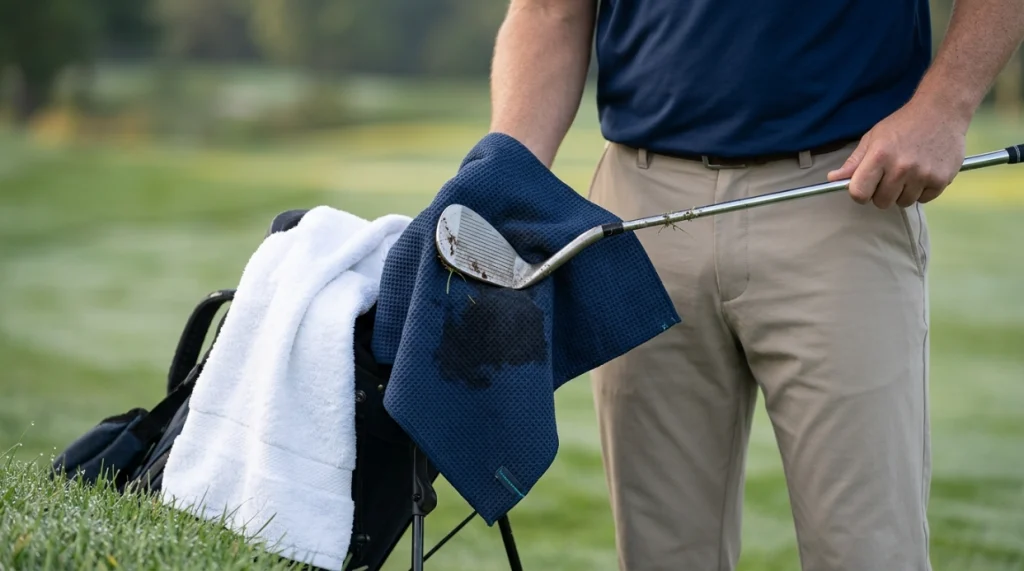
Cotton and microfiber handle water in different ways. Understanding that difference explains why both can be described as highly absorbent.
How cotton handles moisture
Cotton is a cellulose-based natural fiber with strong moisture affinity. Water can enter the fiber structure instead of remaining only between yarns.
That helps explain the familiar behavior of a thick cotton bath towel. It takes in moisture readily and can remain damp afterward.
Research from the United States Department of Agriculture research service has examined how moisture interacts with cotton fibers.
- Soft feel: Cotton terry remains comfortable for hands and faces.
- High fabric mass: Thick terry constructions provide substantial material for holding water.
- Longer drying: Retained moisture can take time to leave a dense towel.
How microfiber handles moisture
Microfiber describes extremely fine synthetic fibers rather than one specific weave. Golf versions commonly use polyester-based constructions, sometimes combined with polyamide.
Fine fibers create a large working surface and tiny spaces that move liquid through capillary action. The towel can therefore handle moisture without becoming excessively bulky.
- Low weight: A useful cleaning area can remain relatively light.
- Fast drying: Many microfiber constructions release moisture faster than dense cotton terry.
- Useful texture: Waffle patterns help collect loose grass, soil, and moisture.
On a damp morning, I like wetting one microfiber corner before the first tee. The opposite side stays dry for grips and hands.
That simple wet-and-dry setup matters more to me than chasing the highest possible laboratory capacity.
Section Takeaway: Cotton absorbs moisture into its cellulose structure, while microfiber relies heavily on fine-fiber surface area and capillary spaces. Both work, but their on-course behavior differs.
How Do Common Golf Towel Materials Compare?
Golf towels aren’t limited to cotton and microfiber. Polyester fabrics, blends, and synthetic chamois-style materials also appear in sports towels.
| Material | Water Handling | Drying | Golf Strength | Main Tradeoff |
|---|---|---|---|---|
| Cotton terry | Strong total capacity in thick constructions | Usually slower when heavily saturated | Hands, grips, heavy moisture | Gets heavier when wet |
| Waffle microfiber | Strong absorbency relative to bulk | Generally fast | Clubs, balls, mud, everyday use | Texture may feel grabby on dry skin |
| Smooth microfiber | Good moisture pickup | Generally fast | Drying and light cleaning | Less scrubbing texture |
| Polyester fabric | Usually lower fiber-level moisture absorption | Fast | Lightweight carrying | Construction becomes especially important |
| Synthetic chamois | Designed for high water pickup | Varies by material | Heavy moisture situations | Less convenient for routine club cleaning |
For golf, waffle microfiber wins my practical comparison. It handles the jobs a towel performs repeatedly during an eighteen-hole round.
Cotton still deserves consideration when sweat, rain, or grip drying dominates your needs. A large cotton towel also provides many clean zones.


Do Weave, Weight, and Size Change Absorbency?
Yes. Fabric construction can change water capacity enough that comparing only “cotton versus microfiber” misses part of the answer.
Fabric weight matters
Towel density is often expressed in grams per square meter. A higher value means more fabric mass within the same surface area.
More mass can increase capacity, but it also increases dry weight and often slows drying. That’s an important tradeoff for golfers who walk.
Weave matters
A terry towel uses raised loops that create surface area and space for moisture. Waffle fabric uses a recessed grid that creates textured pockets.
Current textile research continues to show that weave structure and yarn arrangement influence moisture-management performance. You can explore related research through Scientific Reports.
Size matters
A 40-inch caddie towel naturally offers more absorbent material than a compact square towel of similar construction. Bigger isn’t automatically better, though.
- Walkers: Lower weight and faster drying usually matter more.
- Cart golfers: Larger towels are easier to carry without noticing the added mass.
- Rainy rounds: Extra dry surface area becomes valuable.
- Dry conditions: A compact microfiber towel may be enough.
I’d compare dimensions and construction before believing any headline absorbency number. Two towels labeled microfiber can perform quite differently.
Section Takeaway: Fiber type matters, but towel weight, weave, dimensions, and finishing help determine how much water the finished product can actually manage.
Which Towel Works Best in Different Golf Conditions?
The most absorbent towel on paper isn’t always the one I’d pack. Conditions change what “best” means.
Wet morning or heavy dew
Choose waffle microfiber for routine club and ball cleaning. Keep part damp and protect another section for final drying.
Steady rain
Bring more dry fabric rather than expecting one saturated towel to recover. A large cotton towel can provide useful capacity if kept partially protected.
I also like carrying a second dry towel specifically for grips. Keeping grip moisture separate from clubface mud prevents problems later.
Hot and humid weather
Microfiber’s lighter construction and faster drying can make it easier to manage. Cotton remains comfortable when you need a towel mainly for sweat.
Muddy or sandy course conditions
Waffle texture earns its place here. The grid gives you a better working surface for loosening debris around iron and wedge grooves.
Clean equipment carefully and follow the applicable Rules of Golf when cleaning a ball during play.
- Best all-round: Waffle microfiber.
- Best for lots of moisture: Thick cotton with enough dry surface area.
- Best for walking: Lightweight microfiber.
- Best for hands: Soft cotton or plush microfiber.
- Best for mud: Textured waffle microfiber.
The United States Golf Association is another useful rules resource when equipment cleaning affects play.
How Can You Test Golf Towel Absorbency?
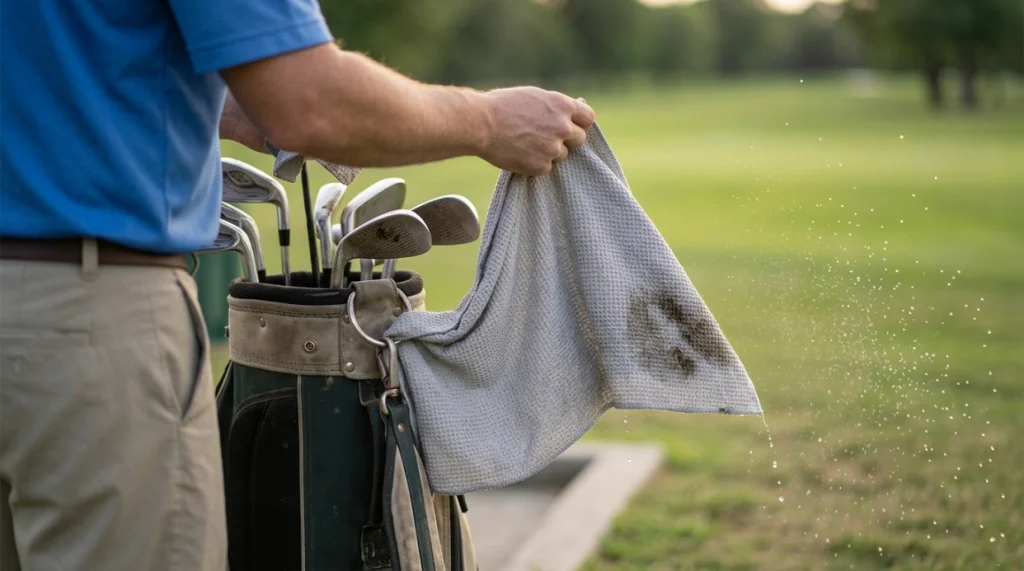
You don’t need marketing claims to compare two towels. A kitchen scale can give you a useful repeatable measurement.
- Wash both towels first. Follow their care labels and avoid comparing a new towel with a conditioned one.
- Dry them completely. Record each towel’s dry weight in grams.
- Fully wet each towel. Use the same water temperature and soaking time.
- Let each towel drip equally. Use the same drain time without squeezing.
- Weigh each wet towel. Record the saturated weight immediately.
- Subtract dry weight. The difference estimates retained water.
One gram of liquid water has a mass of roughly one gram under everyday conditions. That makes the calculation straightforward.
For example, imagine a dry towel weighs 120 grams and reaches 420 grams after the test. It retained about 300 grams of water.
Divide retained water by dry towel weight to compare efficiency. In that example, 300 divided by 120 equals 2.5 grams of retained water per gram of dry towel.
Why the ratio is useful
Total retained water favors larger, heavier towels. The water-to-dry-weight ratio shows how efficiently each towel uses its fabric mass.
For golf, I would record both numbers. Maximum capacity helps in rain, while the ratio matters more when carrying your bag.
Section Takeaway: Test total retained water and absorbency relative to dry weight. Those measurements are more useful than comparing marketing language alone.
Golf Towel Absorbency Questions
Does microfiber absorb more water than cotton?
It depends on towel construction and what you measure. Thick cotton can offer high total water capacity, while microfiber often performs strongly relative to its lower weight and bulk.
Is cotton the most absorbent golf towel material?
Cotton is highly moisture-absorbent and dense terry towels can hold considerable water. However, size, weave, fabric weight, and finishing prevent cotton from being an automatic winner in every comparison.
Why is microfiber so popular for golf towels?
Microfiber combines useful moisture handling with low bulk, fast drying, and effective cleaning. Waffle-weave versions also provide texture for removing grass, sand, and soil from clubfaces.
Is waffle weave more absorbent than regular microfiber?
Waffle construction changes the towel’s surface geometry and creates textured pockets. Actual capacity still depends on fiber composition, fabric density, dimensions, and manufacturing quality.
What towel is best for playing golf in rain?
I prefer multiple towels rather than relying on one extra-absorbent towel. Use one for dirty clubs and keep another protected for grips, hands, and final drying.
Does a thicker golf towel absorb more water?
A thicker towel often contains more material, which can increase total capacity. The tradeoff is extra weight, bulk, and potentially slower drying once the towel becomes saturated.
Should I choose cotton or microfiber for my golf bag?
Choose waffle microfiber for a lightweight all-purpose club towel. Choose cotton when softness, sweat handling, or high total moisture capacity matters more than carrying weight and drying speed.
My final takeaway: If your only goal is storing plenty of water, a substantial cotton terry towel is hard to dismiss. If you want the best overall golf performance, waffle microfiber is the more balanced choice.
Match the towel to your weather, bag setup, and cleaning routine. A towel that stays usable through the back nine is more valuable than one impressive absorbency number.