
What Is a Blended Golf Towel? A Golfer’s Practical Guide

Quick Answer
A blended golf towel is a golf towel made from two or more fiber types, such as polyester and nylon microfiber or cotton combined with a synthetic or regenerated fiber. The blend is designed to balance cleaning ability, absorbency, softness, durability, weight, and drying speed. You can use one for clubs, grips, hands, and your ball whenever cleaning is permitted under the USGA Rules of Golf.
What a fabric blend can offer
- Balanced absorbency: One fiber can help manage moisture while another improves structure or drying.
- Better cleaning texture: Microfiber blends can create fine or waffle-textured surfaces that grab dirt and grass.
- Lower bulk: Synthetic fibers can keep a towel lighter than a thick traditional terry towel.
- Useful durability: A well-made blend can tolerate repeated wiping, washing, clipping, and folding.
- Flexible feel: Different fiber combinations can emphasize softness, fast drying, or tougher club cleaning.
Simple buying tip
- Read the actual fiber percentage and dimensions instead of assuming every “microfiber” or “blended” towel performs the same way.
A golf towel looks like one of the simplest items on the bag. Its fabric becomes much more important once it starts dealing with morning dew, bunker sand, damp grips, and muddy iron faces.
As of 2026, blended golf towels appear in several constructions, so the label alone doesn’t tell the whole story. This guide explains what the term means, how common blends differ, and what matters before you buy one.
In This Guide
What Is a Blended Golf Towel?
A blended golf towel is made with at least two different fiber types rather than one fiber alone. The fibers may be spun or woven together, or used in different layers or zones of the same towel.
Definition: A blended golf towel combines two or more textile fibers to create a practical balance of moisture control, cleaning texture, feel, durability, and drying characteristics.
One common example is microfiber made from polyester and polyamide, often called nylon on product labels. Other towels may combine cotton with polyester, viscose, bamboo-derived viscose, or another fiber.
- Polyester: Often contributes durability, shape retention, and relatively quick drying.
- Polyamide or nylon: Common in microfiber blends and can contribute softness and moisture handling.
- Cotton: Gives a familiar soft feel and performs well for general moisture absorption.
- Viscose-type fibers: May be included to change softness, absorbency, or the towel’s overall feel.
The word blended does not automatically mean premium. Construction, weave, fabric weight, stitching, and size can matter as much as the fiber names.
That distinction is useful when shopping. Two towels can both say “microfiber” while using different fiber percentages, textures, and dimensions.
How Do Golf Towel Fabric Blends Work?

The goal of blending fibers is usually to combine useful characteristics that one material may not provide as efficiently by itself. Golf creates a good test because a towel must deal with both dirt and moisture.
Why polyester and nylon are often combined
Polyester-polyamide microfiber is a good example of a true blended towel. The extremely fine fibers create plenty of contact points for picking up moisture and loose debris.
- Club cleaning: Fine fibers can grab grass, sand, and loosened soil from a clubface.
- Compact carrying: Microfiber can provide useful cleaning area without thick terry-style bulk.
- Drying: Lightweight constructions usually dry more conveniently than a saturated heavy towel.
- Texture options: Manufacturers can use waffle, flat, plush, or other weaves.
What does weave have to do with the blend?
Fiber content tells you what the towel is made from. The weave tells you how those fibers are arranged.
A waffle weave has raised and recessed areas that can help work around grooves and textured clubfaces. A smoother weave may feel better on hands but offer less mechanical scrubbing texture.
Golf Digest also highlights waffle-style towels as useful for reaching small areas on irons and keeping a towel practical for club cleaning.
Section Takeaway: Fiber blend and weave are separate decisions. Check both before deciding how a towel is likely to behave on your bag.
Is a Blended Golf Towel Better Than Cotton or Microfiber?
A blended towel is not automatically better than 100% cotton. It is usually better described as a different balance of weight, feel, drying behavior, and cleaning texture.
There is also an important terminology point. Many towels marketed as microfiber are already blended because the microfiber itself contains polyester and nylon or polyamide.
| Example | Fiber Content | Size | Published Weight | What It Shows |
|---|---|---|---|---|
| Port Authority Grommeted Microfiber Golf Towel | 85% polyester / 15% nylon microfiber | 16 × 26 in. | 2.5 lb./dozen, about 3.3 oz. each | A synthetic fiber blend can create a lightweight golf towel. |
| Port Authority Grommeted Golf Towel | 100% cotton terry velour | 16 × 26 in. | 3.73 lb./dozen, about 5.0 oz. each | A same-size cotton construction can be heavier before either towel gets wet. |
Those examples are useful because the dimensions are the same. They do not prove that every microfiber towel is lighter than every cotton towel, since fabric density and construction still vary.
Choose a blend when you want balance
- Walking golfers: A compact synthetic blend can reduce unnecessary bag bulk.
- Frequent club cleaners: A textured microfiber blend works well when you wipe irons repeatedly.
- Mixed conditions: A towel with useful absorbency and reasonable drying can handle dew, light rain, and dirt.
Choose cotton when feel matters most
Cotton remains a practical golf material. A large terry towel can be especially comfortable for hands, grips, and general drying.
Section Takeaway: Blends are strongest when you value a combination of low bulk, cleaning texture, and convenient drying. Cotton remains a good choice when a soft, traditional towel feel is your priority.


What Do You Use a Blended Golf Towel For?
A blended golf towel performs the same basic jobs as other golf towels. The material mainly changes how efficiently and conveniently it handles those jobs.
- Cleaning clubfaces: Dampen part of the towel and remove grass, soil, or sand after a shot.
- Cleaning grooves: Use a textured area to loosen surface debris before using a groove brush when necessary.
- Drying grips: Keep a clean section dry so moisture does not transfer back onto the grip.
- Drying hands: A protected dry area can help during humid or rainy rounds.
- Cleaning a golf ball: Wipe the ball only when the Rules allow you to clean it.
That final point matters in competitive golf. Under Rule 14.1c, a ball lifted from the putting green may be cleaned, while specific exceptions apply elsewhere on the course.
The R&A Rule 14 guidance explains the same procedures. A towel is useful equipment, but carrying one does not change when the Rules permit cleaning.
A simple wet-and-dry setup
- Wet one corner or one end before the round.
- Use that section for dirty clubfaces.
- Keep the opposite section dry for grips and hands.
- Replace or rotate the towel once dirt spreads into the dry area.
My rule of thumb is simple: never use the muddiest section on a grip. Separating cleaning and drying areas makes almost any golf towel more useful.
How Do You Choose the Right Blended Golf Towel?
Start with the fiber label, then look at size, texture, attachment, and care instructions. Brand name should come after those practical details.
1. Check the actual fiber percentages
Look for labels such as 85/15 polyester-nylon rather than stopping at the word microfiber. Exact percentages give you a clearer picture of what you are buying.
2. Match the texture to the job
- Waffle texture: Useful for clubfaces and grooves.
- Plush texture: Comfortable for hands and general moisture.
- Flat lightweight weave: Easy to pack but may provide less aggressive cleaning texture.
3. Choose a size that suits your bag
A compact towel makes sense on a lightweight stand bag. Larger cart and caddie towels provide more wet-and-dry surface area but can hang too low on smaller bags.
4. Look at the attachment
- Carabiner: Easy to clip to a bag ring.
- Grommet and hook: Simple and widely used.
- Center slit: Lets a caddie towel hang over a club or umbrella.
- Magnet: Convenient when you frequently take the towel away from the bag.
5. Don’t buy by logo alone
Titleist, Callaway, TaylorMade, Ping, Cobra, Mizuno, Srixon, and other golf brands offer accessories, but the logo does not tell you the towel’s fiber content. Read the specification before comparing two models.
The PGA of America is also a useful broader resource when you are building your equipment knowledge or looking for professional instruction.
Section Takeaway: Choose the towel for your playing conditions and bag setup first. Material percentages, weave, dimensions, and attachment tell you more than branding alone.
How Should You Wash and Care for a Blended Golf Towel?
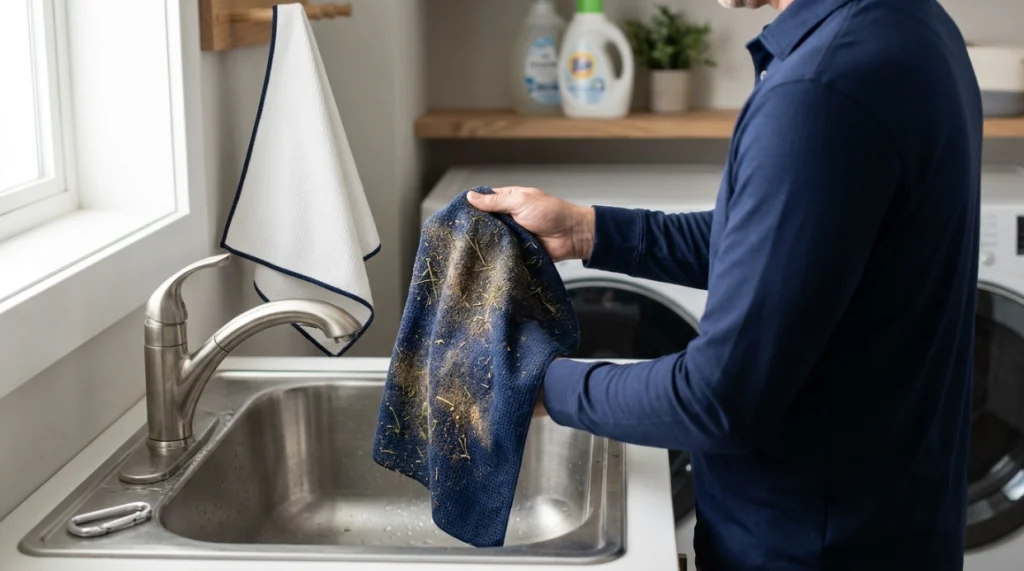
Always follow the manufacturer’s care label because blended fabrics can require different treatment. A method that works for cotton is not automatically ideal for every microfiber blend.
- Shake off loose debris: Remove grass, sand, and dried soil before washing.
- Remove detachable hardware: Take off carabiners or hooks when the instructions recommend it.
- Wash before dirt builds up: Embedded grit makes a towel less pleasant to use on clubs and hands.
- Follow temperature instructions: Heat tolerance depends on the exact fibers and construction.
- Dry it completely: Do not leave a wet towel balled inside a golf bag after the round.
Some microfiber care labels also warn against ironing or high-temperature treatment. The safest approach is to follow the instructions attached to your exact towel.
I also like keeping a spare towel in the bag. Once the main towel is saturated or coated with mud, a clean replacement is more useful than trying to stretch one towel through another nine holes.
Frequently Asked Questions About Blended Golf Towels
Is microfiber considered a blended golf towel?
It can be. Many microfiber golf towels use a blend such as polyester and polyamide or nylon, so they contain two synthetic fiber types even though the product is simply marketed as “microfiber.” Check the fiber-content label to confirm.
Is a blended golf towel more absorbent than cotton?
Not automatically. Absorbency depends on the fibers, fabric density, weave, thickness, and overall towel size, so a thick cotton towel may handle moisture differently from a lightweight synthetic blend.
What blend is best for cleaning golf clubs?
A polyester-polyamide microfiber with a textured or waffle weave is a practical option for club cleaning. The texture helps work around grooves while the lightweight construction remains convenient on a golf bag.
Can I use a blended towel to clean my golf ball?
Yes, when the Rules permit the ball to be cleaned. Rule 14.1c allows cleaning in many situations but includes specific exceptions, so the location and reason for lifting the ball still matter.
Are blended golf towels good for rainy rounds?
They can be a good fit, particularly when the construction dries conveniently and does not become excessively bulky. In steady rain, carry a protected second towel so you still have a dry surface for hands and grips.
How many golf towels should I carry?
One towel is enough for many dry rounds, but two create a more flexible setup. You can dedicate one to wet club cleaning and keep the second dry for grips, hands, and permitted ball cleaning.
Does a higher polyester percentage make a golf towel better?
No single percentage guarantees better performance. Fiber ratio matters, but weave, dimensions, fabric density, stitching, attachment hardware, and care quality also affect how useful the finished towel feels on the course.
Bottom line: A blended golf towel combines multiple fibers to balance cleaning, moisture control, weight, feel, and drying characteristics. Check the actual fiber percentages and weave, then choose the size and attachment that fit how you play.
For most golfers, the smartest choice is not simply “cotton or microfiber.” It is the towel that keeps dirty clubfaces clean while preserving a dry section for the jobs where moisture matters most.