
Best Ball Format in Golf: Rules, Scoring, Strategy & Examples

Quick Answer
In the best ball format, every golfer plays their own ball for the entire hole, and the lowest individual score becomes the team score. The common two-player version is formally called Four-Ball under Rule 23 of the Rules of Golf, although golfers often call it best ball or better ball.
How Best Ball Works
- Play your own ball: Every teammate plays normal golf from tee to hole.
- Compare scores: The lowest eligible score on each hole becomes the team’s score.
- Keep individual scores: Players do not move their balls to a teammate’s shot like they would in a scramble.
- Use gross or net scoring: Events can count actual strokes or scores adjusted by handicaps.
- Play stroke or match play: Best-ball-style competition works with either scoring system.
Simple Example
- Player A makes 5 and Player B makes 4. The team records 4 for that hole.
If someone invites you to a best ball golf tournament, the format is simpler than the name makes it sound. You still play your normal ball from the first tee through the final putt.
The team element appears on the scorecard. This guide covers the rules, scoring, handicaps, strategy, and the important difference between best ball and a scramble as of 2026.
In This Guide
What Is the Best Ball Format in Golf?
The best ball format is a team competition where each golfer plays their own ball and the team’s lowest eligible score counts on each hole. You are competing as a team without giving up your individual round.
Best ball definition: Every teammate completes the hole with their own ball, then the lowest individual score is selected as the team score for that hole.
Suppose I make a 5 on a par 4 while my partner makes a 4. Our team score is 4, and my 5 simply does not count toward the team total.
On the next hole, I might make 3 while my partner makes 6. This time, my 3 becomes the team score.
Best Ball vs. Four-Ball Terminology
There is one terminology detail worth knowing. Golfers commonly use best ball, better ball, and four-ball to describe the two-player format.
Under the formal Rules of Golf, however, Four-Ball is the standard format where two partners each play their own ball and the lower score counts. The USGA’s Four-Ball guide describes the format this way.
The official rules also use “Best-Ball” for a specific match-play variation. In that version, one player competes against a side containing two or three partners.
That distinction rarely matters at a casual event. If a tournament flyer says “two-person best ball,” it almost always means the familiar lower-score team format.
Why Golfers Like Best Ball
Best ball gives you some protection from a disastrous hole without changing normal golf. One partner can make double bogey while the other saves the team with par.
- Your own ball matters: You still hit every type of shot during the round.
- Bad holes hurt less: Your partner can provide a usable team score.
- Different skills combine well: A steady player can pair effectively with an aggressive scorer.
- Individual golf remains recognizable: You can still track your personal performance.
Section Takeaway: Best ball combines normal individual golf with team scoring. Each golfer plays their own ball, but only the team’s best eligible score counts on each hole.
How Does Best Ball Scoring Work?
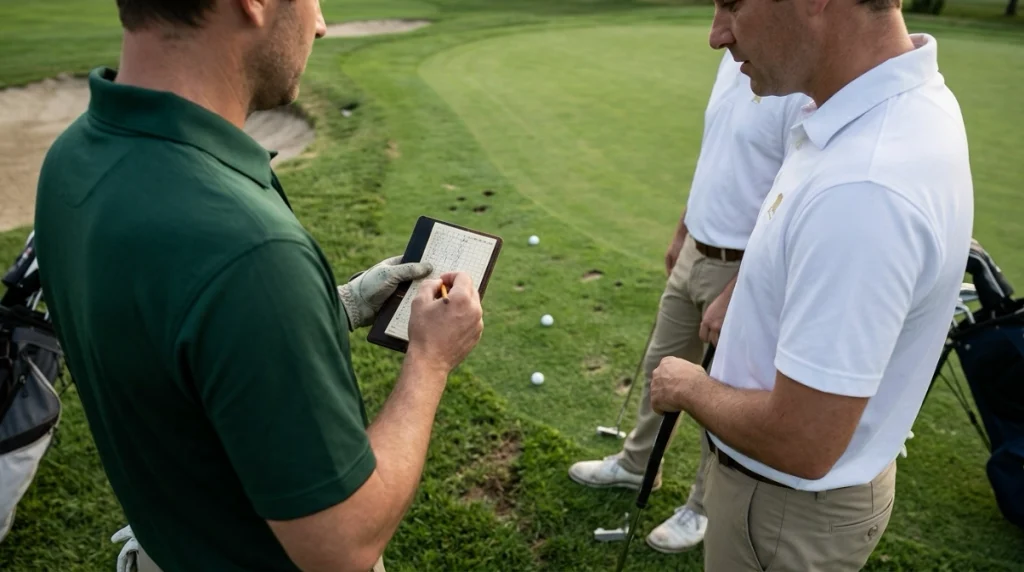
Best ball scoring happens one hole at a time. Compare the teammates’ scores after each hole and record the lowest qualifying score for the team.
Two-Person Best Ball Example
| Hole | Player A | Player B | Team Score |
|---|---|---|---|
| 1 | 5 | 4 | 4 |
| 2 | 3 | 5 | 3 |
| 3 | 6 | 4 | 4 |
| Total | 14 | 13 | 11 |
Notice that the team total is not simply Player B’s 13. The team takes the lowest score available on each individual hole.
Stroke Play Best Ball
In stroke play, you add the team’s counting score from every hole. The side with the lowest total after the scheduled round wins.
A poor individual hole may therefore disappear from the team card. It still matters if your partner does not produce a lower score.
Match Play Best Ball
In match play, teams compare their counting score hole by hole. The team with the lower score wins that hole rather than subtracting strokes from a final total.
A side wins the match once its lead is larger than the number of holes remaining. One blow-up hole therefore usually costs only that hole.
Can Four Players Play Best Ball?
Yes, many recreational and tournament events use four-player teams. The competition must state how many scores count on each hole.
- Best 1 of 4: The team’s single lowest score counts.
- Best 2 of 4: The two lowest scores are added together.
- Best 3 of 4: Three scores count on every hole.
- All 4 of 4: Every player’s score contributes.
These are team scoring variations rather than the standard two-partner Four-Ball format. Always read the tournament’s Terms of the Competition before teeing off.
Section Takeaway: Best ball is scored hole by hole, not by choosing the teammate with the lowest final round. The player providing the counting score can change on every hole.
What Is the Difference Between Best Ball and Scramble?
Best ball selects the best score after players finish a hole. A scramble selects the best shot location after almost every stroke.
This is the mistake I see cause the most confusion. Remembering “best score versus best shot” clears it up immediately.
| Feature | Best Ball | Scramble |
|---|---|---|
| Ball played | Each golfer plays their own ball. | Team repeatedly plays from a selected shot. |
| What gets selected | Lowest finished score. | Best shot location. |
| Individual round | Normally preserved. | Not preserved as a normal individual score. |
| Bad tee shot | Player usually continues from it. | Often abandoned for a teammate’s better drive. |
| Typical feel | Individual golf with team scoring. | Collaborative shot-by-shot golf. |
For example, imagine I drive into the rough while my partner splits the fairway. In best ball, I still play my next shot from the rough.
In a scramble, we would normally choose my partner’s drive. I would pick up my ball and play the next shot from the selected location under the event’s placement rules.
The PGA of America’s format overview also separates best ball from scramble on this same basic principle.
Which Format Is Better for Beginners?
A scramble is usually more forgiving for brand-new golfers because bad shots can be discarded. It also removes some pressure from difficult holes.
Best ball works well once players want to experience a normal round while still having a teammate. It gives beginners support without removing the need to play their own shots.
Section Takeaway: Best ball means best finished score; scramble means best shot. If everyone plays their own ball throughout the hole, you are not playing a traditional scramble.


How Do Handicaps Work in Best Ball?
Handicaps allow golfers of different abilities to compete using net scores. Each player receives strokes according to their Playing Handicap and the hole’s stroke index.
Events can also play gross best ball, where no handicap strokes are deducted. The tournament committee should tell players which method applies.
Gross Best Ball vs. Net Best Ball
- Gross best ball: Compare each player’s actual strokes and take the lowest score.
- Net best ball: Apply each player’s handicap strokes first, then compare the resulting net scores.
Imagine Player A makes a gross 5 on a hole where they receive one handicap stroke. Their net score becomes 4.
If Player B makes a gross 4 but receives no stroke, their net score is also 4. The team’s net best-ball score is therefore 4.
What Percentage of Handicap Is Used?
Under the World Handicap System, the USGA’s recommended handicap allowances depend on the exact team format. These recommendations may be adjusted by the competition committee.
| Format | Recommended Allowance |
|---|---|
| Four-Ball stroke play | 85% |
| Four-Ball match play | 90% |
| Best 1 of 4 stroke play | 75% |
| Best 2 of 4 stroke play | 85% |
Do not simply multiply a rounded handicap number without checking the event setup. Under WHS guidance, handicap allowances are normally applied as part of calculating the Playing Handicap.
The committee’s published Terms of the Competition control the event. Confirm the allowance, tees, stroke allocation, and whether the competition uses gross or net scoring.
Section Takeaway: Net best ball compares handicap-adjusted hole scores, while gross best ball compares actual strokes. For standard Four-Ball stroke play, the USGA recommends an 85% handicap allowance.
What Rules Matter Most in a Best Ball Tournament?
The normal Rules of Golf still apply because every player plays their own ball. Rule 23 then adds provisions for partners competing together as a side.
1. One Partner’s Score Can Count
Both partners do not always need to finish every hole. If one partner completes the hole with a score that will count, the other may not need to hole out.
This can save time when a player’s score clearly cannot improve the team’s result. In stroke play, however, the side must still have a valid score for the hole.
2. Identify the Player Who Made the Score
In Four-Ball stroke play, the side’s scorecard must contain the gross score of at least one partner on each hole. The score must also be clearly attributed to the player who made it.
Do not write only an anonymous team number without identifying the golfer. Scorecard errors can carry serious consequences in competition.
3. Partners Can Choose Their Order
Partners have useful flexibility over who plays first for their side. They can choose the order they believe gives the team the best tactical advantage.
This creates strategy around risky shots. A steady player might establish a safe position before the more aggressive partner attacks.
4. Partners Can Give Each Other Advice
Unlike unrelated competitors, partners may discuss club selection, strategy, reads, and other permitted advice. That makes communication part of the format.
I prefer simple conversations rather than turning every shot into a committee meeting. Decide whether the team needs safety or aggression, then let the player commit.
5. Check the Event’s Additional Conditions
Club events often add details that are not universal best ball rules. Read the competition sheet before assuming your usual weekend-game setup applies.
- Gross or net scoring
- Handicap allowance
- Number of team scores counting
- Tee assignments
- Tie-breaking method
- Local Rules
- Pace-of-play procedures
Section Takeaway: Best ball does not replace the normal Rules of Golf. It adds team scoring and partner-specific rules, so the event’s Terms of the Competition still matter.
What Is the Best Strategy for Best Ball?
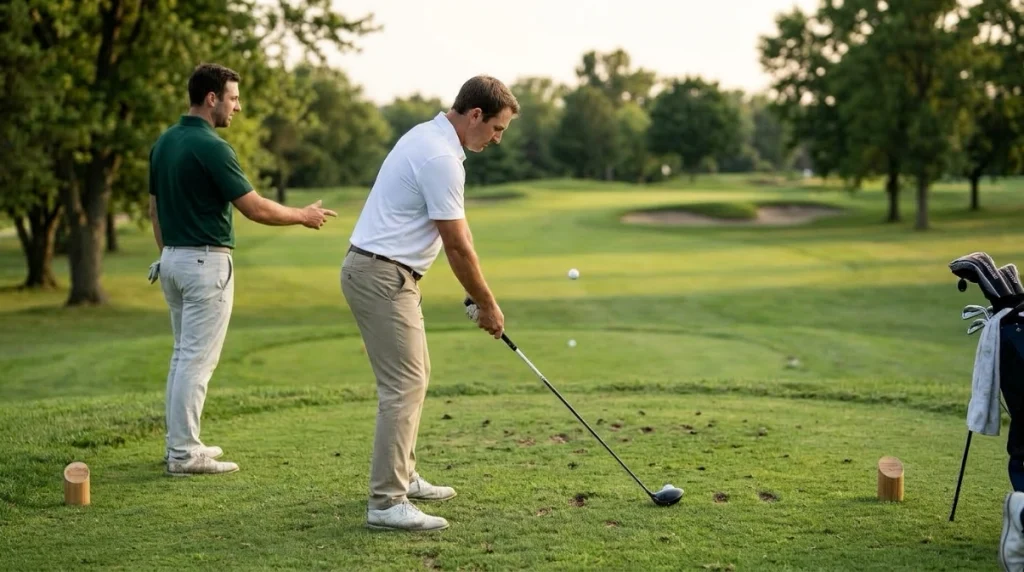
Good best ball strategy is about avoiding two bad scores on the same hole. Partners should balance safety and aggression rather than both taking identical risks.
Get One Ball Safely in Play
Off the tee, I like the idea of establishing a usable position before the second player takes extra risk. That approach is especially useful on tight holes with penalty areas or out-of-bounds trouble.
If the first player finds the fairway, the second golfer gains freedom. They can chase extra distance without leaving the team completely exposed.
Use Complementary Strengths
The best partner is not automatically the golfer with the lowest handicap. Two players whose strengths cover different parts of the course can make an effective team.
- Accurate driver: Provides playable tee shots on demanding holes.
- Strong iron player: Creates birdie opportunities on approach shots.
- Reliable putter: Converts chances when the other partner struggles.
- Steady scorer: Reduces holes where both players make big numbers.
Change Your Risk Level After Your Partner’s Shot
Best ball rewards situational decisions. Your target can change after seeing what your partner has done.
If your partner is safely on the green, attacking a tucked flag may make sense. If your partner is in trouble, the smart play may be the center of the green.
Think Carefully on Par 3s
Par 3s are excellent examples of team strategy because both players begin from the same general challenge. A safe green hit can free the partner to attack a flag.
If the first shot misses badly, the second player should often prioritize putting the team in position for par. Two aggressive misses can turn one difficult hole into a guaranteed team mistake.
Do Not Give Up on Your Hole Too Early
Your partner may look certain to make par, but golf changes quickly. A missed short putt can suddenly make your bogey important.
Keep playing until your score clearly cannot help. Then picking up can improve pace when the format and rules allow it.
Communicate Without Creating Pressure
A good partner should know whether the team already has a safe score developing. That information helps the second player choose a target.
Keep the conversation practical. “I’m safely on in two, so you can attack” is more useful than trying to coach a partner’s swing during competition.
Section Takeaway: The strongest best ball teams avoid having both players fail on the same hole. Establish safety when needed, then use your partner’s position to decide how aggressively to play.
Best Ball Format FAQ
Is best ball the same as Four-Ball?
In everyday golf, people often use best ball to describe the standard two-player Four-Ball format. Under the formal Rules of Golf, Four-Ball is two partners playing their own balls with the lower score counting, while “Best-Ball” also has a narrower match-play definition.
Does everyone play their own ball in best ball?
Yes. Each player normally plays their own ball from the tee until the hole is completed or their score can no longer help the side. This is the easiest way to distinguish best ball from a scramble.
What score counts in a two-person best ball?
The lower eligible score between the two partners counts for the team on each hole. If Player A makes 4 and Player B makes 6, the team records 4.
What is a two-man best ball?
A two-man best ball is a two-player team format where both golfers play their own balls. The lower gross or net score becomes the team score on each hole, depending on the competition rules.
Can best ball use handicaps?
Yes. A competition can use net scoring so each player’s handicap strokes are applied before the team’s lowest net score is selected. The committee should specify the handicap allowance and stroke allocation before play.
Is best ball faster than regular stroke play?
It can be slightly faster when a partner is allowed to pick up after their score can no longer help. However, every player generally plays more shots than in a scramble, so best ball is not automatically the fastest team format.
What happens if both partners have the same score?
If both partners make the same eligible score, that number becomes the team’s score. In a two-player event, it does not matter which equal score is selected for the team result, provided scorecard requirements are satisfied.
Best ball is one of my favorite formats for golfers who want team competition without giving up the challenge of playing their own ball. Learn the scoring before the first tee, confirm the event’s handicap rules, and use your partner’s position to make smarter decisions throughout the round.
Once you remember one rule, the format becomes easy: everyone plays their own ball, and the best eligible score wins the hole for the team.