
Scramble Format in Golf: Rules, Scoring, Strategy, and Handicaps

Quick Answer
A scramble format is a team golf format where every player hits, the team selects the best shot, and every team member plays the next shot from that selected location. The process repeats until the ball is holed, with one team score recorded for the hole. The USGA scramble guidance follows this basic format.
How a scramble works
- Everyone tees off: Each player on the team hits a tee shot.
- Choose the best: The team decides which shot leaves the best next opportunity.
- Play from there: Every team member hits the next shot from the selected location.
- Repeat the process: The team keeps selecting one shot until the hole is completed.
- Record one score: Only the team’s score for the hole goes on the card.
Before you start
- Check the event’s rules for ball placement, minimum drives, handicaps, mulligans, and tie-breaking procedures.
The scramble format is one of the easiest team formats to understand, but organized scrambles can still create plenty of questions. Ball placement, handicaps, tee-shot requirements, and team strategy can change how the event plays.
I like scrambles because one poor swing rarely ruins a hole. A golfer can struggle for several shots, hole one important putt, and suddenly become the hero of the team.
In This Guide
What Is Scramble Format in Golf?
A golf scramble is a team format where players repeatedly select the team’s preferred shot. Everyone then plays the following stroke from that selected location.
Definition: A scramble format combines several players’ shots into one team score by selecting one shot after each round of strokes.
Most people encounter scrambles at charity tournaments, corporate outings, club events, and social competitions. The format works especially well when golfers have different skill levels.
- Team-focused: Individual scores normally do not matter.
- Beginner-friendly: A poor shot can be replaced by a teammate’s better result.
- Collaborative: Players discuss targets, club choices, and which ball to select.
- Flexible: Organizers can add minimum-drive requirements, handicaps, mulligans, or other conditions.
The format also creates a different type of pressure. Instead of protecting your individual score, you are trying to produce one useful shot when your team needs it.
That can make a 20-foot putt feel more meaningful than several perfect drives.
Section Takeaway: A scramble is a shared-shot team format. The team’s best available position matters more than any player’s individual score.
How Does a Golf Scramble Work?
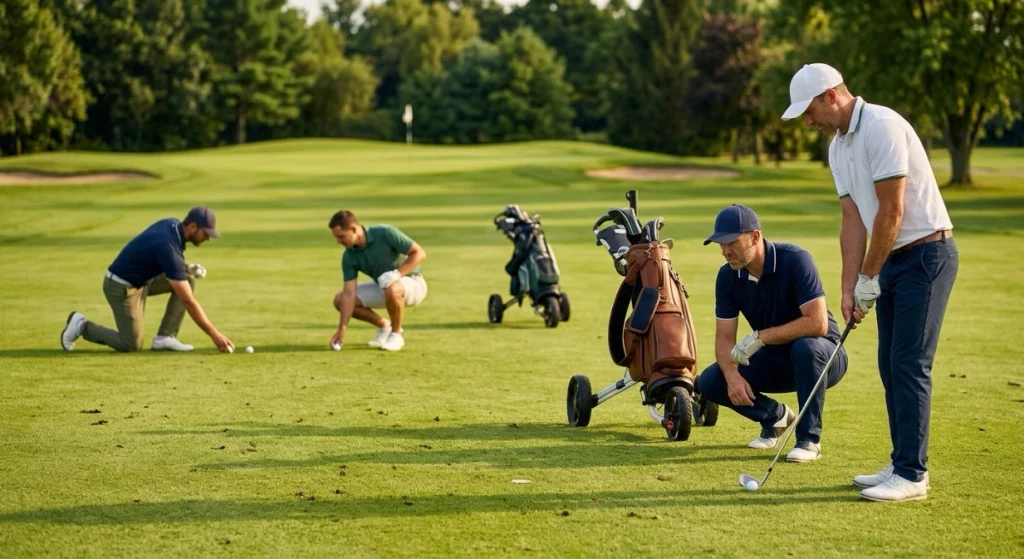
A scramble works by repeating the same basic cycle throughout every hole. All players hit, one shot is selected, and everyone continues from that location.
Step 1: Everyone hits a tee shot
Suppose you have a four-player team. All four golfers tee off from the appropriate teeing areas.
The team then compares the four results.
Step 2: Choose the best tee shot
The longest drive is not automatically the best drive. Position matters.
A 230-yard ball in the middle of the fairway may be more useful than a 260-yard drive behind trees.
- Check the lie: Fairway grass usually gives more control than deep rough.
- Check the angle: Some positions create a much clearer approach.
- Check hazards: Avoid selecting a ball that forces the next player toward unnecessary trouble.
- Check distance: Extra yardage helps only when the next shot remains playable.
Step 3: Everyone plays from the chosen position
After selecting a ball, the other balls are picked up. Each team member then plays from the selected location according to the tournament’s placement procedure.
This is where local event rules matter. Organizers should clearly state how close players may place their balls to the chosen spot.
Step 4: Select the best next shot
The process repeats after the second shots. Your team chooses the preferred result and everyone plays again from there.
Continue until the selected ball is holed.
Step 5: Record one team score
If your team reaches the green in three strokes and holes the selected putt on the fourth stroke, the team records a four. You do not add all four players’ strokes together.
That distinction separates a scramble from formats where each golfer keeps playing an individual ball.
| Stage | What the Team Does | Example |
|---|---|---|
| Tee shots | Everyone hits | Choose Player B’s fairway drive |
| Approach | Everyone plays from the selected drive | Choose Player D’s shot onto the green |
| Putting | Everyone putts from the selected position | Player A holes the putt |
| Score | Record one team total | Team records the completed hole score |
The USGA’s stroke-play guidance explains the broader principle of comparing total scores in stroke-play competitions. Scramble events commonly use a team total across the round.
Section Takeaway: Every player contributes shots, but the team advances only from the selected result. One score is recorded for each completed hole.
What Rules Should a Scramble Tournament Use?
Scramble rules are not identical at every tournament. The committee or event organizer should publish the conditions before play begins.
The USGA’s team competition guidance gives committees authority to establish the form of play and how team results are calculated.
Ball placement
Players need to know exactly where the next shots may be played. Do not assume your previous charity event used the same rule.
An organizer might specify a club-length or another defined distance. The ball should not be moved into a more favorable area unless the event rules allow it.
Minimum tee-shot requirements
Some scrambles require teams to use a certain number of drives from every player. This prevents one strong driver from supplying every tee shot.
A requirement might state that each player’s drive must be selected a certain number of times during the round. The exact number belongs in the event’s Terms of the Competition.
- Track drives early: Mark each player’s selected tee shots on the scorecard.
- Avoid late pressure: Do not leave a required drive until the hardest finishing hole.
- Use safe opportunities: Select a shorter player’s drive when it already leaves a comfortable approach.
Mulligans and special event rules
Charity events sometimes sell mulligans or add contests that are not part of a standard scramble definition. Treat these as event-specific rules.
Confirm when a mulligan may be used and whether it replaces the original stroke.
Penalties and unusual situations
Players should not invent solutions when an organized event has a rules committee. Ask the committee when a penalty area, lost ball, obstruction, or disputed procedure creates uncertainty.
The tournament’s published rules should also explain ties.
- Scorecard comparison: Some events use a predetermined countback procedure.
- Playoff holes: Competitive events may send tied teams back onto the course.
- Event-specific method: Charity outings may use a simpler predetermined tiebreaker.
Section Takeaway: The basic scramble process is simple, but placement, tee-shot minimums, mulligans, penalties, and tiebreakers must come from the event’s published rules.


How Do Scramble Handicaps Work?
Scramble handicaps are designed to create a more balanced competition between teams with different ability levels. The exact allowance depends on team size and the Terms of the Competition.
As of 2026, USGA handicapping guidance lists recommended scramble allowances based on each player’s handicap position within the team.
| Team Size | Recommended Allowance |
|---|---|
| 4 players | 25% / 20% / 15% / 10%, lowest to highest handicap |
| 3 players | 30% / 20% / 10%, lowest to highest handicap |
| 2 players | 35% low / 15% high |
These are recommended allowances rather than a promise that every tournament will use the same percentages. Always read the tournament sheet before calculating a net score.
USGA guidance also says that when one Playing Handicap is used for a team format such as a scramble, allowances are applied to each player’s unrounded Course Handicap. Those results are combined before the final team Playing Handicap is rounded.
Gross score vs net score
- Gross score: The actual number of team strokes taken during the round.
- Playing Handicap: The handicap value the competition applies to the team.
- Net score: The adjusted result after the competition’s handicap procedure is applied.
A team should not create its own handicap method on the first tee. The committee should establish the system before play.
Section Takeaway: Scramble handicap allowances vary with team size. Use the tournament’s stated procedure rather than assuming every scramble uses the same calculation.
What Is the Best Scramble Strategy?
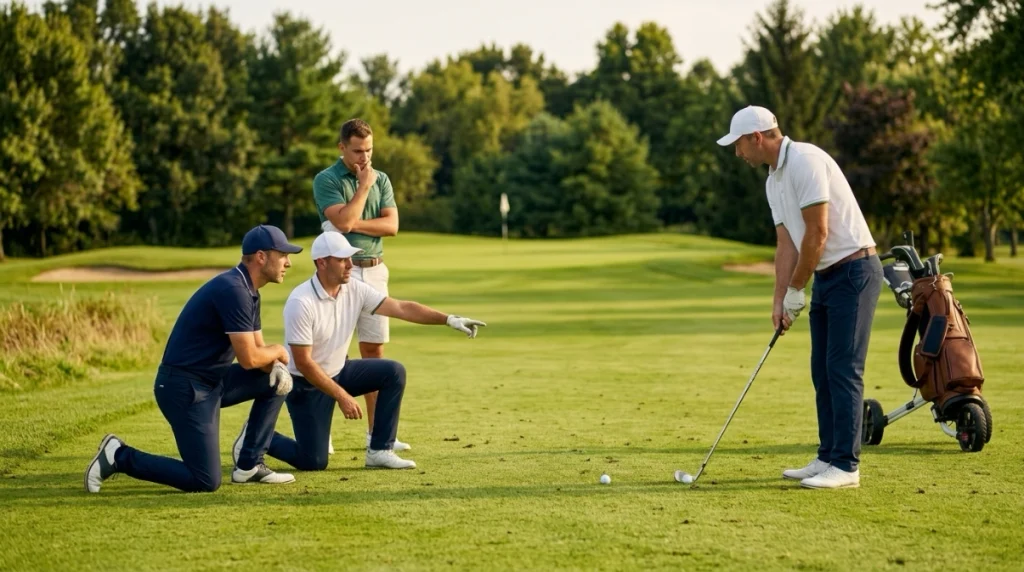
The best scramble strategy is to create safety first and aggression second. Once the team has a playable shot, later players can take more risk.
This approach is especially useful on tee shots, approaches, and putts.
Choose an order with a purpose
I prefer an order where a steady player creates a usable result early. That gives aggressive players more freedom afterward.
The strongest player does not need to hit first.
- First player: Prioritize a playable ball and useful information.
- Middle players: Improve the position while adjusting to what they have seen.
- Last player: Use the team’s existing safety net to attack when appropriate.
Do not automatically choose the longest drive
Distance is only one part of the decision. The next shot matters more.
Compare the lie, angle, hazards, tree lines, green access, and distance before choosing.
Use putting attempts as information
Scramble putting rewards teamwork because later players can learn from earlier rolls. An early putt can reveal speed and break even when it misses.
The key is giving later players useful information without wasting a good scoring opportunity.
- Read the putt together. Agree on the likely break before the first attempt.
- Send a confident starter. Ask the first player to make a committed stroke.
- Watch the entire roll. Do not turn away after the ball passes the hole.
- Adjust intelligently. Later players should react to the observed line and speed.
Manage required drives early
If every player must contribute a tee shot, plan around that rule from the opening holes. Waiting until the final holes can create unnecessary pressure.
A shorter drive can still be a smart selection when the hole leaves a simple next shot.
Think about the team, not individual pride
This is the biggest mental adjustment. Your personal result on a shot has almost no value once the team selects another ball.
Move on immediately and prepare to help with the next stroke.
One thing I enjoy about scrambles is how quickly roles change. A player who has barely contributed from tee to green can still make the only putt anyone remembers.
Section Takeaway: Secure a safe result first, then let later players become more aggressive. Select shots by the quality of the next opportunity, not by ego or distance alone.
Scramble vs Best Ball, Shamble, and Alternate Shot
A scramble is often confused with other team golf formats. The easiest way to separate them is to ask one question: does each golfer keep playing their own ball?
In a scramble, the answer is no. The team repeatedly selects one position.
| Format | Tee Shot | After the Tee Shot | Typical Team Scoring Idea |
|---|---|---|---|
| Scramble | Everyone hits | Select one shot and everyone plays from there | One team score |
| Best Ball | Players hit their own balls | Each player normally continues their own ball | Specified best individual score counts |
| Shamble | Everyone hits | Select a drive, then players continue their own balls | Depends on event rules |
| Foursomes / Alternate Shot | Partners alternate tee shots by hole | Partners alternate strokes with one ball | One side score |
The USGA guidance on other formats of play lists scrambles alongside formats such as foursomes, greensomes, Chapman/Pinehurst, shamble, and other team competitions.
Scramble vs best ball
Best ball allows golfers to keep individual balls in play. The team then uses the required best individual score or scores.
A scramble instead combines the team’s shots throughout the hole.
Scramble vs shamble
A shamble starts like a scramble because everyone tees off and one drive is selected. After that selection, golfers normally play their own balls for the rest of the hole.
That makes a shamble a useful middle ground between team assistance and individual golf.
Scramble vs alternate shot
Alternate shot gives a side one ball and requires partners to alternate strokes. A scramble gives every team member repeated chances from the selected positions.
Alternate shot therefore places more pressure on each individual stroke.
Section Takeaway: In a scramble, the team repeatedly selects one position. In best ball and shamble formats, golfers spend more of the hole playing their own balls.
Scramble Format FAQ
What does scramble format mean in golf?
Scramble format means every golfer on a team hits a shot, the team selects its preferred result, and all players hit again from that location. The process continues until the hole is completed, with one score recorded for the team.
How many players are on a golf scramble team?
Scrambles can use different team sizes. Two-player, three-player, and four-player versions are common enough that USGA handicap guidance provides recommended allowances for each of those team sizes.
Does everyone putt in a scramble?
Generally, everyone gets an opportunity from the selected putting position until the hole is completed. Once the team has holed the ball, the hole is finished, so additional putts are not needed for the team’s score.
Do you play your own ball in a scramble?
Not throughout the hole. You hit your own shot from each selected team position, but the team then chooses one result and abandons the other balls before the next round of shots.
What is the difference between scramble and best ball?
In a scramble, teammates repeatedly choose one shot and all play from that position. In best ball, golfers normally play their own balls through the hole, and the required best individual score is used for the team result.
Can beginners play a scramble?
Yes. Scrambles are especially approachable for beginners because one poor shot does not have to become the team’s next position. New golfers can also contribute with a good drive, approach, chip, or putt without carrying an individual score for every hole.
Are scramble rules the same at every tournament?
No. Organizers may set different conditions for placement, minimum drives, handicaps, mulligans, tees, penalties, and tiebreakers. Read the event sheet before starting instead of assuming rules from a previous scramble.
Final takeaway: The scramble format keeps golf social, strategic, and forgiving. Learn the event’s specific rules, secure a safe shot before attacking, and judge every selected ball by the opportunity it creates for the next stroke.
If you’re playing your first scramble, focus on contributing one useful shot at a time. You do not need to be the best golfer in the group to make a difference.