
Provisional Ball Rule in Golf: Complete Rule 18.3 Guide

Quick Answer
The provisional ball rule lets you play a backup ball when your original might be lost outside a penalty area or might be out of bounds. Under Rule 18.3 of the Rules of Golf, you must announce the provisional before making the stroke, then follow the correct procedure depending on whether the original ball is found.
Provisional ball checklist
- Use it for uncertainty: The original must possibly be lost outside a penalty area or out of bounds.
- Announce it first: Say “provisional” or otherwise clearly state that the second ball is provisional.
- Play from the proper spot: Use the stroke-and-distance procedure for the location of your previous stroke.
- Search for three minutes: Your original becomes lost if it is not found within the permitted search period.
- Use the original if found: If it is found in bounds in time, you normally abandon the provisional.
- Count stroke and distance: If the provisional becomes your ball in play, one penalty stroke applies.
I’ve seen the provisional ball rule create more scorecard confusion than its basic purpose suggests. The idea is simple: hit a backup now so you do not have to walk back later.
The details matter, though. This guide explains when you can play a provisional, what you must say, how the three-minute search works, and when that second ball becomes your ball in play.
In This Guide
- What Is the Provisional Ball Rule in Golf?
- When Can You Play a Provisional Ball?
- How Do You Play a Provisional Ball Correctly?
- When Does a Provisional Become the Ball in Play?
- How Do Provisional Ball Penalties and Scoring Work?
- What Provisional Ball Mistakes Should You Avoid?
- Provisional Ball Rule FAQ
What Is the Provisional Ball Rule in Golf?
The provisional ball rule allows a golfer to play another ball when the original might be lost outside a penalty area or might be out of bounds. Its purpose is to save time if stroke-and-distance relief later becomes necessary.
The provisional does not automatically replace your first ball. It remains conditional while you determine what happened to the original.
This distinction separates a provisional from simply taking stroke-and-distance relief. Once you deliberately put another ball into play under stroke and distance without valid provisional status, your original ball is no longer in play.
The USGA explanation of Rule 18 places lost balls, out-of-bounds balls, stroke-and-distance relief, and provisional balls within the same rule.
What does stroke and distance mean?
Stroke and distance means adding one penalty stroke and playing again from where your previous stroke was made. You therefore lose both a stroke on the scorecard and the distance gained by the previous shot.
For example, imagine your drive may have crossed a white boundary fence. You announce a provisional and hit another drive from the teeing area.
- Stroke 1: Your original tee shot.
- Stroke 2: The stroke-and-distance penalty, if the provisional becomes the ball in play.
- Stroke 3: The stroke made with the provisional from the tee.
If the original is found safely in bounds within the permitted search time, the penalty does not suddenly remain on your score. You abandon the provisional and continue with the original.
Section Takeaway: A provisional is a conditional backup. It only carries stroke-and-distance consequences when it becomes your ball in play.
When Can You Play a Provisional Ball?
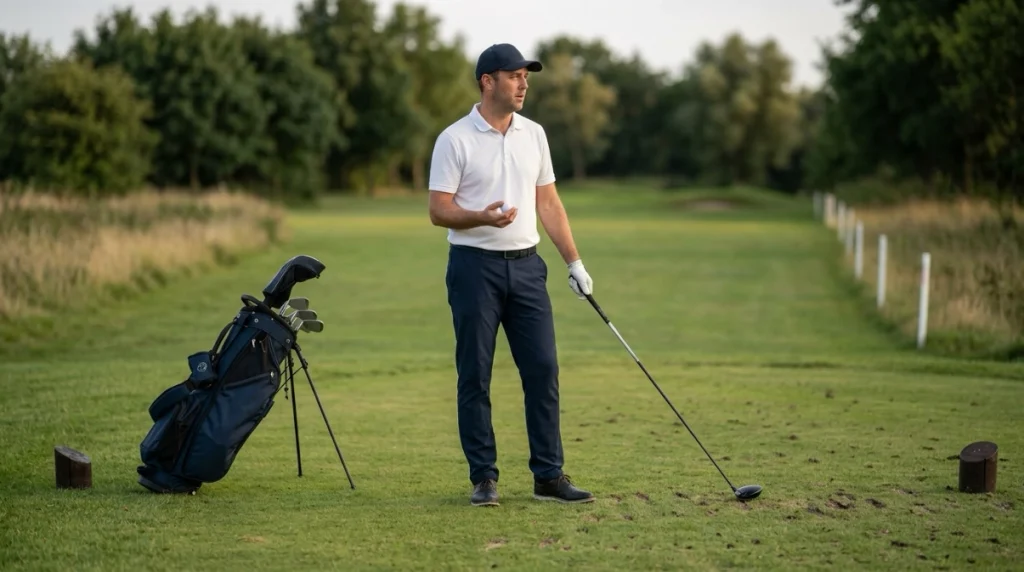
You may play a provisional when your original ball might be lost outside a penalty area or might be out of bounds. You do not need proof that either outcome has occurred.
That uncertainty is the key. The information reasonably available to you at the time determines whether playing a provisional is allowed.
- Thick rough or trees: Your ball may be difficult to find in an area that is not a penalty area.
- Course boundary: Your shot heads toward white stakes, a boundary fence, or another defined boundary.
- Mixed possibilities: The ball might be in a penalty area, but it might instead be lost outside that area.
- Penalty area and boundary: The ball might have entered a penalty area or continued out of bounds.
The USGA lost-ball and provisional guidance also recommends using a provisional when there is a genuine chance you will not find the original.
When is a provisional ball not allowed?
You normally cannot play a provisional when you know the only possible location of your original ball is a penalty area. Penalty areas have their own relief procedures under Rule 17.
For example, suppose your shot clearly splashes into a pond surrounded by closely mown ground. If there is no realistic possibility that the ball is lost elsewhere or out of bounds, Rule 18.3 does not provide the normal provisional option.
Can you play a provisional after you start searching?
Yes, in some circumstances. You can still return and play a provisional before the original becomes lost, provided the three-minute search period has not expired.
In practice, that rarely saves much time. I prefer making the decision before leaving the area of the previous stroke whenever the shot creates genuine doubt.
Section Takeaway: You need uncertainty about a lost ball outside a penalty area or out of bounds. A ball known only to be in a penalty area follows different rules.
How Do You Play a Provisional Ball Correctly?
The safest provisional-ball routine has five steps. Most rules problems happen because golfers skip the announcement or become confused about which ball they should continue playing.
- Decide that a provisional is allowed. Your original might be lost outside a penalty area or out of bounds.
- Announce your intention. Tell someone that you are playing a provisional before making the stroke.
- Play from the previous location. Follow the appropriate stroke-and-distance procedure for that spot.
- Keep the balls identifiable. Use different numbers or markings when possible.
- Search for the original. Apply the three-minute search limit correctly.
What should you say before playing the provisional?
The easiest wording is, “I’m playing a provisional.” It is short, clear, and removes nearly all doubt about your intention.
Saying only “I’ll hit another” or “I’m reloading” may not clearly establish provisional status. Rule 18.3 requires the word “provisional” or another statement that clearly communicates the same intention.
If nobody is nearby to hear you, the Rules allow you to play the provisional and inform someone of what you did when reasonably possible. That situation is different from simply forgetting to announce it when another person is present.
Where do you play the provisional from?
You use the place of your previous stroke under the procedures in Rule 14.6. From the teeing area, that means you may play again from anywhere within the teeing area.
For a previous stroke made from the general area, bunker, or penalty area, the applicable stroke-and-distance procedure involves dropping in the correct relief area. A previous stroke from the putting green is handled from the previous spot.
Section Takeaway: Say “provisional” before the stroke and use the correct previous location. Those two habits prevent most avoidable Rule 18.3 mistakes.


When Does a Provisional Become the Ball in Play?
Your provisional becomes the ball in play when the original is lost outside a penalty area, is out of bounds, or you play the provisional from a spot nearer the hole than the estimated location of the original. Stroke and distance then applies.
What happens after the three-minute search expires?
Your ball is lost if it is not found within three minutes after you or your caddie begins searching for it. Once it is lost, a properly played provisional becomes the ball in play.
A ball found after the search period does not come back into play. This is why keeping track of the search time matters in both competition and casual rounds played under the Rules.
Can you keep hitting the provisional while walking forward?
Yes. You may continue playing it while it remains the same distance from the hole or farther from the hole than the estimated position of the original ball.
The critical point comes when you make a stroke at the provisional from a location nearer the hole than the estimated position of the original. At that moment, the provisional becomes your ball in play.
When must you abandon the provisional?
You must abandon it when your original is found on the course outside a penalty area within the search time. You also abandon it when the original is found in a penalty area or is known or virtually certain to be there.
- Original found safely in bounds: Continue with the original.
- Original found in a penalty area: Use the original or the available penalty-area relief options.
- Original lost outside a penalty area: Continue with the provisional.
- Original out of bounds: Continue with the provisional.
An important trap occurs when the original is found but is in a terrible lie. You cannot choose the provisional simply because you prefer its position.
If the original is in bounds but unplayable, abandon the provisional and use the unplayable-ball options that apply to the original.
Section Takeaway: The provisional remains temporary until a specific Rule 18.3 event changes its status. Do not choose between the two balls based on which result you like better.
How Do Provisional Ball Penalties and Scoring Work?
A provisional itself does not create an automatic penalty. The penalty matters when the provisional becomes your ball in play under stroke and distance.
Compare the main procedures below before assuming every lost-ball situation works the same way.
| Procedure | When Used | Penalty | Where You Play |
|---|---|---|---|
| Provisional ball | Original might be lost outside a penalty area or out of bounds | One stroke if provisional becomes ball in play under stroke and distance | Location of previous stroke |
| Standard stroke and distance | Player chooses relief or original is lost/out of bounds without a usable provisional | One penalty stroke | Location of previous stroke |
| Model Local Rule E-5 | Lost or out-of-bounds ball when the Committee has adopted the Local Rule and its conditions are met | Two penalty strokes | Specified relief area extending toward the fairway |
How do you count a provisional after an out-of-bounds drive?
Suppose your first drive may be out of bounds. You announce and hit a provisional from the tee.
If the original is confirmed out of bounds, the provisional is your ball in play. The provisional drive was your third stroke after adding the stroke-and-distance penalty.
- 1: Original drive.
- 2: One penalty stroke.
- 3: Provisional drive.
- 4: Your next stroke at the provisional, assuming no other penalties.
Can you use the two-stroke Local Rule after hitting a provisional?
Model Local Rule E-5 is an optional alternative that a Committee may adopt for lost or out-of-bounds balls. The USGA explanation of Model Local Rule E-5 states that the option is not available for the original ball after you have played a provisional for it.
Always check the scorecard, notice board, competition information, or golf shop before assuming E-5 is in effect. It is a Local Rule, not an automatic option on every golf course.
Section Takeaway: A provisional that becomes the ball in play uses the standard one-stroke stroke-and-distance penalty. E-5 is a separate two-stroke option available only when the Committee has adopted it.
What Provisional Ball Mistakes Should You Avoid?
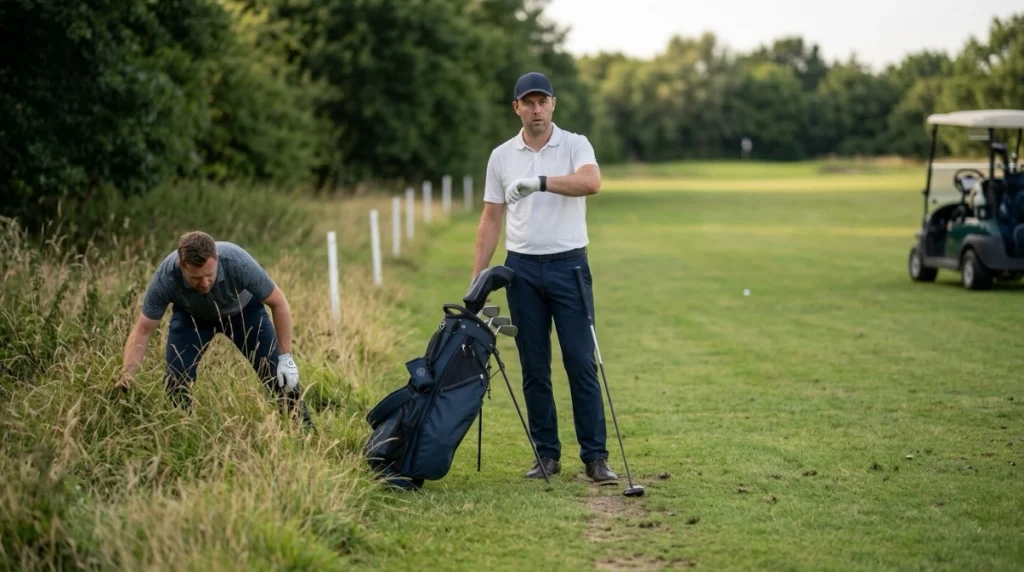
The biggest provisional-ball mistakes usually come from casual wording or rushing the decision. A ten-second rules check can prevent a much bigger scoring problem.
- Not announcing the provisional: The new ball may become your ball in play immediately under stroke and distance.
- Using a provisional for a ball known only to be in a penalty area: The normal Rule 18.3 procedure does not allow this.
- Playing the provisional too far forward: A stroke from nearer the hole than the original’s estimated location can make the provisional the ball in play.
- Searching longer than three minutes: The original becomes lost when the permitted search time expires.
- Choosing the better ball: Rule 18.3 determines which ball counts; the golfer does not get a free choice.
- Assuming E-5 always applies: The Committee must put that optional Local Rule into effect.
Is there ever a provisional for a penalty area?
There is a special Committee option for unusual situations. Model Local Rule B-3 can modify the normal procedure for a specifically identified penalty area where searching first could create unreasonable delay.
This is not a general permission golfers can apply themselves. The Committee must adopt and define the Local Rule, which can be checked through the R&A Local Rules guidance.
A practical on-course habit
When I see a tee shot disappear toward deep rough or a boundary, I make the provisional decision while everyone is still near the tee. I also use a different ball number whenever possible.
That small routine solves two problems at once. It protects pace of play and reduces arguments about which ball is which when the group reaches the landing area.
Section Takeaway: Clear communication is your best protection. Announce the provisional, identify it, watch the three-minute clock, and check Local Rules before using an alternative procedure.
Provisional Ball Rule FAQ
Do I have to say the word “provisional”?
No single sentence is mandatory, but your announcement must clearly indicate that the ball is being played provisionally. Saying “I’m playing a provisional” is the safest choice because simply saying “I’ll hit another” may not clearly communicate your intent.
How long can I search for my original ball?
You have three minutes from when you or your caddie begins searching. If the original is not found within that period, it is lost under the Rules and a properly played provisional can become your ball in play.
Can I play a provisional when my ball might be in water?
Yes, if the ball might also be lost outside the penalty area or might be out of bounds. If you know the only possible outcome is that the ball is in the penalty area, a normal provisional under Rule 18.3 is not allowed.
What happens if I find my original after playing a provisional?
If you find the original on the course outside a penalty area within the search time and the provisional has not already become your ball in play, you must abandon the provisional and continue with the original ball.
Can I use the provisional if my original ball is unplayable?
No. Finding your original in bounds does not let you choose the provisional because the original has a poor lie. You must abandon the provisional and either play the original as it lies or use the applicable unplayable-ball relief procedure.
Can I hit more than one provisional ball?
Yes. If your first provisional might also be lost outside a penalty area or out of bounds, you may play another provisional. Each new provisional relates to the ball immediately before it, so clear identification and announcements become especially important.
Is a provisional ball always the best choice?
It is often the smartest pace-of-play choice when a ball may be lost outside a penalty area or out of bounds. If there is no meaningful doubt about finding the ball, however, there may be no reason to play one.
As of 2026, the core provisional ball rule remains straightforward: announce it, play it from the correct previous location, and let Rule 18.3 determine which ball stays in play.
Before a competitive round, I recommend checking both the official Rules and the course’s Local Rules. That quick check can save strokes, time, and an uncomfortable discussion on the next tee.