
10 Finger Grip in Golf: How It Works, Pros, Cons, and Who Should Use It

Quick Answer
The 10 finger grip, also called the baseball grip, keeps all ten fingers in contact with the golf club without overlapping or interlocking them. It can feel simple and comfortable, especially for golfers who dislike connected-hand grips, but correct hand position still matters. The PGA’s grip guidance is a useful reference for checking hand placement.
When the 10 finger grip may work well
- Simple connection: All ten fingers stay directly on the club.
- Natural feel: Some beginners find it easier than learning an interlock or overlap.
- Hand comfort: It can help golfers who dislike pressure around the pinky and index fingers.
- More hand action: The hands may feel freer through impact, which can be helpful or harmful.
- Easy to test: You can compare it with your normal grip during short range sessions.
My main advice
- Don’t judge the grip after three swings. Start with short shots, check your clubface, and then test longer clubs.
I’ve seen the 10 finger grip dismissed as a grip only for beginners, but that description is too simple. The baseball grip is a legitimate way to hold a golf club when it matches your hands and swing.
What matters most is whether the grip lets your hands work together without excessive tension. In this guide, I’ll show you how to set it up, who should try it, and where it can cause trouble.
In This Guide
What Is a 10 Finger Grip in Golf?
A 10 finger golf grip is a grip style where every finger touches the club. The trail-hand pinky sits beside the lead-hand index finger instead of overlapping or interlocking with it.
Definition: The 10 finger grip, or baseball grip, places both hands next to each other on the handle while keeping all ten fingers in contact with the club.
The name comes from its visual similarity to holding a baseball bat. A golf grip still requires more precise hand placement than simply grabbing the handle like a bat.
How are the hands connected?
They aren’t physically linked through the fingers. Your lead hand sits above your trail hand, while the hands remain close enough to function as one unit.
For a right-handed golfer, the left hand is the lead hand. The right hand sits directly below it.
- Lead hand: Place the handle mainly through the fingers with a small diagonal angle.
- Lead thumb: Let it rest slightly toward the trail side of the handle.
- Trail hand: Fit it below the lead hand without leaving a large gap.
- Trail palm: Let it cover or sit closely against the lead thumb.
- Trail pinky: Place it beside the lead index finger rather than over or through it.
The physical golf grip attached to your shaft must still meet the equipment requirements in the USGA Equipment Rules. Your 10-finger hand placement is a separate issue from the construction of that grip.
That distinction is worth remembering. Golfers sometimes use the word “grip” for both the rubber handle and the way their hands hold it.
How Do You Use a 10 Finger Golf Grip?

Build the grip from the lead hand first, then add the trail hand. Don’t place both hands on the club at once and hope they find the correct position.
I prefer learning any grip with a short iron before moving to the driver. A controlled half-swing makes face-control problems easier to notice.
Step-by-step setup
- Hold the club in front of you. Keep the clubface square while you build the grip.
- Place the handle across your lead fingers. Avoid burying it deeply into the center of your palm.
- Close the lead hand. Keep enough control to support the club without squeezing hard.
- Add the trail hand below it. Place the trail pinky directly beside the lead index finger.
- Bring the hands close together. A large gap can make them behave like two separate units.
- Check the trail palm. It should sit naturally against the lead thumb area.
- Reduce excess pressure. You need security, not a white-knuckle squeeze.
Check your grip before swinging
Address a ball and look at the clubface. Then make several slow waist-high swings while noticing whether the face feels stable.
If the clubface snaps closed or stays open, don’t immediately change your swing. First check whether one hand has become much stronger or weaker than the other.
- Keep both hands close together.
- Avoid excessive tension in your forearms.
- Check that neither hand dominates the grip.
- Start with small swings before adding speed.
- Use the same hand placement from shot to shot.
Pro tip: If you keep changing your grip but can’t control the clubface, have a PGA or LPGA professional check your hand position in person.
Who Should Try a 10 Finger Grip?
The 10 finger grip is worth testing when interlocking or overlapping feels uncomfortable or unstable. It can also give new golfers a simpler starting point.
That doesn’t mean every beginner should automatically use it. Comfort matters, but predictable clubface control matters more.
Beginners learning their first grip
New golfers already have many things to remember. The 10 finger grip removes the extra step of figuring out which fingers must overlap or interlock.
I still want a beginner to learn correct lead-hand and trail-hand placement. A simple connection can’t rescue poor hand position.
Golfers who dislike finger pressure
An interlocking grip creates direct contact between the trail pinky and lead index finger. Some golfers simply don’t enjoy that feeling.
The 10 finger method removes the interlock. That may make the club more comfortable to hold.
Golfers with smaller hands
More fingers stay directly on the handle with this grip. Some players with smaller hands prefer the added contact and straightforward setup.
Grip size matters too. If the rubber grip itself is too large or small for your hands, changing finger patterns may not solve the underlying problem.
Can good players use a 10 finger grip?
Yes. The grip is uncommon among elite players, but uncommon doesn’t mean unusable.
PGA Tour has documented Michael Thorbjornsen using a 10-finger grip throughout his career. His example shows that a golfer does not need to switch simply because another grip is more conventional.
You can read the PGA Tour’s feature on Thorbjornsen’s 10-finger grip for a real professional example.


What Are the Pros and Cons of a 10 Finger Grip?
The biggest advantage is simplicity and full finger contact. The biggest concern is that the hands can become too independent or active.
Those traits affect golfers differently. That’s why I treat grip selection as a test rather than a rule.
Possible advantages
- Easy to understand: There is no overlap or interlock pattern to learn.
- Full finger contact: Every finger touches the handle.
- Comfort: It removes pressure created where fingers overlap or interlock.
- Natural starting point: Golfers from baseball, softball, or hockey backgrounds may find the basic feel familiar.
- Useful alternative: It gives golfers another option when conventional grips feel awkward.
Possible disadvantages
- Active hands: Independent hands can rotate the clubface too quickly for some golfers.
- Timing dependence: Excess hand action can make impact less predictable.
- Hand separation: A gap between the hands can weaken their ability to work together.
- Trail-hand dominance: Some golfers allow the lower hand to take over during the downswing.
- Less common instruction: Many golfers will see overlap and interlock demonstrated more often.
When I evaluate a grip change, I care more about start direction and strike pattern than whether the grip looks conventional. A comfortable grip is useful only if it produces repeatable shots.
10 Finger vs Interlock vs Overlap: Which Grip Is Better?
No connection style is automatically best for every golfer. The main difference is how the lead and trail hands connect.
| Grip Style | Finger Connection | Main Characteristic | Worth Trying If |
|---|---|---|---|
| 10 Finger | All ten fingers contact the handle | Simple, direct hand-to-club contact | Overlap and interlock feel awkward |
| Interlock | Trail pinky and lead index finger interlock | Strong physical connection between hands | You like the hands feeling closely linked |
| Overlap | Trail pinky rests over the lead-hand fingers | Connected feel without interlocking | You want a traditional connected-hand option |
A 2024 Golf Digest audit of the PGA Championship field found interlock and overlap dominated, while the baseball grip appeared only rarely. That tells us what elite golfers commonly use, not what every recreational golfer must copy.
The full Golf Digest grip audit is useful if you’re curious about grip patterns among top players.
How I would compare them
Hit the same club with each grip instead of switching clubs during the test. A 7-iron is a good choice because it allows controlled swings without demanding driver speed.
- Hit short shots with your normal grip.
- Try the 10 finger grip at the same speed.
- Repeat with overlap or interlock.
- Compare strike location and start direction.
- Notice tension or discomfort in your fingers.
Don’t choose the grip that produces one spectacular shot. Choose the one that gives you the easiest repeatable pattern.
What Mistakes Should You Avoid With a 10 Finger Grip?
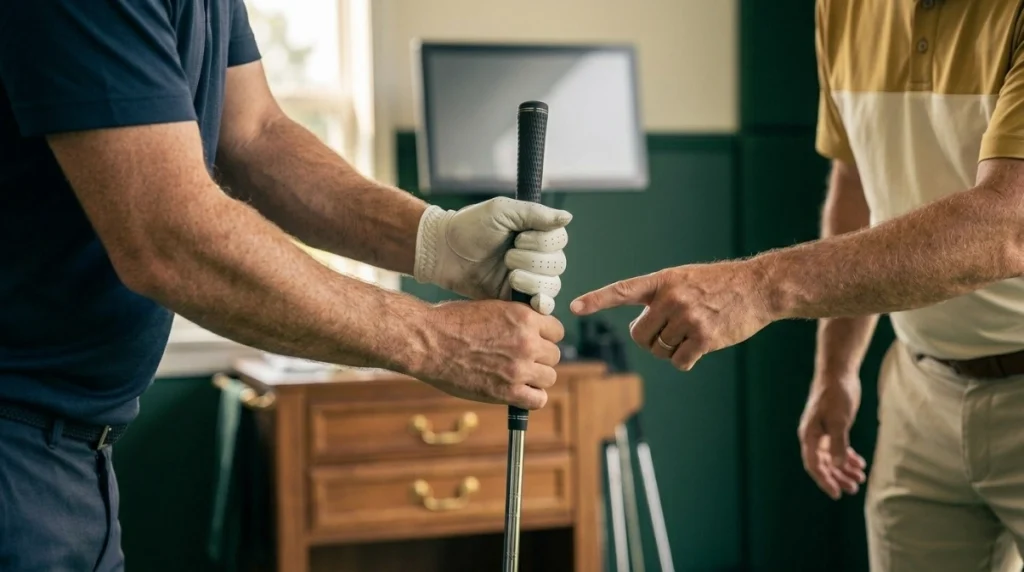
Most problems come from poor hand placement rather than the 10 finger design itself. Keeping all ten fingers on the handle does not mean the hands can sit anywhere.
Leaving a gap between the hands
The hands should sit close together. A visible gap can encourage them to work independently.
Slide the trail hand upward until it sits naturally beside the lead hand. Don’t force the hands together with extra pressure.
Holding the club too much in the palms
A palm-heavy grip can limit natural wrist movement. It can also make golfers squeeze harder to feel secure.
Let the handle run more through the fingers, especially in the lead hand. Your exact position can vary with hand shape.
Squeezing too hard
Extra pressure creates tension through the hands and forearms. That can make a free swing harder.
Your grip must stay secure throughout the swing, but secure doesn’t mean crushed. Check your pressure before every practice shot while learning the grip.
Letting the trail hand dominate
The lower hand can become overly active with a baseball grip. For a right-handed golfer, that means the right hand may rotate the face too aggressively.
If shots suddenly start left, first check your hand position and pressure. Don’t rebuild your whole swing based on one range session.
Changing grip and swing mechanics together
Change one variable at a time. Otherwise, you won’t know whether the grip helped or whether another swing change caused the result.
Pro tip: A certified PGA or LPGA instructor can check grip position, grip size, and clubface control before you make larger swing changes.
Frequently Asked Questions About the 10 Finger Grip
Is a 10 finger grip good for golf?
Yes, it can be. A 10 finger grip is a valid option when it feels comfortable and gives you predictable clubface control, contact, and start direction.
Is the 10 finger grip the same as a baseball grip?
Yes. Golfers commonly use “10 finger grip” and “baseball grip” to describe the same basic hand connection, where no fingers overlap or interlock.
Do professional golfers use a 10 finger grip?
Some do, although it is uncommon compared with interlocking and overlapping grips. PGA Tour has documented professionals using the method, including Michael Thorbjornsen and other competitive players.
Does a 10 finger grip give you more power?
It may make the hands feel more active, but you shouldn’t assume that guarantees extra distance. Club speed depends on the whole swing, while strike quality and face control determine whether that speed becomes useful distance.
Is a 10 finger grip good for beginners?
It can be a simple starting grip because beginners don’t need to learn an overlap or interlock. Correct lead-hand position, trail-hand position, and grip pressure still matter from the first lesson.
Can I use a 10 finger grip with a driver?
Yes. You can use the same grip with a driver, irons, and other full-swing clubs, provided you can control the face and strike consistently.
Should I switch from interlock to a 10 finger grip?
Switch only when you have a reason, such as discomfort or poor control with your current grip. Test the change with short swings first, then compare shot patterns before committing to it.
The takeaway: The 10 finger grip isn’t automatically better or worse than overlap or interlock. It is another way to connect your hands to the golf club.
If it feels comfortable, keeps your hands working together, and improves your repeatability, it deserves a fair test. Start slowly, watch your clubface, and let your ball flight tell you whether the change belongs in your game.