
Golf Practice Mistakes: 12 Errors That Keep You From Improving

Quick Answer
The biggest golf practice mistakes are hitting without a target, changing several swing mechanics at once, ignoring the short game, and measuring success by one perfect shot. Effective practice needs a specific goal, realistic targets, feedback, and a routine that transfers to the course. The PGA of America can also help you find qualified instruction when your own diagnosis stops working.
Fix These Practice Habits First
- Choose one goal: Give each session a clear skill or ball-flight objective.
- Aim every shot: Use an intermediate target and a defined landing area.
- Change clubs: Avoid hitting long runs of identical shots without consequences.
- Practice scoring: Spend meaningful time putting, chipping, pitching, and playing uneven lies.
- Track patterns: Record strike quality, start direction, dispersion, and successful outcomes.
- Finish under pressure: Complete a measurable challenge before ending the session.
A Simple Verification Test
- If the skill works with changing clubs, targets, and consequences, it is becoming ready for the course.
I have left plenty of driving ranges feeling confident, only to lose the same swing on the first tee. The problem was rarely effort; it was how I practiced.
This guide explains the practice mistakes that waste the most time and shows you how to build skills that survive real rounds.
In This Guide
- Why Doesn’t Range Practice Transfer to the Course?
- What Are the Most Common Golf Practice Mistakes?
- How Should You Structure an Effective Golf Practice Session?
- Range Practice vs. Course Practice: What Is the Difference?
- How Can You Tell Whether Your Golf Practice Is Working?
- Golf Practice Mistakes FAQ
- Practice With a Purpose
Why Doesn’t Range Practice Transfer to the Course?
Range performance often fails to transfer because the range removes decisions and consequences. Golfers repeat one club from a flat lie, while the course demands a new problem on nearly every shot.
Practice transfer is the ability to reproduce a trained skill during an actual round, under changing lies, targets, clubs, emotions, and consequences.
A large bucket can create the illusion of improvement. After ten consecutive 7-irons, your brain knows the club, lie, distance, and expected motion.
That repetition can help when learning a new movement. It becomes less useful when it is the only way you train.
Blocked practice and random practice serve different purposes
Blocked practice means repeating the same task many times. For example, you might hit 15 waist-high wedge shots while working on centered contact.
Random practice changes the task between attempts. You might hit a driver, 8-iron, pitch, and hybrid toward different targets.
- Use blocked practice when learning or rebuilding one movement.
- Use random practice when testing whether that movement works without repeated rehearsals.
- Combine both formats during most sessions.
I usually begin with a small block of controlled swings. I then change clubs and targets before the motion starts feeling automatic.
That second stage exposes the truth. A swing thought that works only after six rehearsals is not ready for the course.
Pro tip: Ask a PGA professional or certified instructor to check any major grip, posture, or swing change before you spend weeks repeating it.
What Are the Most Common Golf Practice Mistakes?
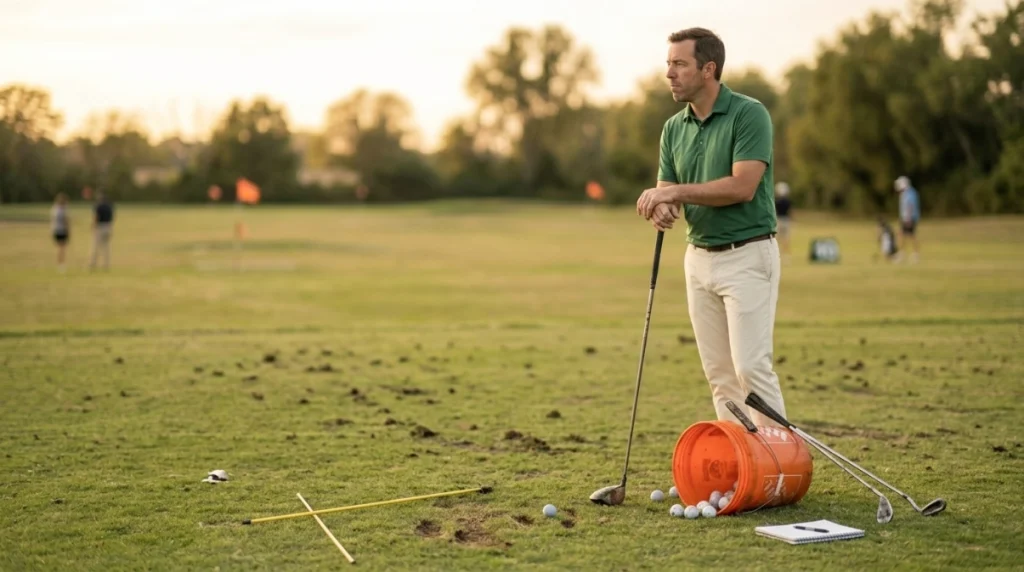
Most wasted practice comes from poor planning, weak feedback, and unrealistic repetition. These 12 mistakes can affect beginners and experienced players alike.
1. Practicing without a specific goal
“Hit balls” is an activity, not a useful practice goal. Decide what success will look like before the first shot.
A clear goal might be starting seven of ten wedges within a target corridor. It could also be striking eight chips without hitting the ground first.
2. Skipping a physical warm-up
Full-speed drivers should not be your first swings. Cold muscles and stiff joints can alter your movement and increase strain.
- Walk briskly or move continuously for three minutes.
- Rotate your hips, shoulders, and upper back.
- Make slow swings without a ball.
- Begin with short wedges before longer clubs.
The sequence matters. The PGA’s current instructional resources also emphasize warming up and rebuilding fundamentals gradually.
3. Hitting too many balls too quickly
Rapid-fire practice removes your routine and encourages careless alignment. Fatigue then turns poor swings into repeated habits.
Step away after each shot. Pick a target, rehearse once, set the clubface, and make a committed swing.
4. Using no target or alignment reference
A straight-looking range is deceptive. Your feet can aim left while the clubface points right, making a functional swing look faulty.
- Choose a precise distant target.
- Select a spot one or two feet ahead of the ball.
- Point the clubface at that intermediate spot.
- Set your body parallel to the target line.
Alignment rods help, but place them safely outside the ball and clubhead area. Never position a rigid rod where your body could strike it.
5. Changing several swing mechanics at once
Grip, takeaway, hip turn, wrist angle, and finish cannot all receive full attention together. Multiple swing thoughts make both diagnosis and learning harder.
Change one variable at a time. Give it a fair test before deciding whether it helped.
6. Chasing the best shot instead of the normal pattern
One flushed iron can hide nine poor strikes. Your useful result is the overall pattern, including misses.
Watch start direction, curve, strike location, carry window, and dispersion. A tighter group is more valuable than one unusually long shot.
7. Ignoring contact feedback
Ball flight shows what happened, but it does not always reveal where the club met the ball. Check the clubface and turf after each strike.
- Face spray: Shows heel, toe, high, or low contact.
- Divot position: Helps reveal whether ground contact occurred before or after the ball.
- Start direction: Offers useful information about the clubface at impact.
- Curve: Helps describe the relationship between clubface and swing path.
Do not diagnose your entire swing from one sign. Use several pieces of feedback together.
8. Spending nearly all your time with the driver
Driver practice matters, but it represents only one shot type. Scoring also depends on approach shots, wedges, chips, bunker shots, and putts.
On days when I have only 45 minutes, I protect time for shots inside 100 yards. Those situations appear repeatedly during a normal round.
9. Practicing only comfortable shots
Golfers naturally return to clubs and distances they enjoy. Weak areas remain weak because they never receive focused repetitions.
Review your recent rounds and identify one recurring problem. It might be 40-yard pitches, long putts, uneven lies, or recovery shots.
10. Using perfect lies for every shot
Practice mats and flat tees produce consistent lies. Golf courses provide rough, slopes, bare areas, sand, and awkward stances.
Use the practice area’s permitted surfaces to vary lie and trajectory. Follow posted restrictions and protect the turf.
The USGA recommends taking grass-range divots in narrow linear strips instead of scattered patches. This pattern reduces the damaged area and helps the turf recover.
11. Practicing technique without pressure
A swing can look stable when failure costs nothing. Add simple consequences once the basic movement becomes reliable.
- Hole three consecutive three-foot putts before leaving.
- Land five of eight chips inside a defined circle.
- Hit seven of ten drives inside a fairway corridor.
- Restart a challenge after a careless routine.
Pressure practice should feel demanding, not punishing. Choose a challenge that you can complete with focused effort.
12. Leaving without recording anything
Memory favors great shots and dramatic misses. A short practice log provides a more honest picture.
Record the goal, drill, result, common miss, and next action. Five lines are enough.
Section Takeaway: Stop judging practice by the number of balls you hit. Judge it by the quality of your goal, feedback, decisions, and attention.
How Should You Structure an Effective Golf Practice Session?
A productive session needs preparation, skill work, transfer practice, and a measurable finish. You can fit all four stages into 45 to 60 minutes.
A practical 60-minute practice plan
- Warm up for 8 minutes: Move your body, make slow swings, and hit short wedge shots.
- Train one skill for 15 minutes: Use blocked repetitions with clear feedback.
- Test the skill for 12 minutes: Change targets, clubs, or trajectories between shots.
- Practice short game for 15 minutes: Divide the time among pitching, chipping, and putting.
- Create pressure for 7 minutes: Complete one scored challenge.
- Review for 3 minutes: Record the pattern and plan your next session.
Shorter sessions can use the same order. Reduce the number of repetitions instead of removing the transfer and review stages.
Use a pre-shot routine during random practice
Your routine connects practice to play. It also gives your attention somewhere useful to go when a shot matters.
- Assess the lie and intended shot.
- Choose a specific target.
- Make one purposeful rehearsal.
- Aim the clubface before setting your stance.
- Look at the target and swing without delay.
- Hold the finish and observe the result.
A routine does not need to be long. It needs to be repeatable.
Practice your on-course decisions
Play an imaginary hole on the range. Hit a tee shot, judge the result, and choose the next club based on where that shot would finish.
If the drive misses your fairway corridor, play a recovery shot. This creates changing tasks and makes poor shots influence the next decision.
Section Takeaway: A complete session moves from preparation to learning, then from learning to testing. Always finish with a result you can record.


Range Practice vs. Course Practice: What Is the Difference?
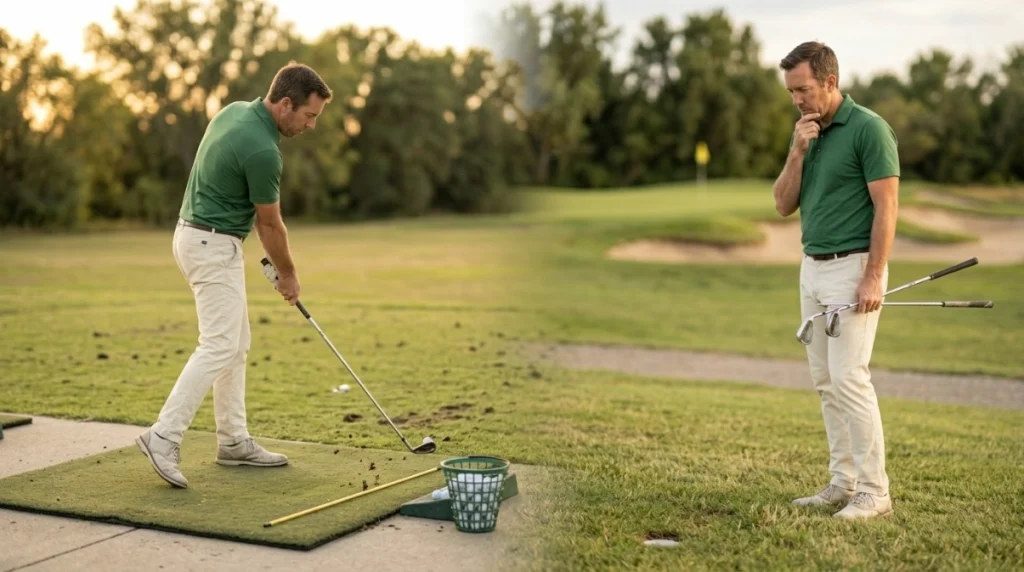
Range practice gives you repetition and controlled feedback. Course practice develops decisions, adaptability, routines, and emotional control.
| Practice Type | Best Use | Main Limitation | Useful Example |
|---|---|---|---|
| Blocked range practice | Learning one movement | Low decision demand | Ten half-swings with face spray |
| Random range practice | Skill transfer and routines | Cannot reproduce every lie | Driver, iron, pitch, then repeat |
| Short-game practice | Distance and trajectory control | Practice greens may differ from the course | Nine-ball up-and-down challenge |
| On-course practice | Strategy, lies, and consequences | Limited repetition and pace concerns | Quiet nine-hole scoring round |
Use range sessions to build and test a skill. Use quiet practice rounds to learn where that skill fits your game.
Respect pace and local course policies when practicing on the course. The USGA Rules Hub explains practice restrictions that may apply during competition.
The R&A also provides rules guidance for golfers outside the United States and Mexico. Competitive players should confirm the event’s conditions before practicing on the course.
How Can You Tell Whether Your Golf Practice Is Working?
Practice is working when your normal pattern improves across several sessions and rounds. Do not use one excellent range day as proof.
Track outcomes that match the skill
- Driver: Fairway-corridor success and playable misses.
- Irons: Start direction, strike location, and dispersion.
- Wedges: Carry-distance error and landing-zone success.
- Chipping: Up-and-down percentage or average leave distance.
- Putting: Three-putts, start-line success, and distance control.
Use groups of at least 10 attempts for a basic practice score. Compare the same challenge over several weeks.
Separate technique goals from performance goals
A technique goal describes what you are trying to do with the movement. A performance goal describes where the ball finishes.
During early practice, the movement may improve before the result becomes consistent. During transfer practice, the target outcome should regain priority.
Use your rounds as a diagnostic tool
After each round, record patterns rather than blaming individual swings. Note penalty shots, three-putts, failed recoveries, and shots that created the largest problems.
Choose the next practice goal from repeated patterns. One unusual bunker lie should not control your entire week.
As of 2026, launch monitors and swing apps can provide extensive data. Use only measurements that help answer your current question.
Clubhead speed and spin rate may matter during fitting. They are less useful when your immediate goal is starting a five-foot putt on line.
Section Takeaway: Improvement appears as a better pattern, not a single perfect swing. Track a small set of relevant outcomes across both practice and play.
Golf Practice Mistakes FAQ
Is hitting 100 golf balls good practice?
It can be, but the number alone means little. One hundred rushed shots may reinforce poor habits, while 40 deliberate shots with targets, feedback, club changes, and a clear routine can produce better learning.
How often should a beginner practice golf?
Two or three focused sessions each week can work well for a beginner. Short sessions are easier to maintain, and a rest day between demanding swing sessions can reduce fatigue.
Should I practice golf every day?
You can practice daily if you vary the workload. Alternate full swings with putting, chipping, mobility, rules study, or visualization instead of making high-effort swings every day.
What percentage of practice should be short game?
There is no universal percentage, because your weakest scoring area should guide the plan. For many recreational golfers, reserving at least one-third of practice for putting, chipping, pitching, and distance wedges is a practical starting point.
Why do I hit the ball well on the range but poorly on the course?
The range provides repeated clubs, flat lies, and little consequence. Add random club changes, a full pre-shot routine, imaginary holes, target corridors, and scored challenges to make practice resemble actual play.
Should I practice with mats or grass?
Both can help. Mats provide consistent footing and protect turf, while grass gives clearer ground-contact feedback and more realistic lies. When grass tees are open, follow the facility’s divot pattern instructions.
When should I get a golf lesson?
Book a lesson when a problem persists, causes discomfort, or produces conflicting swing thoughts. A qualified coach can identify the root cause and give you a safer, more efficient practice plan.
Practice With a Purpose

The best correction for common golf practice mistakes is simple: give every shot a job. Choose a target, make one committed attempt, study the result, and adjust with a clear reason.
Your next session does not need to be longer. Pick one recurring on-course problem, create a measurable challenge, and record what happens.
That small change turns a bucket of balls into genuine practice. It also gives your improvement a much better chance of reaching the first tee.