
Golf Equipment Mistakes: 15 Costly Errors and How to Fix Them

Quick Answer
The most damaging golf equipment mistakes involve using clubs that do not fit your body, swing, or current skill. Wrong loft, shaft flex, club length, lie angle, grip size, and distance gaps can reduce consistency. A professional golf club fitting can separate equipment problems from swing problems.
Equipment mistakes to check first
- Poor club fit: Clubs that are too long, short, heavy, stiff, upright, or flat can make centered contact harder.
- Incorrect loft: Too little loft can lower launch and tempt you to change your swing to lift the ball.
- Bad distance gaps: Clubs that fly similar distances leave holes elsewhere in your bag.
- Unsuited golf ball: Constantly changing models makes distance, spin, and putting feel less predictable.
- Worn components: Slick grips, dirty grooves, loose heads, and damaged shafts reduce control or create safety risks.
- Ego-based purchases: Tour-style clubs may look appealing but offer less forgiveness than many golfers need.
How to confirm the cause
- Record strike location and ball flight before replacing anything. Test one equipment variable at a time.
Golf equipment mistakes can quietly make the game harder, even when your swing is improving. These common golf gear mistakes affect beginners, mid-handicappers, and experienced players.
I learned this after spending months blaming my driver swing for poor contact. A basic fit check showed that the club’s length and setup gave me little room for error.
This guide covers the mistakes I now check before buying, adjusting, or replacing equipment. It also explains when a fitter, coach, or simple bag audit can help.
In This Guide
- What Are the Most Common Golf Equipment Mistakes?
- How Can Poor Club Fit Hurt Your Ball Flight?
- Are You Carrying the Wrong Mix of Golf Clubs?
- Which Golf Ball and Accessory Mistakes Matter?
- What Equipment Buying and Maintenance Mistakes Should You Avoid?
- How Do You Audit Your Golf Equipment?
- Frequently Asked Questions
What Are the Most Common Golf Equipment Mistakes?
The biggest mistakes happen when golfers choose equipment by appearance, reputation, or ego. Good equipment should fit the player and solve a defined problem.
Here are 15 mistakes I regularly see in bags:
- Buying clubs without testing them: A club can look perfect but produce poor contact, launch, or dispersion.
- Choosing clubs above your skill level: Compact players’ irons offer less help on off-center strikes than forgiving cavity-back designs.
- Using the wrong shaft flex: The label alone does not account for swing speed, tempo, release, shaft weight, or manufacturer differences.
- Ignoring shaft weight: A club that feels too heavy can cause fatigue, while an unsuitable light shaft may reduce control.
- Playing too little driver loft: Low loft does not automatically create more distance.
- Ignoring club length and lie angle: Both specifications influence posture, strike location, and how the clubhead meets the ground.
- Carrying duplicate distances: Two clubs with different numbers may still fly almost the same distance.
- Leaving large yardage gaps: Missing a dependable club for a common approach distance creates awkward partial shots.
- Changing golf balls constantly: Different constructions can change launch, spin, feel, and short-game response.
- Using the wrong grip size: A grip that feels uncomfortable may add tension or reduce awareness of the clubface.
- Keeping worn grips: Hard or slick grips encourage tighter grip pressure, especially in rain or humidity.
- Playing with dirty grooves: Grass, sand, and mud interfere with clean contact between the face and ball.
- Buying only by brand: Titleist, Callaway, TaylorMade, Ping, Cobra, Mizuno, and Srixon all offer different design families.
- Replacing clubs before diagnosing the swing: New equipment cannot correct every path, face, setup, or contact problem.
- Ignoring equipment rules: Tournament players must use conforming clubs and balls and follow the 14-club limit.
What counts as an equipment problem?
An equipment problem is a mismatch, defect, or setup choice that makes your normal swing less effective. It is not simply a poor result from one shot.
A club that fits poorly may create a repeated pattern. You might strike the same area of the face, struggle with launch, or feel forced into an uncomfortable posture.
Definition: Golf club fitting is the process of matching club specifications to a golfer’s body, delivery, ball flight, goals, and preferences. Common variables include length, loft, lie angle, shaft profile, total weight, swing weight, grip, and clubhead design.
A swing problem usually remains visible across several suitable clubs. An equipment problem may become stronger with one club or one specification.
I once tested two drivers using the same controlled swing. One encouraged centered contact, while the other repeatedly produced heel strikes and an uncomfortable reach.
That did not prove the longer club was universally bad. It showed that it was a poor match for me.
Section Takeaway: Start with repeated patterns, not one bad shot. Equipment becomes a likely cause when the same miss follows a specific club or specification.
How Can Poor Club Fit Hurt Your Ball Flight?
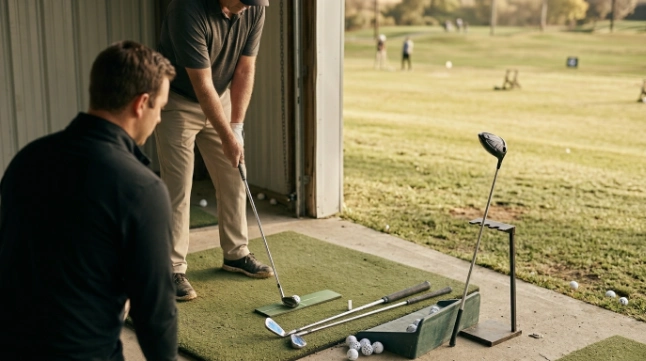
Poor club fit can affect contact, launch, spin, direction, distance, and comfort. However, ball flight alone cannot identify one exact specification.
A fitter should consider the whole club and your delivery. Changing only shaft flex or loft may hide another problem.
Wrong shaft flex and shaft profile
Shaft flex describes how much a shaft bends under a load. Common labels include L, A, R, S, and X, but those labels are not standardized across every manufacturer.
Two regular-flex shafts can feel and perform differently. Weight, torque, bend profile, length, clubhead mass, and your transition all affect the result.
- A shaft that feels too stiff: It may feel difficult to load or produce the launch and feel you expect.
- A shaft that feels too soft: It may feel hard to time, especially during quick transitions.
- A shaft that is too heavy: It can increase fatigue or make speed harder to maintain.
- A shaft that is too light: It may reduce awareness or consistency for some swings.
Do not diagnose shaft flex from a slice or hook alone. Clubface direction, swing path, strike location, and setup can produce the same curves.
*Pro tip: Ask a certified fitter to compare shafts using strike pattern, launch, spin, carry, dispersion, and your feedback—not swing speed alone.*
Too little or too much loft
Loft is the angle of the clubface relative to a vertical plane. It helps influence launch, spin, carry, and landing angle.
Golfers often choose a low-lofted driver because they associate it with power. The ball may instead launch too low and lose useful carry.
Too much loft can also be inefficient for a particular delivery. The correct setting depends partly on dynamic loft and attack angle at impact.
- Low, falling drives: Test more loft before trying to lift the ball with your hands.
- High, weak drives: Check strike location and spin before reducing loft.
- Unstable direction: Inspect face angle, shaft, and strike pattern as well as loft.
Incorrect club length
Club length changes how far you stand from the ball. It also affects posture, swing arc, total weight, and the difficulty of finding the center.
A longer driver may offer speed potential, but it can reduce control. A shorter build may improve contact for some golfers, although head weight may need attention.
Iron length should not be selected from height alone. Wrist-to-floor measurement, posture, arm length, mobility, and delivery all matter.
Wrong lie angle
Lie angle is the angle between the shaft and the club’s sole when the club sits in its measured position. An unsuitable lie can influence turf interaction and face orientation.
A club that is too upright may point the face left of the intended line at impact. A club that is too flat may point it right, assuming a centered strike and right-handed golfer.
Real swings are dynamic, so a static sole check is not enough. Use impact data, ball flight, strike marks, and a fitter’s observations.
Unsuitable grip size
Your grips should allow secure contact without excessive hand tension. They should also feel consistent throughout the set.
Hand size provides a starting point, but comfort and control still matter. Arthritis, finger mobility, glove thickness, and weather can change what feels best.
| Repeated symptom | Possible equipment factors | Best first check |
|---|---|---|
| Heel strikes | Length, setup, total weight, balance | Use face spray and compare strike patterns |
| Toe strikes | Length, posture, delivery, club weight | Check setup and test another length |
| Low driver flight | Loft, strike height, shaft, ball | Check impact location before changing loft |
| Inconsistent iron direction | Lie angle, length, shaft, grip | Test dynamically with a fitter |
| Fatigue late in the round | Total weight, bag weight, grip pressure | Compare effort and contact over several swings |
This table is a diagnostic starting point, not a fitting prescription. Several swing and equipment factors can create the same symptom.
Section Takeaway: Fit is a system. Judge the clubhead, loft, shaft, length, lie, weight, and grip together instead of chasing one label.
Are You Carrying the Wrong Mix of Golf Clubs?
Your bag should cover useful distances and common shots without unnecessary duplication. Carrying 14 clubs is allowed, but using all 14 is not required.
The USGA’s guidance on clubs confirms that players may carry up to 14 conforming clubs. You can carry fewer when a simpler setup suits your game.
Carrying clubs because the numbers look complete
A traditional set may include consecutive irons, but modern lofts vary widely. One company’s 7-iron may have a loft closer to another company’s 6-iron.
Do not build your bag from club numbers alone. Measure actual carry distances under reasonably consistent conditions.
- Carry distance: How far the ball travels through the air.
- Total distance: Carry plus bounce and roll.
- Dispersion: The overall pattern of your shots around the target.
- Landing angle: How steeply the ball approaches the ground.
Carry distance is usually the best starting point for gapping. Total distance changes more with wind, firmness, slope, and landing conditions.
Keeping difficult long irons
Many golfers carry a 3- or 4-iron without producing enough height or consistent contact. A hybrid or higher-lofted fairway wood may cover that role more effectively.
The correct choice depends on your strike, course conditions, and preferred shot shape. Hybrids are not automatically better for every player.
| Club type | Common strength | Potential limitation | Often suits |
|---|---|---|---|
| Long iron | Lower flight and precise turf contact | Demands speed and centered strikes | Confident iron strikers |
| Hybrid | Versatility from fairway and rough | Some golfers dislike the face progression or left miss | Players replacing long irons |
| Fairway wood | Higher launch and useful carry | Longer shaft can reduce control | Players needing launch and distance |
Ignoring wedge gaps
Wedge lofts deserve attention because modern iron sets can have strong-lofted pitching wedges. A large gap may exist before your sand wedge.
Many bags use approximately four to six degrees between wedges. That range is only a starting point because club design and delivery affect distance.
Test full and partial wedge shots. Your goal is to cover scoring distances without carrying several wedges that perform the same job.
Choosing a putter by shape alone
A beautiful putter will not automatically match your setup or stroke. Length, lie, loft, head shape, alignment features, weight, and toe flow can affect comfort.
I once adjusted my stance for a putter that was too long. The compensation felt normal until I compared it with a more suitable length.
*Pro tip: A certified putter fitter or PGA professional can check setup, aim, impact, speed control, and equipment together.*
Section Takeaway: Build your bag around measured carry distances and playable shot types. Club numbers and the 14-club limit should not dictate every choice.


Which Golf Ball and Accessory Mistakes Matter?
The ball is the only equipment used on every shot, so consistency matters. Accessories also affect grip, stability, comfort, and decision-making.
Playing a different ball on every hole
Found balls and mixed practice balls save money. However, constantly changing models makes it harder to learn predictable launch, distance, spin, and feel.
You do not need the most expensive tour ball. You need a ball that suits your priorities and remains available within your budget.
- Two-piece distance balls: Often durable and affordable for golfers who lose balls frequently.
- Multilayer urethane balls: Often provide more short-game spin but cost more.
- Softer-feeling models: May feel comfortable, but feel alone does not prove performance.
- High-visibility colors: Can help some golfers track and identify the ball.
The PGA of America explains that a golf ball fitting can compare how models perform throughout the bag. Start near the green, then confirm iron and driver performance.
Using damaged or unsuitable balls
Deep cuts, cracks, severe scuffs, or deformed covers are reasons to replace a ball. Minor cosmetic marks may be acceptable for casual practice.
Competition players should also confirm that their chosen ball conforms. The USGA Equipment Standards section provides club and ball resources.
Ignoring shoes, gloves, and weather gear
Worn shoes can reduce traction on wet or sloped ground. A hardened glove may feel slippery and encourage excess hand pressure.
Your rain gloves, towel, umbrella, and waterproof layer should be accessible before bad weather arrives. Equipment buried at the bottom of a bag rarely helps.
Trusting a rangefinder without checking the situation
A rangefinder supplies distance, not a complete club choice. Wind, temperature, elevation, lie, hazards, firmness, and your normal carry still matter.
Competition rules may restrict certain features or allow a local rule concerning distance-measuring devices. Confirm the conditions before the round.
Section Takeaway: Use one dependable ball model and maintain the accessories that connect you to the ground and club. Technology should support judgment, not replace it.
What Equipment Buying and Maintenance Mistakes Should You Avoid?
The costliest mistake is buying without a defined goal. A sale price does not create value when the product does not fit your game.
Buying what a professional uses
Tour players often use equipment built for their speed, strike quality, delivery, preferences, and course setup. Their specifications may be difficult for an amateur to use.
A low-spin driver head, extra-stiff shaft, or compact blade is not a badge of progress. Choose equipment that improves your normal misses and supports your best swings.
Testing only your best shots
One perfect shot can make almost any club seem impressive. Pay more attention to the complete pattern.
- Strike consistency: Where did most shots contact the face?
- Carry consistency: Did similar swings produce dependable distance?
- Dispersion: How wide and deep was the full shot pattern?
- Playable miss: Did poor strikes remain usable?
- Comfort: Could you swing normally without forcing speed or posture?
Using unreliable launch-monitor data
Launch monitors can be useful, but poor setup and unusual test balls can distort a comparison. Indoor hitting may also hide visual information you notice outdoors.
Warm up first and use the same ball type when possible. Remove obvious misreads without deleting every poor swing.
Buying used clubs without inspection
Used equipment can offer excellent value. Inspect it carefully before payment.
- Check graphite shafts for cracks, splits, deep scratches, or damage near the hosel.
- Look for bent steel shafts, loose heads, rattles, and ferrule separation.
- Inspect faces for severe damage and confirm adjustable parts move correctly.
- Check grips for hardening, cracks, slick areas, or unexpected buildup.
- Confirm loft, lie, shaft, length, and model details when possible.
Neglecting routine maintenance
Clean clubfaces with water, a soft brush, and a towel. Dry the heads and avoid storing wet equipment in a closed bag.
Wipe grips with mild soap and water when permitted by the manufacturer. Replace them when cleaning no longer restores secure traction.
Do not attempt structural repairs without the right tools and knowledge. A loose head or cracked shaft can become dangerous.
Making prohibited adjustments during a round
Adjustable drivers and fairway woods make fitting easier before play. However, you cannot deliberately change a club’s performance characteristics and then use it during a stipulated round.
The R&A Equipment Rules explain the standards governing clubs, balls, devices, and other equipment. Tournament players should also read the applicable local rules.
Section Takeaway: Buy to solve a measured problem, then protect the equipment you own. Inspect used clubs and complete adjustments before the round begins.
How Do You Audit Your Golf Equipment?

A bag audit finds obvious mismatches before you spend money. Complete it when your swing is reasonably fresh and pain-free.
1. Inspect every club
Remove every club and check the grip, shaft, ferrule, head, grooves, sole, and adjustable parts. Set damaged or questionable clubs aside.
2. Record your specifications
Write down each club’s model, stated loft, shaft, flex, and length when known. Note any custom changes or replacement components.
3. Build a carry-distance chart
Hit several reasonable shots with every club. Record typical carry rather than using only your longest result.
Repeat questionable gaps on another day. Fatigue, wind, temperature, and strike quality can change the numbers.
4. Mark your strike patterns
Use impact tape or foot spray that is safe for the clubface. Look for repeated heel, toe, high, or low contact.
Clean the club after testing. Do not apply a substance during competition to influence performance.
5. Identify duplicate roles
Compare clubs that produce similar carry, trajectory, and usefulness. A hybrid and long iron may overlap even when their lofts differ.
6. List the shots your course requires
Consider your regular tee shots, forced carries, par-3 distances, bunker conditions, rough, wind, and green firmness. Useful equipment should match real shots.
7. Test changes one at a time
Do not replace your driver, irons, wedges, ball, and putter at once. You will not know which change helped.
Simple testing order
- Confirm that the club is safe and undamaged.
- Check strike location and normal ball flight.
- Compare carry distance and dispersion.
- Test an alternative specification.
- Repeat the comparison on another day.
- Make a change only when the benefit is clear.
Bring your current clubs to a fitting. They provide a baseline and may prove that a small adjustment is enough.
A good fitter should ask about your budget, goals, physical limitations, typical course, and preferred feel. Brand loyalty should not control the session.
*Pro tip: Stop testing if you feel pain. Ask a qualified instructor, fitter, or medical professional to evaluate any recurring physical strain.*
As of 2026, adjustable heads and extensive shaft options provide many fitting combinations. More choice makes controlled testing more important, not less.
Section Takeaway: Inspect, measure, compare, and retest before buying. A clear audit can reveal whether you need maintenance, adjustment, coaching, or replacement.
Frequently Asked Questions
Can the wrong golf clubs ruin your swing?
Unsuitable clubs can encourage compensations, such as standing too far away or forcing extra effort. They do not permanently ruin a swing, but they can make good movement harder to repeat. A coach and fitter can identify whether technique, equipment, or both need attention.
How do I know if my golf clubs are too long?
Possible signs include cramped posture, heel strikes, difficulty controlling the club, and standing unusually far from the ball. These signs are not proof by themselves. Compare strike patterns and posture with a qualified fitter before shortening the clubs.
Is stiff shaft flex better than regular flex?
Neither label is automatically better. The right shaft depends on speed, transition, release, weight, bend profile, clubhead, and feel. Flex labels also differ among manufacturers, so test complete club combinations instead of choosing by ego.
How often should golf grips be replaced?
Replace grips when they become hard, polished, cracked, stretched, or difficult to hold securely after cleaning. Playing frequency, storage, weather, sunscreen, and hand pressure affect their lifespan. Inspect them several times each season.
Should beginners get fitted for golf clubs?
A basic fitting can prevent beginners from using clubs that are clearly unsuitable in length, weight, flex, or grip size. Beginners do not always need a premium full-bag purchase. They can use fitting information to choose rentals, used clubs, or a starter set.
Do expensive golf clubs make a big difference?
Price does not guarantee a better fit or lower scores. Modern premium clubs may offer advanced materials and adjustment options, but a suitable used or mid-priced club can perform better for an individual golfer. Fit, condition, and club role matter more.
Should I fix my swing before buying new clubs?
Do both processes together when possible. A coach can identify movement problems, while a fitter checks whether your equipment supports those movements. Replace a club immediately if it is unsafe, but avoid major purchases based on one poor range session.
Golf equipment should make your normal game easier to manage. It should not force you to copy another player’s swing, strength, or preferences.
Start with a simple bag audit. Clean your clubs, inspect every component, chart your carry distances, and mark your strike patterns.
Then take the evidence to a qualified fitter or instructor. Fix the clearest equipment mistake first and confirm the result before changing anything else.